

Andreessen Horowitz just raised $15 billion, representing 18% of all venture capital deployed in the United States in 2025.
The usual critics showed up immediately with the same objections they’ve been making for years: too much money chasing too few deals, venture capital doesn’t scale past a certain size, returns are going to compress into nothing.
Then Ben Horowitz sat down with Jack Altman (yes, OpenAI’s founder brother) for a podcast and walked through exactly how they built a firm that can deploy this much capital without destroying returns.
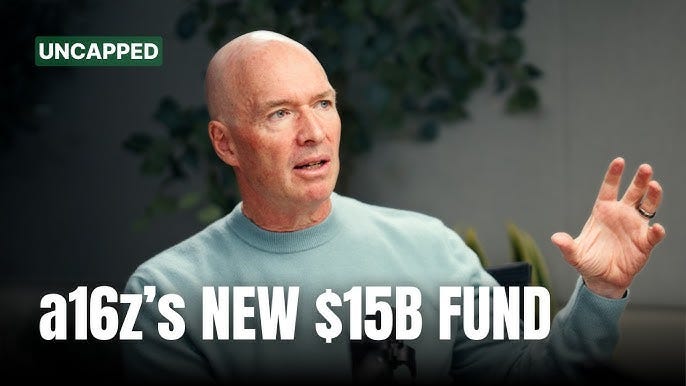
No hand-waving about brand or network effects, no platitudes about helping founders, just the actual organisational playbook they used to get from $40 million in 2009 to $60 billion in assets today.
Turns out a16z isn’t playing the same game as everyone else because they rebuilt the entire structure of how venture firms operate. Different governance model, different hiring strategy, different approach to boards, different everything.
Most venture firms are still running the partnership model from 2009 and wondering why they hit a wall at $2 billion in AUM.

Here’s what actually matters if you’re building a fund or raising from one:
1. Marc Andreessen Made a 10x Bet Everyone Called Crazy (He Was Right)
In 2011, conventional wisdom said 15 companies per year were worth backing at the top tier.
Marc Andreessen wrote “Software is Eating the World” and bet that number would grow to 150-200 companies annually.
They were right.
The companies being built today need Fortune 500 introductions, government relationships, and international expansion support.
“Coffee meetings solve for advice. Operating systems solve for execution.”
For emerging managers: Map the capabilities your portfolio needs beyond capital. If you can’t deliver 80% of what matters post-check, you’re selling an incomplete product.
2. Why the Best Investor You Know Can't Win Deals (And What That Costs)
Ben’s core thesis: winning deals drives returns more than picking them.
An average picker who can win beats a genius picker who loses competitive rounds. At every stage.
Why does Martin Casado work at a16z instead of running his own fund? To actually get into the deals he wants.
The loop:
Winners attract the best pickers
The best pickers make winners better at winning
Access compounds faster than analytical edge
Track this: Win rate on competitive deals. Below 30%? Fix your ability to win before hiring another analyst.
3. The One Decision That Let a16z Scale to $60B While Others Stalled at $2B
Most venture firms can’t scale past 10 partners because of shared control.
When you double in size, you must reorganize. Reorganization redistributes power. If partners vote on it, the chance of getting it right is zero. Everyone optimizes locally except the CEO.
a16z’s solution:
Every fund runs like a small VC (max 5 GPs)
Ben has unilateral organizational authority
Platform scales, investing teams don’t
“Democracy kills scale. Everyone optimizes locally except the CEO.”
If you have shared control and want to scale past 10 partners, start governance reform now. You need 2-3 years.
4. World-Class at One Thing Beats Good at Five: How a16z Actually Picks Winners
Core investment principle: evaluate on magnitude of strength.
Are they world-class at something? Literally the best in the world at one thing that matters?
Passing because monetization is unclear or go-to-market hasn’t been proven wastes time. You can always find weaknesses.
The rule:
Never pass on world-class talent because of a fixable weakness
Never invest in non-world-class talent just because they lack obvious flaws
Try this: In your next meeting, spend 20 minutes only on strengths before discussing any weakness.
5. How Ben and Marc Argued for 30 Years and Built the Best VC Firm in America
Ben and Marc have worked together for 30 years. They mostly talk about work.
Marc: Star-level talent nobody else has (the ideas)
Ben: Knows how to structure around that talent (the execution)
Ben is decisive. Marc generates ideas constantly. They argue about direction and timeframe. By the time they decide, they’ve already worked through the conflict.
Same field, different superpowers.
For partnerships: Optimize for complementary skills in the same domain. Same game, different strengths. Avoid partnering with someone who does exactly what you do.
6. Ben Horowitz's 'Kimchi Problem': The Conflict That Kills Every Venture Firm
Elite investors generate massive deal flow and strong opinions. They don’t follow arbitrary rules unless everything makes logical sense.
The problem: VCs can wreck each other’s businesses.
If Martin owns AI investments and another GP backs a conflicting company, Martin gets conflicted out of his entire category.
“The deeper you bury conflicts, the hotter they get. No conflict improves over time in a venture firm.”
Ben calls these “kimchi problems.” Everything festers.
You must design the organization to eliminate conflict before it becomes interpersonal.
Do this now: Map conflicts across your team. Sector overlaps, stage overlaps, geography overlaps. Eliminate 80% through organizational design before you try to manage them culturally.
7. The $96 Billion Mistake Databricks Almost Made (And Who Stopped Them)
Boards exist to protect founders legally. The only protection a CEO has from personal liability is running material decisions through a functioning board.
Y Combinator analyzed their portfolio in 2015-2016:
Companies without boards: universally failed
Companies with boards: materially better performance
But board value comes from high-leverage moments, not daily engagement.
Databricks: Ben led the Series C when nobody would fund them. He talked the founders out of selling for $4 billion. The company is now raising at a $100 billion valuation.
Daily engagement can actually hurt CEO development. Founders must stand alone to build conviction for the decisions that define their companies.
Track this: High-leverage board moments per year versus total hours spent. Optimize ruthlessly for impact per hour.
8. Why a16z Scrapped Their Entire Platform and Rebuilt It Around One Vertical
General startup research didn’t work at a16z.
Domain-specific research for AI or crypto works exceptionally well.
What they do now:
Test every foundation model
Talk to portfolio companies about which models perform best for which use cases
Publish findings
Accelerate companies by months
Same for talent. AI researchers are completely different from full-stack engineers. Different pools, different comp, different closing strategies.
The key: Companies must eventually own recruiting themselves. a16z helped Databricks hire 100+ people early, but Databricks built their own muscle over time.
Pick one domain where your portfolio clusters. Build proprietary research or talent maps just for that vertical. General platform services get ignored.
9. How a16z Dominates Crypto, AI, Everything
a16z’s mission: Help entrepreneurs build companies that make America technologically dominant.
If crypto matters to US financial strength, they invest. If AI shapes economic competitiveness, they invest. If a sector determines geopolitical outcomes, they care about changing laws and shaping policy around it.
“At this moment of profound technological opportunity, it is fundamentally important for humanity that America wins.”
That’s operating philosophy. That’s what gets said in partner meetings when nobody else is listening.
Write your firm’s mission in one sentence. If it only mentions returns, you’re limiting your appeal to the most mission-driven founders.
10. What a16z Knows About Media That Makes Every Other VC Look 10 Years Behind
Old world: Fixed channels, fixed formats, talking points, press gatekeepers controlling narrative.
New world: Unlimited channels, unlimited formats, brands attached to individual people instead of institutions.
a16z brought on Erik Torenberg to rebuild everything:
No talking points
If you offend someone, flood the zone with more content
The answer to a gaffe is always more speech, not avoidance
Most VCs copied a16z late. They have attempts at the new model, but they’re st
ill optimized for the old one. Press mentions. Controlled messaging. Fear of saying something wrong.
Audit your media strategy today. If you’re optimized for traditional press mentions and message control, you’re playing a game that ended five years ago.
The Implementation Guide You Can’t Get From Watching the Podcast
Ben spent an hour on Jack Altman’s podcast explaining how a16z works.
What he didn’t do: give you the actual frameworks to implement this in your company.
That’s what this section does. The specific questions to ask VCs before you take their money. The 30-minute exercise that prevents co-founder blowups. The hiring filter Databricks used to get to $100B. The knowledge-building system that moves you months ahead of competitors.
You can watch the podcast and get ideas. Or you can use what’s below and actually change how your company operates starting tomorrow: