
McKinsey projects AI agents will mediate $3 to $5 trillion of global consumer commerce by 2030, even under moderate scenarios.
But as we enter October 2026, the industry’s central problem isn’t whether that agentic economy will arrive; it’s who will build the rails it runs on. Ant International just made its bid, unveiling what is arguably the most comprehensive, full-stack, AI-native solution linking every stage of money movement for any business. The architecture rests on two proprietary models, Falcon TST and the new Antom 3-in-1 transformer, which for the first time combines tabular, sequence, and graph data in a single framework critical for financial services. It introduces an interoperable Agentic Mobile Protocol (AMP) designed to connect seamlessly with other networks, all wrapped in a security-first design built to defend against today’s risks while eliminating agent-initiated threats before they emerge.
Taken together, these aren’t just incremental product updates; they are the foundational infrastructure for autonomous commerce. To understand how this stack works and where it leaves room for startups and investors to build, we need to look at the digital ecosystem Ant International launches into.
First, the distribution
Start with the Alipay+ solution that AMP launches into:
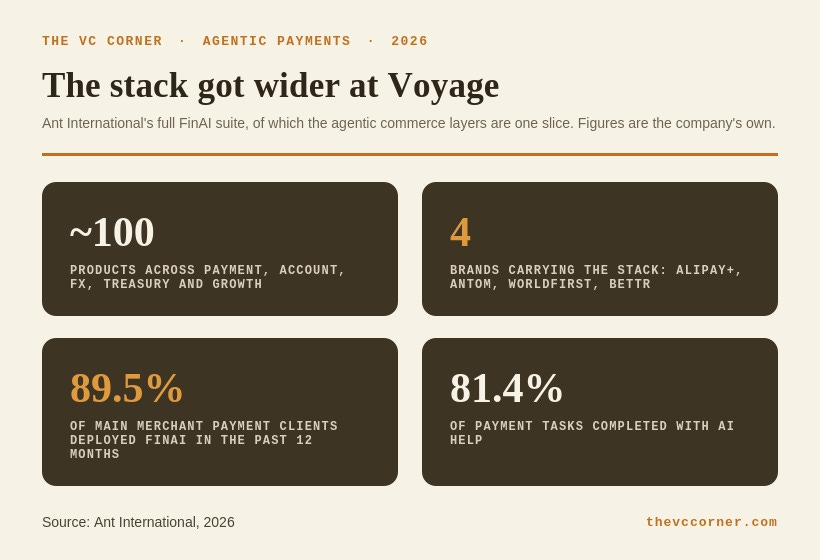
One thing changed between the briefing and publication: the stack got wider. Voyage turned out to be close to 100 products across Alipay+, Antom, WorldFirst, and Bettr, covering payment, account, FX, treasury and growth, which Ant International pitches as the most comprehensive AI-integrated full stack on the market. Its own release carries two adoption numbers that say merchants were already there before the launch: 89.5% of its main payment clients deployed FinAI solutions in the past 12 months, and 81.4% of payment tasks got done with AI help.
The five layers below are the agentic commerce slice of that stack, the part that answers our opening question.
The stack, in plain terms
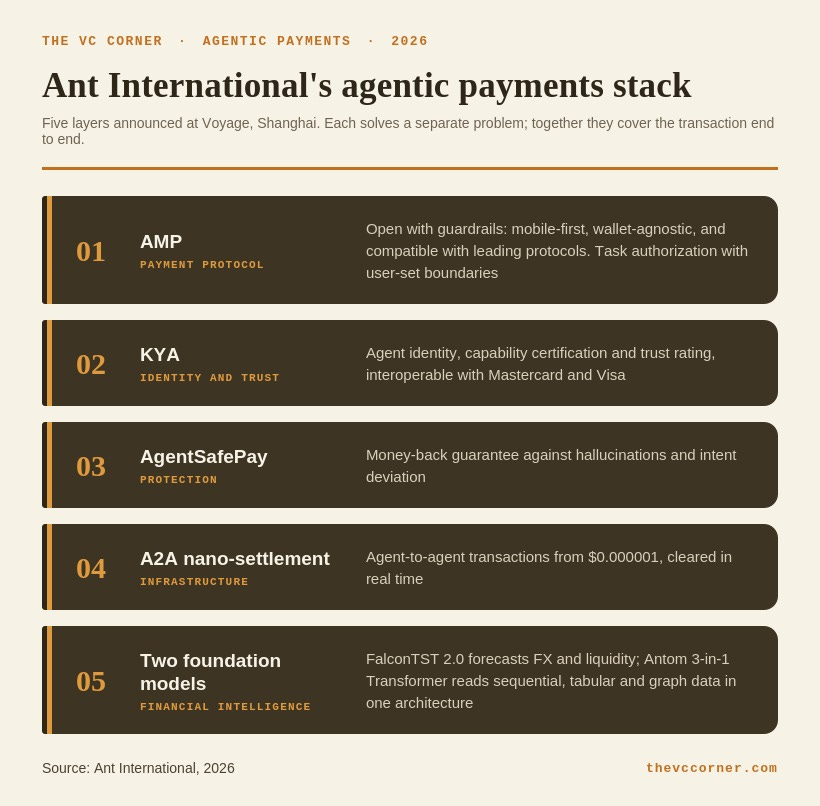
1. AMP is the protocol
Launched in April 2026, the Agentic Mobile Protocol (AMP) lets an AI agent pay through the wallet you already use, built mobile-first and wallet-agnostic from the start.
Where card-network protocols route agentic payments through cards, AMP goes through whatever people actually pay with, which across Asia means wallets and QR codes. Ant says linking an agent to a wallet takes 50% fewer steps than before; that figure, like the settlement numbers further down, is the company’s own, so treat it as a claim until independent volume data exists.
Authorization is where AMP departs from everything before it. A card network asks whether a payment can go through, while AMP asks what is this agent allowed to do?
You authorize a task, with boundaries attached:
▫️ Hotel under $300
▫️ These dates only
▫️ Rating above 4.5
▫️ This wallet
▫️ Ask me again if the price moves
The conditions travel with the task into execution, and you can revoke at any time. You delegate a job while keeping the account.
2. KYA is the trust layer
Know-Your-Agent (KYA) gives every agent a verifiable identity, certified capabilities, and a trust rating, so any wallet or merchant can establish who an agent is, who authorized it, and what it may do on the user’s behalf.
The news is who signed up. Ant International, Mastercard, and Visa are making their KYA frameworks interoperable, working through BuildFin.ai, an initiative under the Monetary Authority of Singapore. Three pillars hold it together:
Cross-network operator traceability. Every agent links back to a validated operator, cardholder, or business.
Shared certification standards. Agents get assessed against common security and behavioral criteria.
Continuous monitoring. Identity and transaction signals evaluated on an ongoing basis, rather than once at onboarding.
Each network keeps its own decisioning while sharing the recognition layer.
“Interoperability across Know-Your-Agent frameworks is essential to making agentic commerce work at scale, giving merchants, platforms, wallets and issuers a consistent way to recognize trusted agents.” — Pablo Fourez, Chief Digital Officer, Mastercard
When the two largest card networks and a central bank agree on how to identify AI agents, you are looking at infrastructure rather than one company’s feature. I expected this move to come from Visa or Stripe first, and the fact that it came from the wallet side tells you where agentic volume is expected to live.
Under the identity layer sits a 2-layered, agent-ready security architecture that points AI both ways: at today's fraud patterns, and at agent-initiated threats it tries to kill before they emerge. After the summer we just had, no financial stack was going to ship without that assumption baked in.
3. AgentSafePay answers the opening question
Every AMP transaction carries a money-back guarantee against agent-specific failures:
▫️ Hallucinations, where the model invents something the user never asked for
▫️ Intent deviation, where a multi-step task drifts from what was approved
▫️ Other failure modes that belong to autonomous execution rather than stolen credentials
Chargeback rules were written for stolen cards, and an agent that confidently books the wrong thing sits outside every one of them. Ant International priced that risk into the rail itself: the guarantee ships attached to every AMP transaction rather than as an optional add-on.
This is the first liability answer in agentic commerce that anyone has actually priced. Merchants and consumers route toward whoever carries the risk, so the default rail will be the one that pays for its own mistakes.
4. A2A nano-settlement, for the economy nobody sees
Agents will pay each other constantly for data, compute, and API calls, in amounts as small as $0.000001, and per-transaction fees designed for a $40 basket collapse at that scale. AMP clears these in real time, capacity that sits mostly idle until agent-to-agent spending arrives at volume.
5. Two foundation models sit underneath
The intelligence layer runs on two proprietary models now. FalconTST, upgraded to 2.0, forecasts FX and liquidity. The new one is the Antom 3-in-1 Transformer, the payment foundation model under everything else, and the name is the technical claim: it processes sequential data (behavior over time), tabular data (structured records), and graph data (who connects to whom, across users, entities and devices) in one architecture. Ant says no other payment foundation model reads all three at once.
LLMs read language. Payments live in those three data types, which is the whole argument for building a dedicated model instead of renting a general one. The scale figures, all Ant’s own: over 10 billion+ parameters, 90 trillion tokens a year, and chargebacks down as much as 87% among leading LLM clients on its new subscription service. Same caveat as the settlement numbers above, company figures until independent data exists.
Open source as strategy
AMP’s source code, SDKs, and documentation are on GitHub.
For a company this size, open-sourcing a protocol is a land grab, and a smart one. Protocols win by counting implementations, so every wallet and acquirer that builds on AMP raises the cost of adopting a competing standard later. The same play is visible across the open-source agent ecosystem: the spec that gets implemented first becomes the spec.
Ant's framing of that openness has an edge to it: AMP connects with other protocols and stays mutually compatible with the leading ones, with clear guardrails, open but within limits that protect its own standards. In payments that's the only version of open that survives contact with reality, because a protocol with no guardrails invites exactly the agent-initiated risks the trust layer exists to stop.
Phase one already covers both sides of the transaction:
▫️ Wallets and QR operators: Alipay, AlipayHK, Dana, GCash, MPay, TNG eWallet, TrueMoney, Toss, Starryblu, NETS
▫️ Acquirers: Adyen, Checkout, Fiserv, Nuvei, Worldline, WorldPay, All in Pay
Fifteen wallets and eight acquirers at launch is where most payment networks arrive after five years. Most don’t.
What you can build on top of this
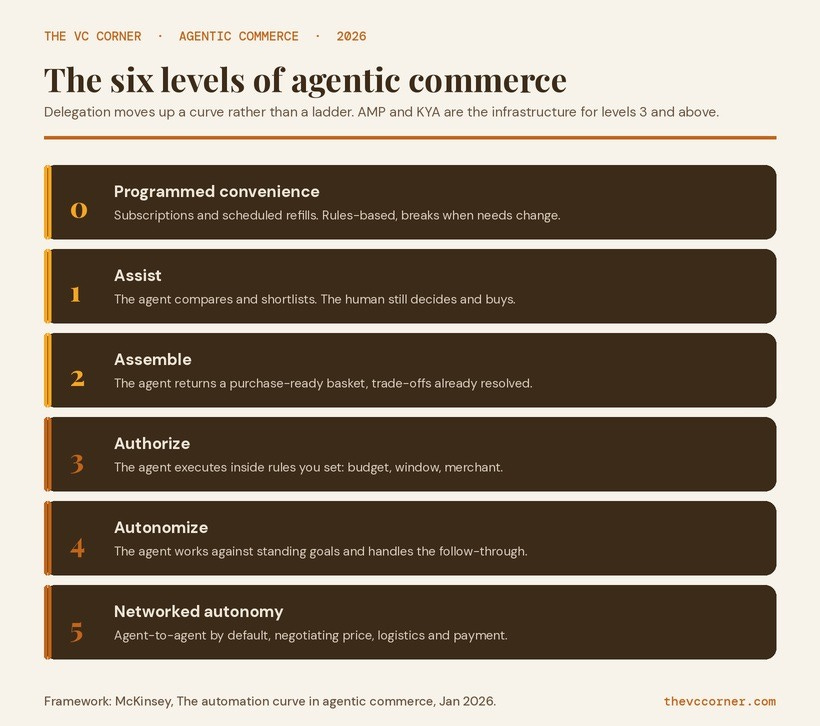
The gaps AMP leaves open
A protocol going open source is an invitation, so here is the practical read for anyone building in the agent economy or investing in this space.
Even with identity and settlement handled at the rail, most of the agentic commerce stack is still waiting to be built:
▫️ Agent-side spend management. AMP handles one task authorization. A company running 400 internal agents needs budgets, approval chains, and audit logs across all of them. That product is missing.
▫️ Merchant-side agent analytics. Once KYA labels agent traffic, merchants can see which agents convert, which return, which abuse. Nobody sells that dashboard yet.
▫️ Agent reputation beyond payments. A trust rating tied to transactions describes a fraction of agent behavior. Delivery quality, task completion, and dispute rates belong in the same score.
▫️ Nano-payment metering. Sub-cent settlement exists at the rail, and the metering, pricing, and billing logic that sits above it for API and compute sellers is wide open.
The sleeper is dispute tooling. A money-back guarantee implies a claims process, and whoever builds the arbitration layer for “the agent misread my intent” will handle enormous volume while everyone else fights over checkout.
A diligence checklist for agentic commerce startups
Screening a company in this space over the next twelve months, these are the questions I’d ask:
Which layer do they own, and does the protocol eventually absorb it? Anything AMP can add as a feature in one release is a feature, and features get commoditized when the protocol is open.
Who carries liability when the agent errs? If the answer is “the merchant” or “the user,” expect adoption to stall. If the startup carries it, ask to see the loss model.
Does it work across protocols? AMP, Visa’s Trusted Agent Protocol, and Mastercard Verifiable Intent will coexist for years. Single-protocol bets carry standards risk.
What happens to the unit economics at sub-cent volume? Companies pricing per transaction get destroyed by agent traffic patterns. Pricing per outcome or per seat survives better.
Where does the distribution come from? In payments, distribution beats product almost every time.
The pattern I keep coming back to: value in payment networks concentrates around whoever holds identity and whoever absorbs risk, while everything else compresses toward zero margin.
What still has to be true
What I'll be watching is interoperability. Ant designed AMP to stay compatible with the leading protocols, and designs meet market share eventually: Visa has its Trusted Agent Protocol, Mastercard has Verifiable Intent, and BuildFin.ai aligns principles rather than merging standards.
Either way, the protocol is live, the trust layer has card networks and a regulator attached, the liability question has money behind it, and the code is public. The last unsolved problem sits in your pocket, next to your wallet.
Would you give an agent a $300 budget and let it book your next trip?