The VC Corner

The VC Corner

Anthropic Just Dropped Claude Opus 4.8.

Here Is Everything That Changed

Ruben Dominguez's avatar
Ruben Dominguez
May 28, 2026
∙ Paid

Anthropic released Claude Opus 4.8 today, and it outperforms its predecessor across most major benchmarks while beating OpenAI’s GPT-5.5 and Google’s Gemini 3.1 Pro in several key categories.

The model still lags Mythos, Anthropic’s most advanced model, but Anthropic says Mythos-class models are expected in the coming weeks.
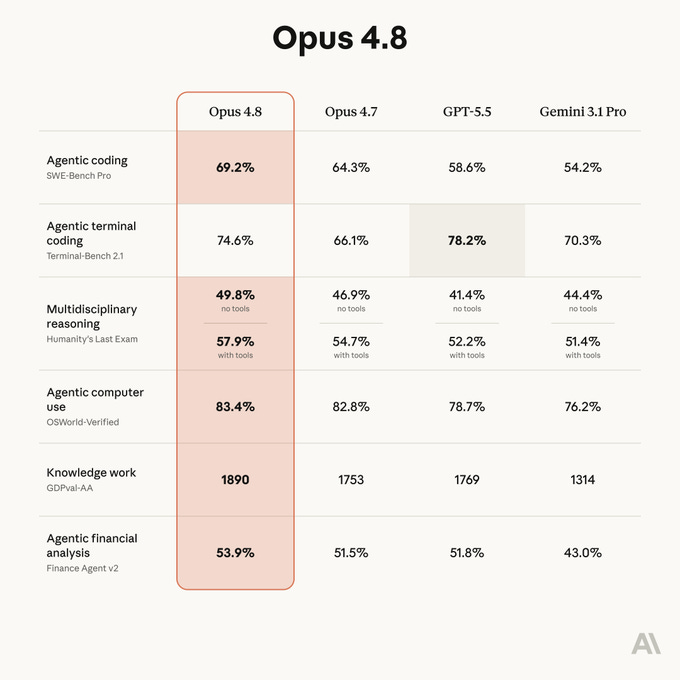
The release cadence is worth noting on its own. Anthropic released Opus 4.6 in February 2026, followed by Opus 4.7 in April 2026, maintaining a roughly two-month cadence that has defined Anthropic’s release schedule this year. Opus 4.8 lands right on that schedule, and the improvements are meaningful across every dimension that matters for serious work.


What Actually Changed

The Benchmarks

The agentic coding jump is the most significant. Opus 4.8 leads the pack on agentic coding with 69.2%, compared to 64.3% for Opus 4.7, 58.6% for GPT-5.5, and 54.2% for the next competitor.

Honesty and Judgment

This is the improvement most people will not benchmark but will feel immediately in real work.

The model is 4x less likely than Opus 4.7 to miss flaws in code it produces and is less prone to unsupported claims. Early testers highlight greater reliability, sharper judgment, and significantly improved honesty. Alignment assessments also reached new highs in prosocial traits while showing substantially lower rates of misaligned behavior compared to Opus 4.7.

A model that tells you when it is uncertain is more useful than one that confidently gives you a wrong answer. This is the improvement that compounds over a long working session.

Fast Mode: Now 3x Cheaper

Fast mode now runs at 2.5x the speed at a significantly reduced rate. The operating cost is now set at $10 per million input tokens and $50 per million output tokens, making it 3x more affordable than previous versions.

Turn it on with /fast in Claude Code. On the API, contact your account manager to request access or join the waitlist at claude.com/fast-mode.

Effort Controls

Users on claude.ai and Cowork can now select how much thinking effort Claude applies, from Low (faster, lower rate-limit usage) to Max. Opus 4.8 defaults to High effort for the best balance of quality and experience.

This matters for cost management. Running Low effort on simple tasks and Max effort on the hard ones is the discipline that cuts your monthly bill significantly without touching output quality on what matters.

Dynamic Workflows in Claude Code (Research Preview)

This is the feature with the highest ceiling.

For the hardest tasks, Claude makes a plan, runs hundreds of parallel subagents, and verifies its work before reporting back. Think a migration touching hundreds of files, a codebase audit, a full test suite generation. Tasks that used to require a team now run as a single instruction.

Claude Opus 4.8 supports the 1M token context window by default on the Claude API, Amazon Bedrock, and Vertex AI, with 128k max output tokens, adaptive thinking, and the same set of tools and platform features as Claude Opus 4.7.

Pricing

Standard pricing remains at $5 per million input tokens and $25 per million output tokens, the same as Opus 4.7. Fast mode runs at $10 per million input tokens and $50 per million output tokens.

Same capability, materially better model, same price. That is a good deal.


How Startup Founders Should Actually Use Opus 4.8

The use cases where Opus 4.8 is better than any other model available right now, how to configure it, and the prompts to get started today 👇

Keep reading with a 7-day free trial

Subscribe to The VC Corner to keep reading this post and get 7 days of free access to the full post archives.

Already a paid subscriber? Sign in
© 2026 The VC Corner · Privacy ∙ Terms ∙ Collection notice
Start your SubstackGet the app
Substack is the home for great culture