

In the spring of 2020, two small startups found out what a free launch can do. Plausible’s blog post “Why you should stop using Google Analytics” hit the Hacker News front page in April and brought 48,000+ visitors in a week, more than the site had seen in the previous 15 months. A month later Supabase posted its alpha on the same site and got 30,000 visitors and 1,400+ signups in seven days.
Both launches were free, and six years later the free places to launch have multiplied: daily and weekly boards modelled on Product Hunt, app stores inside ChatGPT, Slack and Zapier, and review sites that AI assistants quote when a buyer asks which tool to use.
Below are 50 of them, all free, in seven groups, with what each one expects from you.
Traffic and customers are two different numbers
In April 2011, Sahil Lavingia posted Gumroad on Hacker News as a weekend project. It hit 396 points, and “nearly 50,000 people checked Gumroad out on the first day,” as he later told Indie Hackers, yet nearly all of his paying customers came from somewhere else.
AI search shows the same gap. A January 2026 preprint tested 112 startups from Product Hunt’s 2025 top 500 and found that ChatGPT recognised 99.4% of them by name, while surfacing them in only 3.32% of open discovery questions, the kind a buyer asks when looking for the best tool in a category.
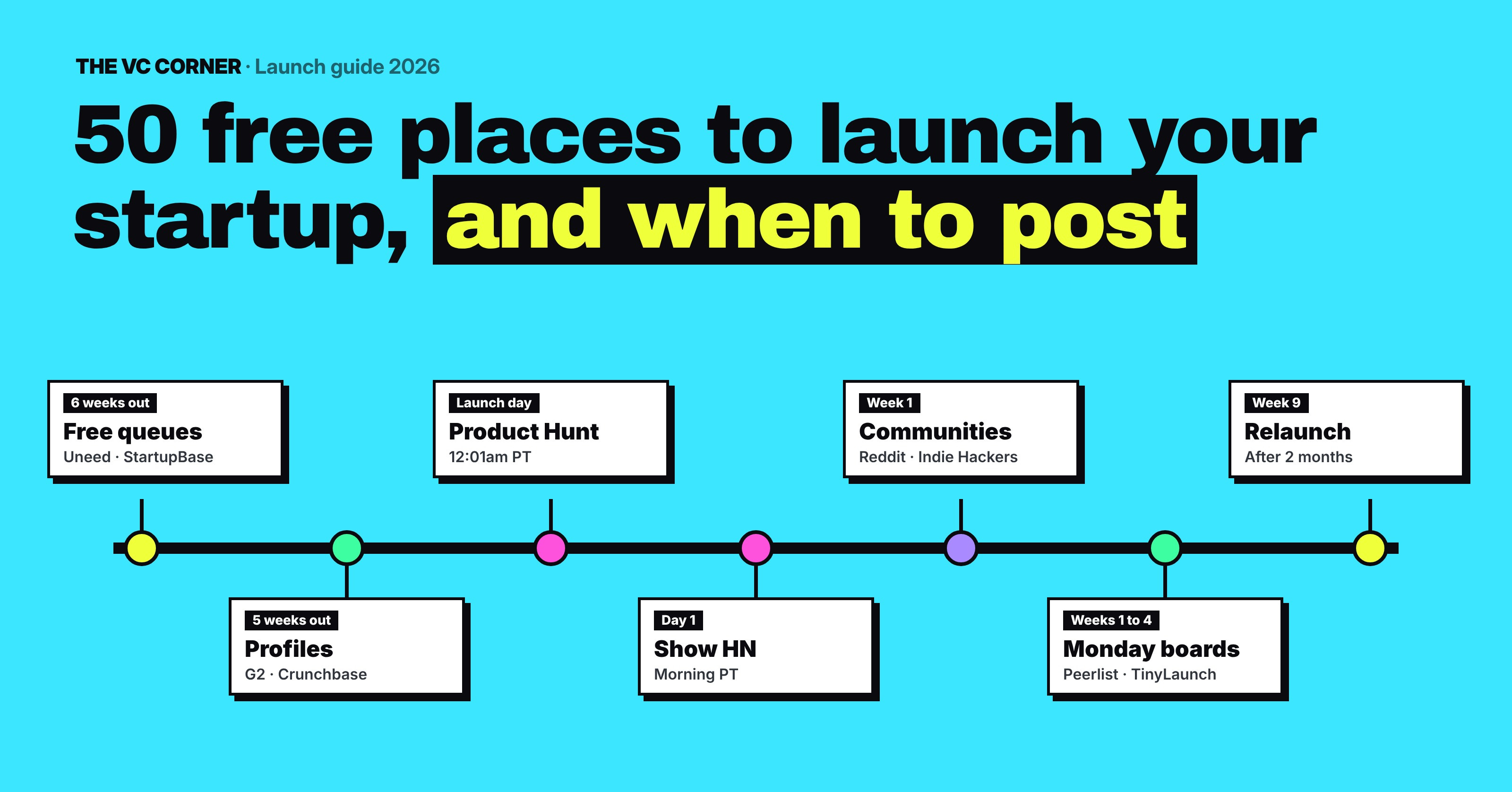
My take: a launch is a sequence that starts six weeks before launch day, because that’s how long the free queues take to reach you. I’d rather see a founder launch well on 12 of these places than rush through all 50. Tally won Product of the Day on its third Product Hunt launch, and Lovable took off after relaunching under a new name.
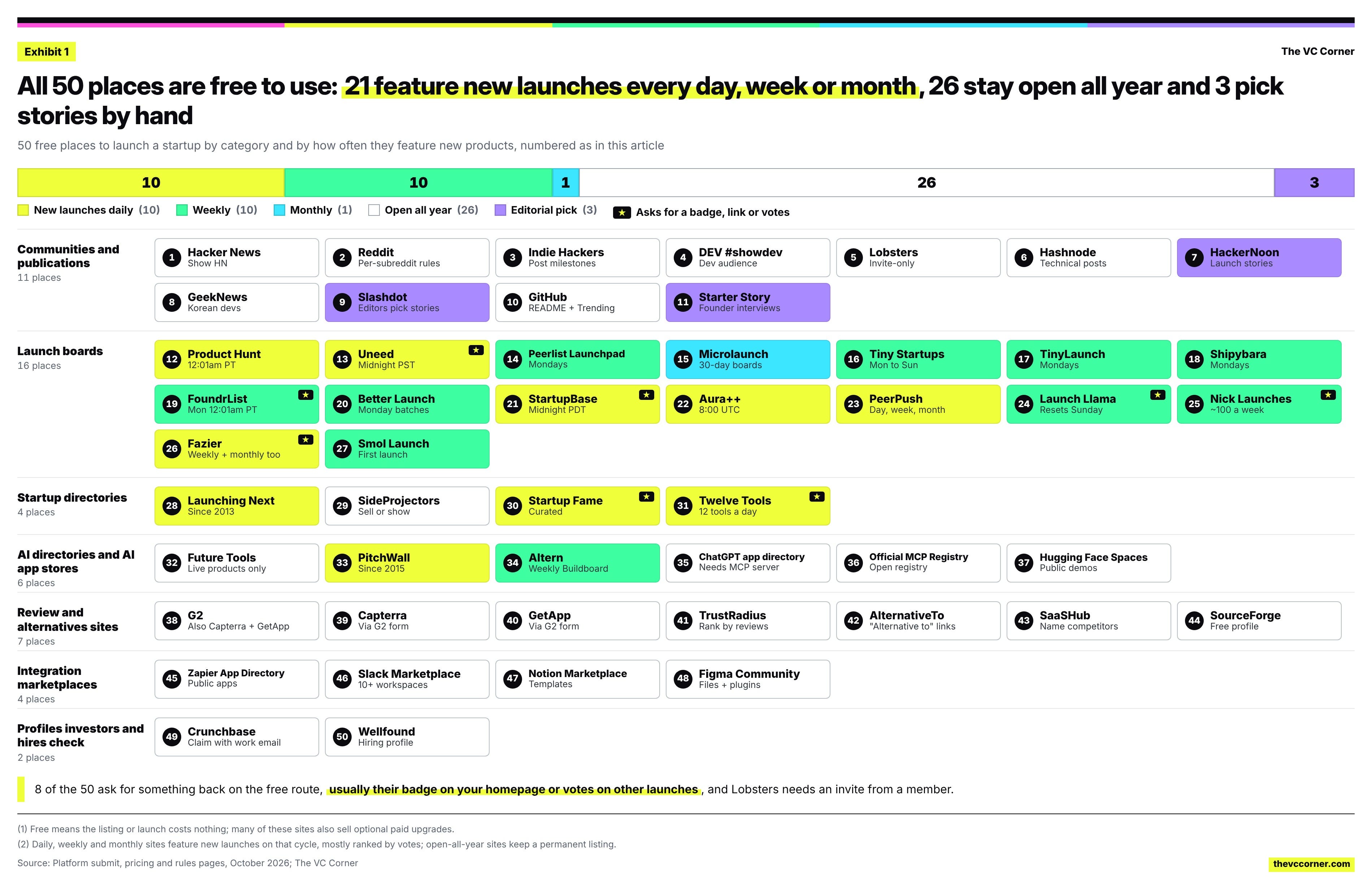
The 50 free places to launch your startup
Numbers match Exhibit 1. A ★ marks the eight places that ask for something back on the free route, usually their badge on your homepage or votes on other launches.
Communities and publications
Eleven places where people already talk about what you build. They reward stories and help, and moderators remove anything that reads like an ad.
1. Hacker News · Show HN
Post a “Show HN” for anything people can try today. The rules ask for something you made, easy to try straight away, and zero upvote requests from friends. They now include a line written for the AI era:
“The project should be non-trivial. Don’t post quickly-generated one-offs; anybody can do that now.”
YC companies also get one curated Launch HN, scheduled with the HN team.
2. Reddit · rules set by each subreddit
Reddiquette’s rule of thumb is the 9:1 ratio: one in ten of your submissions can be your own content. The subreddits that matter most for a launch:
▫️ r/SideProject (876K members) exists for sharing projects, with the title format “[Project name] - [Short description]”
▫️ r/startups (2.1M) keeps your startup to its quarterly “Share Your Startup” thread
▫️ r/webdev (3.3M) saves projects for Showoff Saturday
▫️ r/alphaandbetausers (50K) is built for recruiting early testers
3. Indie Hackers · build in public
Bootstrapped founders sharing revenue and lessons. Add your product to the products database, connect Stripe so your revenue shows as verified, and post milestones with numbers. The Build Board ranks build-in-public posts every day.
4. DEV #showdev: The tag DEV keeps for showing projects to developers. Write the build story and keep the pitch for your landing page.
5. Lobsters: Invite-only and deeply technical. Ask a member for an invite, and keep self-promotion under a quarter of what you post, the admin’s own rule of thumb.
6. Hashnode: Developer blogging with a community feed. Publish the “how we built it” post, since the code of conduct bans accounts used mainly for self-promotion.
7. HackerNoon: Free tech publishing with an editorial team. Turn the launch into a technical story.
8. GeekNews: Korea’s answer to Hacker News. Post under “Show” with a Korean title and summary, and make the product usable instantly. New accounts wait a week before posting links.
9. Slashdot: Editor-picked tech news. Send a neutral story of about 100 words with a 6 to 10 word headline, since editors prefer stories to press releases. Its free software directory runs through SourceForge.
10. GitHub · README, topics and Trending
For open source, the README is your landing page. GitHub’s own docs say it should explain what the project does, why it’s useful, how to get started and where to get help. Add up to 20 topics so the repo appears on topic pages, aim for Trending, and pitch the awesome lists in your niche. Put a runnable example near the top.
11. Starter Story: Free founder interviews, sent to a newsletter it says has 247K subscribers. Apply once you have revenue to talk about.
Launch boards
Sixteen leaderboards that rank new products by votes over a day, a week or a month. They reward the founders who show up on launch day and answer every comment.
12. Product Hunt · daily, from 12:01am PT
The biggest one. Days run on Pacific time, so launches go live at 12:01am PT, and you can schedule up to 30 days ahead. Hunt it yourself: makers hunted 79% of featured posts, and Product Hunt says a third-party hunter brings “no discernible advantage.” Only personal accounts can post, and a new account waits a week.
“The only real rule here is that you cannot ask people directly to upvote your product.” (Product Hunt’s launch guide)
Ask for visits, comments and feedback instead.
13. Uneed ★ · daily, midnight PST
Each day features 30 to 50 free launches. The free line books a date 30+ days out, and a free launch stays published once it scores 10 on its day (20 earns the dofollow link). The top 3 get podium badges and a spot in the weekly newsletter.
14. Peerlist Launchpad · weekly, Mondays
Launches run Monday to Sunday in front of an audience that is 58% software engineers and 22% founders and CTOs, per Peerlist’s own numbers. Projects show in random order on Monday and Tuesday, then rank on votes, comments and traction, and the top 5 get a backlink. You need a verified personal profile and a project page filled in completely.
15. Microlaunch: 30-day launches where voters score your idea and product and leave “roasts,” blunt feedback you can turn into testimonials.
16. Tiny Startups: A free weekly launchpad plus a newsletter built from that week’s submissions. Verify revenue through your payment provider to join its revenue leaderboard.
17. TinyLaunch: Weekly launch periods starting on Mondays. The top 3 earn a badge and a backlink, and embedding their badge keeps a dofollow link for everyone else.
18. Shipybara: Monday launches with 18 free slots a week, bookable up to 180 days ahead. The weekly top 3 get a dofollow link.
19. FoundrList ★: A new board opens every Monday at 12:01am PT. Free launches land 4+ weeks out and ask for their badge, or 3 upvotes and a comment on other launches. Ranking mixes upvotes with recency, so share your link early in the week.
20. Better Launch: Monday batches. Free dates land 30 to 45 days out, or about 14 days if you vote on 3 launches, and adding the badge makes your link dofollow.
21. StartupBase ★: Daily launches at midnight PDT. The free queue runs 4 to 5 weeks and asks for their badge on your site.
22. Aura++ · daily, 8:00 UTC
Five free slots a day. Its launch guide has two rules worth stealing for every board: submit 3 to 7 days ahead, and reply to comments within about two hours. It also says to run several platforms in the same week: “Treat launches like a portfolio, not a lottery ticket.”
23. PeerPush: Product of the Day, Week and Month, plus an MCP server so AI assistants can read the listings. Free launches wait behind paid ones, so submit early, and link to your PeerPush page from your site for a small ranking boost.
24. Launch Llama ★: A weekly board that resets Sunday 00:00 UTC. The top 5 keep a permanent dofollow link and #1 gets the newsletter. The free path takes their badge, 5 upvotes and 1 review, then about 4 weeks.
25. Nick Launches ★: About 85 to 105 launches a week. Free launches keep their badge up to stay listed, and the site’s MCP server can draft your launch from your coding agent.
26. Fazier ★: Daily launches with weekly and monthly leaderboards. The free tier asks for a link or badge on your homepage, and review can take up to 30 days.
27. Smol Launch: Weekly cohorts with 50 free slots, made for your first launch.
Startup directories
Four permanent listings that keep sending visitors long after launch day.
28. Launching Next: Featuring new startups daily since 2013, with free submissions reviewed every day.
29. SideProjectors: Show a side project, find a co-founder or sell the project later. Its FAQ says listings with screenshots, a demo and documentation do best.
30. Startup Fame ★: A curated directory, free with their badge after about 7 days of review. Its FAQ has the best advice in this section: “one strong directory link is better than many weak ones.”
31. Twelve Tools ★: Twelve new tools a day. Free when you link back from your homepage or footer, with review within 72 hours.
AI directories and AI app stores
32. Future Tools: Matt Wolfe’s curated AI directory, with a newsletter it says reaches 250K+ subscribers. It’s strict: over 75% of submissions get turned down, it takes live products only, and it asks you to wait a week before resubmitting.
33. PitchWall: An AI products directory running since 2015. Free launches wait 30+ days and get a day on the homepage, and every listing needs a working product or demo.
34. Altern: A directory of AI tools, models and APIs with a weekly community vote. Free to submit.
35. ChatGPT app directory · open since December 17, 2025
If your product can run as an app inside ChatGPT, this is the newest free launch slot on the list. Submissions need a verified organization, a public MCP server, test cases and a video walkthrough. Build the MCP server once and the next two entries come almost for free.
36. Official MCP Registry: The open registry for MCP servers, free and in preview since September 2025.
37. Hugging Face Spaces: “The AI App Directory.” Host a public demo: static Spaces are free, and free accounts get up to 2 Gradio Spaces on ZeroGPU.
Review and alternatives sites
This is where B2B buyers compare tools, and where AI assistants look for answers about software. In Hall’s analysis of 456,570 AI citations, GetApp drew 47.65% of ChatGPT’s citations of review platforms.
38. G2 · also lists you on Capterra and GetApp
The biggest B2B software review site. In early 2026 G2 bought Capterra, Software Advice and GetApp from Gartner, so one free product form now feeds all three. G2’s research team verifies a new product in 3 to 5 business days. Categories and badges depend on review volume, so ask your first customers for reviews in week one.
39. Capterra: SMB software reviews. “Get listed” now opens G2’s form, and the listing is free.
40. GetApp: The same G2 onboarding. Keep the product description identical across all three sites.
41. TrustRadius: Long, vetted reviews for mid-market and enterprise buyers, owned by HG Insights since June 2025. The profile is free, and rank comes from reviews alone: “Software companies can’t pay for placement.”
42. AlternativeTo: Where people look for a replacement for software they already use. Link your product as an “alternative to” the apps you replace so it shows up on their pages. Approval takes from a couple of days to about a week.
43. SaaSHub: An independent alternatives directory since 2014. Name your competitors and verify with an email on your domain, and your submission moves up the review queue.
44. SourceForge: B2B software reviews plus open-source hosting. Create a free vendor profile, or import an open-source project straight from GitHub.
Integration marketplaces
If your product plugs into a tool people already pay for, that tool’s marketplace puts you in front of buyers who are searching for exactly that.
45. Zapier App Directory: Free to build and publish an integration once your app is public, so plan it for launch day. Zapier counts 9,000+ integrations.
46. Slack Marketplace: Listing needs 10+ active workspaces and 10+ weekly active users, so it fits a few weeks after launch.
47. Notion Marketplace: 30,000+ templates by Notion’s count. A free template built around your product works as a small launch of its own.
48. Figma Community: Free publishing for files and plugins. A free plugin or template puts your product in front of designers.
Profiles investors and hires check
49. Crunchbase: The profile investors, journalists and sales teams look up. Create it for free, or claim it with an email on your company domain, and list closed rounds only.
50. Wellfound: The startup hiring marketplace, formerly AngelList Talent. A free company profile and free job posts give candidates one page with your product, funding and team. Its help center keeps investor matchmaking out of scope, so treat it as your hiring page.
Which ones fit your product
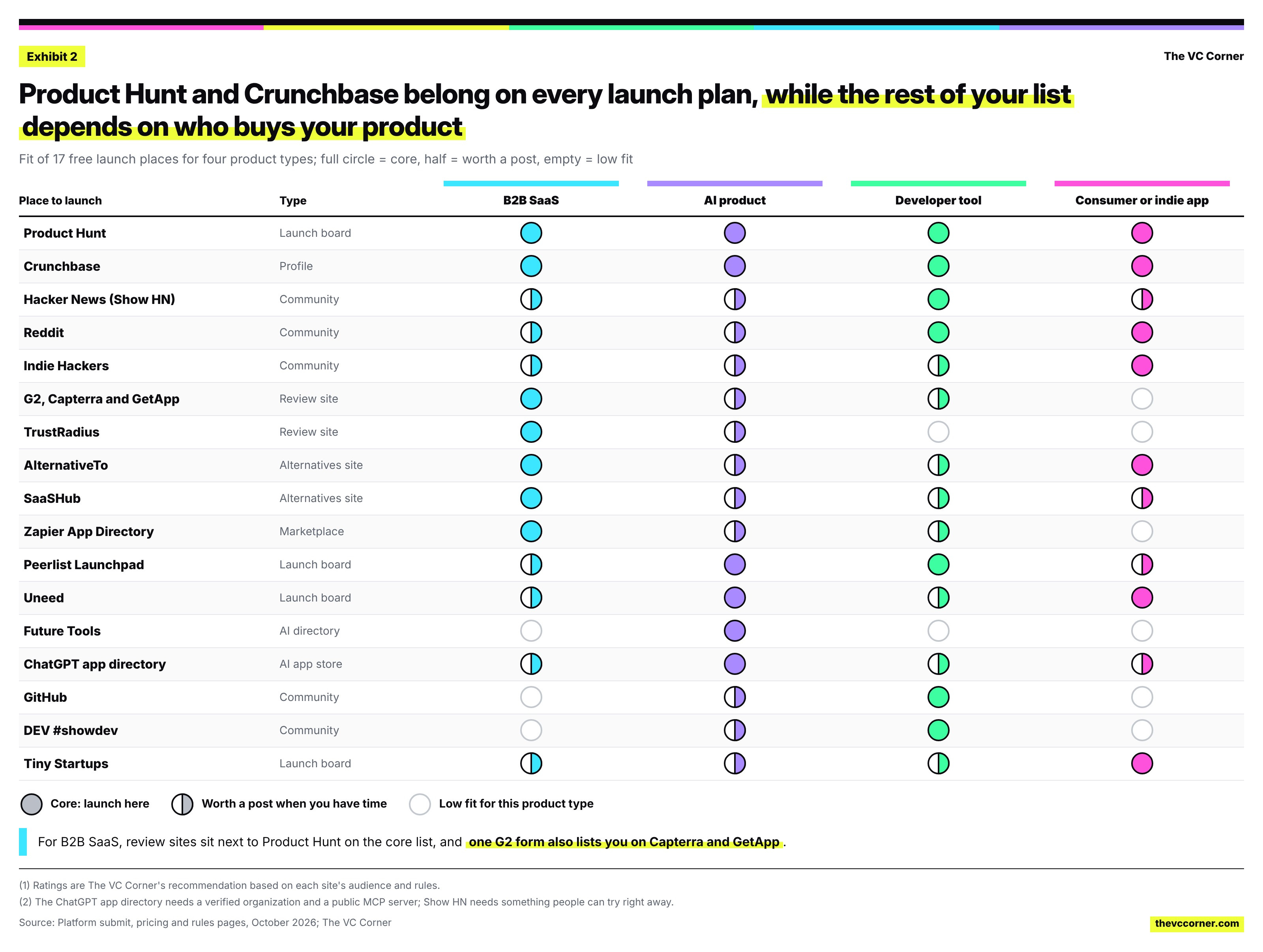
Product Hunt and Crunchbase belong on every plan. After that, the list depends on who buys: a B2B SaaS tool gets more from G2 and TrustRadius than from a weekly board, while a developer tool lives or dies on Show HN, GitHub and DEV.
When to post on each
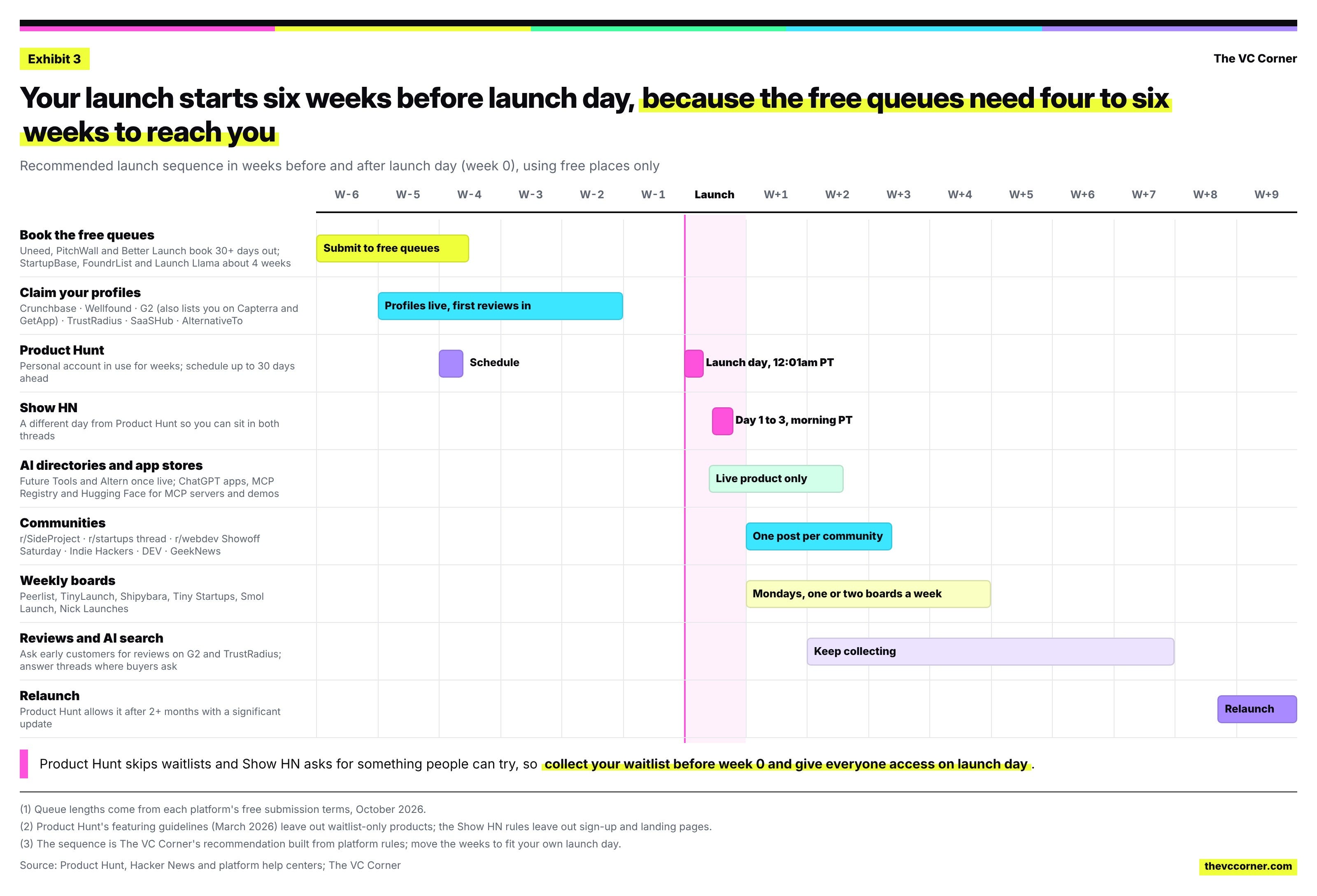
The free queues set your calendar. Uneed, PitchWall and Better Launch book 30+ days out, StartupBase, FoundrList and Launch Llama about four weeks, so the work starts six weeks before launch day and runs about eight weeks after it.
What premium members get today
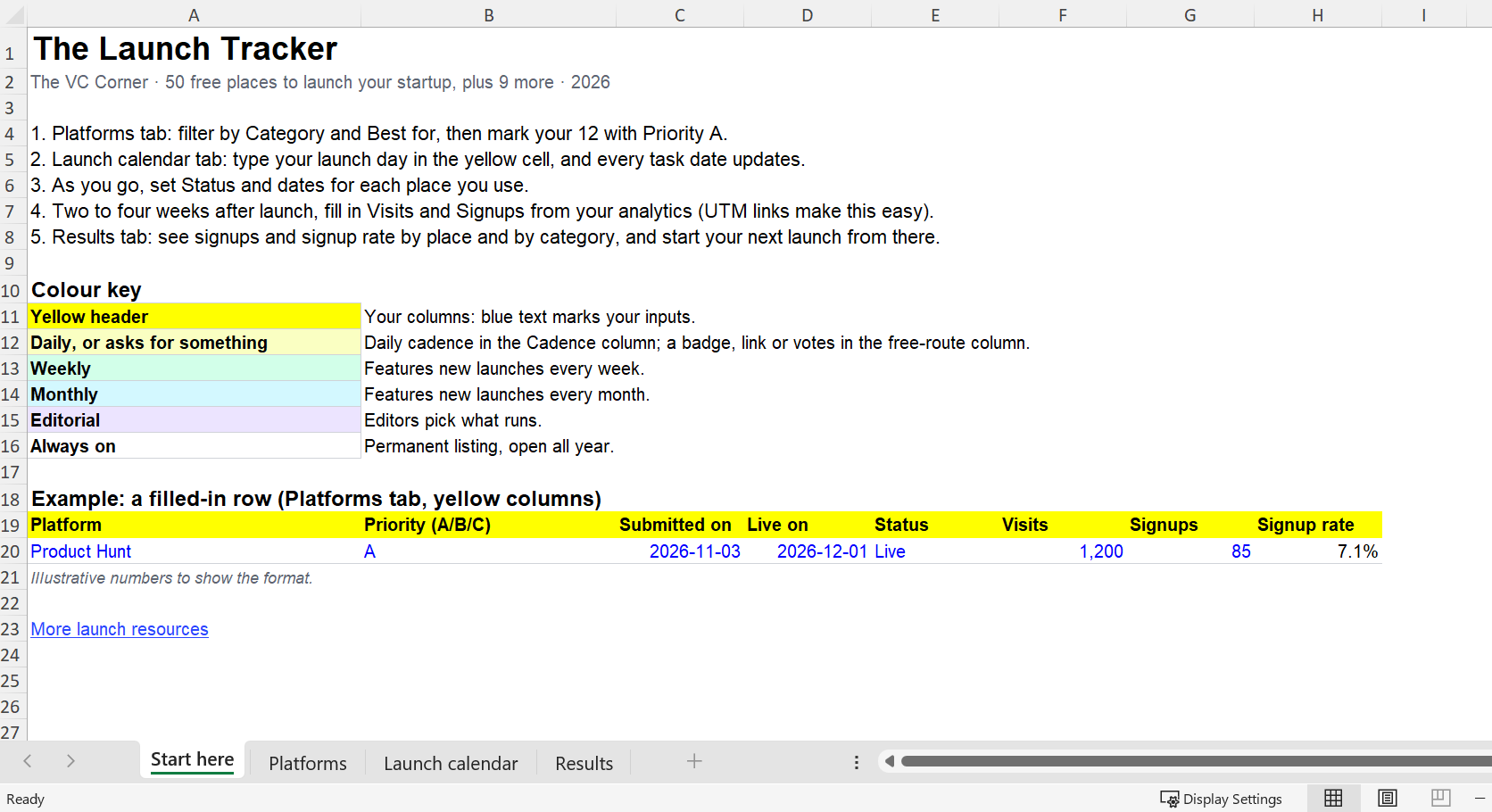
▫️ The Launch Tracker (Excel): all 50 places plus 9 more, a calendar that dates 29 tasks from your launch day, and a results tab that works out signups and conversion by platform
▫️ The six-week plan, week by week, with what to submit, claim, write and post
▫️ The launch-day run sheet, hour by hour on Pacific time
▫️ Pick your 12: the core list for B2B SaaS, AI products, developer tools and consumer apps
▫️ Playbooks for Product Hunt, Show HN, Reddit, AI app stores and review sites, built from each platform’s own rules and data
▫️ Five copy templates: the Show HN post, the Product Hunt maker comment, the Reddit post, the launch email and the message to your users
▫️ 12 launches with numbers, from Supabase and Tally to Bolt.new and Lovable
▫️ What launch sites do for Google and AI search, with the data
▫️ 9 more free places, the free newsletters that feature launches and the free launch stack
Premium members launch with the full playbook.