

Most seed decks never leave the partner meeting. This one raised $6.1M in a company’s first year.
Lightsprint came out of Y Combinator’s Spring 2026 batch, and on Tuesday it announced a $6.1M seed led by 645 Ventures. The rest of the cap table reads like a list of the funds founders fight to get into: Y Combinator, January Capital, Rebel Fund, Sterling Road, Fjor, Batch Ventures, Founders Capital and Seraph Group. Then the angels, including Opendoor’s Kaz Nejatian and Henri Stern. TechCrunch had already picked Lightsprint as one of the 11 standout companies of the batch.
Here’s what they backed.
Every product team has the same graveyard. A PM writes the spec, a designer mocks it up, and the change sits in the engineering backlog for three sprints because something bigger always comes first. The PM could build a prototype over lunch, but a prototype lives outside the production codebase, so nothing changes for customers.
Lightsprint closes that gap. A PM, designer or anyone on the business side describes a change in plain language, the team agrees on a plan, AI agents write the code on the company’s existing codebase, and everyone reviews a live preview. The change lands as a pull request, and engineering reviews and merges it through its normal process. Product gets speed, and engineering keeps control of production.
CEO Ben Ong says the team kept seeing “product managers, designers and even business teams build features” once the tools let them. The deck turns that observation into the sharpest problem slide I’ve read this year:
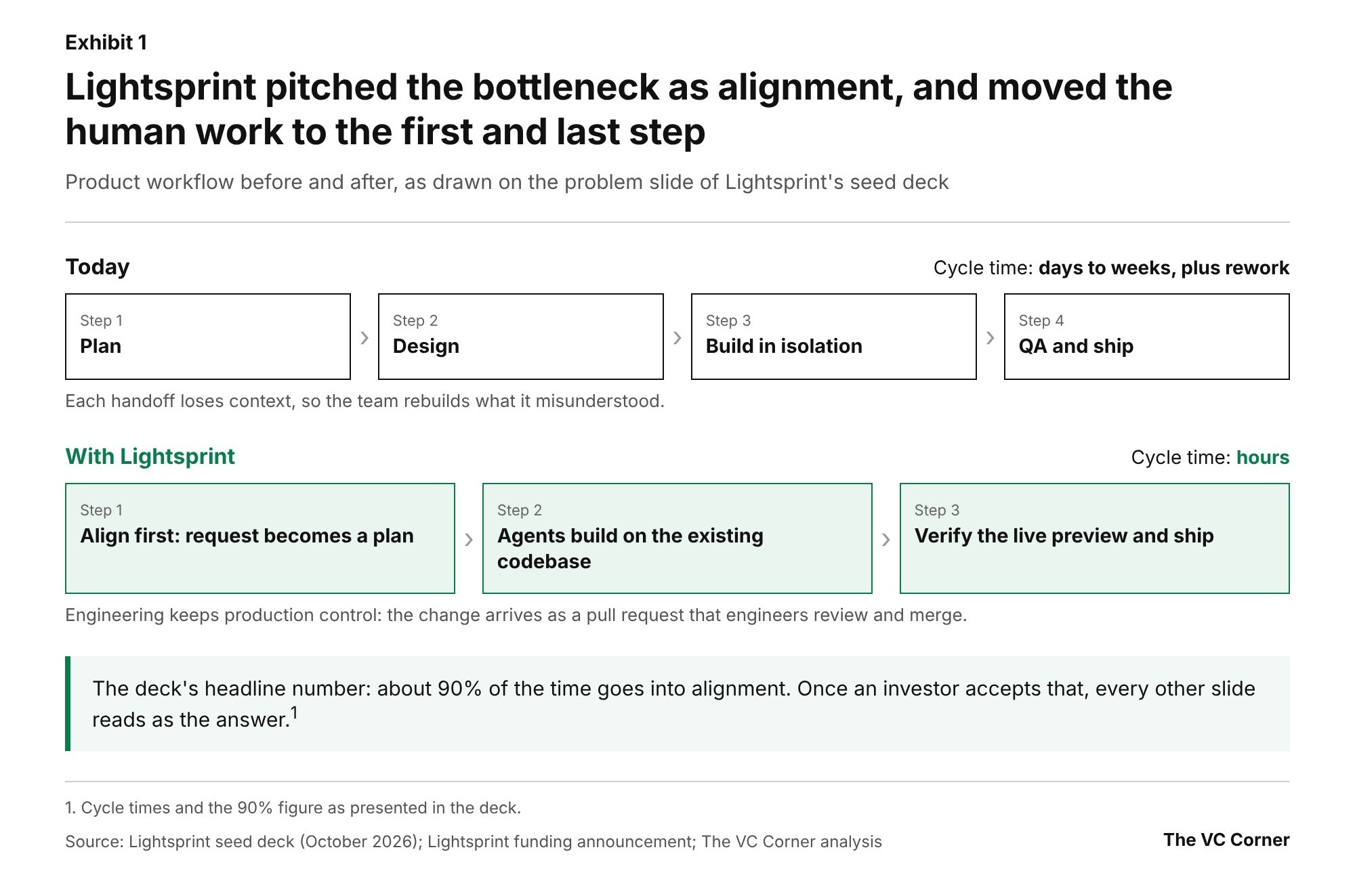
Every AI coding pitch sells speed. Lightsprint sells agreement. Coding agents already write code faster than any team can review it, so the scarce resource is the conversation between product, design and engineering about what to build. Whoever owns the pull request that engineering trusts owns the relationship with engineering, and Lightsprint got there first.
The traction slide backs it up: 3x more code shipped per team, about 80% of merged code written by agents, and more than 1,000 pull requests from non-technical teams merged by engineering.
I know this company well. Guillermo Flor and I invested in Lightsprint through GR Angel, our YC rolling fund. We back the five best startups in every YC batch, 20 deals a year, and founders let us into rounds like this one because of what our distribution does for them once they’re live. We’ll close 2026 with $2M invested, and in 2027 we plan to more than double that with new LPs joining.
Lightsprint is one of my favourite decks of the year, and the founders have let me share it. Premium members get all eight slides.
Below the paywall
The Full Lightsprint Seed Deck: all eight slides that raised $6.1M from 645 Ventures, YC and the rest of the round
The Slide-by-Slide Teardown: what each slide claims, the job it does for the investor and what to steal for your own deck
The Eight-Slide Template: the exact order to copy if you’re raising for an AI product, from the problem reframe to the positioning matrix
The Traction Slide Prompt: a Claude prompt that rebuilds your own traction slide around the metric your toughest investor already trusts
The Full Lightsprint Seed Deck
Eight slides, one idea: product teams should be able to ship changes to the production codebase while engineering keeps control. Here’s each slide and what it’s doing.
Slide 1: The cover
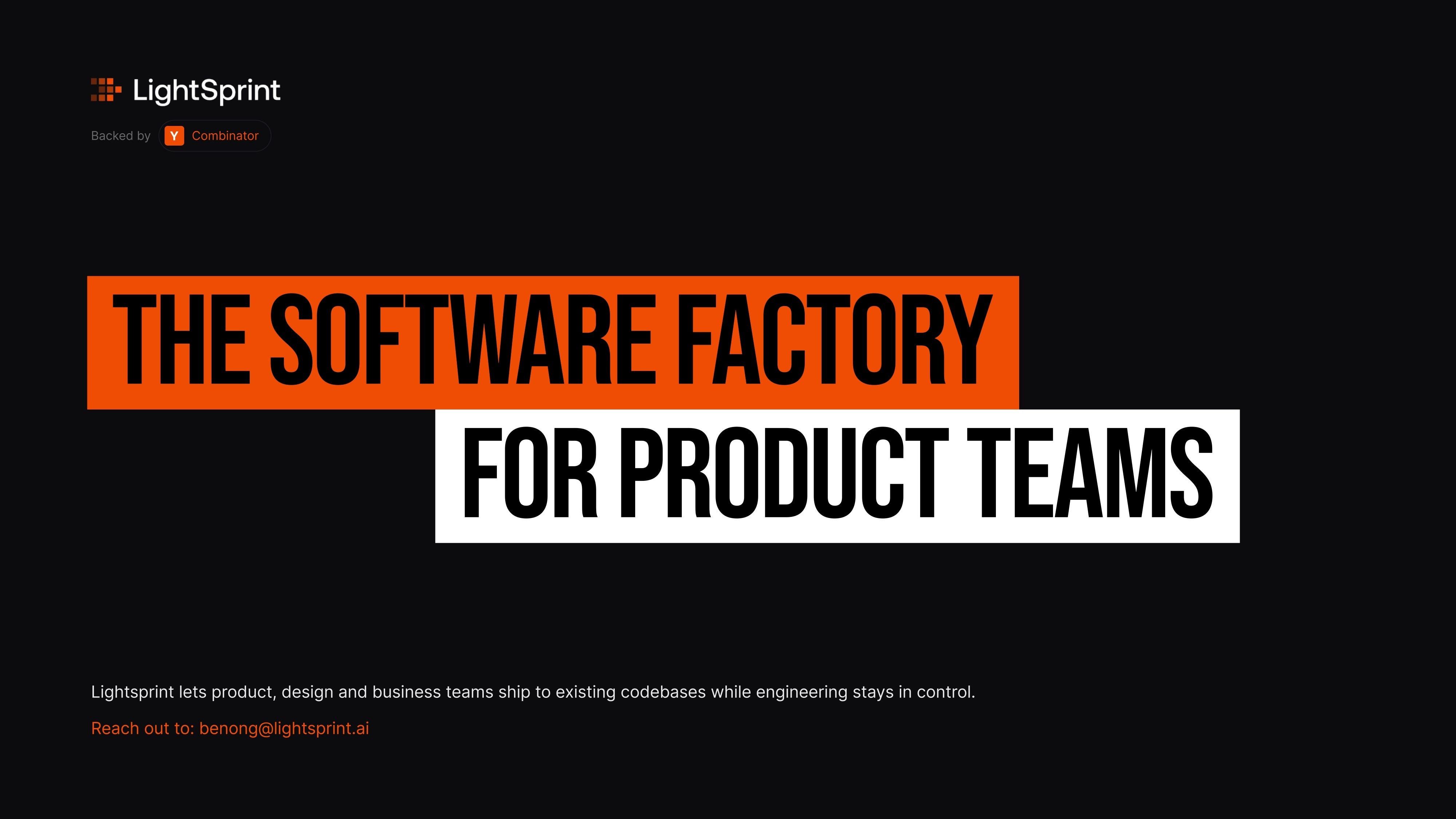
“The software factory for product teams.” Product, design and business ship changes to existing codebases, and engineering keeps control.
The cover does the positioning in one line. “Software factory” signals output at scale, and “for product teams” names the buyer. The second line answers the first objection every CTO raises, so it never reaches the meeting.
Steal this: put your buyer and their biggest objection on the cover.