

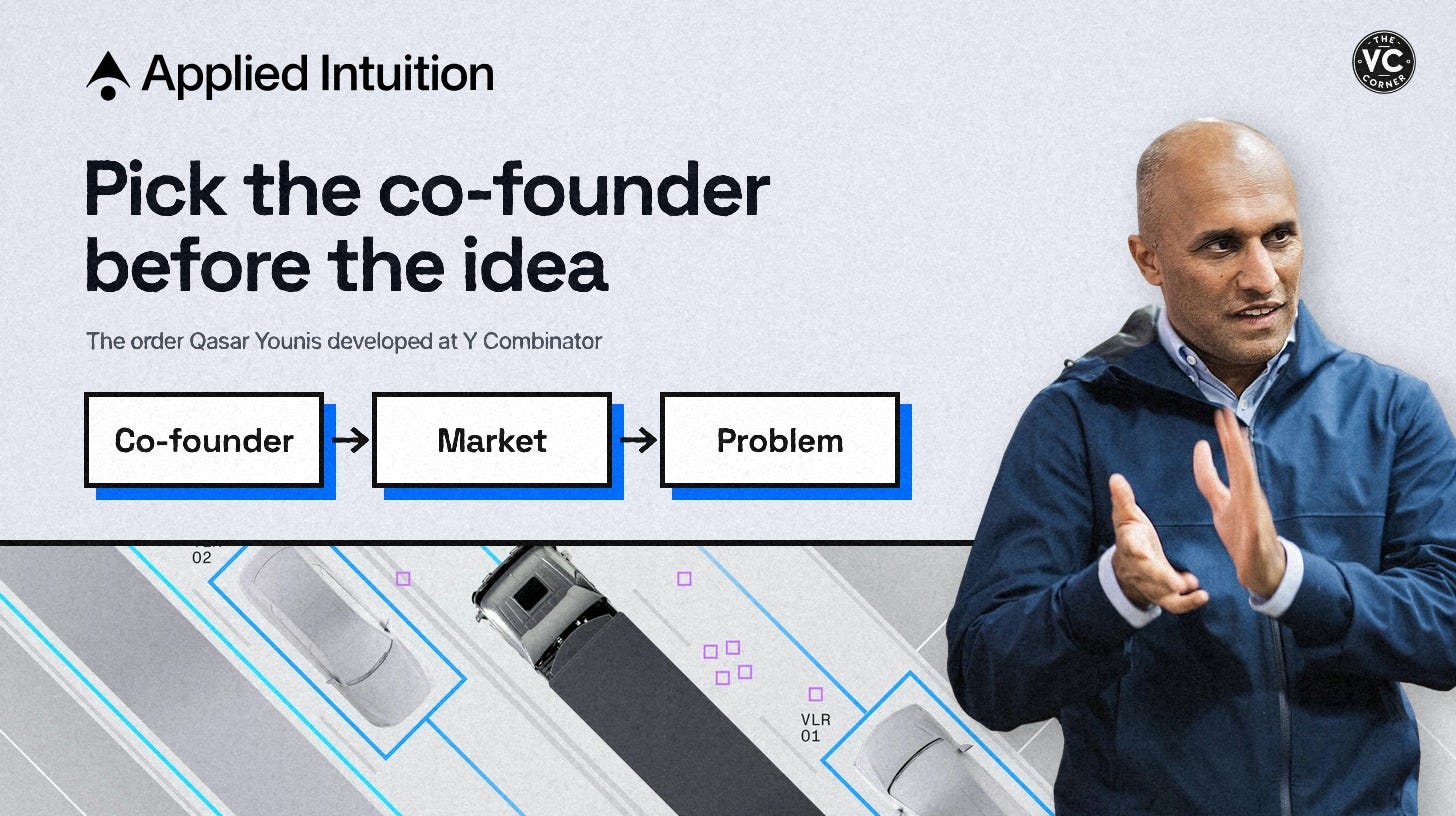
When we sat down with Qasar Younis at Slush in November 2025, he had held the same five-letter handle on X for 16 years and had never posted once. He planned to start that same week (Qasar Younis, interview, 00:39).
About three weeks after Slush, on December 10, 2025, he published his first post on X, linking to an essay on why he finally joined. Marc Andreessen quoted it and called him the best AI CEO nobody knows, as Lenny Rachitsky recalled when he had Qasar on his podcast in March 2026.
He was doing it for the company. Qasar runs Applied Intuition, a physical AI company valued at $15 billion in its June 2025 Series F. At the time, Applied had about a thousand engineers, a next goal of crossing a billion dollars in revenue, and billions raised that it had never had to spend, because the company generated cash (Qasar Younis, interview, 01:41).
And yet, “we have a pretty large company that very few people actually know of” (Qasar Younis, interview, 01:25).
Guillermo Flor and I talked with him for 50 minutes, right before he went public on X. He was blunt about startup advice and venture capital, and he explained why he had decided to build an audience. The whole conversation is below, followed by 8 rules worth handing to any founder, each with its clip.
If you know a founder who consumes more startup content than customer calls, send them this one.
The full interview
Qasar Younis is the co-founder and CEO of Applied Intuition, which builds software for vehicles that drive themselves: cars, trucks, defense vehicles, mining and farm machines. Before Applied, he was COO of Y Combinator and sold his previous company to Google (Qasar Younis, interview, 08:11). Applied’s last priced round was a $600 million Series F at a $15 billion valuation in June 2025, co-led by BlackRock-managed funds and Kleiner Perkins. On October 13, 2026, The Information reported that Applied had fielded investment offers valuing it at $30 billion or more (summary via Benzinga). The company has yet to announce a round at that price.
Where to find Qasar
X: @qasar
Website and essays: qy.co
Company: appliedintuition.com
More long conversations with Qasar: Lenny’s Podcast, March 2026 and Uncapped #9 with Jack Altman, May 2025
Qasar’s 8 rules at a glance
Treat customers as the only source of truth, and measure money made against money spent.
Pick the co-founder first, then the market, then the problem.
Plan product two before product one hits its ceiling.
Copy the org chart of the company one or two steps ahead, and protect your cash.
Choose hungry investors before they are famous.
Consume advice from founders at your stage, and very little of it.
Work hard on the details that make you right.
Build an audience before obscurity starts to cost you.
In this conversation
Recorded at Slush, November 2025. Timestamps match the video above.
(00:23) About to join X after 16 years with zero posts
(02:02) Why founders now need a direct line to customers
(05:05) Why social media can corrupt founders
(06:25) Flip how you explain success and failure
(08:49) Money from customers versus money from selling stock
(11:07) Most startup advice is entertainment
(14:15) Startups are just businesses: the laundromat test
(16:21) Co-founder first, then market, then problem
(19:49) Plan product two before product one peaks
(22:00) A five-to-ten-year plan that keeps updating
(23:30) Hire from the companies one or two steps ahead
(24:02) Applied’s three product lines
(25:42) Why venture capital became a marketing game
(26:28) In venture, the asset picks the manager
(28:16) Picking hungry investors before they were famous
(31:20) Why Qasar kept going after making money
(33:51) Why physical AI is the biggest market in AI
(35:10) Automotive is a minority of Applied’s revenue
(36:28) Why building Applied has no two-sentence recipe
(38:10) Hard work counts once you are also right
(39:56) More startup advice than Steve Jobs had in 1975
(42:10) Is there room for more VCs?
(43:53) The investors Qasar rates most
(46:03) When obscurity becomes a business liability
(47:59) Why an audience is a practical tool
(49:42) Customers, employees, shareholders and content
1. Customers Are the Only Truth
When you work at a bank or a law firm, the institution tells you what success looks like. Founders get “thrown into this ocean” with no swim lane, so they go looking for frameworks on social media (Qasar Younis, interview, 05:51).
His replacement for those frameworks is simple:
“It’s like what the customer wants and that like maniacal focus on the closing the loop, you know, on customers is actually the only truth.”
Qasar Younis, interview, 09:05
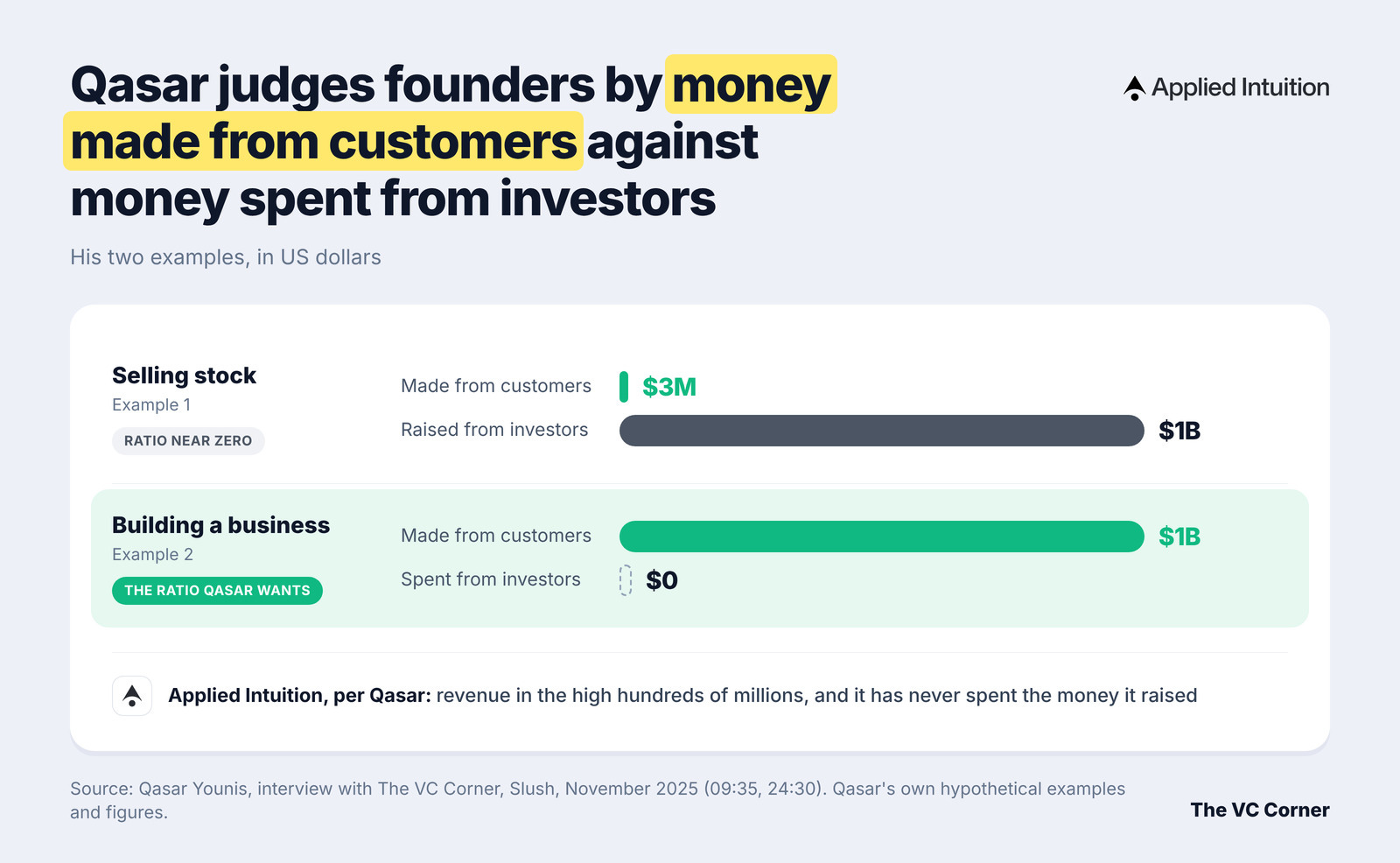
Then he handed us the ratio he uses to judge founders. Compare what a company made from customers with what it spent from investor dollars. His example: a company that made $3 million after raising a billion sits at one end, and a company that made a billion and spent zero sits at the other (Qasar Younis, interview, 09:35).
“That ratio tells you is the founder good at making money from customers or selling stock.”
Qasar Younis, interview, 09:51
The trap: founders copy the playbook of people who are excellent at selling stock and then try to run a real business with it.
How to use this: put two numbers at the top of your next board deck. Cumulative revenue collected from customers, and cumulative investor cash spent. If the second number grows faster for three quarters in a row, you are selling stock.
2. Pick the Co-Founder Before the Idea
Most founders start with a problem, “because that’s what everyone says” (Qasar Younis, interview, 16:17). Qasar starts somewhere else.
“I think the first thing that you need is a co-founder.”
Qasar Younis, interview, 16:21
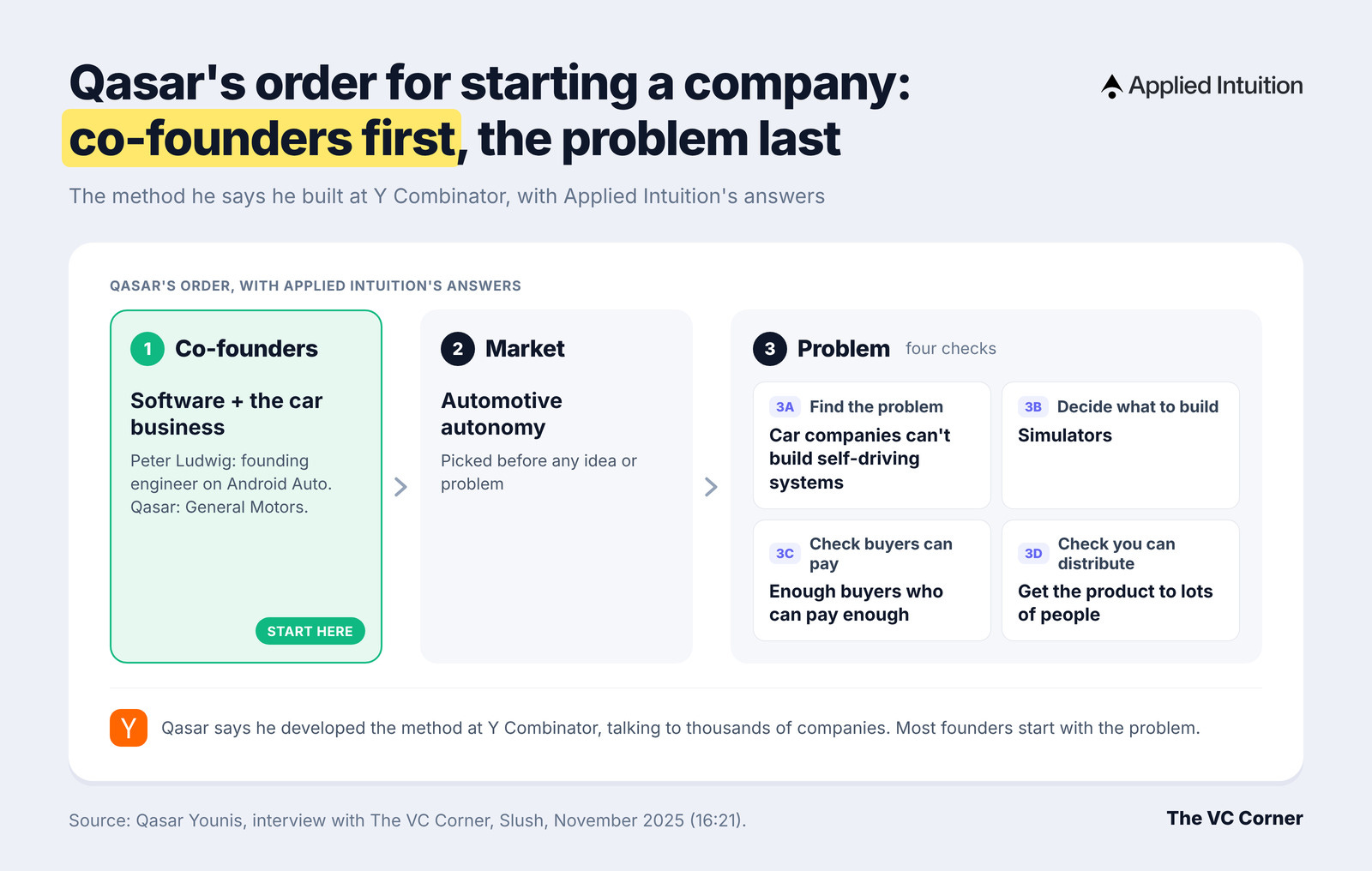
He built the method at YC after talking to thousands of companies, and he runs it in a fixed order (Qasar Younis, interview, 16:08). It starts with a piece of paper:
Co-founders. Each person writes down their background and the markets they know, then you look for the overlap “that we are uniquely good for.” At Applied, Peter Ludwig had been a founding engineer on Android Auto and came from a family that worked in automotive, and Qasar had studied at General Motors Institute and worked at General Motors. The overlap was software plus the car business.
The market. For Applied it was roughly automotive autonomy.
The problem, in four checks. First, find the problem: car companies did not know how to build self-driving systems. Second, decide what you would build: simulators. Third, check whether enough buyers can pay enough to make it a business. Fourth, check whether you can get the product into the hands of lots of people.
“It’s like a very methodical way of going from founder to market to problem.”
Qasar Younis, interview, 18:28
He uses a laundromat to make the point. If your parents own a laundromat and you studied the business, you start with an advantage everyone else in the room lacks. When founders pick generic ideas, “everybody in the room can come up with the same idea. And then it’s just randomness” (Qasar Younis, interview, 15:38).
How to use this: before your next brainstorm, each co-founder writes one page with their background, the industries they know from the inside and the buyers they can call. Only ideas that sit in the overlap make the shortlist.
3. Plan Product Two Early
Qasar borrowed a line from Napoleon’s memoirs: people thought he improvised on the battlefield, when he had studied the field in advance and planned to the end. For a company, that means you plan all the way to the end from day one.
“So right early on, we were already thinking of a second and third product.”
Qasar Younis, interview, 20:55
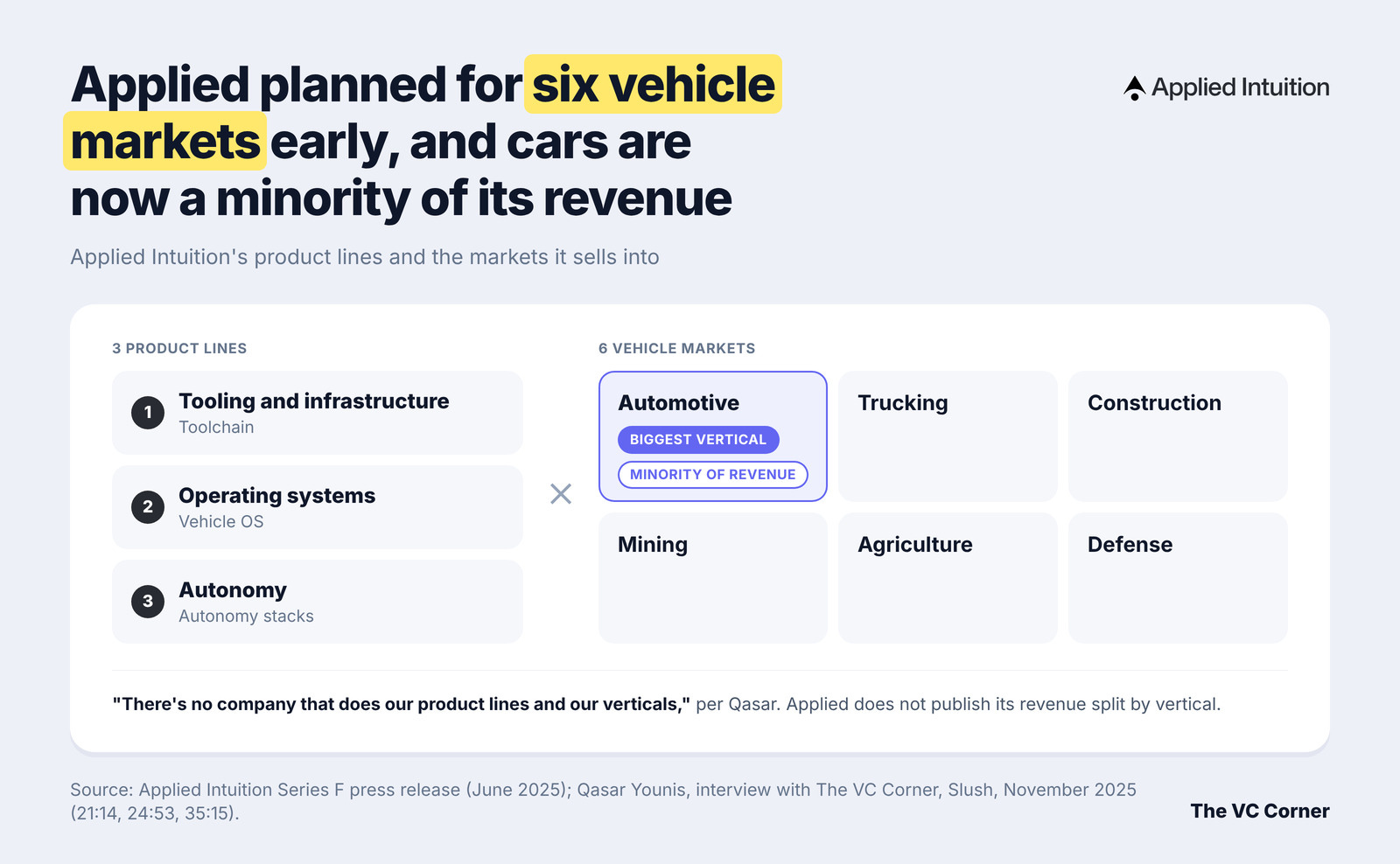
The first product, a planning simulator, would have “some natural asymptote” even if it was the best on the market. And automotive itself has a finite number of buyers. So Applied built for parallel verticals from the start: defense, commercial trucking, agriculture, construction and mining, all markets with a physical vehicle (Qasar Younis, interview, 21:14).
That planning showed up in the revenue. At the time of our interview, automotive was Applied’s biggest vertical and still a minority of the company’s revenue (Qasar Younis, interview, 35:13).
“Everyone sits in a car, so they think they know the car business.”
Qasar Younis, interview, 36:05
How to use this: write the honest answer to one question. If you became number one in your category, how big would that be, and what are steps two, three, four and five? Qasar treats the answer as a five-to-ten-year hypothesis and keeps adjusting it as the company learns (Qasar Younis, interview, 22:26).
4. Copy the Org Chart Ahead of You
We asked how to make the first full-time hires. His answer was practical: look at the companies one or two steps ahead of you in your market, see who is in their org and what their backgrounds are, then hire people with those backgrounds.
“You basically just copy them.”
Qasar Younis, interview, 23:54
Applied did this for years. For the first five years, nobody at the company was allowed on LinkedIn, and the team mapped competitors’ org charts all the time (Qasar Younis, interview, 24:06).
“We’re building a company with high 100 millions in revenue and we’ve never spent money we raised.”
Qasar Younis, interview, 24:30
The other part of the moat is breadth. Each product line and each vertical has its own competitors. By Qasar’s count, no single company covered all of Applied’s product lines and verticals together, “just like Tesla minus the manufacturing” (Qasar Younis, interview, 24:57).
How to use this: build a one-page map of the two companies ahead of you. Their org chart by function, the backgrounds of the people in each seat, and the products they ship. Your next five hires come from that page.
5. Pick Investors Who Are Still Hungry
Qasar sees venture as an odd market. In most investing, the manager picks the asset. In venture it runs the other way.
“It’s the only investing class where the asset picks the manager.”
Qasar Younis, interview, 27:39
He treats the money itself as interchangeable: “the dollars are a commodity. So it’s just a marketing game” (Qasar Younis, interview, 26:09). If capital is sugar, what you are really choosing is the person.
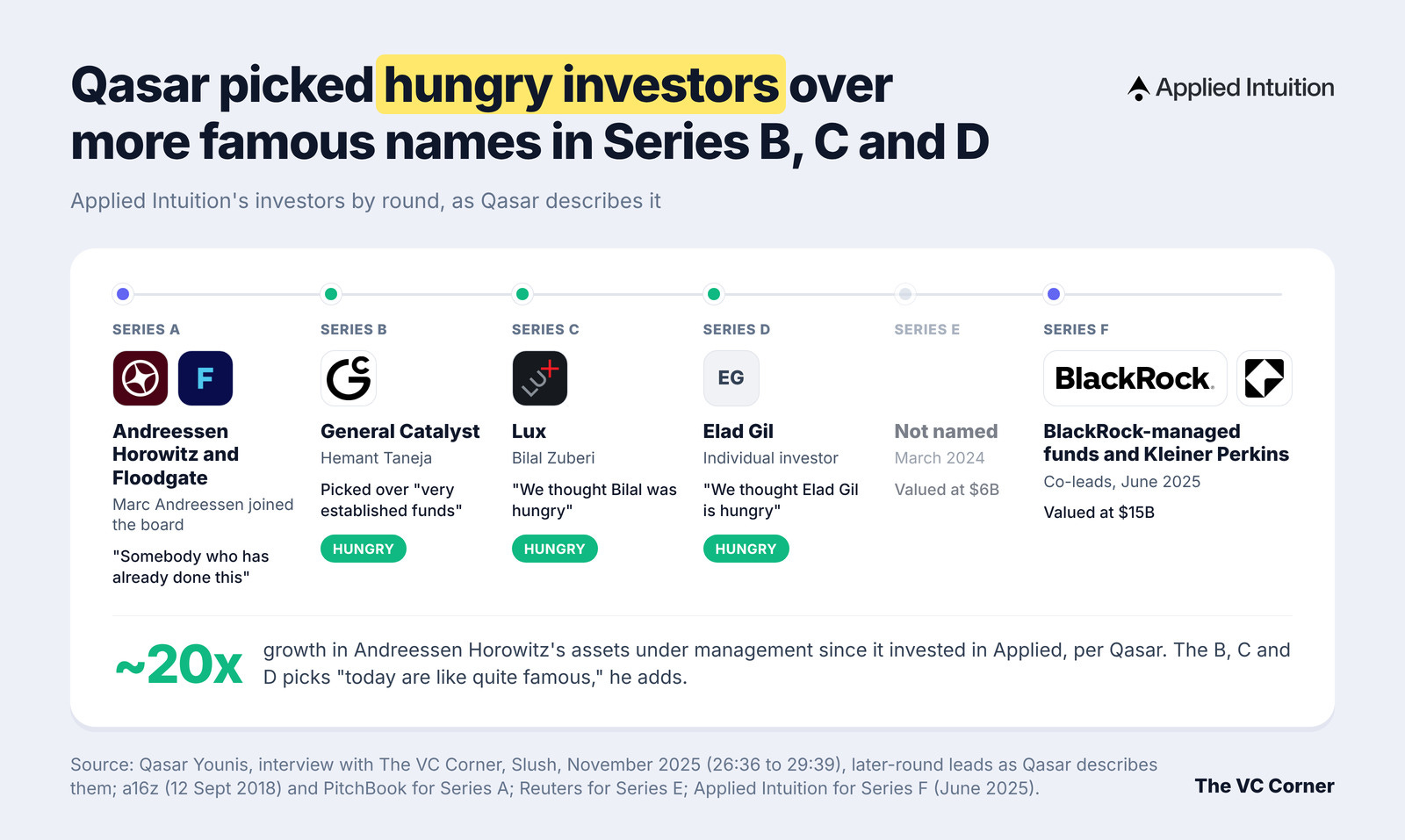
Qasar rarely talked to investors who stayed off Applied’s cap table. The overlap ran almost one to one, from the Series A to the Series F (Qasar Younis, interview, 26:57). He picked each lead for hunger.
“Our series C, we picked Lux and Bilal because we thought Bilal was hungry. Our series D was Elad Gil because we thought Elad Gil is hungry.”
Qasar Younis, interview, 29:31
By the time of our interview, Andreessen Horowitz alone had grown its assets under management by roughly 20 times since it invested in Applied (Qasar Younis, interview, 29:13). He also warned against turning his answer into a rule. Picking a VC is like picking a car, and the right one depends on the driver.
How to use this: for each investor on your shortlist, write down two things. What signal their name sends to the market today, and whether they are still building their reputation. The second answer tells you who will pick up the phone at 11 p.m.
6. Learn From Founders at Your Stage
Qasar stayed off social media for most of his career. To him it is “very corrupting for founders,” because most companies fail, so most of the water founders swim in is contaminated (Qasar Younis, interview, 05:15).
“Most of the stuff in the tech ecosystem is actually just entertainment.”
Qasar Younis, interview, 11:45
His comparison is health content on YouTube: “I’m certain there’s a class of people who watch exercise videos more than they exercise” (Qasar Younis, interview, 12:01).
He also runs a test on the stories founders tell themselves. When a company fails, founders blame what was outside their control. When it succeeds, they credit what was inside it. His fix is to flip both, because how you explain success shapes the decisions you make (Qasar Younis, interview, 06:35).
“You’ve consumed more startup advice than f***ing Steve Jobs did in 1975.”
Qasar Younis, interview, 41:43
His filter is the stage. If he were being really discerning, he would study Jensen Huang’s interviews from the late 90s and early 2000s, when Jensen was “in the phase of the company that I’m at” (Qasar Younis, interview, 12:48).
How to use this: cut your startup content diet in half for a month and move those hours to customer calls. When you do read, pick founders from the stage you are in today, in your industry, and skip the rest.
7. Get the Details Right
We asked what question we should have asked him. His answer: founders want a two-sentence answer, and building a $15 billion AI company has none. “Building a $15 billion AI company, there’s no Twitter answer” (Qasar Younis, interview, 37:07).
He went back to the laundromat. Three people could open the same laundromat, and one would win because it got the details right.
“You have to have ambition. Yes, you have to work hard. But you also have to be right.”
Qasar Younis, interview, 39:19
His list of what “right” means for a laundromat covers the location, the rent, the detergent, the sign, the distribution, the employee, the ding of the bell when you open the door and the speed of the back office. Even a business that simple has “a hundred different reasons” why one owner beats another (Qasar Younis, interview, 39:52).
And the fastest way to find those details is the customer: “the core of being a founder is listening to customers” (Qasar Younis, interview, 39:58). He counts both kinds of payment, the end user “who either pays you through dollars or attention.”
How to use this: write your own laundromat list. Ten operating details that decide whether a customer picks you, ranked by how much you actually know about each one. The bottom three are your next customer interviews.
8. Build Your Audience Early
For most of a decade, Qasar skipped interviews and conferences like Slush. He assumed a giant company would speak for itself.
“If we just build a giant company, it’ll be so obvious, right?”
Qasar Younis, interview, 47:20
By November 2025 he had changed his mind. People assume they would already know any company that mattered, so an unknown name reads as a weak one (Qasar Younis, interview, 47:02).
He saw it with investors too. Late-stage funds are humans who see founders on TV and on podcasts, and his own appearance on Jack Altman’s podcast introduced the company to people who already knew him (Qasar Younis, interview, 47:40). His explanation for why founder voices work: “People don’t follow corporate accounts. They trust people” (Qasar Younis, interview, 03:36).
“I’ve always thought it’s about ego, but it’s actually just a practical tool.”
Qasar Younis, interview, 48:45
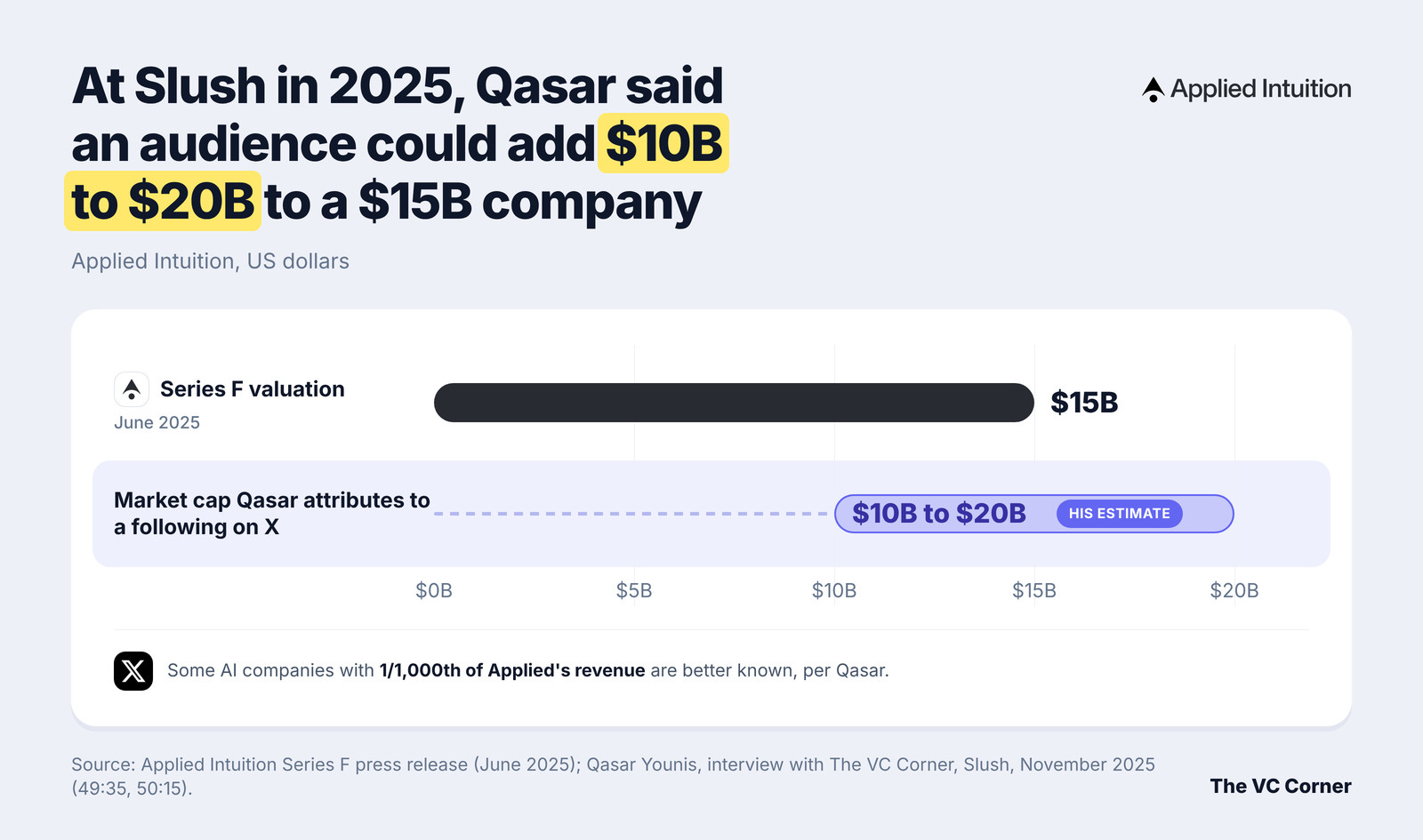
Then he priced it. At Slush, Qasar put the value of a following on X at $10 to $20 billion of market cap for Applied (Qasar Younis, interview, 49:35). He also benchmarked Applied against AI companies with one thousandth of its revenue that were better known (Qasar Younis, interview, 50:15).
Then he did it. His first post went out on December 10, 2025, Marc Andreessen quoted it, and by March 2026 Lenny Rachitsky was opening his episode with Qasar on that first tweet. Qasar’s own explanation is in his essay on qy.co.
How to use this: list your three stakeholder groups the way Qasar did: customers, employees and shareholders. For each, write the one thing they should hear from you directly every month. That list is your content plan.
Qasar’s Founder Checklist
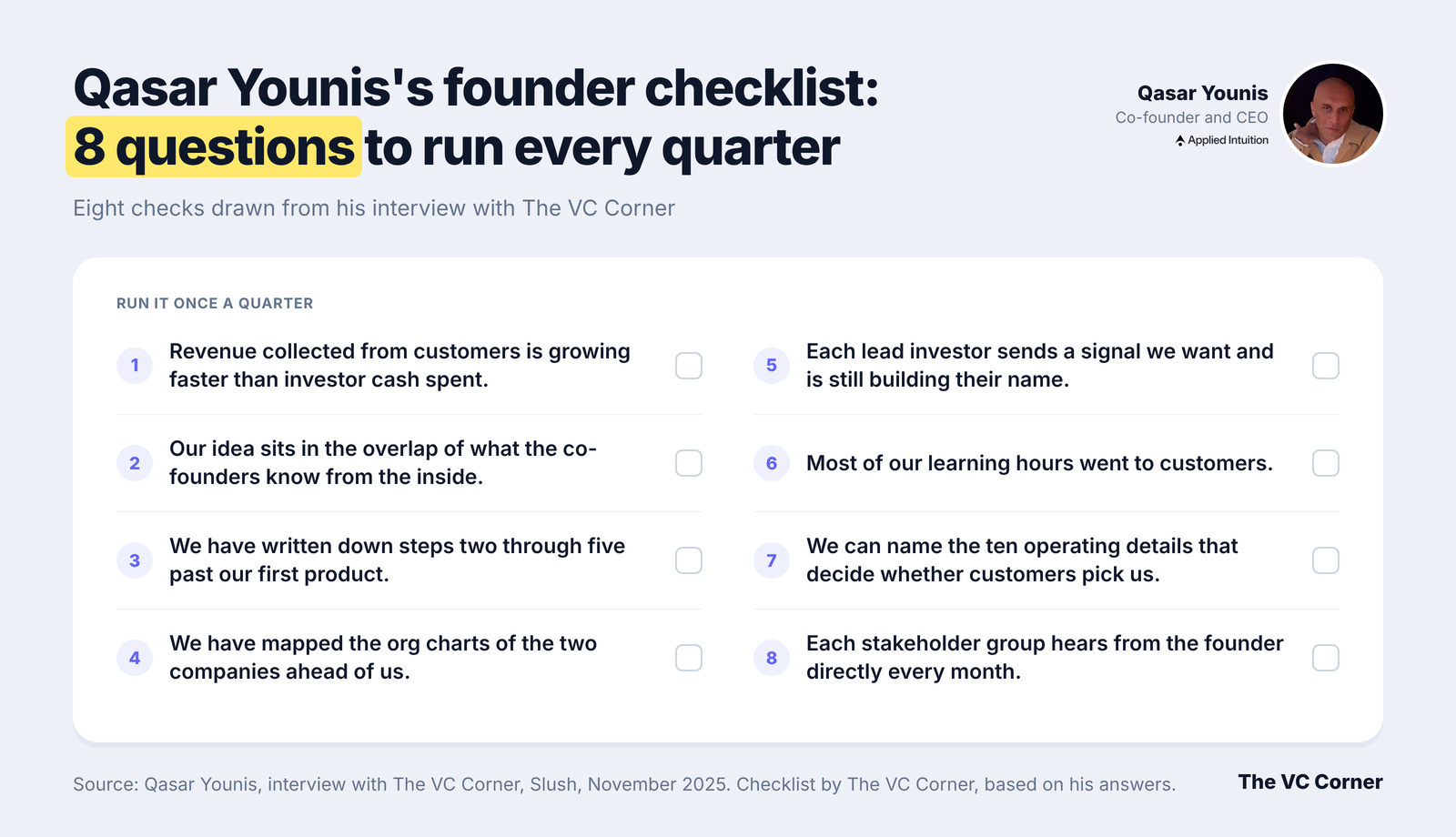
Print this and run it once a quarter:
Revenue collected from customers is growing faster than investor cash spent.
Our idea sits in the overlap of what the co-founders know from the inside.
We have written down steps two through five past our first product.
We have mapped the org charts of the two companies ahead of us.
Each lead investor sends a signal we want and is still building their name.
Most of our learning hours went to customers.
We can name the ten operating details that decide whether customers pick us.
Each stakeholder group hears from the founder directly every month.
FAQ
What does Applied Intuition do?
Applied Intuition builds software for vehicles that drive themselves in six markets, automotive, trucking, construction, mining, agriculture and defense, according to its Series F press release. In his November 2025 interview with The VC Corner, Qasar Younis listed three product lines (tooling and infrastructure, operating systems and autonomy) and put automotive as the biggest vertical yet a minority of revenue.
What is Qasar Younis’s test for judging a founder?
Qasar Younis judges founders by one ratio, money made from customers against money spent from investors (interview with The VC Corner, Slush, November 2025, 09:29). His example puts a company that made $3 million after raising a billion at one end and a company that made a billion and spent zero at the other. In his words, “that ratio tells you is the founder good at making money from customers or selling stock.” (Qasar Younis, interview, 09:51)
What is Qasar Younis’s framework for starting a company?
Qasar Younis starts a company with the co-founder first, then the market, then the problem, a method he built at Y Combinator after talking to thousands of companies (interview with The VC Corner, November 2025). The problem step has four checks: the problem itself, what you would build, whether enough buyers can pay enough and whether you can get the product to lots of people.
Has Applied Intuition spent the money it raised?
Applied Intuition kept the billions it raised unspent because the company generated cash, with revenue in the high hundreds of millions, according to Qasar Younis in his November 2025 interview with The VC Corner. At the time, it had about a thousand engineers and its next goal was crossing a billion dollars in revenue. Applied is a private company, so these figures are Qasar’s own statements.
How did Qasar Younis choose Applied Intuition’s investors?
Qasar Younis picked hungry investors who were still building their name, choosing General Catalyst for the Series B, then Lux and Elad Gil for the next two rounds (interview with The VC Corner, November 2025). By then, by his count, Andreessen Horowitz had grown its assets under management roughly 20 times since it invested in Applied.
Why did Qasar Younis start building an audience on X?
Qasar Younis put the value of a following on X at $10 to $20 billion of market cap for Applied Intuition, in his November 2025 interview with The VC Corner at Slush. He had held his handle for 16 years with zero posts, and he published his first post on X on December 10, 2025. To him, an audience is “a practical tool” (Qasar Younis, interview, 48:45), and his explanation for founder voices was simple: “People don’t follow corporate accounts. They trust people” (Qasar Younis, interview, 03:36).
How does Qasar Younis filter startup advice?
Qasar Younis filters startup advice by stage: learn from founders at your own stage, and treat most tech-ecosystem content as entertainment, based on his November 2025 interview with The VC Corner. His own example is Jensen Huang’s interviews from the late 1990s and early 2000s, when Jensen was in the same phase of the company Qasar was in at the time.
How much is Applied Intuition worth?
Applied Intuition was valued at $15 billion in its $600 million Series F in June 2025, co-led by BlackRock-managed funds and Kleiner Perkins, according to the company’s press release. On October 13, 2026, The Information reported investment offers valuing Applied at $30 billion or more, and the company has yet to announce a round at that price.
Referenced
Applied Intuition: appliedintuition.com
Naval Ravikant, early investor in Applied, on fame and accountability (discussed at 04:49)
Marc Andreessen, Applied’s board member (discussed at 25:28)
Jensen Huang’s interviews from the late 1990s and early 2000s (discussed at 12:48)
Uncapped with Jack Altman, episode 9 with Qasar Younis
Mamoon Hamid at Kleiner Perkins, whom Qasar rates as possibly the best Series A picker in the valley (discussed at 45:15)
Sources: Applied Intuition Series F press release · Reuters, 17 June 2025 · The Information, 13 October 2026 · Lenny’s Podcast, March 2026 · Qasar’s first post on X, 10 December 2025 · Andreessen Horowitz on Applied Intuition, 12 September 2018 · Lux Capital on Applied Intuition, 12 September 2018 · Full interview with Qasar Younis, recorded at Slush in November 2025 by Ruben Domínguez and Guillermo Flor.
Applied’s operating figures in this post come from Qasar in the November 2025 interview and are his own statements. Applied is a private company and does not publish its financials.
If this helped, send it to one founder who is planning their next round.