

In December 2017, Index Ventures published Rewarding Talent, a handbook on stock options for European founders. A year later came the expanded edition, and in 2021 Index refreshed the benchmarks behind its OptionPlan tool (Index Ventures).
Its argument fit in one line. European startups gave their people too little of the company, too late, on worse terms than Silicon Valley.
The numbers backed it up. Index found that 75% of Series A and B companies in the Bay Area gave equity to all employees, against 32% in continental Europe. At late-stage companies, European staff owned around 10% of the business and US staff around 20%.
Eight years on, Index still points founders to the same grid through its free OptionPlan tool, which now draws on 20,000+ grants.
The grid holds up well. Almost everything around it moved.
→ The gap narrowed. The Index-led Not Optional campaign said in 2024 that European employees owned 16% of their late-stage startups, up from 12% in 2019, against 22% in the US, and that more than €5bn has gone to European startup employees since 2019 (tech.eu, Sifted). Those are the campaign’s own figures, so read them as a direction more than a measurement.
→ The rules changed, country by country. Germany rewrote its option tax in 2024. The UK doubled its EMI company limit to £6m on 6 April 2026 (GOV.UK). France, the Czech Republic, Denmark and Belgium all changed theirs this year, and in March the European Commission proposed one optional option scheme for the whole EU (European Commission).
→ Employees stopped exercising. In Q4 2024, employees on Carta exercised 32.2% of their vested, in-the-money options, down from 54.2% three years earlier (Carta). An option only rich employees can exercise is a bonus with a 90-day expiry date.
→ The AI talent war rewrote the top of the market. OpenAI cut its vesting cliff to six months in April 2025 and dropped it entirely in December (The Neuron, SaaStr). Median initial grants for AI/ML engineers rose 31% between January 2024 and February 2026 (Carta). And startups ran 396 tender offers on Carta in 2025, up 62% on 2024, while a record 16,538 employees sold shares, so staff now expect to sell some equity long before an IPO (Carta, Carta).
i expected the country tab to be the boring part of this guide. Building the toolkit, it turned into the tab i’d send a founder first, because the same gain can be taxed at 14% in Portugal or at up to 49.5% in the Netherlands, depending on where your engineer lives.
So here’s the 2026 edition: Index’s method, updated with 2025 and 2026 data, rules for 25 countries and a spreadsheet that does the maths. By the end you’ll have:
▫️ A pool plan for every round, with the top-up cost to founders worked out
▫️ Grant sizes for your first ten hires, then a grid by function and level from Series A
▫️ A vesting, leaver and exercise-window policy you can paste into your handbook
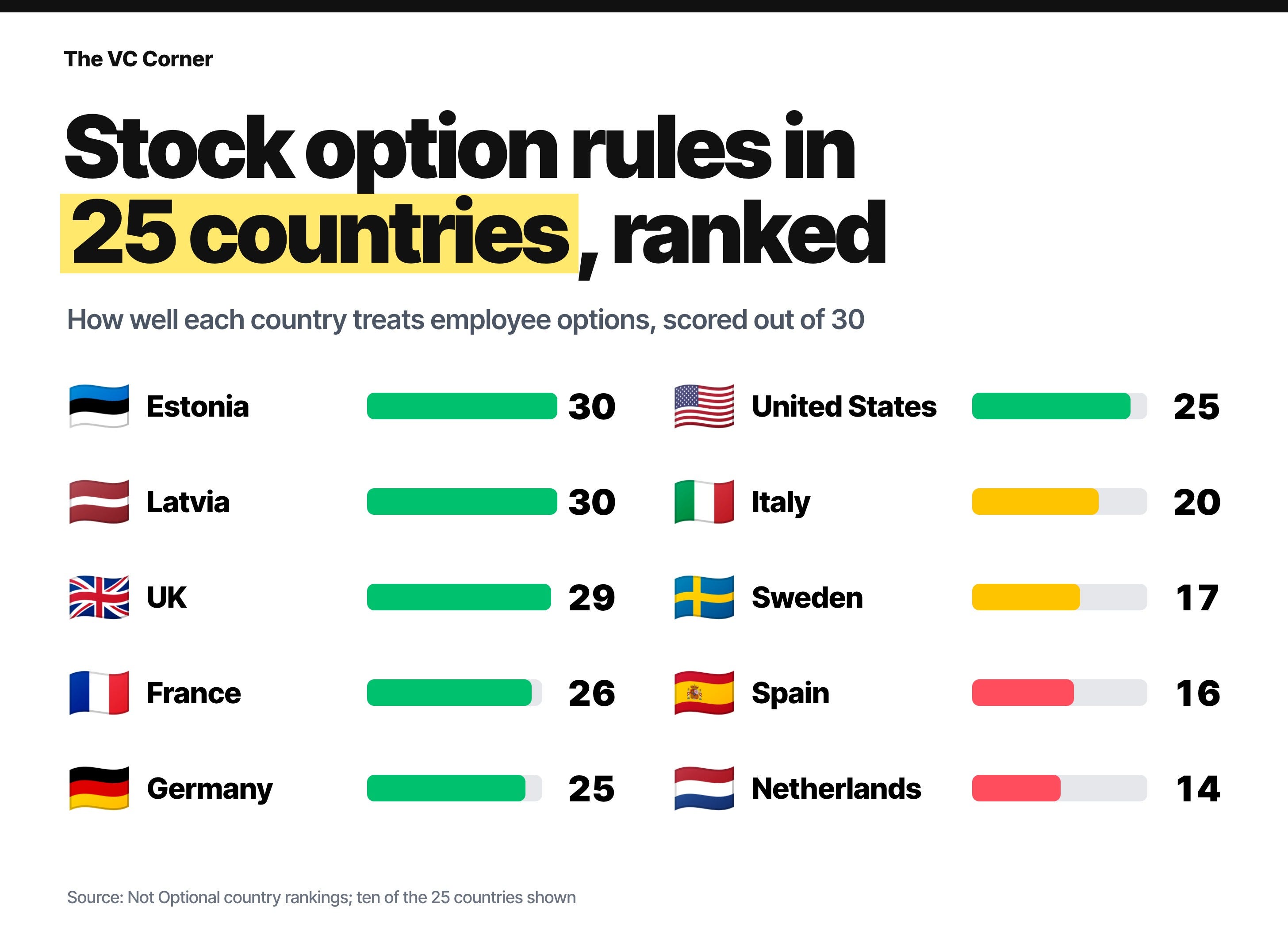
▫️ The option rules in 25 countries, with what changed in 2026
▫️ A tender-offer playbook for when employees want cash before an exit
▫️ Four templates: offer-letter paragraph, employee FAQ, leaver clause in plain English and a board checklist
▫️ The Equity Toolkit 2026, an Excel file with seven working tabs built on the method above
▫️ The 23 best free videos, guides, tools and essays on employee equity
Part 1: Size the pool for the next 18 months
The option pool is the slice of the company set aside for employees, counted as a % of fully diluted shares (everything issued plus every option granted or promised).
Index’s 2018 plan for a successful European startup: start at 10% at seed, then top up to 12% at Series A, 14% at Series B and 16% at Series C. US practice ran higher, from 10% at seed to 15% at Series A and “20%, or even 25%, by Series D” (Index Ventures).
Today’s medians sit a little above the European plan:
▫️ 12.1% at seed (Carta, Founder Ownership Report 2026)
▫️ 15% at Series A (Carta, State of Startup Compensation H2 2025)
▫️ 16.8% at Series C, where the median pool now outweighs median founder ownership (16.1%) (Carta, Founder Ownership Report 2026)
▫️ 19.6% at Series E and later (Carta, State of Startup Compensation H2 2025)
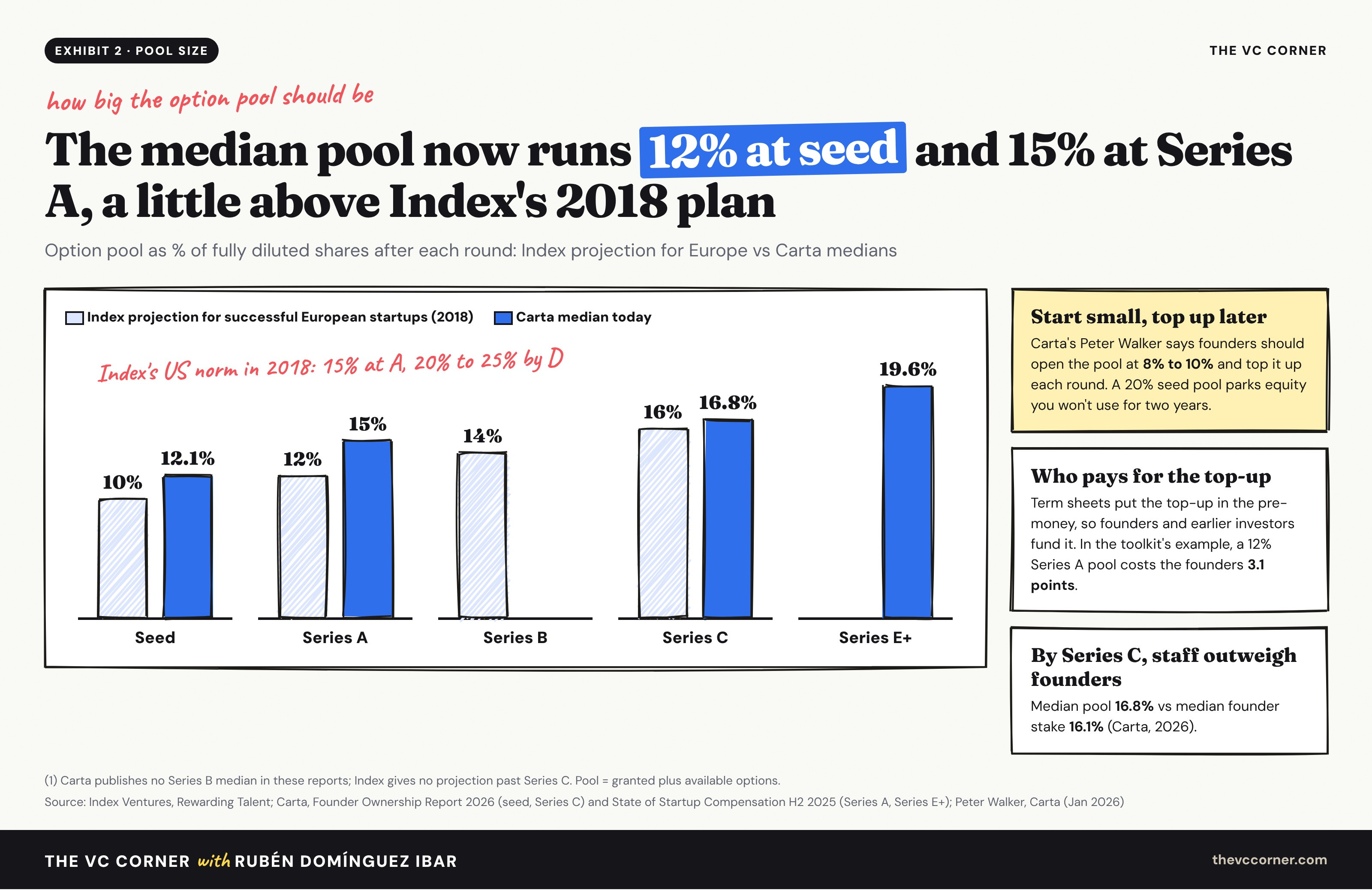
One warning on seed pools. Some seed investors still ask for a 20% pool before they wire. Carta’s Peter Walker argues founders should open at 8% to 10% and grow the pool each round, because startups now hire fewer people at seed (Carta). Size the pool to the hiring plan, and make the term sheet follow it.
Who pays for the top-up
Almost every term sheet asks for the pool top-up to happen before the new money comes in, inside the pre-money valuation. That means the founders and earlier investors fund it, and the new investor pays the same price per share as if the pool were already there.
The maths, in the form the toolkit uses:
▫️ Call E the shares held by everyone before the round, P the pool shares already there, i the new investor’s stake after the round and p the pool target after the round
▫️ New pool shares needed = p × E ÷ (1 − i − p) − P, or zero if the pool is already big enough
▫️ Price per share = pre-money valuation ÷ (E + P + new pool shares)
A worked example from the toolkit, with 10 million founder shares:
Seed: $1.5m on a $6m pre-money with a 10% pool. The price is $0.525, and founders own 70% after the round.
Series A: $6m on a $25m pre-money, with the pool topped up to 12%. The price is $1.655, and founders drop to 53.4%.
The top-up alone costs the founders 3.1 points of that dilution.
Every extra point of pool you agree to at Series A comes out of your stake at the same rate. If your hiring plan only needs 10%, show the investor the plan.
Below the line: grant sizes for the first ten hires, Index’s grant grid updated with 2026 data, the vesting and exercise-window policy, the rules in 25 countries, the tender-offer playbook, four templates, the investor questions and the Equity Toolkit 2026.
Cancel anytime. First subscribers get 50% off forever.
Here’s the Equity Toolkit 2026. Open it now, because every part below points to a tab in it: