

The data room request usually lands the day after a good first meeting. That’s how a16z describes it in the firm’s insider’s guide to data rooms: once the first meeting goes well, the investor asks for the room. It’s the moment a fund is most excited about you, and the worst moment to start digging for your 83(b) elections.
In April 2025 we published a data room checklist. It listed the right documents in one long list, and founders kept writing back with the same three questions: which of these do I send, to whom, and when?
So we rebuilt it from scratch as a Notion workspace. It holds 71 documents sorted into three access tiers, and for each one it tells you what investors check, the red flag that stalls a round and the file name to use. It also tracks which fund has seen what, logs every diligence question with a reusable answer and plans your customer reference calls.
A good data room works as three rooms, opened one at a time as a fund moves closer to a term sheet. The two common ways to get it wrong run in opposite directions: one folder shared in full on day one, or a room built after the term sheet, when the weeks the fund is most motivated go to chasing signatures.
The clock behind your data room
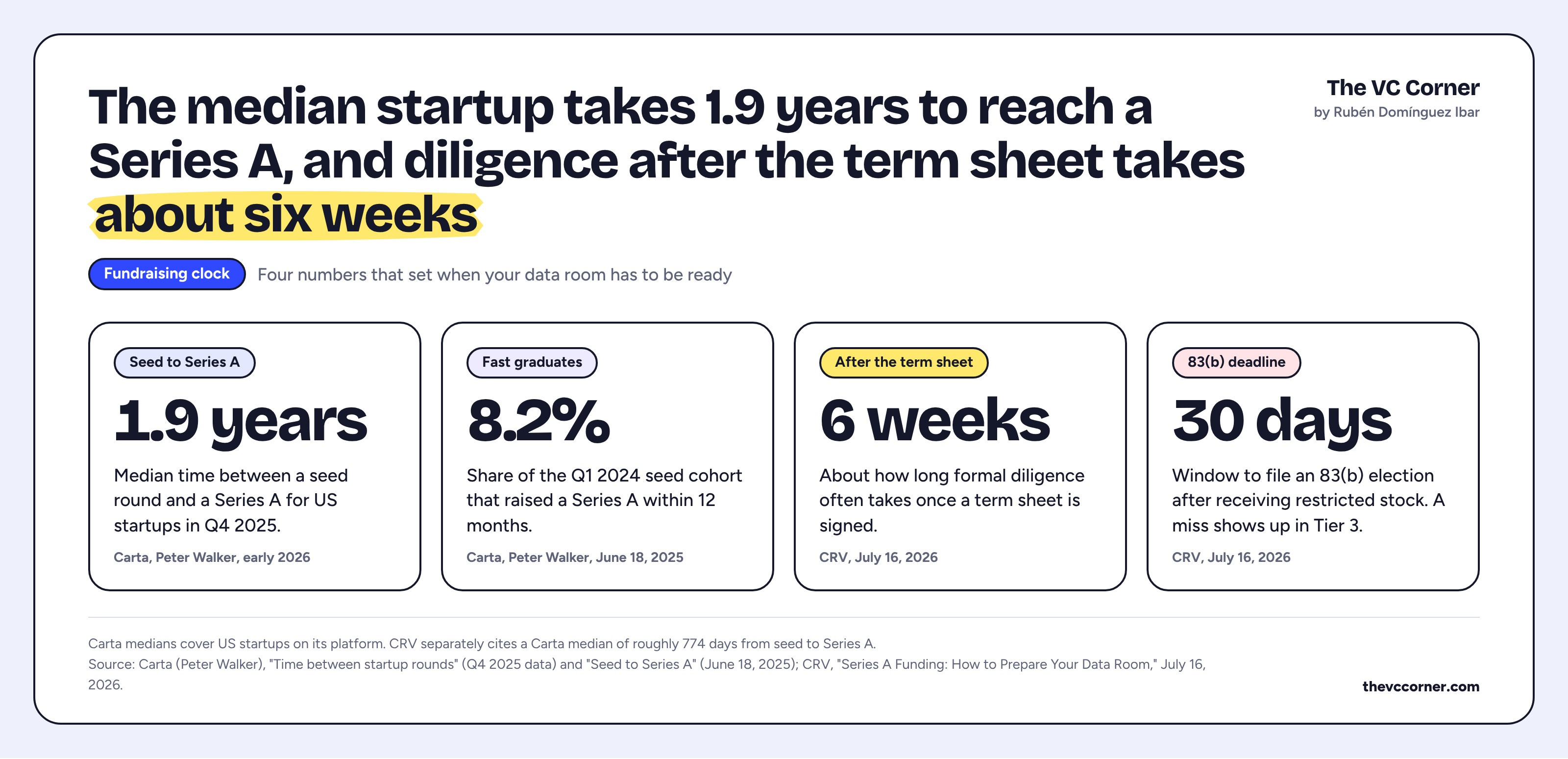
Carta’s Peter Walker put the median time between a seed round and a Series A at 1.9 years for US startups in Q4 2025 (Carta). Only 8.2% of the Q1 2024 seed cohort raised a Series A within 12 months (Carta, June 2025).
That gap changes how you should think about the room. Your Series A data room gets built every month between the two rounds: the monthly close, the board consent for each option grant, the IP assignment a new contractor signs on day one. A founder who keeps those records as they happen can open Tier 3 in an afternoon, while one who rebuilds them under a term sheet spends the closing period chasing old signatures.
Then the term sheet clock starts. CRV wrote in July 2026 that formal diligence after a signed term sheet often takes about six weeks, and told founders to start building the room one to two quarters before they plan to raise (CRV).
The three tiers
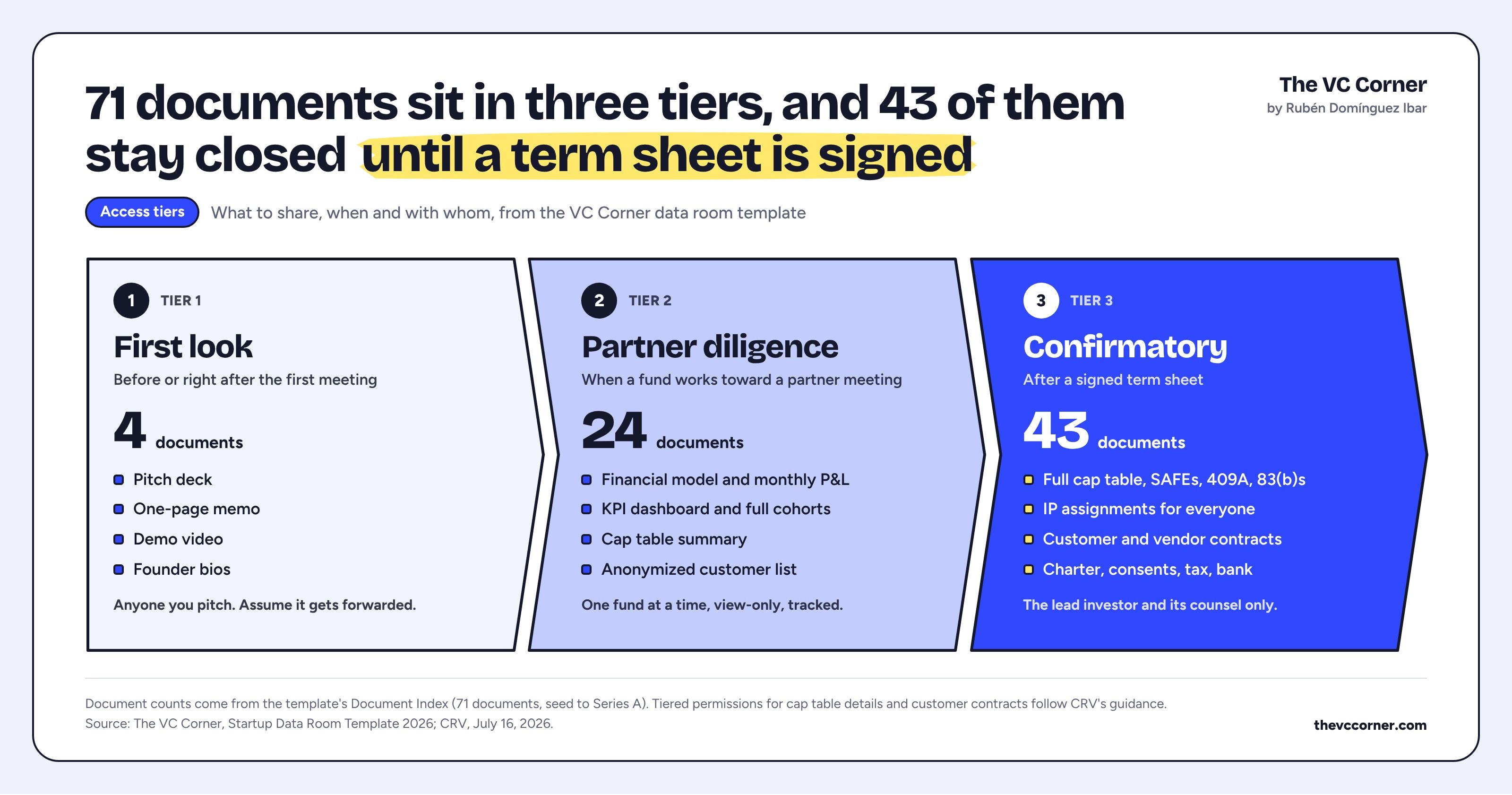
The template splits the 71 documents by who should see them and when.
→ Tier 1, First look (4 documents). The deck, a one-page memo, a short demo video and founder bios. Share these with anyone you pitch, and assume they get forwarded inside the fund.
→ Tier 2, Partner diligence (24 documents). The financial model, monthly P&L and burn, the KPI dashboard, full cohorts, a cap table summary and an anonymized customer list. Open it to one fund at a time once a partner is doing work on you.
→ Tier 3, Confirmatory (43 documents). The full cap table and stock ledger, every SAFE, the 409A, the 83(b)s, IP assignments, customer contracts, the charter, consents, tax filings and bank statements. Open it after a signed term sheet, to the lead investor and its counsel.
CRV recommends the same split: tiered permissions so that sensitive material, such as cap table details and customer contracts, reaches only investors at an advanced stage.
What changes between seed and Series A
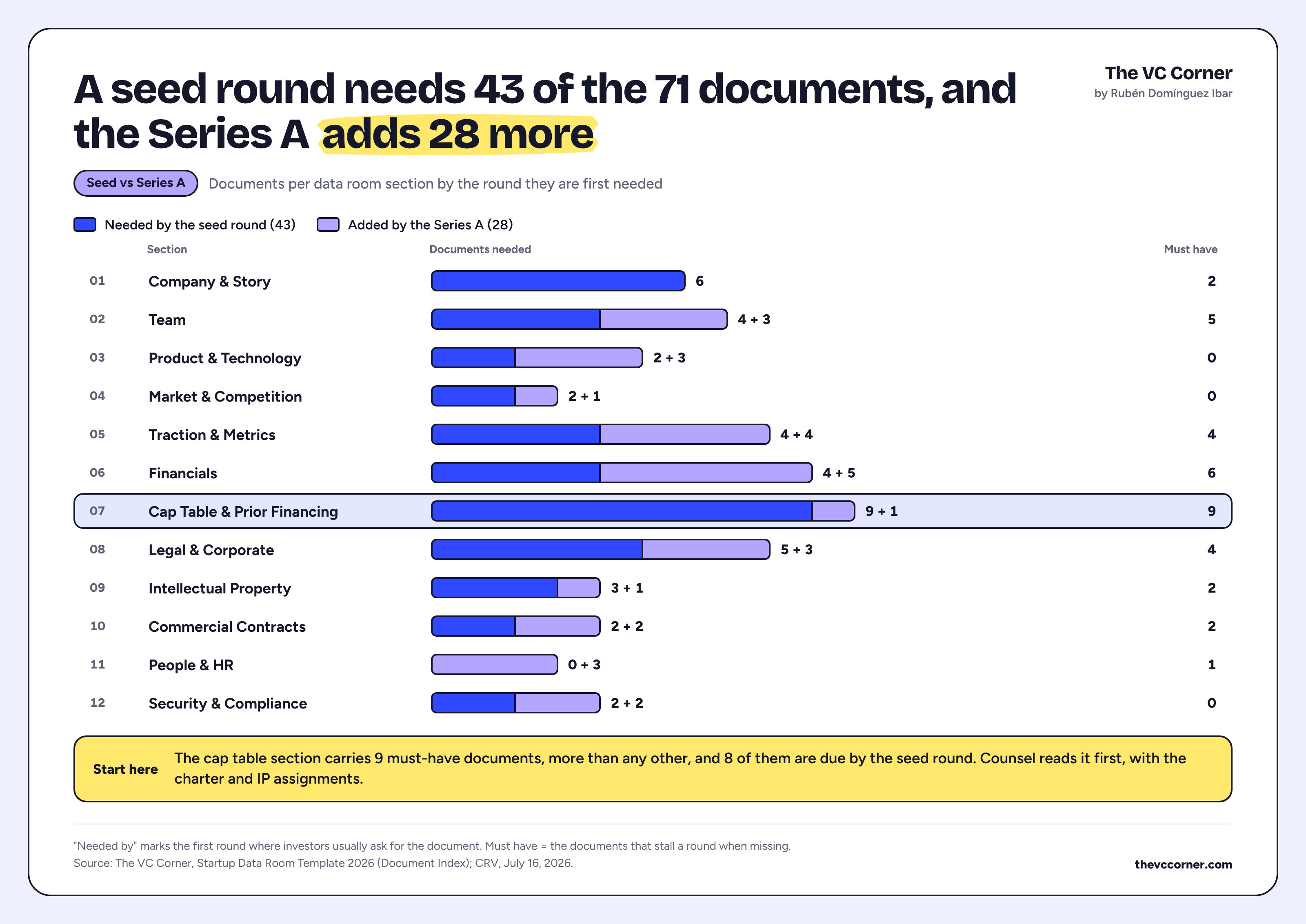
A seed round needs 43 of the 71 documents. The Series A adds 28 more, led by financials (5 documents), traction and metrics (4) and then three each for team, product, legal and people.
The section to start with is the cap table. It carries 9 must-have documents, more than any other section, and 8 of them are due by the seed round. CRV notes that investor counsel typically reviews the cap table, the certificate of incorporation and the IP assignments first.
Where diligence stalls
The red flags investors name are the same at every stage:
Numbers that disagree. a16z’s example: a deck that shows $2M of ARR next to a model that shows $1.5M.
Cherry-picked cohorts. Showing your three best cohorts in place of the full table.
Projections mixed with actuals, or a few months of history for a company that’s been operating for years.
Cap table errors. CRV lists conflicting spreadsheets, undocumented grants, missed 83(b) elections and skipped 409A valuations.
Missing IP assignments from founders, contractors or early employees, which per CRV can mean the company doesn’t legally own its core technology.
Several versions of the same document. CRV’s rule: keep only the governing final version in the room.
Every one of these shows up in the template as a red-flag line next to the document it affects.
Inside the template
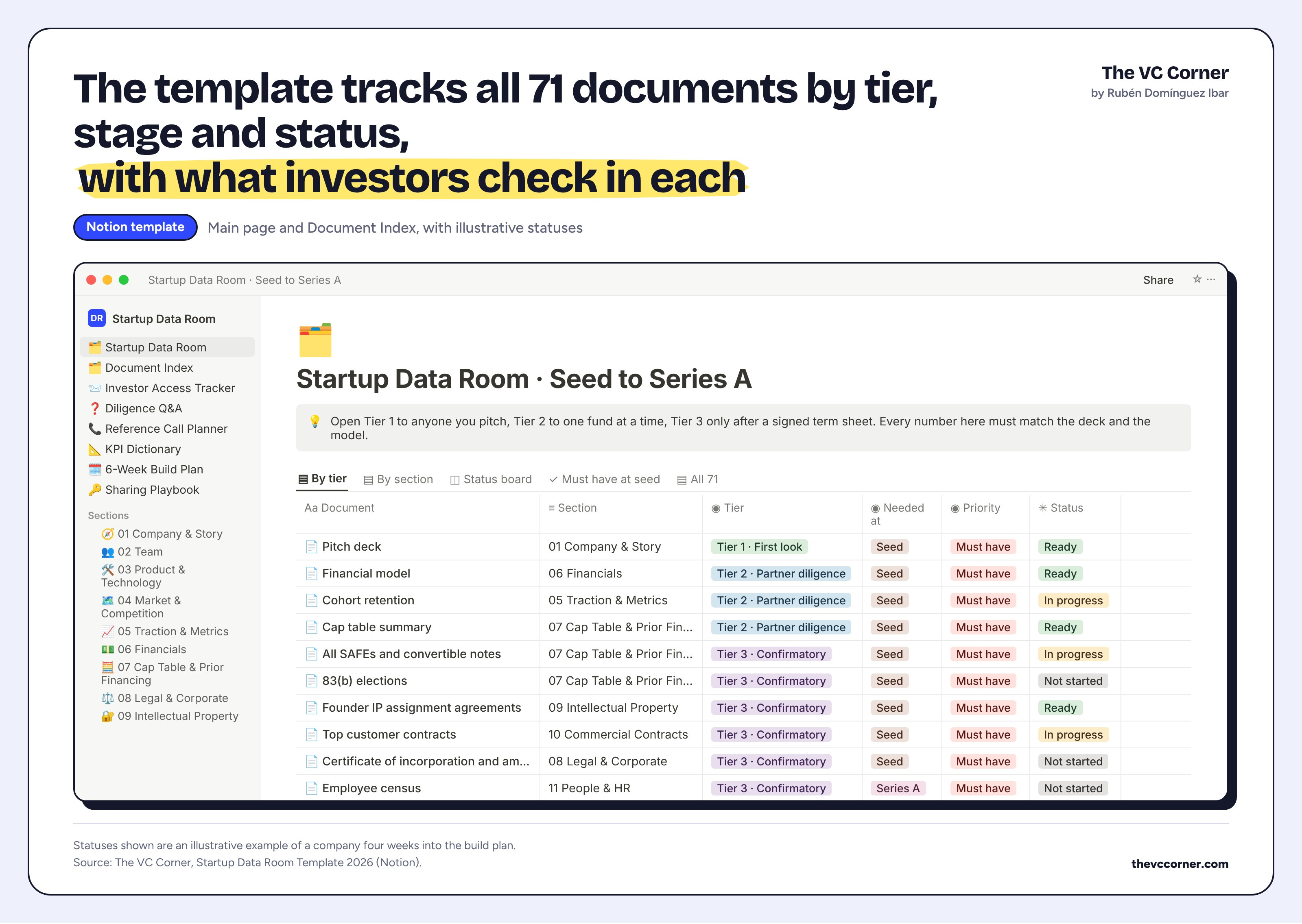
Premium subscribers get the full Notion workspace, ready to duplicate:
A main page with the setup checklist, the three tiers, links to every section and a live list of must-haves still open
Document Index with all 71 documents, each tagged by tier, stage, priority and status, plus what investors check, the red flag and a file name, in five views
12 section pages, numbered 01 to 12, each with what goes in, what investors look for and the common mistakes
Investor Access Tracker that shows which fund has which tier, what you shared and what they asked
Diligence Q&A with the 25 questions partners ask, what each one tests, how toS answer and which document backs the answer
Reference Call Planner so no customer gets called by five funds in one week
KPI Dictionary with 12 metric definitions and formulas, so the deck, the dashboard and the model show the same numbers
6-week build plan and a sharing playbook for each tier
Below the paywall: the template link, how to run each tier, the build plan, the top diligence questions with what they test and the checklist to run before you open Tier 3.
Cancel anytime. First subscribers get 50% off forever.