

Most founders spend more time looking for investors than actually talking to them.
Six weeks building a spreadsheet. Another month cold emailing people who were never going to say yes. An entire fundraising cycle burned on research that already exists somewhere.
That stops today.
Below is every resource from The VC Corner I would hand to a founder raising right now. Investor lists, financial models, pitch decks from companies that made it, and launch platforms. Everything organized by where you are in the process.
Find the one closest to where you are. Start there.
Finding the Right Investors
If you’re raising pre-seed or seed
Y Combinator W26: The Complete Company Database Every company, every founder, every traction signal from the strongest YC batch ever recorded. Demo Day was March 24. Includes a downloadable Excel database of all 190 companies, color-coded by sector and filter-ready.

Family Offices That Cut Pre-Seed Checks The investor list that saves you 40 hours of research. Decision-makers who actually write checks at pre-seed, with exactly how to reach them. https://www.thevccorner.com/p/family-offices-that-cut-pre-seed
Family Offices That Cut Pre-Seed Checks (And How to Reach Them)

Most founders waste time chasing the wrong investors. VCs move slow, reject 99% of deals, and follow rigid investment cycles. But family offices? That’s a different game.
300+ VCs That Accept Cold Pitches No warm intro needed. Over 300 venture firms and angel syndicates that take cold outreach, with stage, sector, and contact details included.
300+ VCs That Accept Cold Pitches — No Warm Intro Needed for Funding in 2025

One of the most common challenges for founders?
2,500+ Angel Investors Backing AI and SaaS Startups The most comprehensive early-stage backer list for AI and SaaS founders. Curated to cut the noise and help you raise faster with less friction.
2,500+ Angel Investors Backing AI & SaaS Startups💰

If you're building an AI tool or SaaS product and struggling to raise capital, here’s the hard truth:
If you’re thinking bigger
200+ VC Funds Under $200M Still Actively Investing The funds most founders overlook. Smaller AUM means faster decisions and genuine openness to new companies. A lot of the best early-stage rounds get done here.
VC Fund Database for Early-Stage Startups: 200+ Funds Under $200M Still Actively Investing
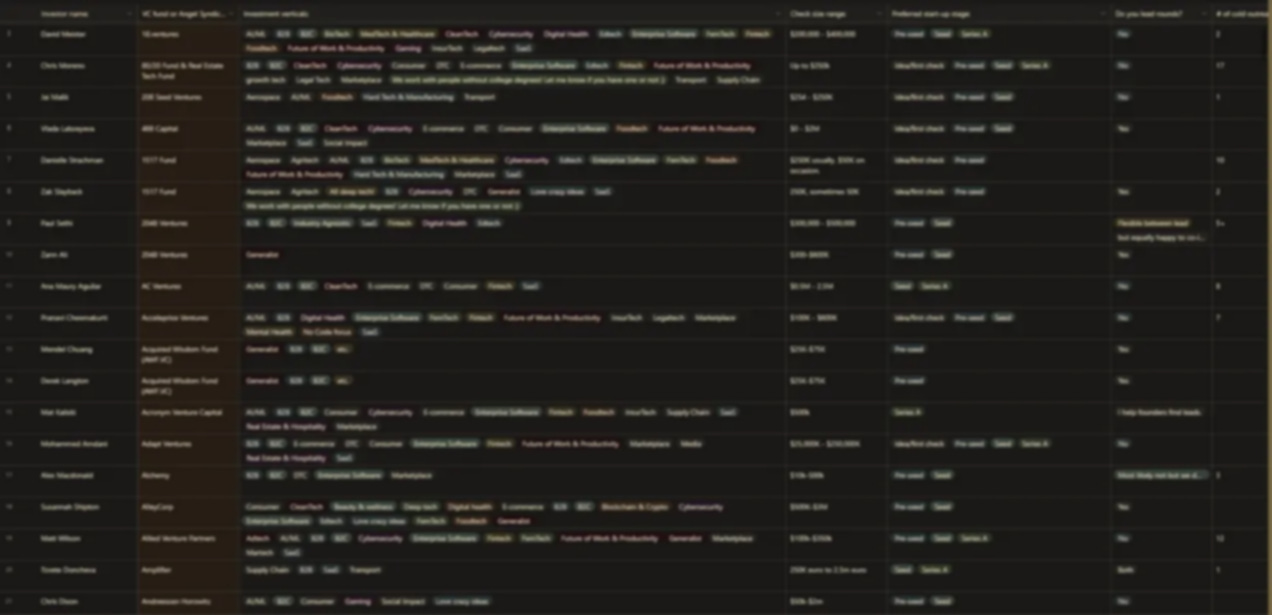
A database to help founders find VCs with fresh funds, focused mandates, and dry powder to back your next round.
15,000+ VCs, Angels and the Glassdoor of Venture Capital The full investor universe, plus reputation data on which VCs actually treat founders well. Both matter. You want to know both before you take a meeting.
15,000+ VCs, Angels & The Glassdoor of Venture Capital
·
Finding the right investors can make or break your startup. With over 15,000+ curated investor, this resource provides everything you need to raise funds and secure partnerships. Whether you're targeting specific industries, regions, or angel investors, this collection has you covered.


The 100 Most Important Pension Funds in the World The institutions controlling more than $24 trillion. How founders can identify and reach the people who actually allocate from them.
The 100 Most Important Pension Funds in the World

Pension funds are one of the most powerful forces in global finance.
If nobody knows your startup exists yet
350+ Ways to Get Your Startup Discovered The complete list of launch and discovery platforms for getting users, press, and traffic fast. Most of them cost nothing.
Nobody Knows Your Startup Exists. Here Are 350+ Ways to Fix That:

Every founder struggles with visibility. Building a great product is only half the job. The harder part is getting people to see it.
Building the Financial Models That Close Rounds
Finding the right investors is step one. Showing up prepared is step two.
Investors have seen thousands of decks. They ask the same hard questions every time. What breaks your model? When do you run out of money? What does the exit look like from their seat?
These resources give you the models to answer all of it before they ask.
Financial Modeling for Founders Start here if you’re building your first serious model. Real examples, real templates, no fluff. This is the foundation everything else builds on.
Financial Modeling for Founders

As a founder, your primary responsibility is simple: ensure your company doesn’t run out of cash. Without sufficient funds, scaling or achieving product-market fit becomes impossible. If your business isn’t yet profitable, your runway shrinks with each passing day, and the risk of running out of cash increases.
The SaaS Financial Model Every Founder Needs A complete Excel model covering SaaS metrics, cash runway, and growth planning. Built for founders who want to walk into a raise with numbers that hold up under pressure.
The SaaS Financial Model Every Founder Needs: Build Investor-Ready Forecasts With This Excel Template

The Financial Operating System Behind Every Scalable SaaS Company
What’s Your SaaS Company Worth in 2026? The data-backed formula private SaaS founders use to calculate their baseline ARR multiple before anyone sits across the table. Built from 63 real transactions, updated for Q1 2026.

How to Build a Real Operating Plan A fully linked startup FP&A model. Plan your growth, defend your raise, and show investors you have a genuine handle on how the business runs.
How to Build a Real Operating Plan: Inside a Fully Linked Startup FP&A Model

Why Every Startup Needs a Real FP&A Model
The Lean Revenue Model Every Startup Needs Track the metrics that actually matter in 15 minutes a month. No complexity, no noise. Useful well before you’re ready for a full FP&A build.

The Exit Scenario Tool You Need An Excel template that models IPO, secondary, and acquisition outcomes side by side. Investors think about exits on day one. You should too.

The Anatomy of an M&A Deal Inside an Excel Template A hands-on framework for founders, CFOs, and corp dev teams who want to understand the real economics of a deal before they’re sitting in one.

How to Model Mezzanine Financing End-to-End Most founders never need this until they suddenly do. A step-by-step breakdown of the mechanics behind modern mezzanine deals.

The Pitch Decks That Actually Raised the Money
Reading about pitch decks is useful. Seeing the real ones is different.
16 Unicorn Pitch Decks: Before the Billions The actual slides used to raise their first rounds. Before the valuations, before the press. What they showed when they had nothing but a thesis.
16 Unicorn Pitch Decks: Before the Billions

I compiled 16 pitch decks from companies that are now worth a combined $1.5 trillion+.
26 Pitch Decks That Raised $400M in 2026 Pre-seed to Series B. The decks that closed, with what actually worked in each one.

Anthropic’s 2022 Pitch Deck Just Leaked 10 slides. No product. FTX money. Now worth $61B. Worth studying for the narrative architecture alone.
Anthropic's 2022 Pitch Deck Just Leaked

I’m sharing the pitch deck Anthropic used before raising their $580M Series B.
Peter Thiel Only Explained Once How to Raise Money. Here It Is. A rare document from the PayPal and Founders Fund co-founder. The only deck he ever wrote himself, and the lessons that still hold up.
Peter Thiel Only Explained Once How to Raise Money. Here It Is:

Peter Thiel rarely talks about how to raise money.
What Top VCs Actually Want to See
What Top-Tier VCs Actually Look For in 2026 40 questions they will ask you. The benchmarks they measure you against. The 15 things that kill deals before they start. How Sequoia, a16z, and Benchmark each actually decide.
What Top-Tier VCs Actually Look For in 2026

I spent the last month talking to founders who raised in Q4 2025 and Q1 2026.
What Top VCs Check in Due Diligence Before Writing Checks The one-page framework that shows investors you’re ready before they open a single data room document. Includes an Excel template. https://www.thevccorner.com/p/vc-due-diligence-checklist-excel
What Top VCs Check in Due Diligence Before Writing Checks (+ EXCEL TEMPLATE Inside)

Most early-stage diligence cycles are one broken Google Drive folder away from chaos. You’ve got half a cap table in Excel, founder bios in a pitch deck, financials buried in a PDF, and someone asking, “Did we ever get their IP assignments?”
The Ultimate Startup Data Room Template The exact checklist top investors use to evaluate companies. Decks, cap tables, traction, legal documents. Everything in the right place before they ask for it.
The Ultimate Startup Data Room Template (VC-Ready & Founder-Proven)

Most startups don’t lose the round during the pitch.
80+ Ways to Fund Your Startup Without Giving Up a Single Share Grants, revenue-based financing, prizes, government programs, venture debt, and corporate credits. Zero equity required.
80+ Ways to Fund Your Startup Without Giving Up a Single Share

A founder I know raised $1.2M last year without giving up a single share of his company.
Pick the one that matches where you are right now.
The research is done. The models are built. The decks are there to learn from.
The only variable left is execution.
Having all the fundraising resources in one place is incredibly valuable. Most founders waste weeks just figuring out where to even start looking.