

The S&P 500 closed Friday at 6,910.39, down 3.7% on the day and 11.6% below its October 6 record. That is a correction, and by my math about $8 trillion of market value gone in 45 days. The Nasdaq Composite is now negative for 2026, the VIX touched 40 for the first time since April 2025, and the S&P 500 just posted its worst week since April 2025 after seven straight losing sessions.
Nvidia closed at $125.53, down from a record $239.24 on October 6.
In the same 45 days, Nvidia reported revenue up 103%, S&P 500 earnings grew 31.4%, and Anthropic raised $81.3 billion in the largest IPO in history. That leaves two questions: did the AI bubble just pop, and what happens to the private companies that took 82.7% of every venture dollar in the US this year?
I went through the filings, the IPO numbers and the venture data to answer both. Below are five charts, and after the paywall the playbook for founders and investors.
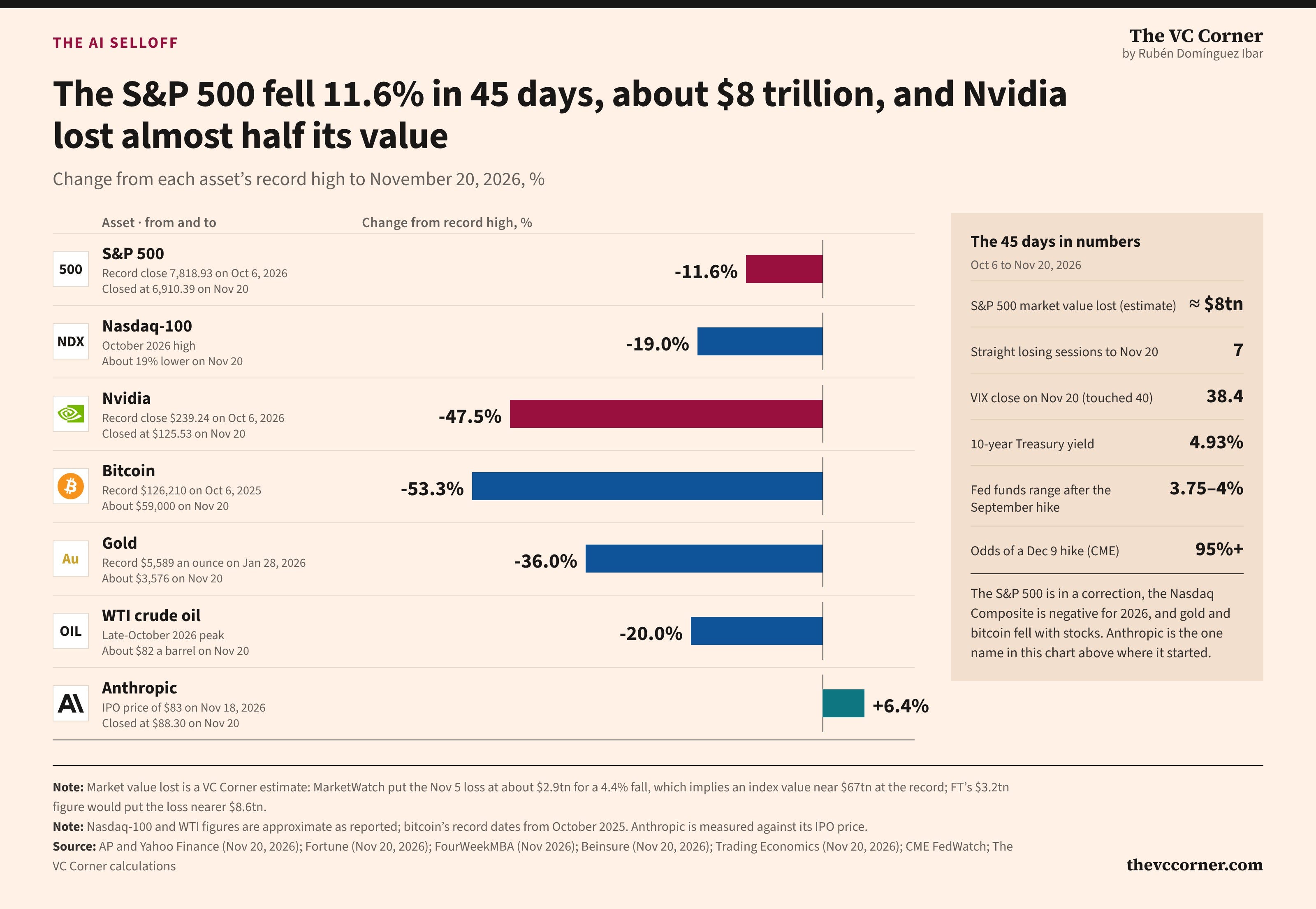
The 45 days, in order
The selloff started before any of the headlines people blame for it. Goldman Sachs data shows hedge funds dumped tech stocks at the fastest pace in a decade in mid-October, while the index still sat near its record.
October 6: The S&P 500 closes at a record 7,818.93 and Nvidia at a record $239.24.
October 22: Goldman’s basket of hedge fund favorites falls 4.2%, its worst day since 2011.
October 28: The Fed holds at 3.75% to 4% after its September hike, and two officials vote for another hike.
November 4: Democrats win both chambers of Congress, and the Dow has its best post-midterm day since 1982.
November 5: The S&P 500 drops 4.4%, a record one-day loss of about $2.9 trillion, as chip stocks absorb what a Democratic Congress means for data centers.
November 12: Jensen Huang resigns as Nvidia’s CEO after 33 years, and CFO Colette Kress becomes interim CEO.
November 17: Nvidia reports $115.8 billion of quarterly revenue, beating estimates by about $7 billion. The stock keeps falling.
November 18: Anthropic prices its IPO at $83, above the $70 to $78 range, and raises $81.34 billion.
November 19: Anthropic opens at $111.50 and closes up 17.1%. AMD falls about 8% after the short seller Hunterbrook ties its firmware to a blacklisted Chinese server maker.
November 20: Nvidia, AMD, Micron and Broadcom each drop 12% to 14%. The S&P 500 closes in a correction.
What the market is pricing
Five things hit at once. Some of them are noise, and one of them deserves more attention than it gets.
1. Capex is running ahead of cash
Amazon, Alphabet, Microsoft and Meta spent $201.9 billion on capex in Q3 2026, more than double a year earlier and 3.4 times Q3 2024. Here is the part I take seriously: three of the four now spend more than they generate.
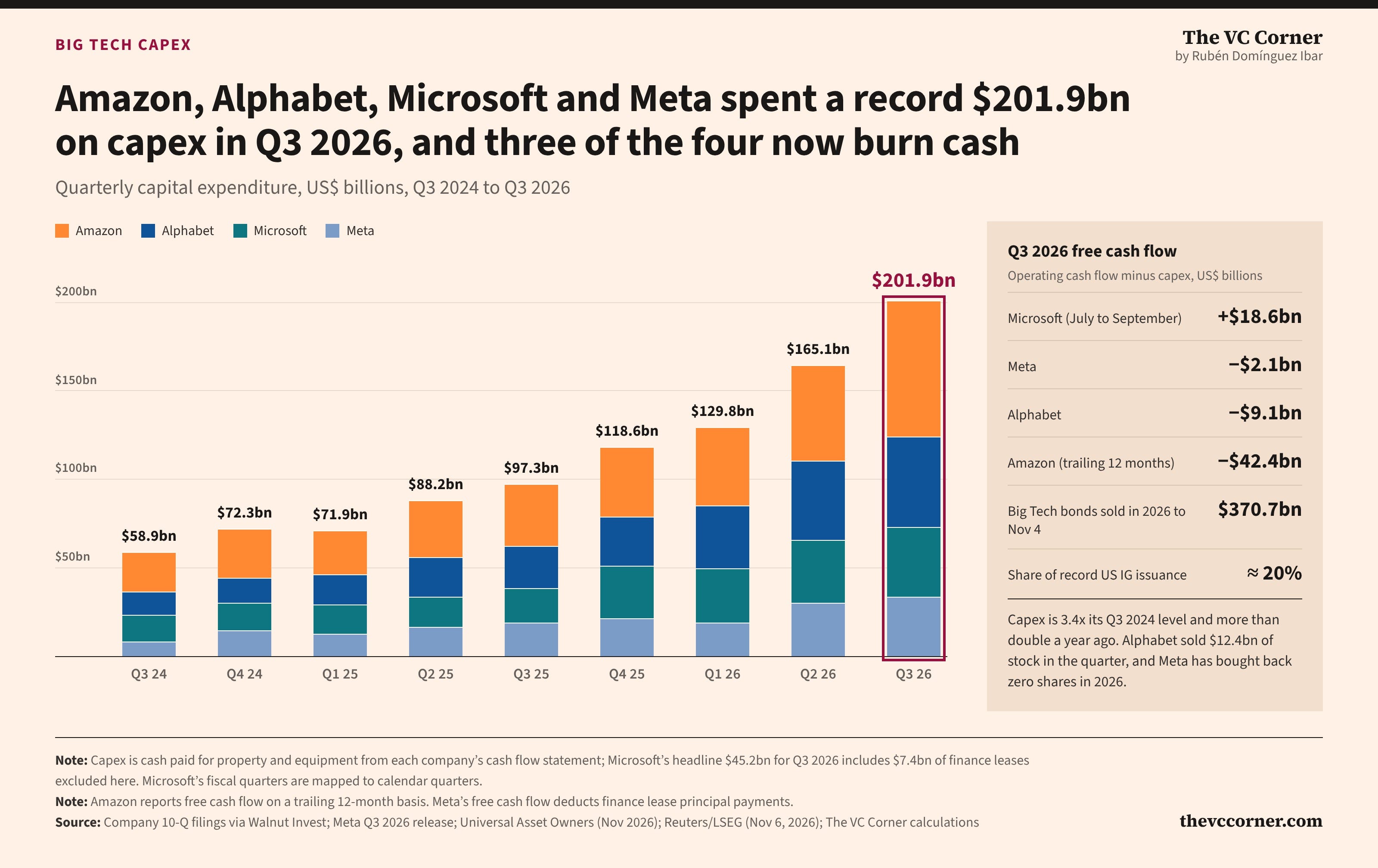
Alphabet’s free cash flow was minus $9.1 billion in the quarter, Meta’s was minus $2.1 billion and Amazon’s is minus $42.4 billion over the last 12 months. Microsoft is the exception at plus $18.6 billion. To fill the gap, Alphabet sold $12.4 billion of stock and stopped buybacks, Meta bought back zero shares in the first nine months of 2026, and the hyperscalers have sold $370.7 billion of bonds this year, about a fifth of a record $1.88 trillion in US investment-grade issuance.
The demand side looks fine. Microsoft’s commercial backlog rose 73% to $677 billion and AWS grew 39%. What changed is who pays for the build-out, and in 2026 the answer moved from cash flow to bond buyers and shareholders.
2. Washington changed hands
Democrats swept the midterms and take control of Congress in January. Markets rallied on the result for one day, then sold chip stocks hard on what a Democratic Congress means for data center construction. On top of that, President Trump threatened a “tremendous tax” on US companies that build data centers abroad.
I think the market is pricing a harsher policy outcome than any bill that can pass with a president who can veto it. Expect more regulation and possibly new taxes, with the US still racing China on AI.
3. The Fed is hiking into it
The Fed raised rates in September for the first time in more than three years, held in October with two votes for another hike, and futures now price a December 9 hike at about 95% or more. Christopher Waller floated half a point. The 10-year Treasury yield touched 5% this week before falling to 4.93% on Friday’s flight to safety.
Higher rates make every dollar of AI capex more expensive to finance. The offset is oil, which fell about 20% in November to around $82 as talks to end the Iran war gained ground. If that holds into 2027, the Fed has room to stop.
4. Nvidia lost its founder
Jensen Huang resigned on November 12 after admitting to an affair, amid reports that linked it to a former executive alleged to have worked for Chinese intelligence. Nvidia’s board opened an independent investigation, said it has no reason to believe national security was compromised, and later said it will not reinstate him.
Five days later the company posted $115.8 billion of revenue, up 103%, with data center revenue up 110% and fourth-quarter guidance of about $130 billion that assumes zero data center sales in China. At $125.53, Nvidia trades at about 8 times the pre-earnings consensus of $15.75 a share for its fiscal 2028. Before the report, UBS called the earnings path that price implies “incredibly draconian.”
For a deeper look at the chip trade, The AI Corner’s semiconductor pullback playbook covers Nvidia and Micron.
5. The biggest IPO ever soaked up cash
Anthropic sold 980 million shares at $83 for $81.34 billion, plus a $26 billion private placement at the same price. Together with SpaceX’s roughly $75 billion IPO in June, 2026 has produced the two largest listings in history.
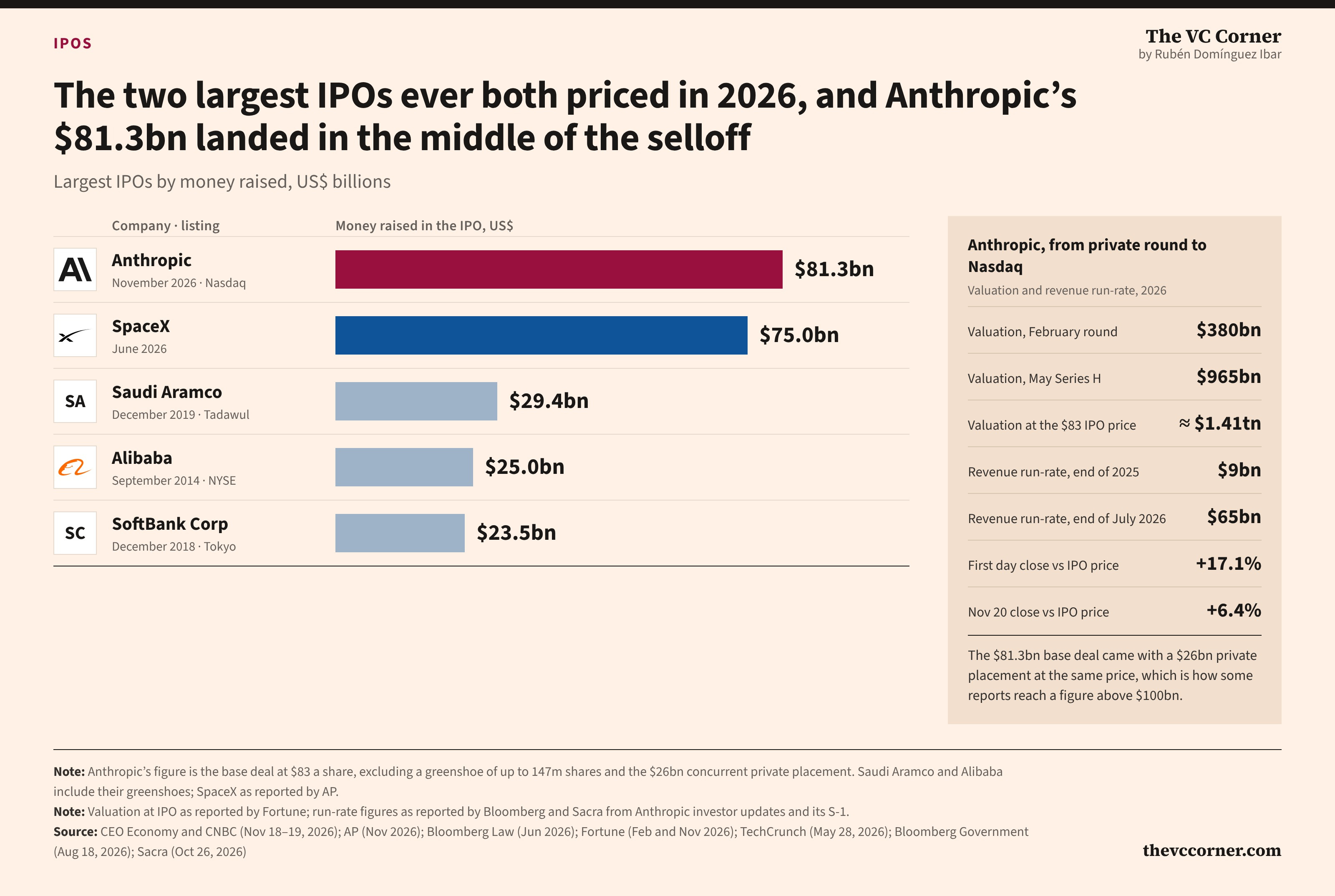
That is more than $100 billion of new stock in one week, and Yahoo Finance’s markets desk flagged the debut as a likely drain on other tech names. What surprised me most is the other side of that trade: Anthropic closed Friday at $88.30, still 6.4% above its IPO price, in the worst week for the S&P 500 since April 2025. In February its private round valued it at $380 billion; in May it raised $65 billion at $965 billion; at $83 a share it is worth about $1.4 trillion. If you want to see where that started, read the deck Anthropic used to raise with no product.
Bubble or opportunity?
A bubble pops when the numbers stop supporting the price. This week the price fell and the numbers kept rising.
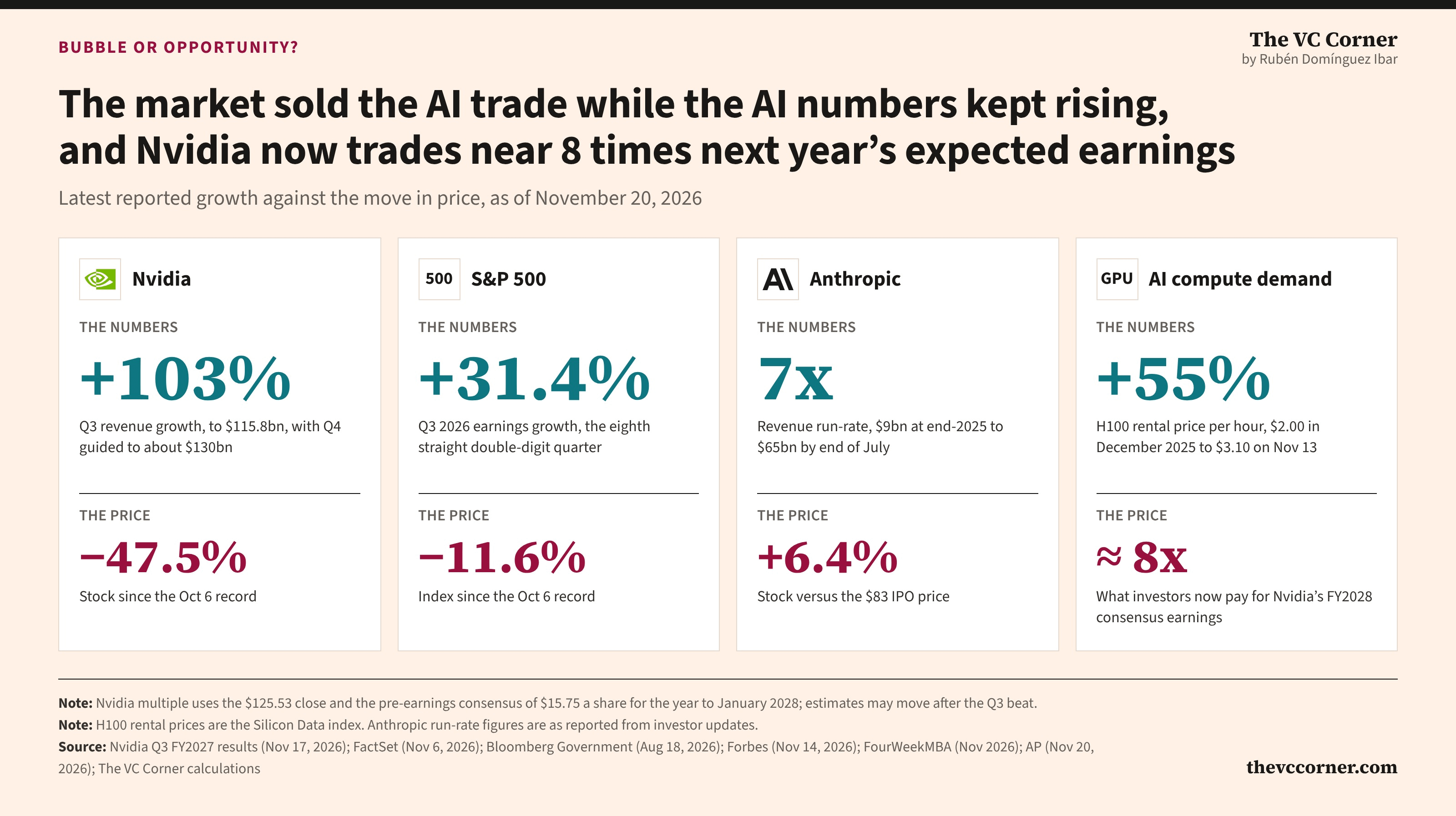
S&P 500 companies grew Q3 earnings 31.4%, the eighth straight quarter of double-digit growth, and the index traded at 17.7 times forward earnings on November 6, below its five-year average of 19.8, per FactSet. It is cheaper today. Anthropic’s revenue run-rate went from $9 billion at the end of 2025 to $65 billion by the end of July. The price to rent an H100 rose from $2.00 an hour in December to $3.10 on November 13, which tells you demand for compute still outruns supply.
History argues for patience and for humility. E*Trade counts 15 corrections from record highs since 1983, and 5 of them became bear markets. Goldman’s Rich Privorotsky summed up 2026 in one line: “In hindsight, the painful trade was going long AI and short bonds.”
My read: this week ended cheap financing for AI, and the demand for AI is still climbing. The companies that fund capex from their own cash will come out of this stronger, and the ones that need the bond market at 5% rates will spend 2027 explaining their returns.
What it means for startups and VCs
Most coverage stops at Nvidia. The bigger exposure sits in private markets, where AI took 82.7% of US venture dollars through Q3 2026, about $426.6 billion of $515.8 billion, per the PitchBook-NVCA Venture Monitor. OpenAI and Anthropic alone raised about a third of all global venture funding this year.
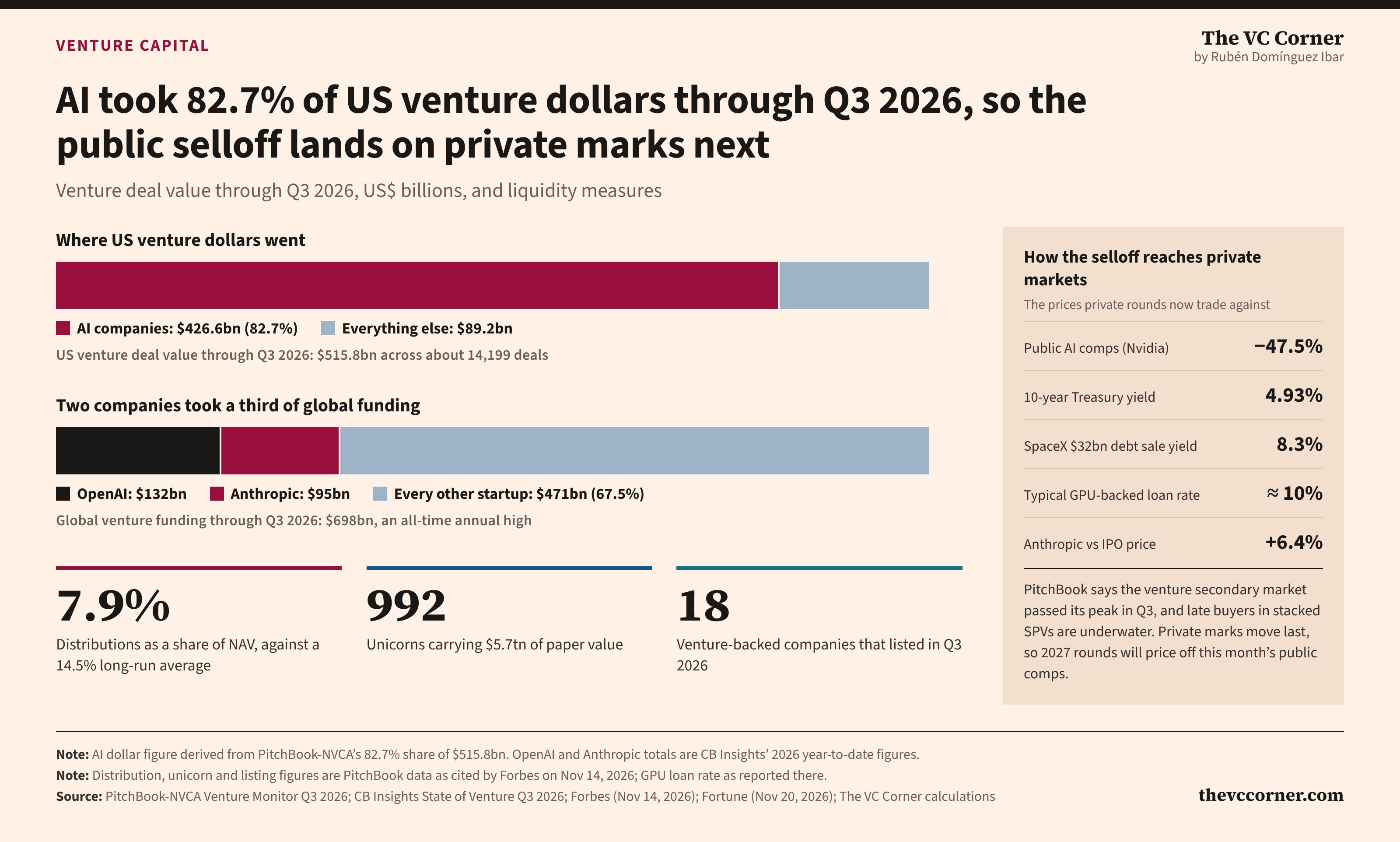
Four things change for anyone raising or investing in 2027:
Private marks move last. Nvidia fell 47.5% and the Nasdaq-100 about 19% in six weeks, and rounds priced in early 2027 will be benchmarked against those prices, with the step-ups of 2026 under review.
The exit door opened wider. Two IPOs of $75 billion or more priced in one year, and Anthropic held its price through a correction. Venture distributions run at 7.9% of NAV against a 14.5% long-run average, so LPs need exactly these listings.
Capital got more expensive. SpaceX had to raise the yield on a $32 billion debt sale to 8.3%, per Fortune, and GPU-backed loans price near 10%, per Forbes. Compute-heavy startups feel that first.
Secondaries already turned. PitchBook says the venture secondary market peaked in Q3, and late buyers in stacked SPVs are underwater.
Below, the playbook for founders and investors for the next six months, with the 10 numbers I am tracking into January and the templates to act on them.
Below the paywall: the founder playbook for raising into a correction, the investor checklist for 2027 marks, the 10 dates and numbers that decide where this goes, plus the 13-week cash flow forecast, the 10,000+ investor lists and the fund economics model.
Cancel anytime. First subscribers get 50% off forever.