

Every GP raising a fund meets the same LP math early. Pensions and endowments want a long track record and a long diligence cycle. Family offices move fast once they believe in you, and finding them takes months of one-by-one work. Between those two sits the allocator built to back fund managers as its core business: the fund of funds.
A fund of funds pools capital and commits it across a portfolio of external managers. Picking GPs is the whole job, and some programs set aside capital for new manager relationships. For an emerging manager with a clear strategy, that makes it one of the most natural first institutional conversations to have.
The hard part is reaching the right person. A large allocator carries dozens of senior titles, and only some of those people sit on the manager selection side. This guide gives you a workbook of 100 named LP contacts at 36 funds of funds and multi-manager allocators across 19 countries. Confirm each firm’s current mandate before you pitch, then use the playbook below to plan your outreach.
What a fund of funds is, and which GPs it fits
A fund of funds raises capital from its own LPs, usually pensions, insurers, sovereign programs and wealthy families, and commits it to a basket of underlying funds. It earns its fee by spotting strong managers early and blending them into a portfolio with the right mix of strategies and vintages. If you want the mechanics behind that fee layer, our breakdown of fund economics and carry walks through the full waterfall.
The fit is strongest for these GPs:
Emerging managers on Fund I to Fund III with a defined strategy and a credible way to source deals.
Specialist funds whose sector or stage fills a gap in an allocator’s existing portfolio.
Managers raising in a region where a state-backed or regional program has a mandate to back local funds.
GPs who can show early proof, such as a warehoused portfolio, a strong first close or a track record from a prior platform.
The fit is weaker for a first-time manager still testing the thesis. In that case, the stronger first move is to build the proof, then come back with numbers. Our guide to IRR versus return multiples shows how allocators read early performance, which helps you decide when your story is ready.
What is inside the workbook
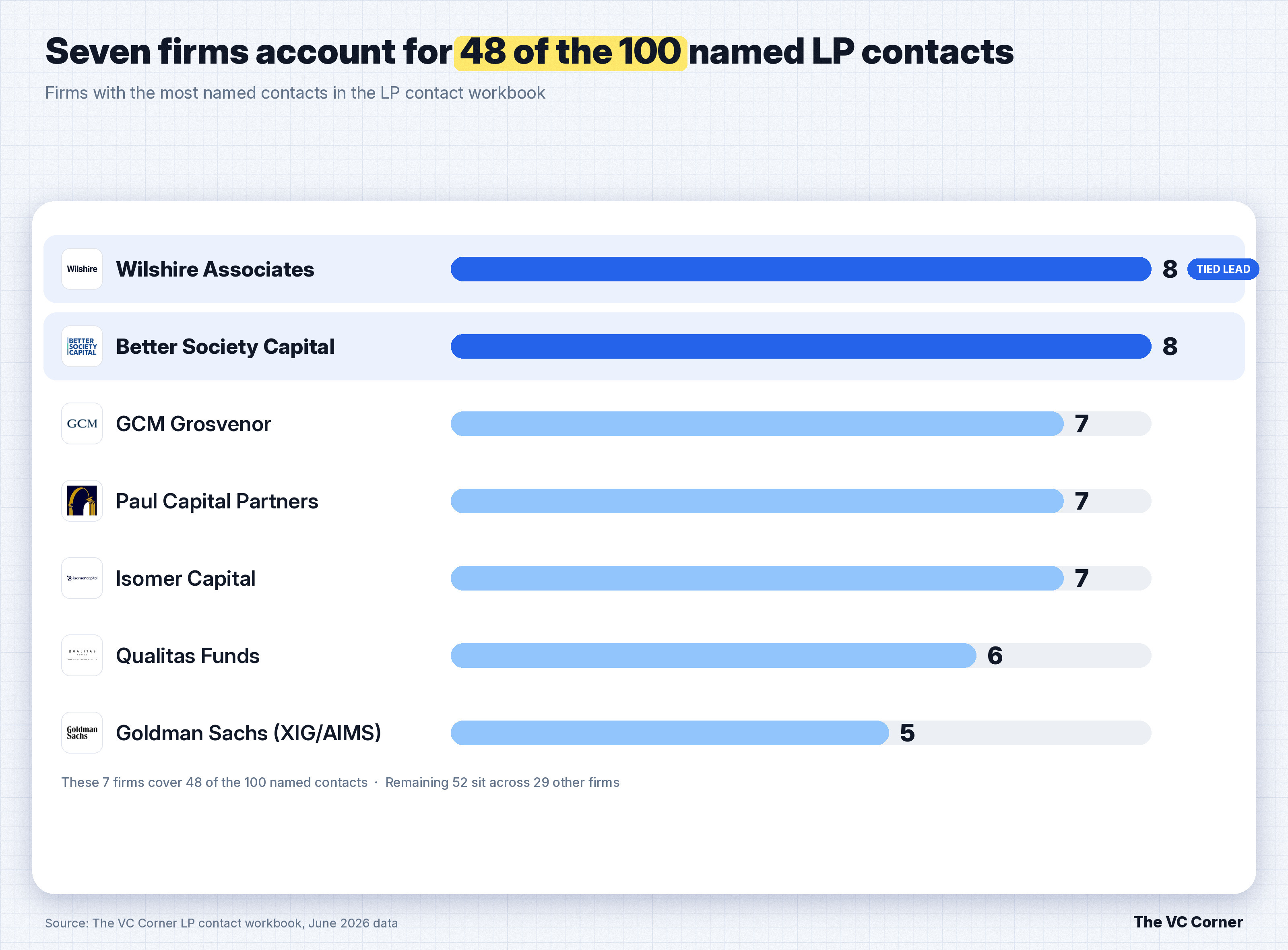
The workbook covers 100 named contacts at 36 funds of funds and multi-manager allocators, spread across 19 countries. The United States holds 47 of the contacts, the United Kingdom 16 and continental Europe 27, with the rest across Asia-Pacific and Latin America. The mix runs from venture-focused allocators such as Isomer Capital to impact programs such as Better Society Capital, alongside large multi-manager platforms and state-backed programs.
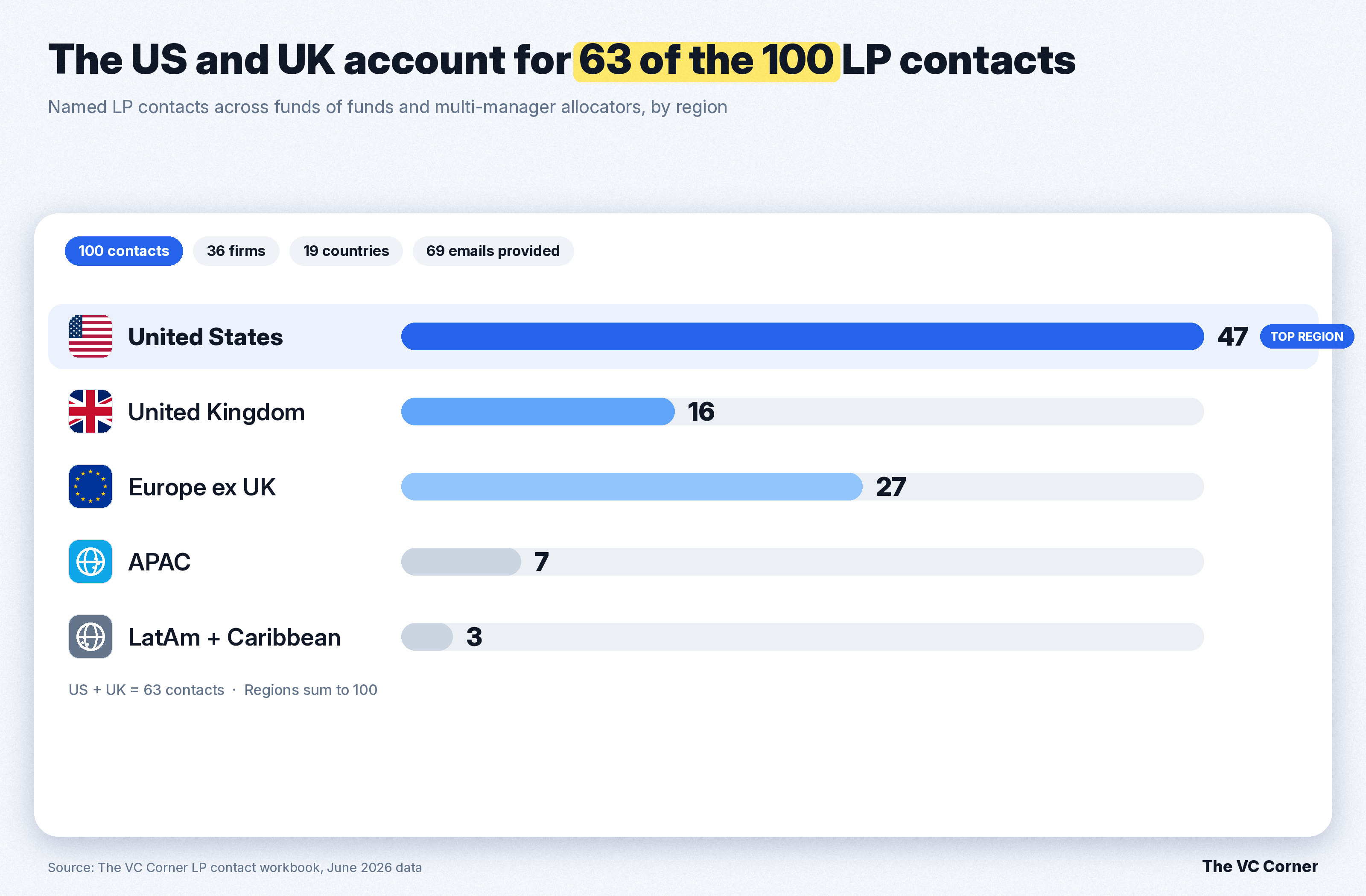
Each row carries the person’s name, title, firm, location and region. 69 of the 100 rows include a direct work email from a June 2026 build, so re-check each address before you send. The rest are best reached through LinkedIn search or a warm introduction.
How to segment the list before you send a single email
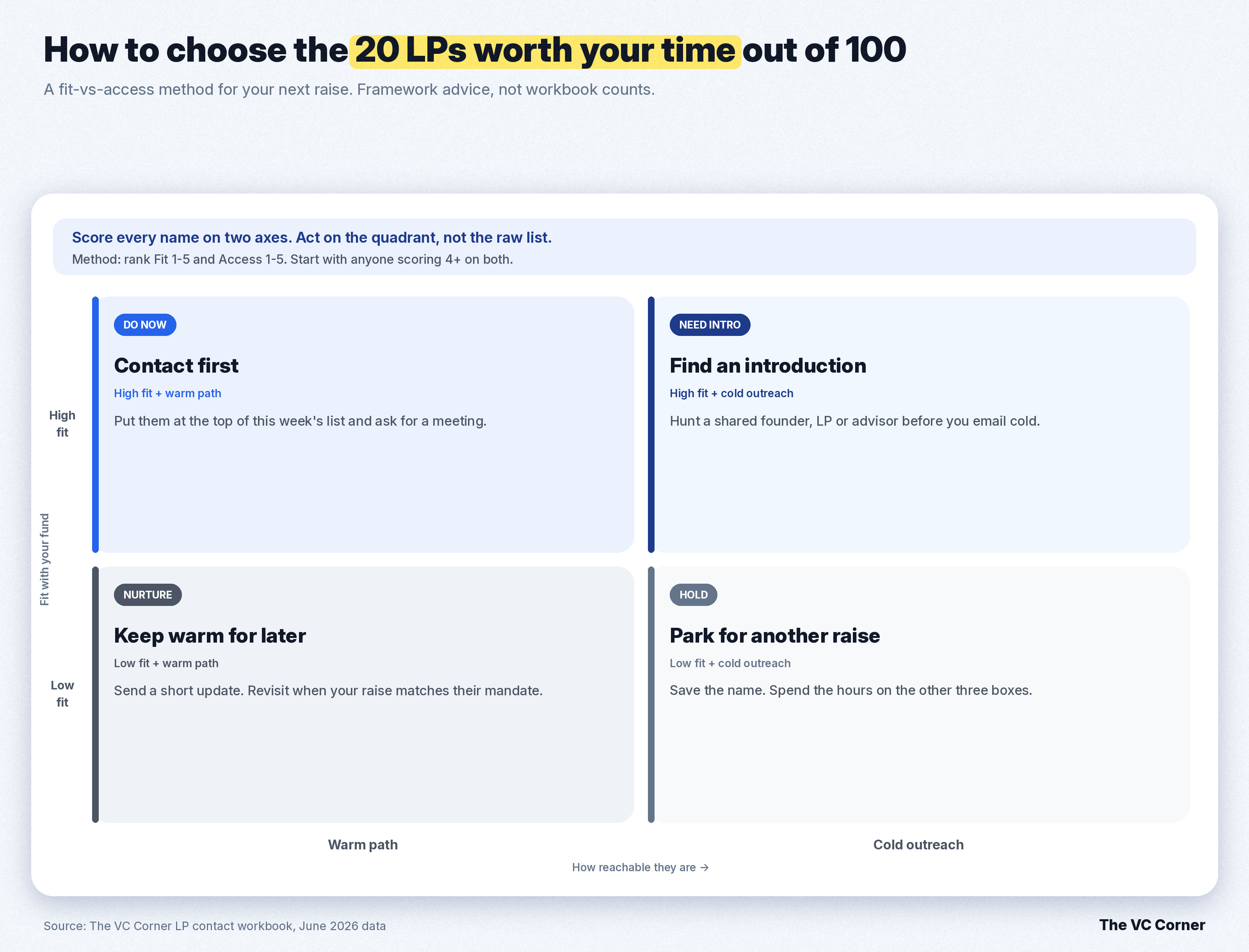
A list of 100 works best once you cut it down to the 20 to 30 people who match your raise. Score every row against these 6 criteria.
Strategy. Match your asset class and style to what the allocator currently backs. A venture-focused program and a secondaries buyer need very different pitches.
Stage. Check whether the allocator backs first-time funds or prefers Fund II and later. Many programs publish this on their site or in their annual report.
Geography. Look for regional mandates. State-backed programs often have a home-market requirement, and global platforms often split coverage by region.
Vehicle size. Your fund size sets the check you can absorb. A large platform with a minimum commitment above your target close is a later-round conversation.
Live mandate. Confirm the allocator is deploying from a current vintage. Recent commitments and new program launches are the clearest signals.
Emerging manager fit. Look for a dedicated emerging manager program or a history of commitments to Fund I managers.
The workbook ships with strategy, stage and check-size fit columns, plus warm path and research notes, so you can score in the same file you send from. Our investor qualification engine shows the same scoring logic applied to founders raising from VCs, and it ports over to LP lists well.
The workflow: from 100 rows to 30 conversations
Step 1: Pick your 20 to 30
Sort by your strategy fit score, then by stage fit. Keep the top 30 and park the rest in a later wave. 2 or 3 people from the same firm are fine at this point, as long as you plan to approach one of them first.
Step 2: Research each person
Spend 10 minutes on each name. Read the firm’s site for its current programs. Check recent fund commitments in press releases and annual reports. Read what the person has posted or spoken about in the last year. Write one line in the research notes column that links their interests to your fund.
Step 3: Map warm paths
Review your existing LinkedIn connections against the shortlist. The best introduction into a fund of funds comes from one of its existing GPs or from an LP who already backs you. Log every possible path in the warm path column.
Step 4: Prioritize
Rank the 30 into 3 tiers. Tier 1 is strong fit with a warm path. Tier 2 is strong fit with cold access. Tier 3 is partial fit worth a light touch. Start with Tier 1 and build references you can mention in Tier 2.
Step 5: Outreach
For warm intros, send your contact a short forwardable note with the fund size, strategy, current stage of the raise and one proof point. For cold outreach, keep the email to 5 or 6 lines, open with the specific reason you chose this allocator and close with a clear ask for a 30-minute intro call. Our investor outreach system has the full sequence and templates we use, for building and running the sequence.
Step 6: Follow up across quarters
Fund of funds commitments often take 2 or more quarters from first call to signature. Send a short quarterly update to every contact who took a meeting, with progress toward your close and one fresh data point on performance. Update the status of every row in the tracker after each touch so each relationship keeps moving.
Where this fits in the rest of your LP pipeline
Funds of funds are one layer of a full LP map. For the institutional side, pair this list with our database of 260+ institutional LPs that back VC funds, which adds pensions, endowments and sovereign programs. When you want to add private capital to the mix, our 1,999 European family offices and private investors gives you named decision-makers on that side too.
Below the paywall, premium subscribers get the full workbook with all 100 contacts and the outreach tracker. They also get the complete playbook, with ready-to-use prompts and email templates for every step above.