

In late 2013, Carolynn Levy, then counsel at Y Combinator, sat down with a few partners to solve a simple but costly problem: early founders were wasting weeks negotiating convertible notes they barely understood.
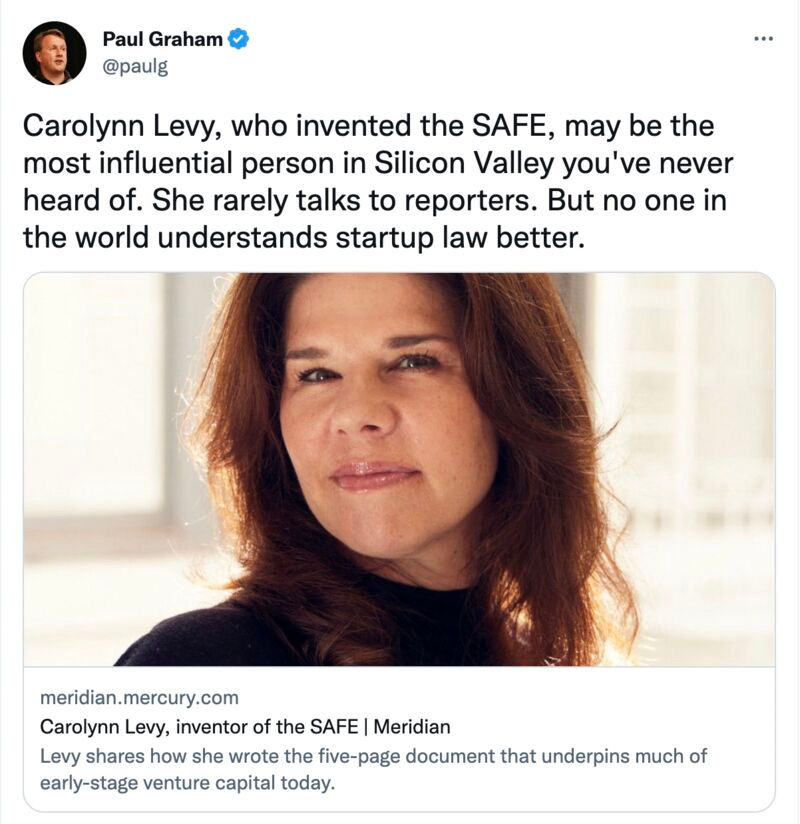
So Carolynn’s team drafted a five-page contract and named it the Simple Agreement for Future Equity, or SAFE. This contract essentially stripped out interest, maturity dates, and legal overhead.
By the next year, YC’s winter batch was already using it. Within a few years, the rest of Silicon Valley followed. The SAFE became the shared operating system for risk capital at zero revenue. Founders and investors could close on conviction and move on to building.
Deel went through Y Combinator in 2019. Their first round was a +$3M SAFE, the exact instrument this article breaks down. Today they run global payroll for thousands of companies. And they just launched something worth your attention:
The Pitch is a global startup tournament giving away $15M+ in SAFEs 👇

▫️ 10 global winners get a $1M SAFE each
▫️ 100 regional winners get a $50K SAFE each
▫️ Live finals in Tel Aviv, Dubai, Singapore, Berlin, London, Paris, and New York

Three minutes to apply. Every applicant gets startup perks and access to a global founder community 🔥
What made the SAFE special wasn’t its legal engineering but how quickly it aligned everyone involved. For the first time, founders and investors could close on conviction and move on to building. The SAFE became both a legal instrument and a coordination default, the shared operating system for risk capital at zero revenue.
12 years later, emerging founders are still unsure how SAFE financing works. So we’re breaking everything down. How the pre money SAFE evolved into the post money SAFE, why it created new math around dilution, and what practical fixes founders and investors now rely on.
Table of Contents
1. The Messy Status Quo Before SAFE
2. Writing SAFE: Goals, Design Choices, Tradeoffs
3. From Launch To Default: How A Template Went Viral
4. The Criticism That Forced An Upgrade: Enter Post-Money In 2018
5. How SAFEs Are Actually Used Now
6. Edge Cases And Real Pitfalls Founders Still Miss
7. Accounting And Tax Treatment For Dummies
8. Practical Playbooks For Founders And Investors
9. The Safe’s Real Legacy: Speed With Responsibility
1. The Messy Status Quo Before SAFE
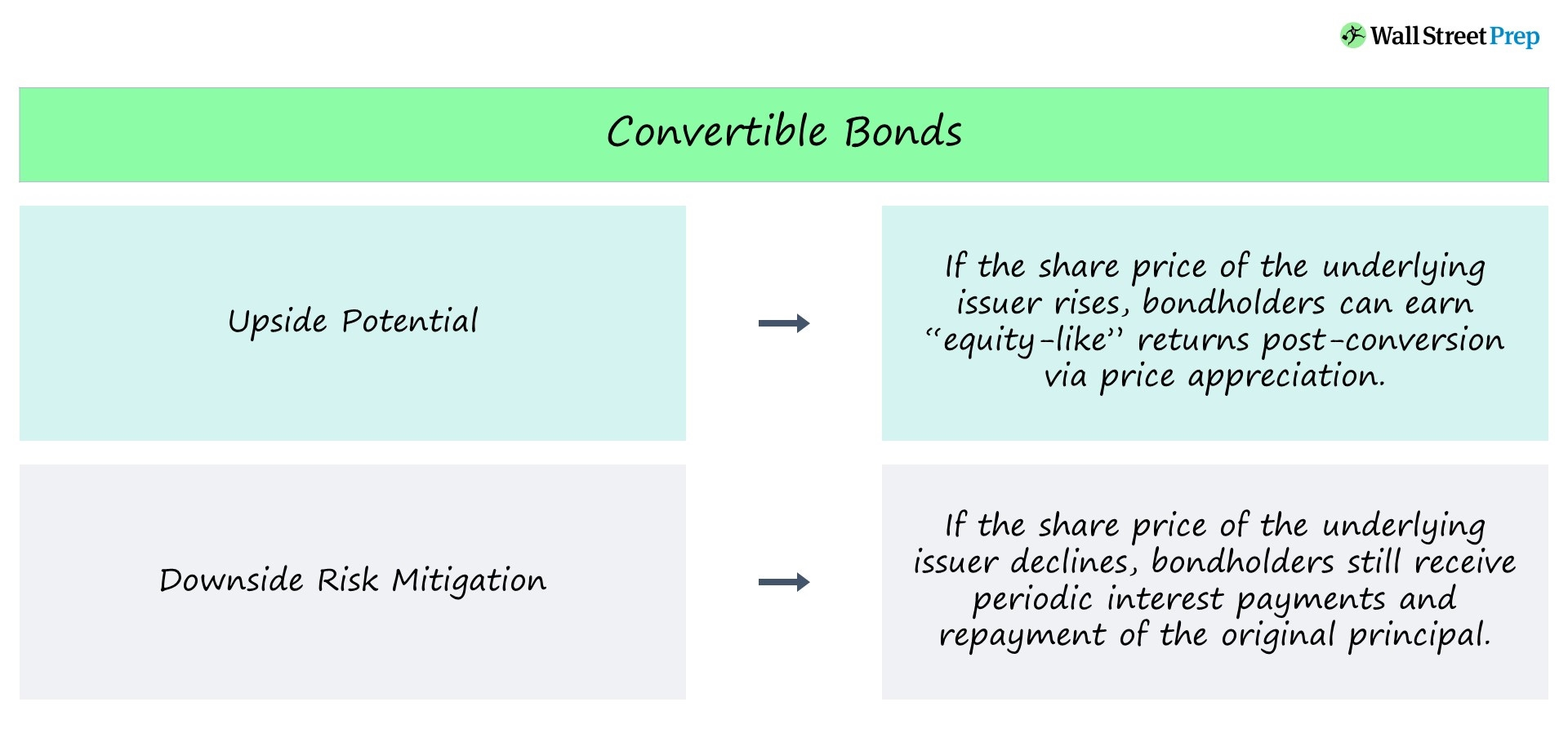
Before the SAFE existed, early-stage funding ran on convertible notes, which are legal “hand-me-downs” from bridge loans.
Founders used them because a full equity round meant lawyers, board approvals, and valuation debates they couldn’t afford. So a note was faster. Investors lent money that would later convert into equity, usually with a discount and an interest rate attached.
Convertibles worked, but they had their downsides. Notes came with maturity dates, which meant founders technically owed investors repayment if a priced round didn’t happen in time. They also accrued interest, which was irrelevant to a company with no revenue but still had to be calculated and documented. Every round added new spreadsheets, side letters, and ticking clocks.

That debt structure created a subtle but constant drag. Founders building high-risk equity businesses were signing legal IOUs, while investors were funding startups that could, in theory, default.
Conversations that were supposed to be about hiring or product roadmap often turned into reminders about extensions and rate adjustments. This situation was both administrative pain and misalignment. The system pushed early-stage founders to negotiate like debtors instead of partners.
As Carolynn Levy later explained, “We wrote it so it was different from the convertible note, to show that it was equity and not debt.”
The idea of turning a loan into a became the foundation of the SAFE financing model. It stripped away the leftover mechanics of debt and re-centered early funding around equity, speed, and trust.
2. Writing SAFE: Goals, Design Choices, Tradeoffs
A SAFE (Simple Agreement for Future Equity) is a short contract that lets an investor put money into a startup today in exchange for the right to receive equity later, usually when the company raises its next priced round.
When the SAFE took shape inside Y Combinator, its real innovation wasn’t the idea of deferred equity, it was the act of productizing legal trust. The YC team treated the document like a startup release. It defined the user’s pain, stripped away the bloat, and shipped something so simple it couldn’t be misunderstood.
The brief was direct. Founders needed a funding tool that behaved like equity, executed like a wire transfer, and didn’t expire. That meant no interest, no maturity, no countdown clocks. Just a clean conversion into shares when a priced round finally happened. The test of success was whether founders could close in a day.
Every design choice served that speed. The SAFE was intentionally five pages long so that a founder could actually read it before signing. It used plain English, avoided cross-references, and fit into one PDF instead of a packet of attachments. YC wanted a contract founders would understand without having to call their lawyer first.

It kept only the useful DNA from convertible notes, the ability to close investors one by one and to set terms flexibly. What it dropped were the mechanics that made notes behave like debt, such as the interest accrual, maturity dates, and looming repayment risk.
Those details might have comforted investors, but they cluttered early fundraising with false urgency.
By cutting them out, the SAFE redefined what “early stage” meant. It wasn’t just a cheaper legal form, but a coordination system that trusted founders and investors to align around progress instead of paperwork.
3. From Launch To Default: How A Template Went Viral
The SAFE debuted quietly in Y Combinator’s 2014 winter batch. Within months, dozens of alumni had raised capital using it, and those rounds began seeding the next generation of accelerators, angels, and lawyers with the same five-page template.

YC had just designed a distribution loop in the form of a document. Every batch cycle trained new founders to use the SAFE, who then reused it in their own startups, portfolios, or syndicates.
The decision to publish the official templates on YC’s website turned that loop into a network effect. Anyone could download, duplicate, and close a round the same day. Angels trusted it because YC had vetted it, while founders trusted it because they’d seen peers use it.
Over time, that brand signaling made the SAFE a de facto default. It wasn’t only cheaper, it was also legible. A YC-style round carried an implicit quality mark that shouted: “we know what this contract means.”
Other accelerators tried their own versions. 500 Startups launched the KISS (Keep It Simple Security) around the same time, which was a hybrid between a convertible note and a SAFE. It offered more legal structure by including interest and optional maturity, but fewer network effects. KISS documents were longer, jurisdiction-specific, and rarely open-sourced.
But, without YC’s alumni engine or unified training, its adoption plateaued. In the meantime, the SAFE was scaling like a modern day SaaS company.
By 2024, according to Carta’s State of Pre-Seed data, roughly 90% of early-stage financings on its platform were executed through SAFEs, with post-money versions dominating new issuance.
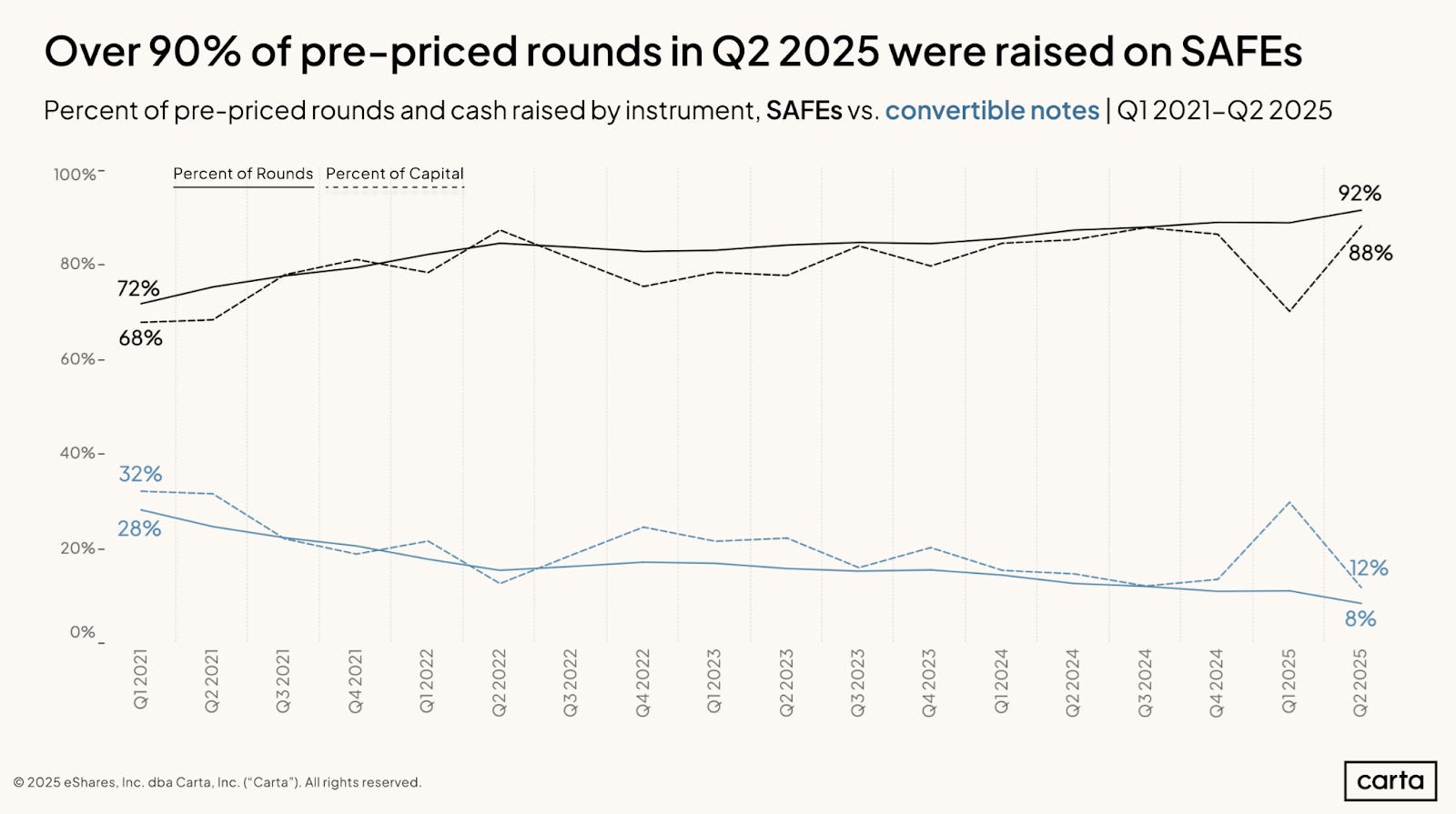
In just a decade, a five-page YC handout had become the standard operating system for startup capital, defining how risk, trust, and speed converged at the earliest stage.
4. The Criticism That Forced An Upgrade: Enter Post-Money In 2018
By 2017, the SAFE had become Silicon Valley’s favorite contract, and also its biggest headache. The problem wasn’t speed, but math.
Founders often raised several tranches of pre-money SAFEs, each with different valuation caps or discounts. Although it looked clean on paper, the stack made ownership almost impossible to predict in practice. When the priced round finally happened, everyone - from founders to early angels - discovered that their percentage was smaller than they thought.
That’s when investors began to push back. Stacked SAFEs blurred the true post-raise valuation methods and made it hard to model ownership across multiple unpriced rounds.
Fred Wilson famously called it “a house of cards waiting for a priced round to collapse it.” Founders agreed in private: no one wanted to do cap table triage right before a Series A.
In 2018, Y Combinator released the post money SAFE to fix that opacity. Under this version, each investor’s ownership is defined after accounting for all SAFEs in the same round.
That simple tweak made dilution clear at signing. No more guessing games. YC’s official explainer describes it as “making it easier for both founders and investors to understand how much of the company has been sold.”
Here’s how it works, in plain numbers:
A startup raises $1 million on an $8 million post money SAFE.
Ownership = Investment ÷ Post. So: 1 ÷ 8 = 12.5%.
Add a second $1 million SAFE at the same post = another 12.5%.
Combined, 25% of the company is sold before a priced round that is visible and predictable from day one.
This new format changed everything. Founders started tracking dilution in real time instead of discovering it later. Angels could model their percentage without needing the next investor’s math. The post money SAFE simply added honesty.
5. How SAFEs Are Actually Used Now
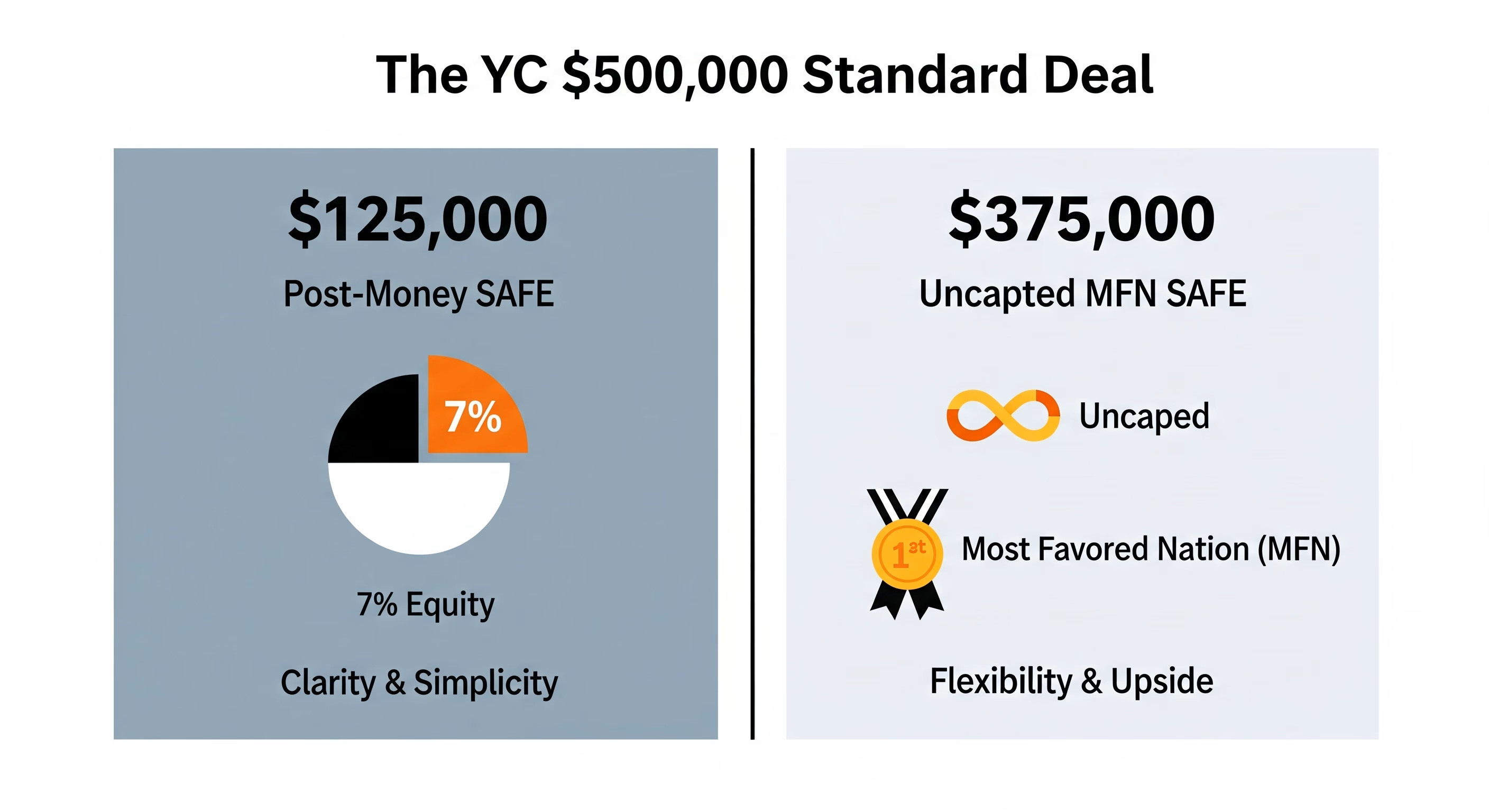
In 2024–2025, the dominant SAFE is post-money with a valuation cap. Most deals no longer include discounts, and uncapped MFN clauses are rare beyond special cases like YC’s $375K deal. Founders at the pre-seed stage almost always default to this clean structure; simplifying modeling, reinforcing transparency, and avoiding surprises.
Carta’s data backs this up, with roughly 90% of early-stage financings on its platform having used SAFEs or notes, and among those SAFEs, post-money versions dominate new issuance.
The median valuation cap for rounds under $250K rose to $7.5M in Q2, indicating investor confidence in startup valuations. Meanwhile, the total capital raised via SAFEs/notes in Q2 2025 was ~$822M over ~5,200 instruments.

Over time, founders often trade SAFEs for priced equity rounds once they hit $3M–$4M in raise size. That’s when lead investors demand stronger rights (board seats, ratchets, pro rata) and full financial modeling becomes non-negotiable. Up until that point, SAFEs let teams fund core traction without complex negotiations.
In practice, modern founders tend to issue a single SAFE instrument per round, with a public cap and known target raise. That simplicity helps prospective investors understand the dilution math before signing. Later, when a priced round arrives, the lead investor can fold in the SAFE stack cleanly without any retroactive price-fixing or sticky side letters.
In short, SAFEs remain the operating default at pre-seed, and the post-money SAFE with a clean cap is now the gold standard.
6. Edge Cases And Real Pitfalls Founders Still Miss
Even a decade after its debut, the SAFE agreement still has some traps that even smart founders might not catch. Most stem from the assumption that a short document means a simple outcome.
In reality, edge conditions like stalled conversions, overlapping caps, or loose MFN clauses can flip a company’s ownership upside down, long before a priced round. The following scenarios show where things go wrong, and how to fix them early.
Scenario 1: No priced round ever occurs
When a company never does a priced equity round, early paper can sit unresolved for years. In the case of Toptal, a 2012 investor’s $1 million note never converted, because the required trigger event didn’t happen before the maturity date. So, litigation followed, and court findings decided that conversion rights depend on the contract and triggers elected on time. In short, no automatic conversion, no equity.

Another example of a company trying to avoid the wrath of investors pre-emptively was Notion, which raised a small equity round in 2019 primarily to convert outstanding notes and close out interest accrual. A deliberate cleanup before scaling.
That’s why you always need clear triggers that protect you.
What founders can add (pick one, keep it in term sheets):
Time-based conversion: Board option to convert after, say, 24 months at a pre-agreed floor; simple to administer, may feel investor-unfriendly if the floor is low.
Revenue-based trigger: Convert when ARR or revenue crosses a threshold; ties economics to traction but can be gamed or delayed.
Board-option conversion window: Board may convert within a set window at a valuation floor indexed to the last cap; preserves flexibility, requires clear governance.
Third-party valuation fallback: Independent appraisal if no round by a date; objective and auditable, introduces cost and timing friction.
Scenario 2: Stacked SAFEs increase dilution silently
Multiple tranches at different caps compound dilution even with a post money SAFE. Each post-money instrument defines its percentage independently, so totals add up quickly.
Take our previous example, where two $1 million investments at an $8 million post each imply 12.5% + 12.5%, or 25% before the priced round. YC’s user guide and practitioner primers emphasize that post-money simplifies the cap table dilution SAFE modeling, but does not remove it.
Here’s what you need to do in this case:
One instrument, one cap, one round window: Announce a single SAFE form and cap for all checks in the round; reduces surprise totals and negotiation whiplash.
Aggregate cap on total SAFE volume: Publish a hard dollar limit for the round; signals discipline and lets all parties model ownership credibly.
Live dilution tracker: Share a simple spreadsheet that updates implied ownership as commitments arrive; prevents last-minute shock.
Scenario 3: Uncapped MFN SAFEs
MFN gives the holder the best later terms that appear, which is attractive to early backers and common in YC’s $375 K instrument. Leads can worry that an uncapped MFN SAFE paper will inherit any sweeteners they negotiate, raising modeling or signaling concerns for the priced round.
What to do:
Limit MFN scope in writing: Apply MFN only to later SAFEs, not to priced rounds; prevents automatic inheritance of Series A terms.
Set an MFN sunset: MFN expires at the close of this SAFE round or after a fixed period; keeps protections reasonable and time-bound.
Disclose stack early: Provide a one-page summary of all outstanding SAFEs, caps, and MFN terms; helps a future lead underwrite cleanly.
The bottom line is that SAFEs solve speed, but not always. A short, explicit conversion path, a single-cap policy, and clear MFN language handle most landmines before they ever reach the term sheet.
7. Accounting And Tax Treatment For Dummies
Finance leaders often treat the SAFE as “equity later,” but auditors don’t see it that way. Under U.S. GAAP, a SAFE can be classified either as equity or a liability, depending on its exact wording and economic substance. That distinction can affect everything from your balance sheet to your next fundraise, so it’s worth getting right early.
How auditors look at it
Two accounting standards guide the classification:
ASC 480 (Distinguishing Liabilities from Equity) decides whether an obligation must be settled in cash or another asset.
ASC 815-40 (Derivatives and Hedging: Contracts in Entity’s Own Equity) determines whether the agreement qualifies as equity or must be treated like a derivative liability.
If your post money SAFE includes investor protections that could trigger cash settlement, or complex valuation caps that function like embedded derivatives, auditors may classify it as a liability.
And when it’s equity-classified, the contract sits in permanent capital. But when it’s liability-classified, it affects debt ratios, covenants, and reported net income.
Getting that wrong can derail an audit or violate bank terms.
Practical fix: loop in your controller or auditor as soon as SAFEs are issued and not months later. Documentation at signing, especially around conversion triggers and investor rights, will help you avoid reclassification headaches during year-end reviews.
Key tax angles to flag early
QSBS timing (Section 1202): Stock issued when a SAFE converts can qualify for Qualified Small Business Stock treatment if the company meets the $50 M / $75 M asset test and other IRS criteria at the time of conversion. This is when the five-year clock for capital-gains exclusion starts.
409A implications: A large SAFE round can shift the company’s fair-market-value estimate. Update the 409A valuation after significant SAFE issuances to keep option grants compliant.
Compensation crossover: If SAFEs are used in employee or advisor contexts, they may trigger payroll or benefit accounting rules. Always confirm with counsel before mixing compensation and capital instruments.
The takeaway
A SAFE financing round might close in a day, but its accounting footprint lasts years. Treat it like any other capital event by documenting clearly, consulting early, and making sure that finance, tax, and legal teams agree on classification before the audit team shows up.

8. Practical Playbooks For Founders And Investors
Most SAFE problems usually aren’t legal, but operational. Founders underestimate compounding dilution and investors assume future rounds will clean things up. In practice, both sides can stay aligned with a few structured habits. Here’s what disciplined teams do.
For founders
Standardize your paper.
Use a post money SAFE, cap-only, and one instrument for the whole round. Publish the valuation cap and a total target raise (e.g., “$1.5M on $9M post”). It signals transparency and keeps future modeling clean.
Model dilution before signing.
Use a simple formula:
Ownership = Investment ÷ Post-money valuation
Example: raising $1M on a $10M post = 10% sold. Add another $500K at the same post and your cumulative dilution is 15%. Keep that spreadsheet open; every new check adjusts founder ownership in real time.Add a conversion path if no priced round happens.
Write a clause allowing the board to convert after 24 months at a pre-agreed floor (for example, the last SAFE’s cap). It avoids legal limbo if no equity round materializes.Clarify MFN limits and sunset.
Define exactly which future SAFEs the MFN applies to and when it expires. A time-bound or round-specific MFN prevents accidental term inheritance.Loop in your controller early.
Send executed SAFEs to finance immediately. Classification (equity vs. liability) under ASC 480/815-40 should be documented at signing, not at audit.
For investors
Insist on post-money terms with limits.
Confirm a clearly stated cap and a ceiling on total SAFE issuance. Too many SAFEs at varying caps distort your eventual ownership.Check the conversion path.
There should be a defined timeline or trigger for conversion, such as at the next priced round or after a set date, to avoid indefinite paper.Review pro rata rights.
Make sure any pro rata clause meshes cleanly with the post money SAFE math. Overlapping rights can double-count allocation.Audit MFN exposure.
Ask if any existing SAFEs have MFN terms that might shadow your deal. Understanding that stack now saves conflict later.Demand a living cap table.
Request a simple list of all outstanding SAFEs, amounts, caps, and implied post-money ownership. Transparency here is worth more than another point of discount.
A SAFE financing works best when everyone can see the math before the signature. These two checklists keep the contract as simple in practice as it looks on paper.
9. The Safe’s Real Legacy: Speed With Responsibility
The SAFE agreement gave startups a gift the ecosystem badly needed, and that is speed. It replaced weeks of negotiation with a document founders could understand, sign, and close in a day.
That velocity helped entire generations of startups form faster and raised the bar for how early-stage capital moves. In just five pages, it turned startup fundraising into a coordination exercise instead of a legal marathon.
But with simplicity comes responsibility. Every SAFE demands clear math, explicit conversion paths, and disciplined issuance.
Founders who treat it as “just paperwork” risk silent dilution or open-ended obligations that surface only when it’s too late. Investors who rely on assumptions instead of modeled ownership make the same mistake in reverse.
But make no mistake, the SAFE financing model isn’t just a shortcut. It’s a startup’s infrastructure. Used with structure and supervision, it keeps early capital aligned with the one thing that still drives venture forward: building something worth owning.
Adeo is pretty sure he invented the SAFE… smh 🤦🏻♀️ https://fi.co/insight/who-invented-the-safe-adeo-ressi