

The “sweet spot” of financing
Yes, most startups ultimately fail because they run out of cash. You knew that already. But what’s less discussed is how many startups fail because they raised cash the wrong way.
Some founders choose to give up equity when they shouldn’t, and others choose to borrow when they should just give up ownership instead. It is a tough choice, especially for a founder whose goal is to keep his company afloat.
So, what if there was a way to find the perfect middle ground? The “sweet spot of financing.”
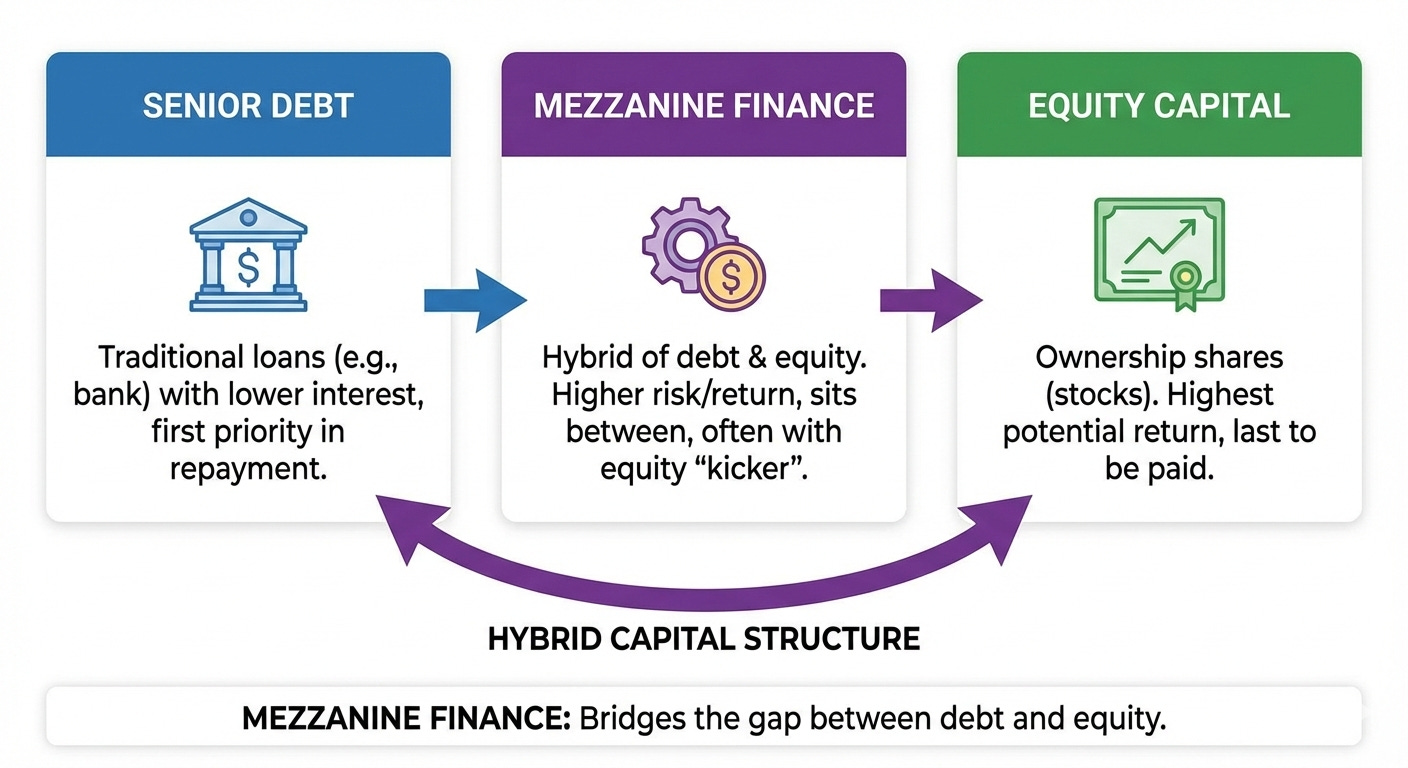
That middle ground exists, and in finance it has a name. It’s called mezzanine financing; that is capital that sits between debt and equity, designed for moments when neither option feels quite right.
And if you want to learn how to model it out easily, you are in the right place.

Table of Contents
1. Why this mezzanine finance model is essential
2. What this model is designed to do (and what it is not)
3. What’s in this Mezzanine Finance Model
4. Who should use it
5. How it works
6. Download the Mezzanine Finance Model in Excel
7. Frequently Answered Questions
1. Why this mezzanine finance model is essential
Mezzanine financing is rarely understood in full. Most discussions stop at surface terms like interest rates, payment-in-kind (PIK) options, or a warrant percentage. Those terms sound complicated at first, especially when there’s no template to go by.
And this is evident in how deals are executed. Mistakes are spotted all over the place.
Founders fixate on the stated interest rate and underestimate the compounding effect of PIK. CFOs model cash runways but miss how exit timing changes the lender’s return. Lenders quote target IRRs without fully testing how fees, repayment structure, and equity upside interact.
Everyone believes they are negotiating well, but the mistakes will only appear months or years later.
The core problem is not mezzanine as an instrument, but the absence of end-to-end modeling. Mezzanine outcomes are driven by how several elements work together, such as cash interest versus PIK, upfront and exit fees, whether principal is repaid over time or at exit, how warrants are structured, and when the company exits. Change any one of these, and the economics move in ways that are not obvious until you see the full cash-flow timeline.
This mezzanine finance model shows how the economics actually work. From the moment capital is deployed in Year 0 to the moment value is realized at exit, every dollar is tracked. Cash flows are explicit, trade-offs are visible, and assumptions are forced into the open.
2. What this model is designed to do (and what it is not)
This particular financial model is an economic structuring and return analysis tool. It is not a legal document, a term-sheet generator, or a substitute for documentation. Its purpose is narrower and more demanding. That is to show how a mezzanine deal actually behaves over time.
Most confusion around mezzanine comes from looking at pieces in isolation. An interest rate here, a PIK toggle there, a warrant percentage on the side.
This model brings those pieces together and shows how they interact once capital is deployed, fees apply, and the deal eventually exits.
It runs end to end and is flexible by design. It allows for the financial modelling of real world choices around PIK, repayment structure, exit timing, and equity upside, because those variables are negotiated, not fixed. It is built from the lender’s perspective, since mezzanine pricing is ultimately driven by how lenders assess risk and returns.
At the same time, it does not hide consequences. Borrower cash burden, fees, and dilution remain visible throughout. The goal is not to tell you what deal to do, but to make clear what deal you are actually doing.

3. What’s in this Mezzanine Finance Model
This model is built to turn mezzanine mechanics from abstract to explicit. Instead of describing terms in isolation, it shows how each component feeds into cash flows, principal growth, and ultimate returns.
Let’s discuss the structure of the model, which is essentially the economic lifecycle of a deal, starting from how assumptions are set, how they compound over time, how risk is priced through equity, and how everything resolves into lender outcomes.
1. Inputs: what you are actually deciding on page one
Everything starts with the inputs as they define the deal at inception.
Principal amount
This is the face value of the mezzanine loan. It is the amount the lender commits, not necessarily the cash the company receives after fees. All interest, fees, and equity coverage are calculated off this number.
Issue date (Year 0)
This simply defines when the loan starts. Year 0 is the moment capital is funded. All interest, PIK accrual, and timing assumptions are measured from this point.
Tenor (years)
The tenor is the intended life of the loan. A four-year tenor means the deal is structured to run for four years unless it is repaid or refinanced earlier. Longer tenors usually increase risk for lenders and cost for borrowers.
Cash interest rate
This is the interest paid in cash, typically once per year. It is an actual cash outflow for the company and affects liquidity and runway. This is the rate founders tend to focus on first, often too much.
PIK interest rate
PIK stands for “payment in kind.” Instead of being paid in cash, this interest is added to the loan balance. It does not hurt cash flow today, but it increases how much must be repaid later.
PIK toggle (ON/OFF)
This switch determines whether PIK interest is active.
ON means interest compounds into the principal each year.
OFF means no compounding and a lower final repayment.
This is one of the most important levers in the model because it ultimately changes the total cost of capital.
Upfront fee / OID
This is a fee charged at the start of the deal, expressed as a percentage of principal. It reduces the cash the company receives on day one, even though interest is still calculated on the full principal amount.
Exit fee
This is a fee paid when the loan is repaid, usually at exit or refinancing. It increases the lender’s return but is easy to overlook because it shows up only at the end.
Repayment type
This defines how principal is repaid. Bullet means no principal is repaid until exit. An amortizing structure would repay some principal over time. Bullet structures preserve cash but increase the exit payment and risk.

Exit and prepayment assumptions
Exit year
This is when the loan is assumed to be repaid. Even a one-year change here can materially change lender returns and borrower cost.
Prepayment premium
If the loan is repaid early, this premium compensates the lender for lost interest. It only applies if the toggle is turned on.
Prepayment toggle (ON/OFF)
Controls whether early repayment penalties apply at all.
Company and equity assumptions
These inputs are used only to value the equity kicker, not to price the debt.
Entry equity value
The company’s assumed equity value at the time the mezzanine is issued.
Entry share price
Used to translate equity value into shares outstanding.
Shares outstanding
The total number of shares before any warrants are exercised.
Exit equity values (low, base, high)
These define three possible exit outcomes. They are not predictions, but scenarios used to understand how the equity kicker behaves across different results.
Exit share prices
Derived from exit equity value and shares outstanding. These prices determine what the warrants are worth at exit.
2. Debt schedule mechanics
The debt schedule is the mechanical core. Each year shows beginning principal, PIK accrual if enabled, total principal including PIK, and ending principal after any amortization.
Cash-interest payments are calculated annually and separated from principal movement. In the exit year, the model triggers principal repayment, exit fees, and any prepayment premium. Nothing is netted, everything is visible.

This is where intuition often fails, even for finance experts. PIK does not feel expensive until you see it capitalized year after year. Bullet repayment looks simple until you see how much principal has grown by exit.
3. Equity kicker and warrants
The equity kicker section is meant to handle warrants with discipline.
Coverage is defined as a percentage of principal, not as a narrative promise of upside. Strike price and target ownership are explicit inputs. Warrant shares are calculated mechanically. Exit value is shown across low, base, and high cases, based on exit-equity assumptions. Implied dilution is calculated so the cost is not abstract.

This framing is important because warrants are a priced component of risk compensation. Treating them casually is a common and costly mistake.
4. Lender cash flows and return math
The cash-flows and returns section aggregates everything from the lender’s perspective. Principal funded, cash interest received, principal repaid, exit fees, prepayment premiums, and equity-kicker value all appear on the same timeline.
From those cash flows, MOIC and IRR are calculated directly.

There is no massaging of numbers. If returns look high, you can see why. If they fall apart under a different exit year, you can see that too.
5. The dashboard
The dashboard provides a one-page snapshot. Key deal terms sit alongside net proceeds, total interest paid, total PIK accrued, total fees, equity-kicker value, and lender returns.
It helps sanity-check the structure quickly and to facilitate serious conversations with stakeholders.

4. Who should use it
This model is not designed around job titles, but around decision-making roles in mezzanine transactions. Each group below interacts with mezzanine differently, but they all face the same underlying risk. The risk of misunderstanding how structure turns into economics over time.
This model is useful precisely because it aligns those perspectives around the same mechanics and outcomes.
Founders and CFOs
Founders and CFOs considering mezzanine as bridge or growth capital can use the model to understand the full all-in cost of capital. Not just the coupon, but the combined effect of cash interest, PIK, fees, and dilution.
It helps answer whether the flexibility mezzanine provides is worth what it extracts over time.
Lenders and private credit funds
Lenders and private credit funds can use the model to standardize underwriting. Consistent PIK math, explicit fee capture, and disciplined warrant valuation reduce internal confusion and make return targets more defensible.
What’s great about this model is that it also improves communication by grounding discussions in shared mechanics rather than negotiated narratives.

Advisors and investors
Advisors and investors can use the model to compare structures, like bullet versus amortizing, higher cash interest versus higher PIK, different warrant coverage and strike prices, different exit years.
The value lies in seeing how small changes propagate through returns, not in debating abstractions.
If you are looking for a simplified overview of mezzanine, this model is not for you. However, if you want to understand how mezzanine actually behaves under pressure, it is.
5. How it works
The model is designed to be used in sequence. Each step builds on the previous one, and skipping ahead usually leads to the same misunderstandings that cause mezzanine deals to be misread in the first place.
Step 1: Lock the deal terms
The model starts with discipline at the input level. You define the deal terms explicitly: principal, tenor, cash and PIK rates, upfront and exit fees, repayment type, and exit or prepayment year. There is no default narrative and every assumption is visible and adjustable.
Step 2: Let the debt schedule run
Each year begins with the outstanding principal. If PIK is on, interest accrues and is capitalized into principal. Cash interest is calculated separately and paid annually. If amortization is selected, scheduled repayments reduce principal over time. If the structure is bullet, principal remains outstanding until exit.
In the exit year, the model resolves everything at once. Outstanding principal, including all accumulated PIK, is repaid, and exit fees are applied. If a prepayment premium is active, it is triggered. The result is a clear picture of what the borrower owes and what the lender receives at resolution.
Step 3: Price the equity kicker properly
Warrant coverage is set as a percentage of principal. Strike price and target ownership determine the number of warrant shares. Exit-equity values are defined for low, base, and high cases, and the model calculates intrinsic value per warrant and total warrant value in each scenario.
You can see how sensitive the equity kicker is to exit assumptions, and how that sensitivity feeds directly into lender returns.
Step 4: Aggregate cash flows and compute returns
The lender cash-flow timeline shows the initial outflow at funding, annual inflows from cash interest, and exit-year inflows from principal repayment, fees, and warrant value. From that timeline, IRR and MOIC are calculated without interpretation.
This is where leverage hides or reveals itself. A one-year shift in exit timing often changes IRR more than a material change in coupon.
Step 5: Sanity-check everything
The dashboard pulls the story together. It allows a fast check: do the proceeds, payments, and returns make sense together? If something looks off, you know exactly where to look.