

TL;DR
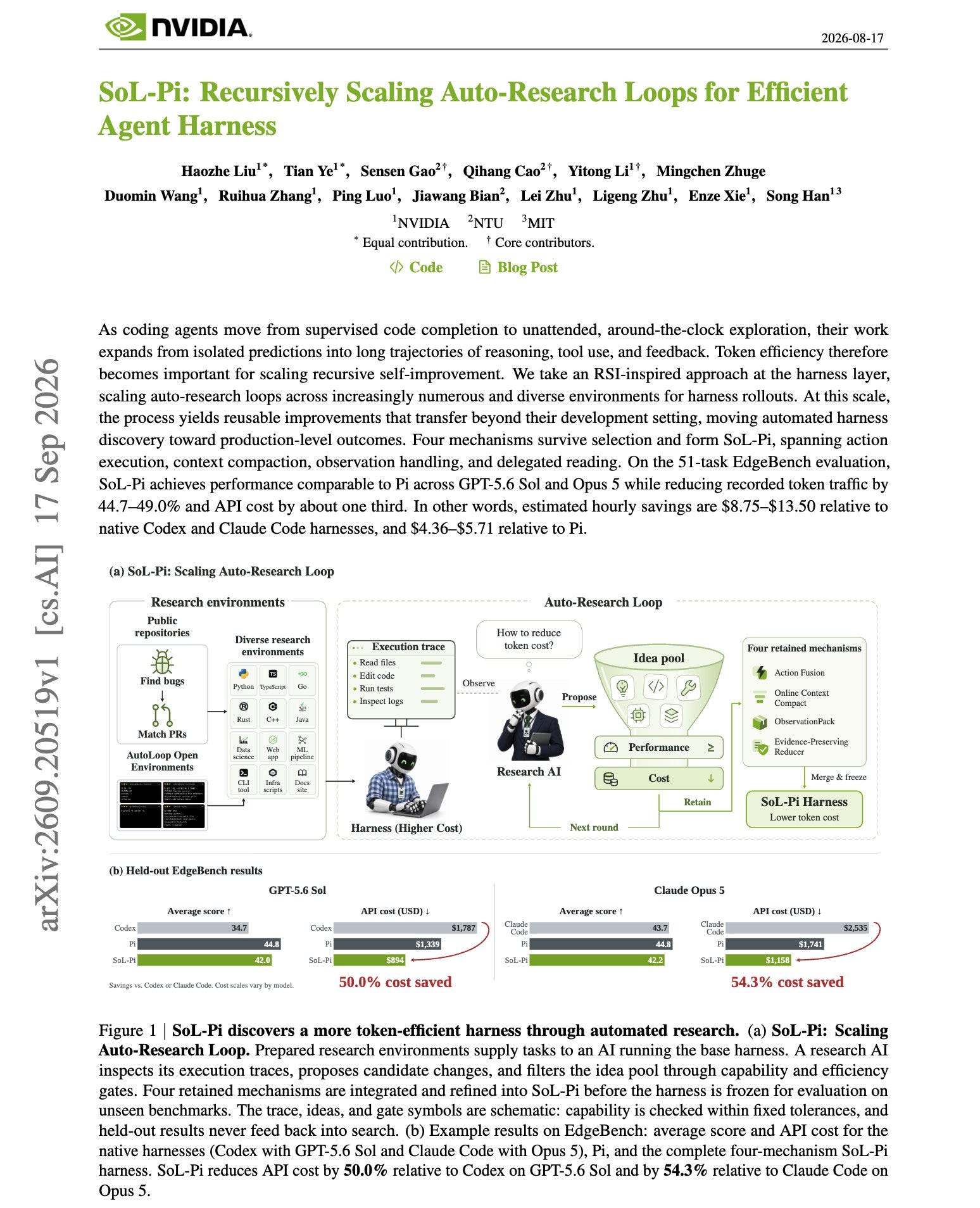
The paper: NVIDIA pointed a research AI at the harness, the machinery around the model, and let it hunt for wasted tokens across 51 held-out tasks. Four mechanisms survived selection.
The result: 50 to 54% off API costs versus native Codex and Claude Code harnesses, at the same model and comparable quality. NVIDIA’s estimate: $8.75 to $13.50 saved per hour of agent work.
The move: the code is MIT-licensed and opt-in, and the four patterns are stealable even if you never install it. The audit below takes an afternoon.
Every AI-native startup has the same line item growing faster than revenue: inference. And almost every founder attacks it the same two ways, switch to a cheaper model or wait for prices to fall.
NVIDIA just published the third way, and it’s the one you control.
The paper is called SoL-Pi, and the setup is the interesting part. Instead of engineers hand-tuning the harness (the machinery around the model that organizes tools, context, files and feedback), they pointed a research AI at it. The AI watched agents work across many environments, spotted where tokens were being wasted, proposed fixes, and tested them. 152 candidate ideas entered the loop. Four mechanisms survived selection.
The result, on the held-out 51-task EdgeBench evaluation: performance on par with the baseline harness across GPT-5.6 Sol and Claude Opus 5, with recorded token traffic down 44.7 to 49% and API cost down roughly a third against the baseline, and 50.0 to 54.3% against the native Codex and Claude Code harnesses. In dollars, NVIDIA estimates $8.75 to $13.50 saved per hour of agent work against the native harnesses.
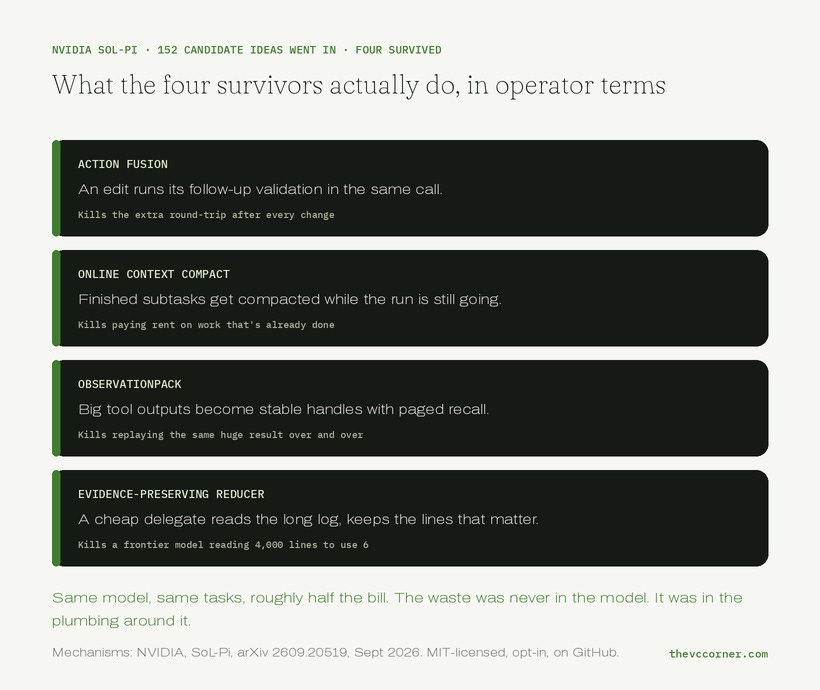
The four survivors share a pattern that should change how you look at your own bill. None of them makes the model smarter:
The waste was in the plumbing. A frontier model reading a 4,000-line log to use six lines of it. Completed subtasks sitting in context, billed on every turn. The same giant tool output replayed for the tenth time. An edit followed by its obvious validation command as two separate round trips.
That is where half your agent bill is going right now, and it has been an engineering choice all along.
And you can have it. The code is MIT-licensed on GitHub under NVlabs, opt-in, every mechanism off by default. NVIDIA’s own one-line summary of the repo:
“Spend less without making the agent do less useful work.” (NVlabs, SoL-Pi README)
Because the search ran across many environments instead of one, the mechanisms kept working outside the setting that produced them, which separates a lab trick from something worth deploying.
Now the fine print, because I’d rather you quote this correctly. EdgeBench is NVIDIA’s own evaluation, the dollar figures are their estimates, and “comparable performance” still means a point or two below baseline on average. You are trading a sliver of capability for half the cost. For most production workloads that trade is obviously right, and it is still a trade.
Below the paywall
The five-move harness audit. Move 2 alone, the log-reading check, is an afternoon of work and it’s where the paper found the biggest single waste
The three questions investors are already asking about agent margins, and the answer that reads as running the business versus renting a margin
The board-meeting frame: where this fits in the systems-engineering-beats-model-capability story, with the one line to steal
Cancel anytime. First subscribers get 50% off forever.
A membership also opens the AI-native product operating model, the inference engineering playbook, the agent reliability playbook, and 10,000+ named investors when the margins are good enough to raise on.