

The Most Underrated Story on AI Coding
History is full of examples of companies who revolutionized entire industries by moving complex work into shared, live environments.
Figma did it for design by ditching static files for a collaborative canvas, and Google Docs did it for writing by ending the hustle of emailing Word attachments back and forth.
Today’s guide is presented by our partners at Vanta
NIS2, DORA, and the EU AI Act are reshaping the regulatory landscape fast. If you’ve already achieved SOC 2 or ISO 27001, the question is how to map those existing frameworks to new EU requirements without rebuilding from scratch.

Vanta is running a free session on March 31 covering exactly that: how to reuse controls across audits, scale compliance with automation, and future-proof your program for 2026 and beyond.
In the same way, Replit has completely changed the way software is created by moving the entire development process into the browser. But Replit’s story is even more fascinating.
Replit was not built to make existing developer workflows slightly better. It was built to remove the friction that usually decides who gets to write software from the get go.
This removal of friction is exactly why the platform became the natural home for the AI era. Once the machine setup was gone, the only thing left to do was speak a project into existence.
Two days ago, Replit announced a $400M Series D at a $9 billion valuation, tripling from $3 billion in just six months. The round was led by Georgian Partners, with a16z, Coatue, Y Combinator, Craft Ventures, Qatar Investment Authority, Databricks Ventures, and even Shaquille O'Neal and Jared Leto participating. Amjad Masad is now a billionaire for the first time, worth an estimated $2 billion. The company is targeting $1 billion ARR by the end of 2026.
Table of Contents
1. The Origin Story That Actually Matters
2. The Dismissal of a “Beginner Tool”
3. Dismissal Was The Moat
4. Building the “Motorcycle”
5. AI Was Not a Feature. It Was a Reorientation
6. The Billion Developer Future
7. Beyond the Tool: The Sovereign Builder
1. The Origin Story That Actually Matters
The shape of Replit makes more sense when you look at the conditions its founder learned to code under.
Amjad Masad, who co-founded Replit in 2016 with Faris Masad and Haya Odeh, did not grow up in an environment where a personal computer, stable internet, or hours of uninterrupted access could be taken for granted. Coding happened on shared machines, often in internet cafés, under time pressure and with fragile setups. Installing tools, configuring environments, or recovering broken dependencies was not a rite of passage, rather a barrier.

Those constraints go against what most developer tools assume. Traditional workflows are built around ownership. You own the machine, control the environment, and can afford to break and rebuild it.
In shared or unstable settings however, setup step becomes a tax, and any local dependency becomes a point of failure. The rational response is not better documentation or faster installs; it is to remove setup entirely.
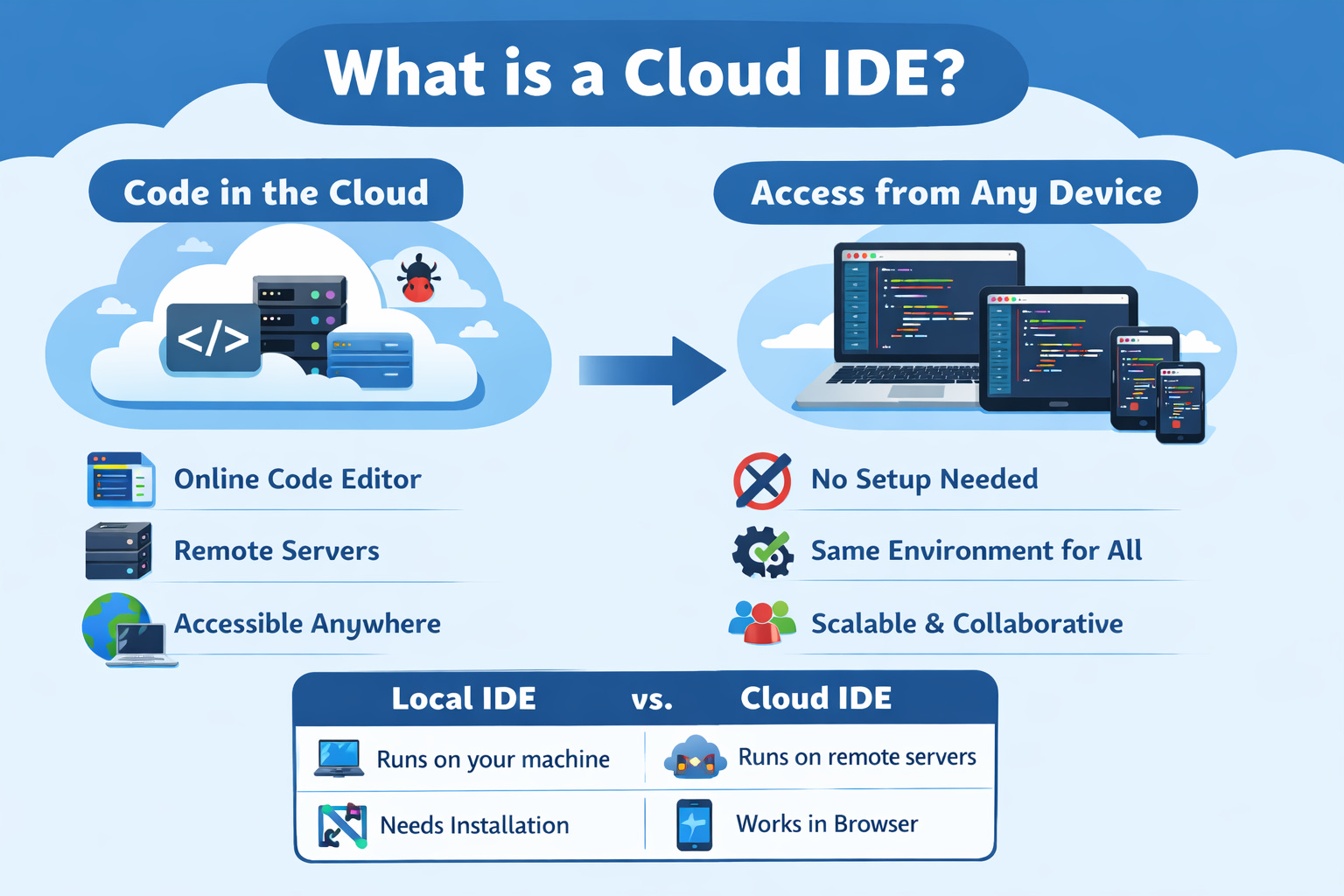
That is the logic behind a browser-native Cloud IDE. If the environment lives in the browser, access becomes transient by default. You open a session, work, and leave without consequence. Nothing depends on the state of the machine you are sitting at. The product decision follows directly from the constraint. Coding becomes something you enter, not something you provision.
What makes this founder-market fit rather than a lucky insight is that the same constraint showed up again later, in different forms.
At Codecademy, Masad saw how many beginners never made it past the first environment error. At Facebook, he saw the opposite extreme, where powerful internal tooling worked precisely because the environment was tightly controlled. The conclusion is that ease of creation is all about eliminating fragility at the entry point.
That’s why Replit’s early focus was defensive, rather than idealistic. It was designed to survive hostile conditions such as limited access, unreliable machines, and users who could not afford to spend time fixing tooling before writing code.
And the browser was the only place the product could exist without inheriting the assumptions that excluded most would-be builders in the first place.
2. The Dismissal of a “Beginner Tool”
Replit was famously rejected by Y Combinator three times before finally getting in on the fourth attempt. During one interview, a partner suggested that an online REPL was not a real business and that Masad should join another company instead.
The eventual acceptance into YC only happened because Amjad leaned into his unconventionality. After years of rejections, he received a late-night invite to apply one last time.
Frustrated and exhausted, he submitted a bare-bones application and replaced the traditional pitch video with a YouTube link to the “Rickroll” video. He was accepted not because he fit the typical Ivy League mold, but because his interview performance showed a level of determination that the partners couldn’t ignore.
This “misfit” energy became the foundation of Replit’s internal culture. Amjad consciously builds teams by finding undervalued talent in niche online communities, people he calls “weirdos and misfits” who may lack traditional credentials but possess raw talent and unique perspectives.
This hiring philosophy allowed Replit to stay in an “unserious” market for years, refining accessibility while others chased professional benchmarks.
By the time the professional world began to take notice, the platform already had scale, familiarity, and a generation of builders who had never known any other way to work.
3. Dismissal Was The Moat
Early skepticism toward Replit followed a predictable pattern in technology. New tools are almost always judged by how well they serve the experts already inside the system.
So professionals evaluated the platform by asking if it could replace their complex local setups without losing any capability. Because a browser-based IDE initially lacked the raw power and deep customization of a desktop machine, it was labeled as a fun toy rather than a serious startup.
This dismissal happened because markets tend to overvalue tools that make the productive more productive, while undervaluing tools that expand the number of people who can participate.
Why Professional Dismissal Happens Predictably
In most tech cycles, professionals judge new tools by asking whether they can replace what is already being used without sacrificing any capability.
A browser-based IDE answered that question poorly at first. It didn’t promise deeper control, better performance, or tighter integration with established stacks. It only promised less friction. And to experienced developers, that sounded like a downgrade.
This is where mispricing begins. Markets tend to overvalue tools that improve productivity for the already productive and undervalue tools that expand participation. The former shows immediate ROI, while the latter looks like a long tail of low-value users.
Venture and product markets both make this mistake because they measure upside through current behavior rather than future compounding.
Students and Hobbyists as Distribution
Replit’s early users skewed toward students, teachers, and hobbyists because they felt setup costs most acutely.
In classrooms, adoption had nothing to do with novelty. It worked without negotiation. Teachers could start a session without waiting for IT approval, and students didn’t need identical machines or preinstalled software. The environment leveled itself automatically, which meant everyone could begin at the same moment rather than drifting in over days or weeks.
This mattered because those users didn’t just consume the product, they propagated it. A shared project became an invitation, a classroom became a cohort, and a hobbyist experiment became a reference someone else could copy.
Each use case pulled in more users without paid acquisition. What looked like a shallow user base was actually a distribution engine tuned for repetition.
Patience as a Strategic Choice
The important part is that this dynamic required patience. Replit did not rush to validate itself against professional benchmarks that would have forced premature complexity. It stayed focused on reliability, accessibility, and continuity of use.
That restraint preserved the original advantage. By the time professional developers began paying attention, the platform already had scale, familiarity, and behavioral lock-in among the next generation of builders.
This is how moats form when markets misprice early demand. What looks like weakness through one lens becomes compounding strength through another. The dismissal wasn’t a hurdle Replit overcame by accident. It was the space that allowed the platform to grow without being pulled into the wrong optimization loop.
4. Building the “Motorcycle”
Replit’s competitors were busy building the “skyscraper” of the professional IDE; think massive, complex structures requiring local servers, configuration files, and expert maintenance. But Replit decided to build a “motorcycle.”
A motorcycle is integrated, lightweight, and ready to go the moment you sit down. By owning the editor, the database, and the hosting within a single container, Replit reduced coordination costs to zero. There is no hand-off between writing code and making it live.

This infrastructure was the result of a decade of preparation. When the breakthrough in Large Language Models (LLMs) arrived, Replit was the only platform where an AI agent could not only write code but also execute it, test it, and deploy it autonomously. Because the agent lived inside the machine it was building for, it didn’t have to ask for permission or wait for a human to fix a broken environment. It simply worked.
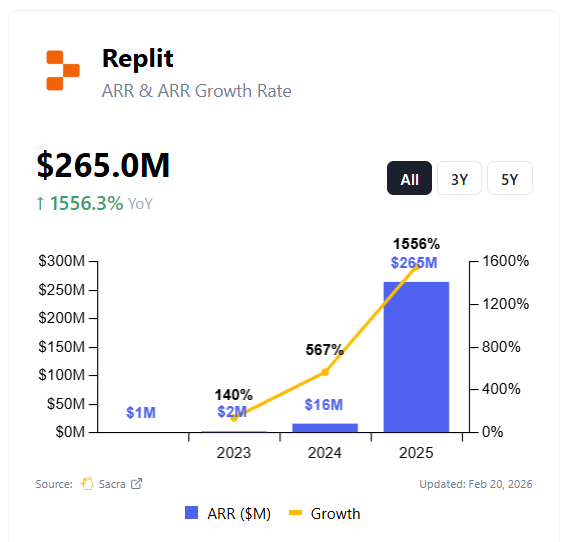
The financial results of this readiness were explosive. Replit grew from $10M to $100M in ARR in just over five months during early 2025. By September 2025, the company reported $150M in annualized revenue and closed a $250M round at a $3B valuation. By the end of fiscal year 2025, total revenue reached $240M. The platform now has 40 million total users, 150,000+ paying customers, and is used at 85% of Fortune 500 companies. In March 2026, Replit tripled its valuation to $9B with a $400M Series D, and is now targeting $1B ARR by year-end.
And none of this was the result of luck. This was simply the inevitable outcome of a platform that had spent years solving the “boring” problems of infrastructure so that AI could finally handle the “hard” problems of creation.
Underlying this growth is a bet on the Jevons Paradox. In economics, this paradox states that as a resource becomes more efficient and cheaper to use, the total consumption of that resource actually increases rather than decreases.
Replit believes that as AI makes software “cheap” to build, the world will not need fewer developers. Instead, we will see an explosion in demand. When every small business, student, and knowledge worker can build their own tools for the cost of a few API tokens, the total amount of software in the world will grow by orders of magnitude.
5. AI Was Not a Feature. It Was a Reorientation
Most AI tools are built for efficiency, helping developers type faster, to be more productive.
But Replit focuses on autonomy. While a “Copilot” suggests the next line of code, the Replit Agent acts as a junior architect. It plans the file structure, installs the database, and configures the server.
This is a reorientation of the entire development flow. In a traditional setup, you must translate an idea into precise instructions before a computer can help you. Replit inverted this where the system now responds to intent before demanding precision.
And that’s when AI coding or “vibe coding” entered the mainstream conversation. Critics argue that generating code without manual typing leads to messiness or a loss of fundamentals, but this misses the structural change in the work. Value has migrated from implementation to judgment. When the cost of writing code drops to zero, the hard part is no longer typing the syntax; it is deciding what should exist, evaluating the results, and exercising taste. The human role has moved from being the engine to being the editor-in-chief.
To maintain this lead, Replit abandoned rigid development plans. CEO Amjad Masad famously noted that “roadmaps are dead” in an era where technology changes every two weeks.
The depth of this shift was visible even to industry legends. Two years ago, Masad invited Paul Graham to his home office near Palo Alto to demo the AI agent. When Graham, a lifelong programmer, instinctively looked at the generated code, Masad stopped him. There was no need, he said. Source code would be an unimportant byproduct. Programming would now be done in English.
That conviction is now being tested against formidable competition. Claude Code, Anthropic’s coding product, surged to $2.5B in annualized revenue and is widely considered the vibe coding frontrunner. Cursor grew to over $2B ARR and has been in ‘war time’ mode internally. OpenAI’s Codex has 1.6 million weekly active users. Lovable and Cognition are gaining ground in narrower niches. Replit’s answer is to occupy a different lane entirely: coding for non-technical workers. Sales staff, marketers, small business owners. Instead of a code editor, Replit offers a whiteboard-style interface where users choose from buttons to tell the agent what to create, from spreadsheets to data visualizations to 3D games. That positioning is why the company tripled its valuation even as larger competitors scaled past it in raw revenue.
The company proved this by rapidly adopting Anthropic's latest models (now Claude Opus 4.6) and Google Cloud's infrastructure.
6. The Billion Developer Future
Amjad Masad’s vision of “a billion developers” is not a prediction that everyone will become a professional software engineer, but a prediction that the barrier between having an idea and building it will vanish.
For the first time, the internet is becoming the great wealth equalizer it was promised to be. And the enterprise world is already moving. Replit is now used at 85% of Fortune 500 companies. Employees at Zillow, Duolingo, and hundreds of other companies use the platform to prototype and deploy internal tools at speeds that would have required engineering teams a year ago.
This is where the Replit’s origin story ties into its future. By using Replit, a student in rural India with no laptop, only a low-end Android phone can bypass the need for expensive hardware and learn to build applications in the browser. By taking on tasks through the platform’s bounties program they can earn more in a month than his entire family earned in a year.
The tools to do this are now tangible. Replit launched Mobile Apps on Replit for iOS and Android, allowing users to describe an app idea in plain English and watch it become a working product, then publish directly to app stores. Stripe integration is built in from day one, so monetization works out of the box. Agent 4, the latest iteration, lets users start by choosing from a set of buttons (spreadsheets, data visualizations, 3D games, storefronts) instead of writing prompts. The gap between idea and product keeps shrinking.
Masad is investing accordingly. The $400M round is going primarily toward international expansion, particularly in Asia and the Middle East, and toward growing the go-to-market team. 'Innovation can come from anywhere in the world,' Masad said in the announcement. 'We want to help unlock it.
This is the “Long Tail” of software, where millions of people previously locked out of the digital economy can now export their intelligence globally without a plane ticket or a degree.
This eventual transition could change the internal structure of companies. For a century, businesses have operated like industrial pipelines. A salesperson finds a problem, writes a request, and waits weeks for an engineer to build a solution. Replit replaces this pipeline with a network of “generalist problem solvers.”
In this future, a sales representative doesn’t wait for a “ticket” to be resolved; they use an agent to spin up a custom SDR tool in an afternoon. A marketer doesn’t ask for a data dashboard; they build one.
We are moving away from a world where software is a scarce resource controlled by a priesthood of experts. As the “setup tax” disappears and agents handle the implementation, the economy shifts toward participation. The final result of the Replit story isn’t just a better way to write code, but the decentralization of the power to create.
7. Beyond the Tool: The Sovereign Builder
The arc of Replit offers a lesson that builders and investors often overlook. The most valuable disruptions do not come from making a difficult task faster, but from making a gated task common.
The software industry has always been a cathedral of high walls. We measure a founder’s potential by their ability to hire a specific kind of expert who could navigate a specific kind of friction. We treat the “setup tax” and the “infrastructure hurdle” as natural filters for quality.
Replit’s success proves those filters were actually bugs. By collapsing the stack into a browser and handing the keys to an agent, Replit has turned software from a capital-intensive product into a liquid form of expression.
This is the end of the “Ticket Era.” The takeaway is that the competitive advantage of the next decade will belong to the companies with the highest density of builders. When the cost of implementation falls to zero, the only remaining scarcity is the ability to identify a problem worth solving.
And just like that, we might really be moving into a world of “Sovereign Builders,” individuals who possess the taste of a designer, the logic of a programmer, and the agency of a founder, all without needing the traditional credentials of any of them.
The path forward carries risk. Earlier in 2025, the Replit Agent mistakenly deleted a customer's entire codebase. Masad issued a public apology and the company rolled out new safeguards. When an AI agent can build, it can also destroy. The trust required to hand over production environments to autonomous systems is still being earned, one incident at a time.
Replit did not build a better IDE. It built a world where the kid in the Jordanian internet café and the marketing lead in a Fortune 500 company have the exact same power to materialize an idea.
very interesting to read! the origin story reframes the whole product: zero setup wasn't a limitation, it was the thesis from day one.
Tried using it..but it never allowed me to loging with my gmail..
Got tired of seeing the founder in YouTube advertisement.
Two basic criteria due to which Replit is useless for me