

i expected the family offices to be the best part of the US investor databases we pulled for this list. They turned out to be the worst.
We started with 1,039 US firms from public investor databases, the kind of file founders download, filter for an hour and then email in bulk. Of those rows, 191 were tagged “family office”. Every single one turned out to be a wealth manager, an asset manager or a firm selling retirement and estate planning, from Ritholtz Wealth Management to BNP Paribas Asset Management.
Picture a founder sending a seed deck to a 401(k) adviser in Minnetonka. That’s the cost of a dirty list: wasted sends, a burned domain and a week of silence you read as rejection.
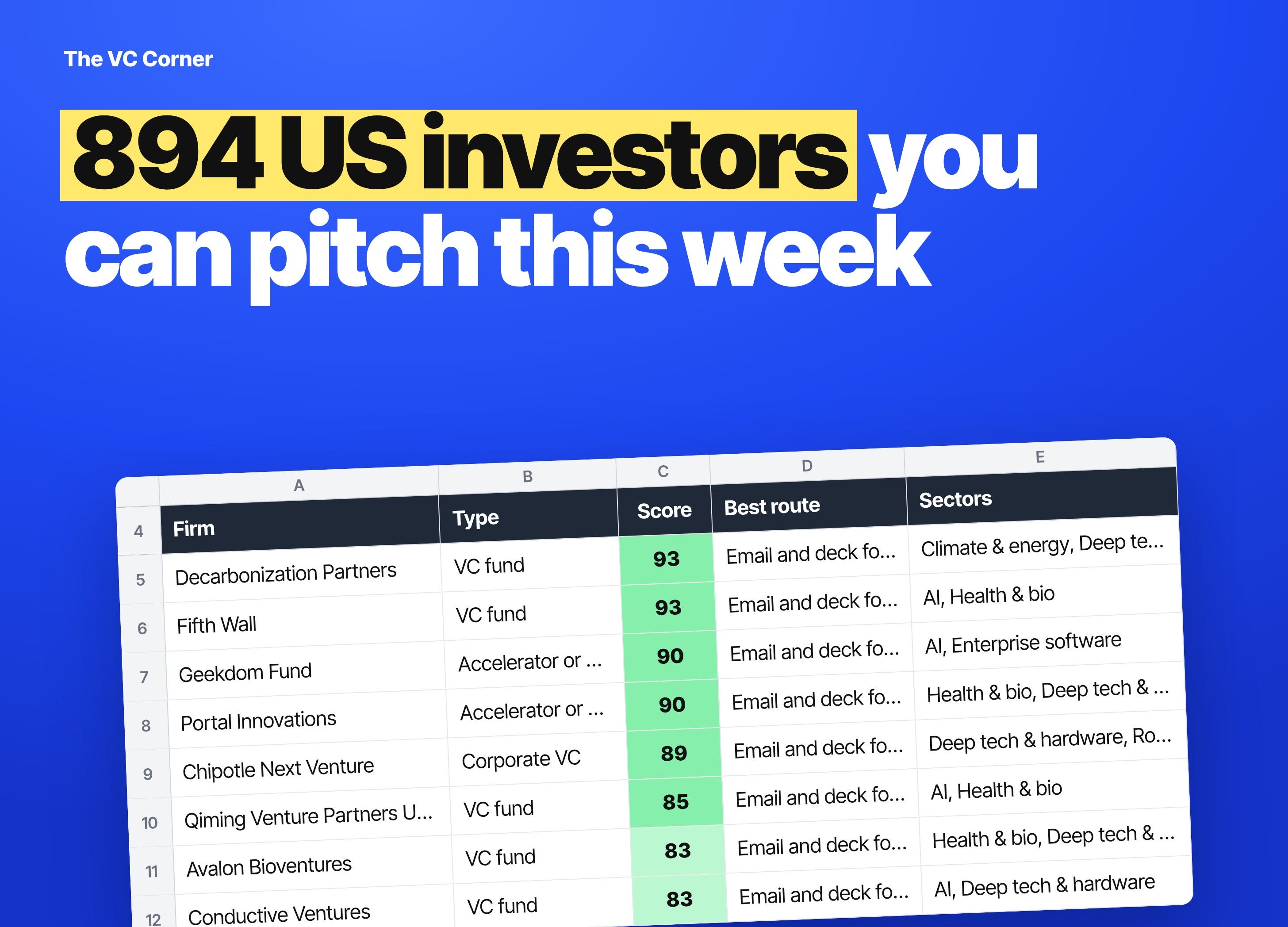
So we rebuilt it. The result is The US Investor List 2026, with 894 funds, angels, corporate VCs and accelerators that back startups. Every row is sorted by how easy the firm is to reach, and every removal is logged with its reason. It joins the rest of our investor lists.
A shorter list you can trust beats a longer one you have to second-guess.
The market you’re pitching into
First, the money. The PitchBook-NVCA Venture Monitor for Q3 2026 has US venture deal value at $515.8bn through September, across an estimated 14,199 deals (PitchBook-NVCA).
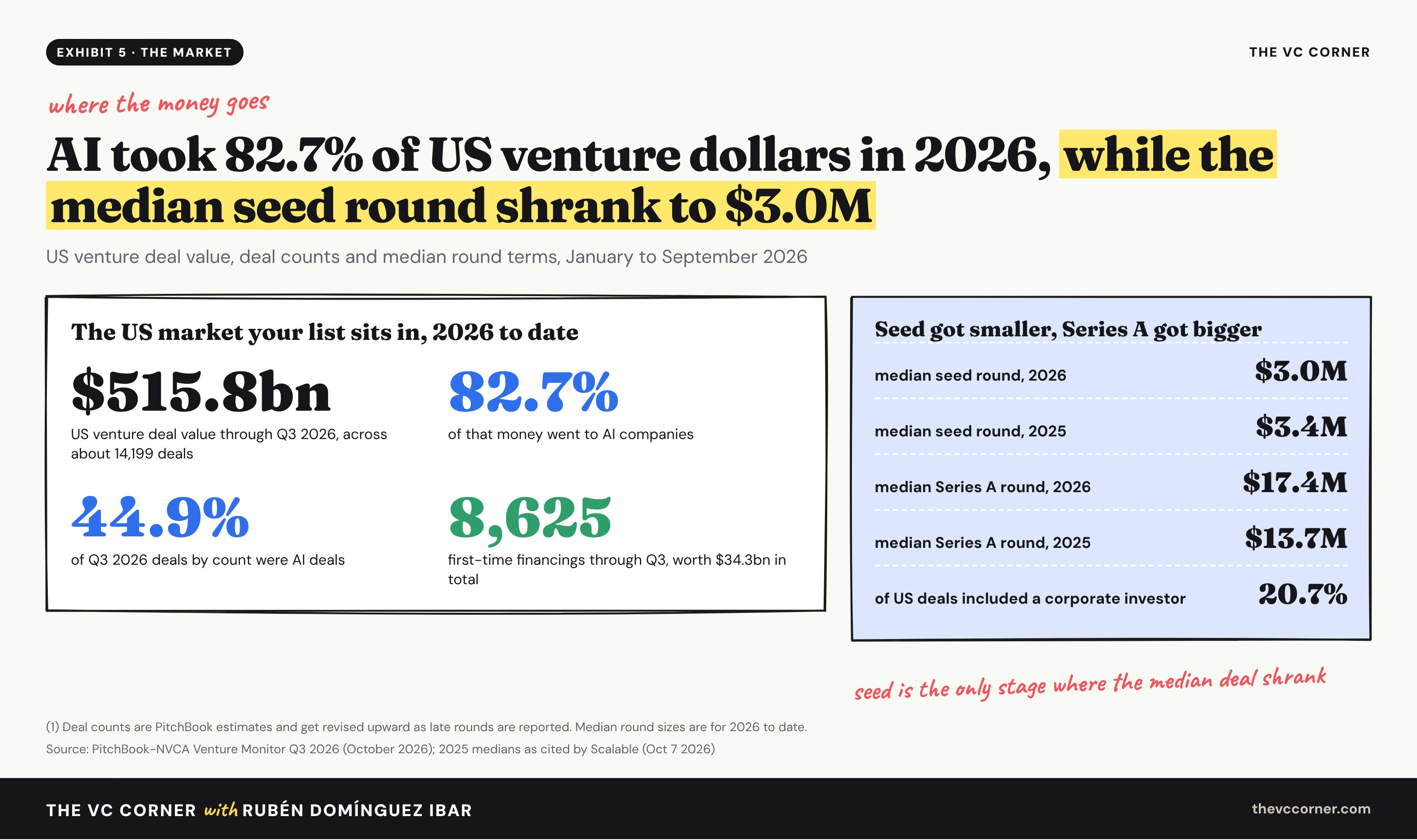
Four numbers from that report shape how you should use any investor list this year:
→ AI took 82.7% of the dollars. In Q3 alone, 44.9% of all US deals by count went to AI companies. If you build in AI, most of the list is in play. If you build outside AI, the firms that still write other checks matter more.
→ The median seed round shrank to $3.0M, from $3.4M in 2025, while the median Series A grew from $13.7M to $17.4M (Scalable). Seed is the only stage where the median deal got smaller, so plan your round around the median and treat the giant rounds as outliers.
→ 8,625 companies raised their first round through Q3, for $34.3bn in total. That’s the crowd your cold email competes with.
→ Corporate investors sat in 20.7% of US deals. The list includes 57 corporate VCs for exactly that reason.
At pre-seed, the instrument is settled: 93% of pre-seed rounds on Carta were SAFEs in Q2 2026, and SAFEs above $2.5M carried a median valuation cap of $35M (Carta).
What they back
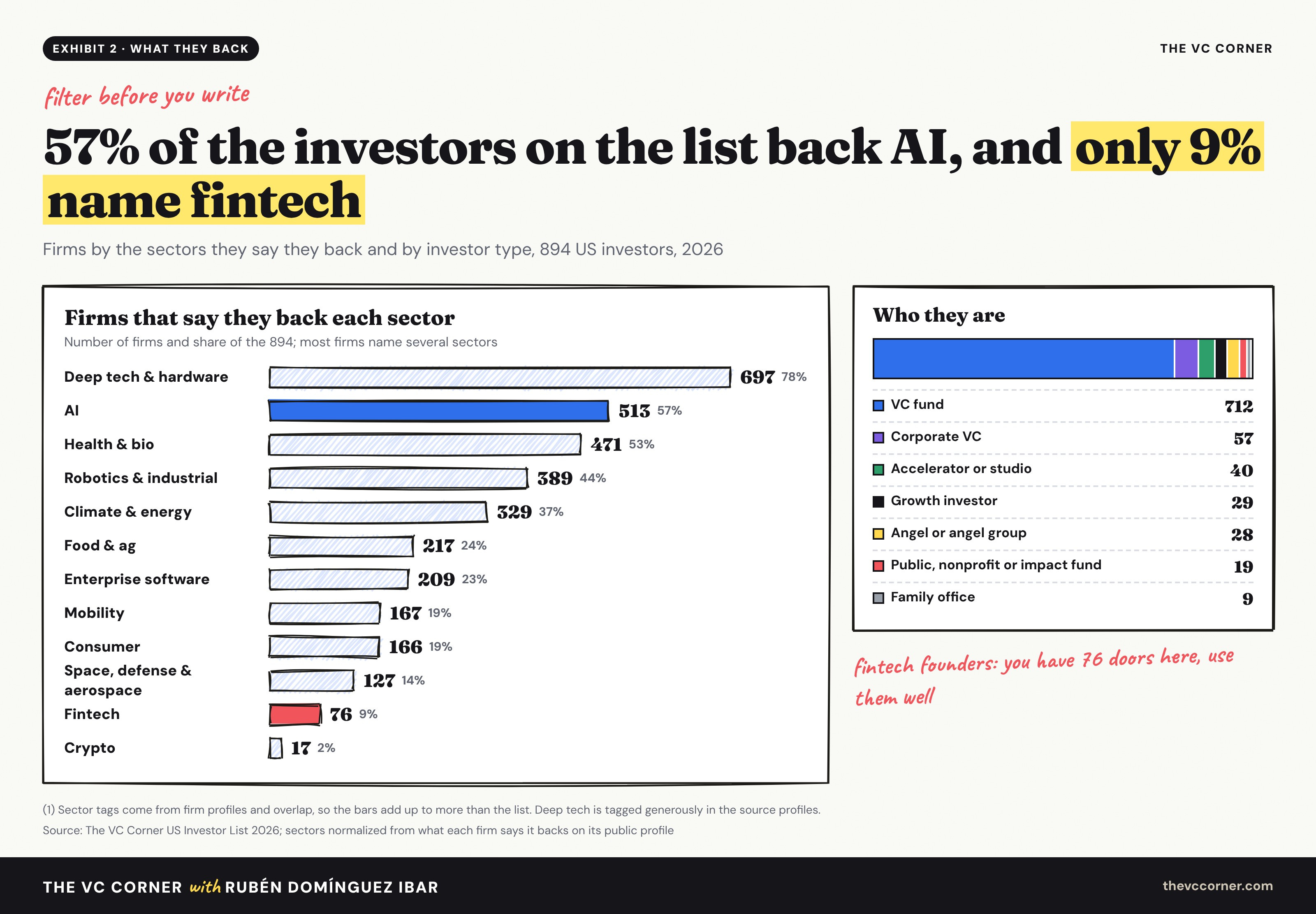
57% of the investors on the list say they back AI, which matches where the money went. Health and bio follows at 53%, then climate and energy at 37%.
Fintech founders have the thinnest bench: 76 firms, or 9% of the list, name fintech. That number is worth knowing before you plan your raise, becuase it means fewer second chances. Run fewer, better-prepared waves.
By type, the list is 712 VC funds, 57 corporate VCs, 40 accelerators and studios, 29 growth investors, 28 angels and angel groups, 19 public, nonprofit or impact funds and 9 family offices that invest directly, such as DNS Capital and Pritzker Group.
What’s in the list
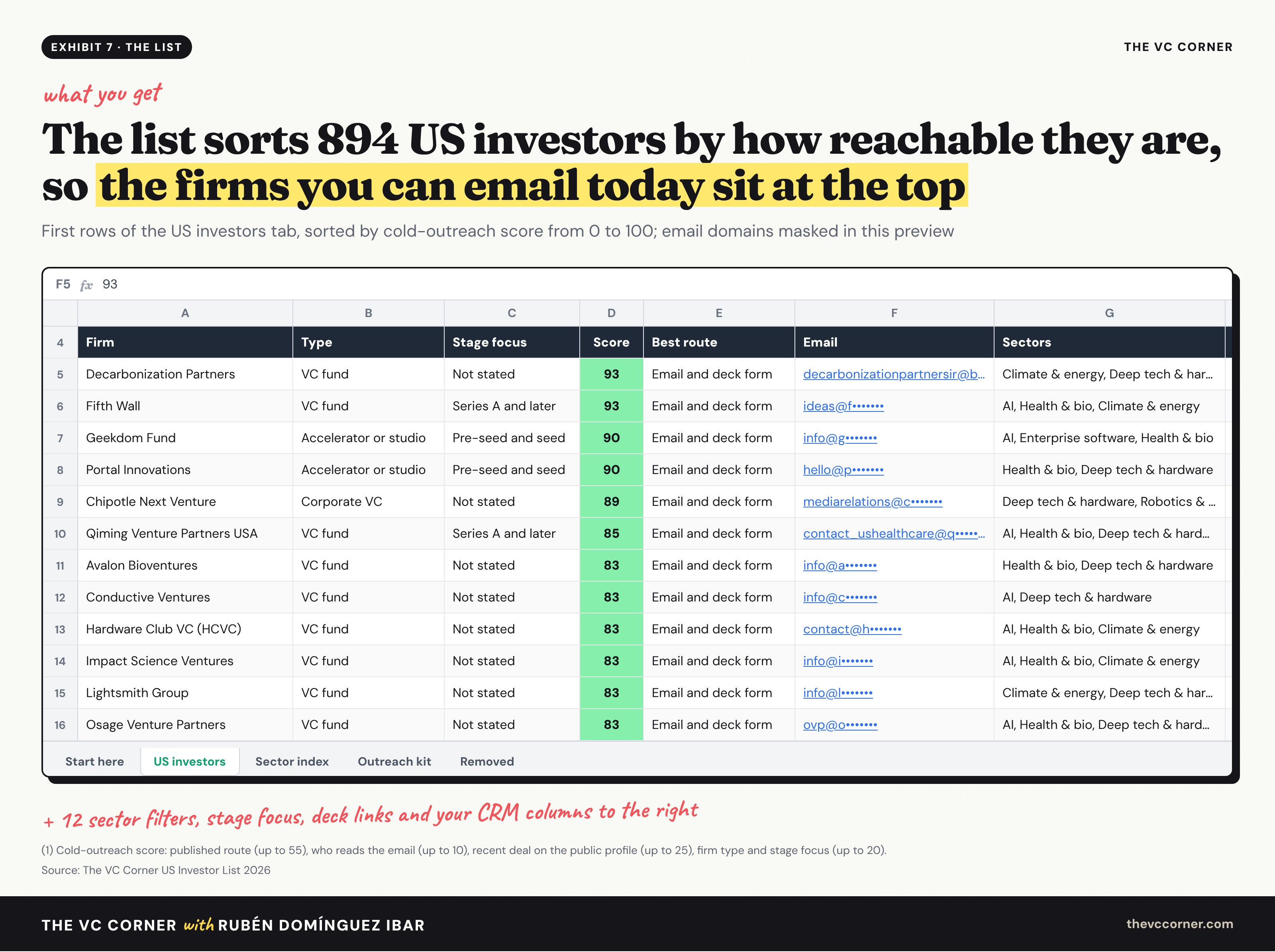
894 US investors, sorted by a cold-outreach score from 0 to 100, so the firms you can reach today sit at the top
12 sector filters, from AI and fintech to space, defense and aerospace, each as its own column
Stage focus for 329 firms, from pre-seed to growth, plus city, website and the last deal on the public profile
454 published routes: 207 emails, each labelled by who reads it, and 321 deck forms with a direct link
92 active funds the public databases missed, marked so you can find them
CRM columns for status, last touch, next step and notes, with a live pipeline count
The Outreach kit: a six-week plan, three emails that get answered and a reply-rate tracker
The Removed tab: all 237 rows we cut, each with its reason
Cancel anytime. First subscribers get 50% off forever.
Here’s The US Investor List 2026. Download it, open it in Excel or Google Sheets and make it your fundraising CRM: