
The Secret Strategy Behind Stealth Startups
Somewhere right now, a team of four is working out of a borrowed office, shipping code without doing LinkedIn posts, no launch countdowns, and no brand name on their door. They’re not chasing press and Forbes articles. They’re not collecting claps on a blog post.

That’s because they’re busy building something real.
At the same time, another startup from a few blocks away was just featured on TechCrunch. Bold branding, angel round announced, top of Product Hunt. Loud by design.
In six months, only one of these teams will still have momentum. And it's probably not the one trending today.
Building in silence doesn’t mean building recklessly…
The best stealth teams move fast but stay disciplined about what they ship and what risks they take on, especially with AI tools entering the stack.
Vanta’s free AI Security Assessment Template helps fast-moving teams evaluate AI tools before deployment, align with GRC best practices, and standardize internal risk reviews.

If you’re scaling quietly and adopting AI, this is how you stay fast without creating liabilities:
Stealth isn’t secrecy for secrecy’s sake.
It’s a strategy; a deliberate trade-off between focus and optics, between progress instead of perception. And for a certain kind of founder, it can be the difference between building a launch… and building a company for the long-run.
Building in stealth does not mean you wish to create mystery. It’s because you wish to control the surface area of distraction.
In this article, we’ll break down how stealth mode startups actually work in 2025, the two types of stealth, why founders choose it, where it goes wrong, and most importantly, how to launch from stealth without missing your shot.
Table of Contents
1. What Stealth Really Means in 2025
2. Why Founders Go Stealth: The Strategy Behind the Silence
3. The Hidden Risks of Stealth
4. The DNA of a Successful Stealth Startup
5. How to Emerge from Stealth: The Modern Launch Masterclass
6. The Investor Perspective: How VCs Evaluate Stealth Deals
7. Should You Go Stealth? The Decision Framework
8. The Power of Building in the Shadows
1. What Stealth Really Means in 2025
When most people hear “stealth startup,” they picture a company in hiding. No website, no press, no public product. But in 2025, stealth mode is all about deliberate, strategic quiet. Building with intention, not isolation.
A true stealth startup is a purpose-driven quiet builder. These founders aren’t ducking attention because they’re unsure. They’re opting out of the noise to focus, iterate, and surface on their own terms.
Stealth may have started as a marketing gimmick or a mystique play, but now it has evolved into a phase of controlled silence designed to create an unfair advantage.
Two Flavors of Stealth
In practice, most stealth startups fall into one of two categories:
1. Full Stealth
These companies keep everything under wraps. They do not reveal names, products, or even their existence at all. They will often use placeholder legal entities, keep their website unpublished, and post vague job listings. Early SpaceX and Magic Leap operated this way, building heavy tech in secret until they had something game-changing to show the world.

2. Partial Stealth
Although these startups are publicly visible, they obscure their real mission. Yes, you might know the name or part of the team, but nobody knows what their ultimate purpose is. They’ll tease a problem space but not say what they’re building. Robinhood’s early waitlist and Anthropic’s pre-launch era are prime examples of companies that were quiet on product, loud on potential.'
Both approaches are valid. What matters is intent.
A Temporary Phase, Not a Business Model
Stealth isn’t forever, and nor should it be. The goal isn’t to stay hidden, but to stay focused long enough to build something worth showing. Then, when you emerge, you do it with force.
That’s why “build quietly, launch loudly” has become the new mantra, replacing the old startup ethos of “move fast and break things.”
Speed is still important. But clarity and timing matter more. Stealth is the space to find both.
2. Why Founders Go Stealth: The Strategy Behind the Silence
No one chooses stealth mode because it’s easy. Founders choose it because they’re optimizing for control. Control over their product, their pace, and the moment they step into the market.
A stealth startup isn’t trying to avoid attention forever. It’s just not willing to be distracted by it yet. Here’s why founders make that call:
Competitive Edge
Startups live and die by speed, but also by surprise. Stealth gives founders a window to develop defensible IP without alerting fast-followers or incumbents watching the space.
Magic Leap raised hundreds of millions before revealing what it was building, preserving secrecy around its AR tech while it locked down patents and prototypes.

In deep tech, that kind of runway is the elixir of survival.
Freedom to Iterate
Without public eyes on every move, stealth teams can experiment aggressively. No press coverage, no SEO playbooks and blog posts, no pressure to make each sprint demo-worthy. Just space to break things in private.
Figma spent nearly three years in stealth, rebuilding its editor from scratch multiple times. The result was a product that felt instantly polished at launch because it had failed quietly before it ever went live.
Narrative Control
Once you go public, your story starts writing itself, usually through someone else’s pen. And stealth mode lets you hold the pen longer. You decide when to show the product, what to say about it, and who sees it first.
Many Israeli cyber and defense startups use stealth precisely for this. They refine quietly, secure strategic customers or pilots, and only reveal the full picture once the foundation is locked. The public story doesn’t shape them, they shape the public story.
Expectation Management
The wrong kind of hype and buzz can crush a startup before it even launches officially. Stealth protects teams from that type of “early-stage overexposure”. No inflated headlines, no half-baked product demos, no pressure to deliver on promises made too early.
Stealth mode is a buffer, especially for founders building ambitious tech, where timelines stretch and pivots are inevitable. It’s a chance to underpromise in public so they can overdeliver later.
Remember: Stealth isn’t hiding from the world. It’s building the world before anyone else sees it.
3. The Hidden Risks of Stealth
For all its strategic upside, stealth is not actually a cheat code. It’s a constraint, and constraints always carry risk.
When you cut yourself off from the world, you also cut yourself off from feedback, momentum, and support.
While stealth may protect you from noise, it also silences the signals that many early-stage teams rely on. That’s why stealth magnifies execution risk, and only the most disciplined teams make it through.
Here’s what founders give up when they go quiet:
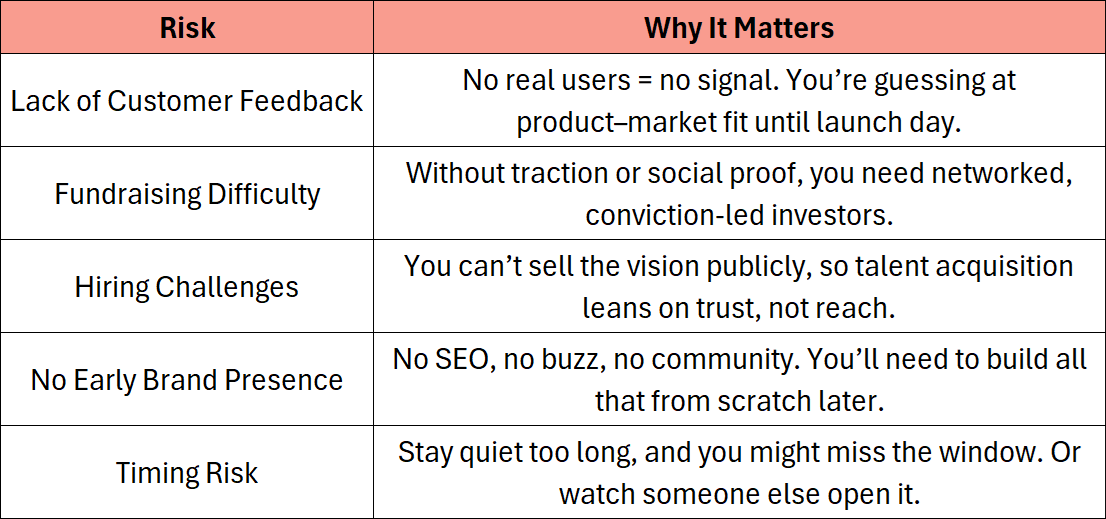
In public, you get small corrections early. In stealth, you don’t get corrections, you just launch and find out if you were right.
That’s why stealth isn’t for the indecisive. It’s for teams who can self-regulate, validate privately, and make real progress without applause.
If that’s not you, going dark won’t protect you, it’ll bury you.
4. The DNA of a Successful Stealth Startup
Stealth doesn’t work by accident. It works when the internal machine runs tighter than the external story. Because when you cut out the world’s feedback loop, you better have a real good one of your own.
Here’s what separates the stealth teams that ship from the ones that stall.
Clear Vision and Conviction
No one stumbles into stealth. The best stealth startups have a sharp thesis about what they’re building, why it matters, and why it needs to stay quiet. SpaceX’s early roadmap wasn’t fully public, but internally, it was crystal clear. Reusable rockets or bust.
This kind of conviction is essential, because without public validation, internal belief is the only fuel you’ve got.

Tight-Knit, Trusted Team
Culture leaks faster than code when in stealth. Which means the team needs to run on trust and avoid politics. Fewer people, fewer handoffs, higher output.
LinkedIn’s stealth period was marked by a compact team that iterated privately but aligned tightly on the mission.
Quiet Market Validation
You can’t test in public. So you are forced to test in the shadows. The best stealth startups find smart ways to simulate signal via trusted advisors, pilot customers, or closed betas with friends-of-friends.
For example, many cybersecurity or defence tech startups, build first deployments with government or enterprise partners long before launch. Feedback isn’t forbidden, it’s just gated.
Internal Milestone Discipline
Without press cycles or user metrics to track progress, stealth teams live and die by internal markers. Launch is merely a checkpoint: “MVP stable,” “first pilot complete,” “patents filed.”
Clubhouse famously emerged from invite-only stealth after hitting internal velocity markers on user retention and engagement, not hype. The play is to measure momentum quietly, instead of theatrically.
Selective, Long-Term Investors
You don’t need investors who ask for weekly decks and timelines, you need ones who bet on the teams.
Successful stealth startups often raise from insiders who get the vision, know the domain, and don’t need press releases to believe in progress. Figma’s backers waited years. Not because they didn’t need noise, but because they needed clarity first.
the FREE AI Fundraising Kit for Founders 🤖

We’ve spoken with hundreds of founders over the past year, and almost every one of them says the same thing: fundraising takes too much time, too many tools, and too much manual work. It distracts them from the most important thing: their Customers.
Strategic Exit Plan
The best teams know how and when they’re coming out, and they build toward it. That means planning the launch artifacts, identifying early champions, and pressure-testing messaging long before launch day. If you don’t plan your exit, stealth turns into stasis.
“Stealth doesn’t just protect you from mistakes. It also protects you from noise.”
The irony of stealth is that the startups that thrive in silence are the ones with the loudest alignment inside. Everything else is just hiding.
5. How to Emerge from Stealth: The Modern Launch Masterclass
You don’t get a second chance at a first impression. Coming out of stealth doesn’t just mean that you are revealing what you’ve built, it’s also about orchestrating a moment that converts all the progress that’s been built behind the scenes into public momentum.
Most stealth startups fail at the exit. Not because their product is wrong, but because the reveal was unplanned. The story is unclear, the launch is soft, and the opportunity slips.
This is more about control than theatrics. Here’s the operating blueprint for stepping into the light the right way.
Step 1: Set the Date and the Scope
Don’t wait for perfect. Pick a launch date and work backwards.
Set a “Must-Have” feature line that is based on what you need working to deliver real value. Be ruthless.
List “Coming Soon” commitments including what you’ll ship post-launch to keep energy flowing.
Write your Launch Promise. Simple, straight-forward, no overpromising, no fluff. When, who, what.
This becomes your internal rally cry and your external headline.
Step 2: Build the Three Narrative Artifacts
Before you decide to tweet or announce on Linkedin, you need to build a spine. These three things define your story and surface area:
Website: Clean, confident homepage. Clear tagline, social proof (if any), one crisp CTA. Add “About” and “Careers” sections. You’re not just launching a product, you’re launching a company.
Founder’s Launch Note: What you built, why it matters now, who it’s for, and where it’s going. This is your voice. The more human, the better. Write it like you’re explaining it to someone you respect.
Social Kit: One primary post per channel (Twitter, LinkedIn, etc.). Include a short demo video, a GIF, or a walkthrough. Test it with the cold viewer rule; if someone outside tech watches for 5 seconds, will they get it?
Step 3: Plan Distribution by Audience
You’re not just launching to the internet. You’re launching to two specific crowds:
Your Ideal Customer Profile (ICP) - where they hang out (Slack groups, subreddits, Discords, niche forums). Go there. Speak their language.
The Tech Ecosystem - founders, operators, angels, VCs. Use this lane for amplification, not conversion.
Don’t ask people to follow you to new channels. Meet them where they already are.
Step 4: Pre-Seed the Flywheel
Momentum doesn’t start on launch day. It starts the week before.
Build an amplifier list of 20–50 people who want you to win. That could be friends, early users, advisors, investors.
Send them a heads-up 7-10 days before launch with links, ask, and timing.
Offer something in return, like early access, private roadmap preview, or just gratitude with context.
You’re inviting them to be part of the ignition, not asking for favors.
Step 5: Run Launch Day Like an Ops Drill
Treat launch day like a product release, not a marketing stunt.
1. Assign clear roles:
Comms lead → posts + replies
Ops → coordinate timing + backups
Founder → direct DMs, key shares, media
Support → handle inbound and feedback
2. Schedule publishing waves:
Owned channels → Personal social → Ecosystem → Partner boosts
3. Be active, respond fast, log what hits. Launch is a loop, not a single burst.
Step 6: Measure Momentum, Not Myth
Ignore the dopamine and measure the signal.
Track these four metrics:
Reach - who saw it
Intent - who clicked or replied
Quality - who matters in that group
Learning - what surprised you
Review them a day later, 3 days later, and 14 days later. A launch is not underlined by how much noise you make, but by how you find the next move.
Step 7: Follow Up With Proof
The fastest way to kill buzz is to disappear.
Ship something from your “Coming Soon” list within 30 days of launch. Announce it and show that launch wasn’t the end but the ignition. This turns curiosity into belief. And belief into traction.
One last note: If you’re coming out of stealth, you already did the hard part. You built in silence. Now it’s time to speak with clarity. Not loudly, just cleanly. The rest takes care of itself.

6. The Investor Perspective: How VCs Evaluate Stealth Deals
Most investors will fund what they can see. Stealth startups ask them to believe in what they can’t. That makes diligence a different game.
When a startup is in stealth, there are no metrics to point at. No user charts, no brand buzz. The usual signs of momentum are missing. So good investors will approach them differently. They will look past traction and into texture.
What VCs Really Evaluate in Stealth
Here’s what replaces dashboards and headlines in a stealth deal:
Team Quality
Can this team ship? Have they done it before? Are they tight-knit, cross-functional, and fast?
In stealth, the team is the traction.
Tech Defensibility
Is the product hard to copy? Is there IP, novel architecture, or a hard technical edge?
No one funds a secret clone, they fund a technical wedge.
Founder Conviction
Why are you in stealth? Can you explain it clearly, without sounding evasive?
Good founders can articulate stealth as strategy. Weak ones use it as a cover story.
Network Validation
Who else believes in this? Have smart angels, advisors, or former colleagues quietly joined the cap table?
The company might be hidden, but the signal still leaks through your network.
Spotting “Fake Stealth”
Not all stealth is real. Some startups say they’re in stealth, because they have nothing to show.
Investors can tell from the red flags such as:
Vague answers about milestones or timelines
No prototype, no pilot, no pre-product progress
No clear reason for staying hidden
Defensiveness around basic questions
Real stealth is earned, whereas fake stealth is laziness dressed up as mystery.
What Good Investors Want to See
Even without public proof, smart VCs will look for:
Clear internal milestones hit (“We’ve completed XYZ internally, now moving to pilot with ABC”)
Functional prototype or strong technical demo
Selective early users or pilots under NDA
Reputation signal (strong founder track record, credible intros, trusted backers)
Intentional stealth rationale; a clear explanation of why now is not yet
No one expects perfection, but they do expect progress, and intent.
Stealth doesn’t mean invisible. It’s about being selective. And the best investors know how to read between the silences.

7. Should You Go Stealth? The Decision Framework
Stealth mode sounds cool. But that alone is not a reason to do it.
Stealth is not a brand or an aesthetic. It’s a strategy, and like any strategy, it works only when it’s aligned with reality.
Here’s how to check if stealth fits yours.
Go stealth if:
You’re building deep-tech or something defensible that’s easy to replicate.
Your space is hyper-competitive, and speed isn’t your only weapon, surprise is.
You have a tight network to raise from, hire through, and validate quietly.
You can operate for months without external praise or public feedback, and stay aligned.
Don’t go stealth if:
You need continuous customer input to shape the product.
You’re building something community-first, social, or behavior-driven.
You’re a first-time founder with no network and little capital.
Your product differentiates more by execution than secrecy.
The Stealth Equation
Stealth Success = (Clarity × Trust × Timing) ÷ Ego
Let’s break that down:
Clarity: Are you sure what you’re building, and why it matters, even without outside feedback?
Trust: Do you have the internal team, investors, and advisors who can guide you in the dark?
Timing: Are you early enough that secrecy matters, but not so early that silence will stall you?
Ego: Are you going stealth to protect your process, or your pride?
The lower the ego, the higher the odds this equation works in your favor.
8. The Power of Building in the Shadows
Stealth is an operating strategy, not a branding one.
It creates space to focus, test assumptions, and work without external noise shaping internal decisions.
Most early-stage startups don’t fail because they moved too slowly, they fail because they were rushed into visibility before they were ready. Stealth slows the clock in a useful way.
Used well, it gives technical teams a speed advantage. It shields prototypes from premature judgment. It helps early narratives form privately before they harden in public. It buys time to recruit the right people, close aligned investors, and build a product that survives contact with the market.
But stealth is not a cheat code. It only works if what you’re building gets better in the dark. That requires internal accountability, sharp milestones, and a clear plan to surface when it counts.
Over the next decade, we’ll see stealth transition from exception to default for a certain class of company, mostly by AI-native infrastructure, deep-tech systems, dual-use defense. These aren’t products you iterate in public. They require a different launch posture.
If you’re in stealth now, ask yourself one question: is this time buying clarity, or just comfort? If it’s the former, stay the course. If it’s the latter, it’s time to step out.
Quiet is only powerful when it’s used with intent.