
Demo Day happens twice a year and most people watch it the wrong way. They wait for TechCrunch to publish a list, skim the names, and move on.
The founders and investors who build real conviction show up with data before the presentations start.

This batch rewards that approach more than any in recent memory. Rebel Fund, which has attended every YC Demo Day since 2013 and built a machine learning algorithm specifically to score YC batches, published something striking before a single company presented: 35% of W26 startups score in the top 20% of all YC companies ever evaluated. No previous batch has come close to that number.

Meanwhile, founders have been sharing their own traction publicly. One company is walking into Demo Day at $27M ARR.
Here’s everything worth knowing.
A note on sources:
Everything in this article comes from publicly available information: YC’s website, company websites, founder LinkedIn profiles, public funding announcements, and traction figures shared directly by founders on social media. Nothing here is private or confidential.
Why this batch is genuinely different
Rebel Fund publishes its batch analysis publicly. Their data on W26 shows the entire distribution curve has shifted right, not just the top few companies. More startups scoring in the top percentiles, fewer predicted to become zombies.
Three things stand out in their analysis:
Younger founders. This batch skews significantly younger than recent cohorts, with more founders coming straight from university. YC’s historical data shows younger founders correlate with stronger outcomes.
More Bay Area concentration. Geographic data has consistently predicted YC success in Rebel’s model. W26 is more Bay Area-heavy than the batches immediately preceding it.
Far fewer consumer companies. Only about 5% of this batch is consumer-facing. This batch is 64% B2B, heavily weighted toward infrastructure and hard technical problems.
The asset class context
Garry Tan published this data publicly last year, and it’s worth knowing before watching today.
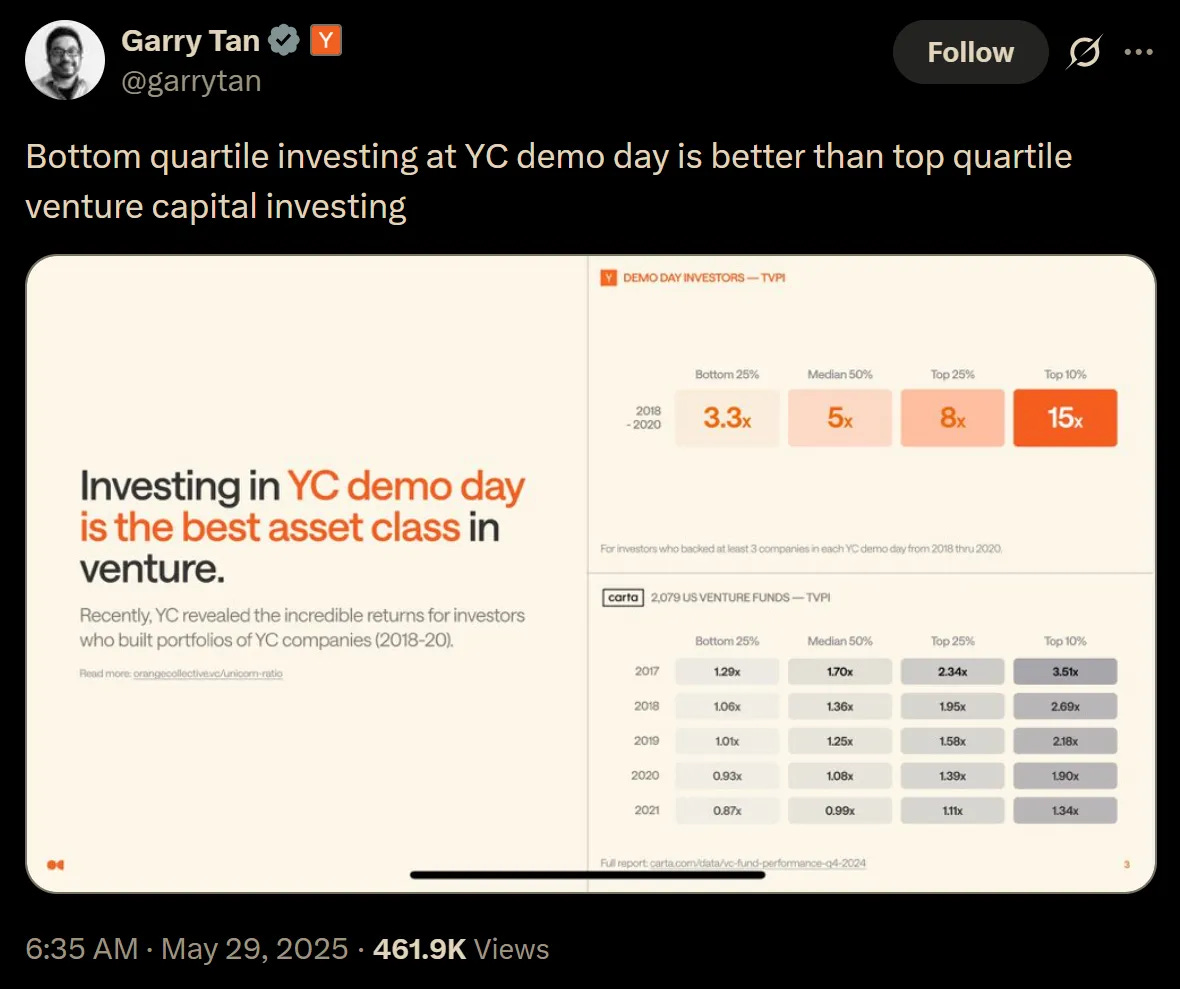
For investors who backed at least 3 companies per YC Demo Day from 2018 to 2020:
Bottom quartile: 3.3x TVPI
Median: 5x TVPI
Top quartile: 8x TVPI
Top decile: 15x TVPI
The bottom quartile of Demo Day investing outperforms the top quartile of the broader venture capital market. That’s the context for what’s happening today.
YC’s overall track record, published by the organisation itself: over $600 billion in combined alumni valuation, 4.5% of companies reaching unicorn status, 45% raising a Series A, and one in four YC unicorns becoming a decacorn. Multiple observers are projecting this specific batch produces 20 unicorns from around 200 companies -- roughly a 10% hit rate against a historical average of 4.5%.
The trends
AI is the baseline, not the thesis.
Every serious company here uses AI. The interesting question is where it’s being applied. This batch tilts hard toward physical-world problems: robotics, energy, agriculture, aerospace, construction. The consumer AI wave of 2023-2024 is largely absent.
Healthcare is accelerating.
Close to 10% of the batch is building in healthcare: AI prior authorizations, autonomous primary care, dental operations, drug discovery using parasite biology. Hard regulatory moats, enormous markets.
Legal tech is having a moment.
Around 4% of the batch. Harvey and Legora both reached unicorn status quickly, and founders noticed. The pattern is repeating.
The hard stuff is back.
Mines, drones, satellites, battery packs, chip design tools, radar for autonomous vehicles. The easy SaaS layer has been commoditized. The founders in this batch are going where AI assistance matters most and competition is thinnest.
want More?
The full breakdown is for premium subs:
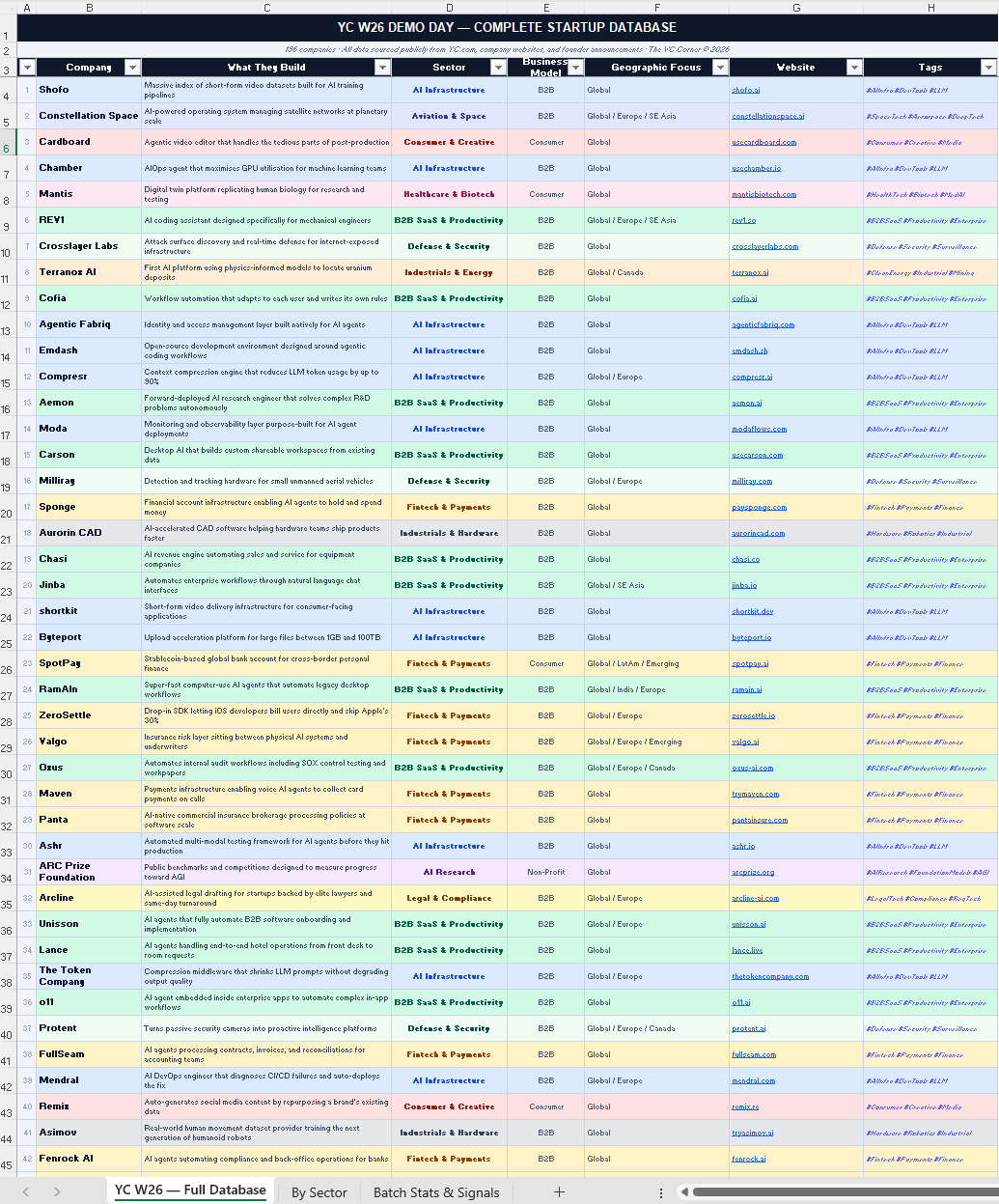
The downloadable Excel database -- every W26 company with original descriptions, sector tags, business model, geographic focus, and website. Three tabs. Built exclusively for The VC Corner:
full database,
sector breakdown,
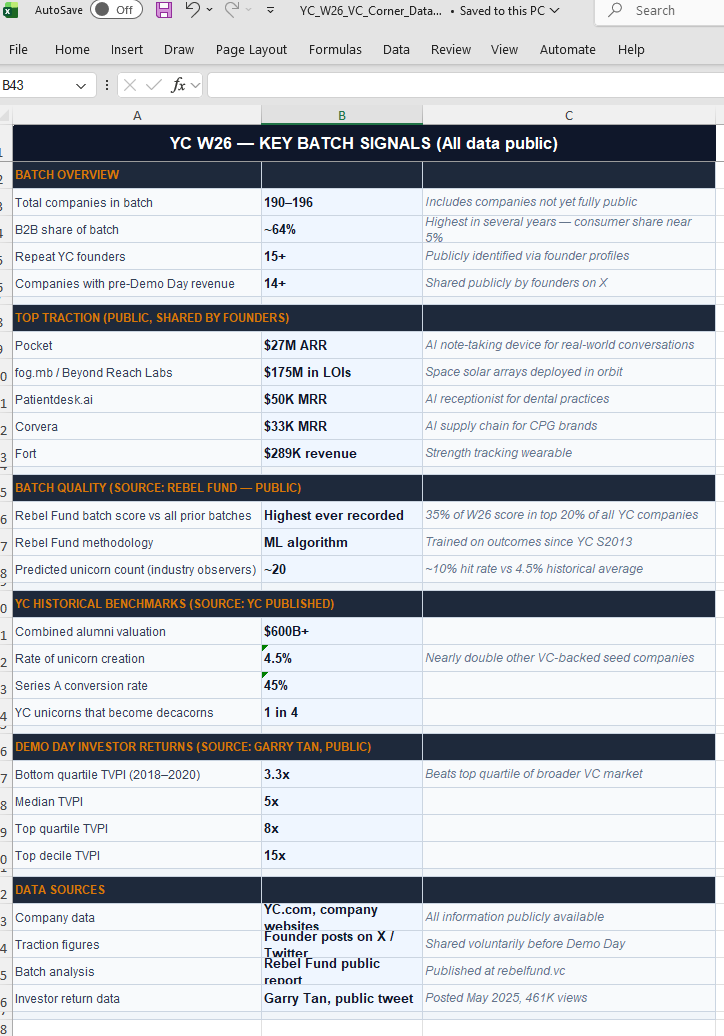
and batch stats.


The sector-by-sector company breakdown -- every notable company across AI infrastructure, fintech, healthcare, industrials, legal, consumer, and AI research, with what they actually build and publicly available traction data
The repeat founders list -- all 15 repeat YC founders identified in this batch, with their prior companies and outcomes
The YC Partner assignments -- which partner coached which startup, with partner backgrounds so you understand the mentorship dynamic
The companies already generating press before presenting, including specific Forbes and TechCrunch coverage
Our editorial picks -- the 10 W26 companies worth the most attention heading into Series A season, and why
This article is part of The VC Corner premium library, which includes 300+ real pitch decks from funded startups, curated investor databases, YC batch databases, Financial Models, and way more.
Free 7-day trial. Cancel anytime. Join 140,000+ subscribers.