

Most startup founders don’t realize just how powerful Reddit has become. Everyone’s busy polishing threads on LinkedIn or firing off one-liners on X, but the real conversations, like the unfiltered war stories, the blunt feedback and the hidden playbooks, are happening in Reddit’s corners.
The platform is messy and candid; and that’s exactly why it works. If you want surface-level inspiration, scroll elsewhere, if you want startup advice online that actually helps you build, Reddit is where you’ll find it.
What makes it different is that anonymity brings out honesty. Niche startup communities on Reddit offer laser-focused advice on fundraising, side projects, SEO, or product design without wading through generic content. Because the discussions move fast, you'll often see trends break here before they hit newsletters or podcasts.
But here's the thing. Reddit gets you discovered by humans. What gets you discovered by AI is a completely different game.
Today’s guide is brought to you by HubSpot for Startups:
When someone asks ChatGPT “best CRM for early-stage startups,” only a handful of companies appear in the answer. The ones that show up built for AI discovery. Everyone else is invisible to a whole generation of buyers.
Traditional SEO got you to page 1. AEO gets you into the answer.

The AEO Playbook for Startups by HubSpot for Startups walks you through exactly how to get cited by LLMs, optimize for AI-driven discovery, and turn that visibility into customers, investors, and talent. Free. Practical. Built specifically for founders.
Now, back to the channel that still runs on human instinct.
This guide rounds up the 20 best subreddits for founders. A map covering everything a founder might need: where to validate ideas, where to get roasted, where to learn growth, and where to hang with other founders going through the same thing.
Table of Contents
1. How Founders Should Use Reddit in 2026
2. Core Founder Hubs
3. Idea Validation and Early Feedback
4. Growth Marketing and Distribution
5. Product Development and UX
6. Funding and Commerce
7. Putting It All Together
1. How Founders Should Use Reddit in 2026
Reddit isn’t your usual news or social media platform, it’s a ripe and fertile ground for candid conversation. That’s what makes it unique.
The advantage for founders is that Reddit is one of the few places left where you get unfiltered reactions. Anonymity drives authenticity, so you’ll hear what people actually think about your your idea, your pitch deck, landing page, or growth tactic.
This mix of diverse perspectives that includes marketers, devs, investors, side hustlers, makes it a rapid testing ground for ideas. Treat it right, and it’s the closest thing you’ll get to a 24/7 focus group without spending a dime. Oh, and it’s also global.
Here’s how to play the game:
Do:
Read each subreddit’s rules before posting as mods are strict and don’t tolerate ignorance.
Engage before promoting. Comment, answer, and upvote to build trust.
Use recurring “share your startup” or “feedback” threads before starting your own. They exist for a reason.
Tailor your posts to the community’s vibe (what works in r/startups won’t fly in r/Entrepreneur).
Lead with value: share lessons learned, ask specific questions, or open up about challenges. But be authentic and honest.
Don’t:
Self-promote outside of approved threads; you’ll get flagged and banned fast.
Copy-paste the same pitch across multiple subs; it feels lazy and spammy.
Ignore etiquette; Redditors expect reciprocity, not one-way asks.
Dismiss lurking. Spending time just reading and absorbing can be as valuable as posting.
And one last warning: brigading, AI-generated spam, or thinly veiled sales pitches are a big no-go.
But if you show up real, thoughtful, and ready to contribute, Reddit becomes more than a forum. It becomes an early traction engine and a signal lab for your startup.
2. Core Founder Hubs
Every founder needs a home base. These are the big rooms on Reddit where entrepreneur communities gather to swap war stories, test ideas, and get business advice from people who’ve been in the trenches.
We’ve grouped them together because they’re the heartbeat of Reddit’s business advice forums. They are broad enough to cover strategy, but specific enough to surface real insights you won’t find in polished posts.
r/startups (1.9M members)
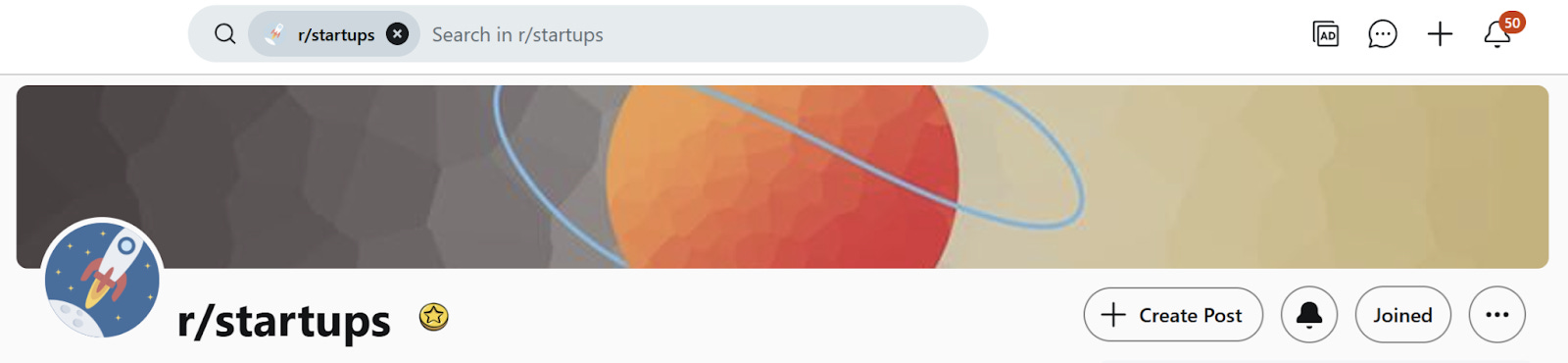
The most active community for early-stage builders. The culture here is direct: people expect you to do your homework before posting.
Share your MVP, ask about fundraising, or troubleshoot a tech stack problem and you’ll usually get responses rooted in firsthand experience.
Best use case: treat r/startups as a rehearsal stage. If your positioning or pitch gets shredded here, it won’t fly with investors.
r/Entrepreneur (4.9M members)
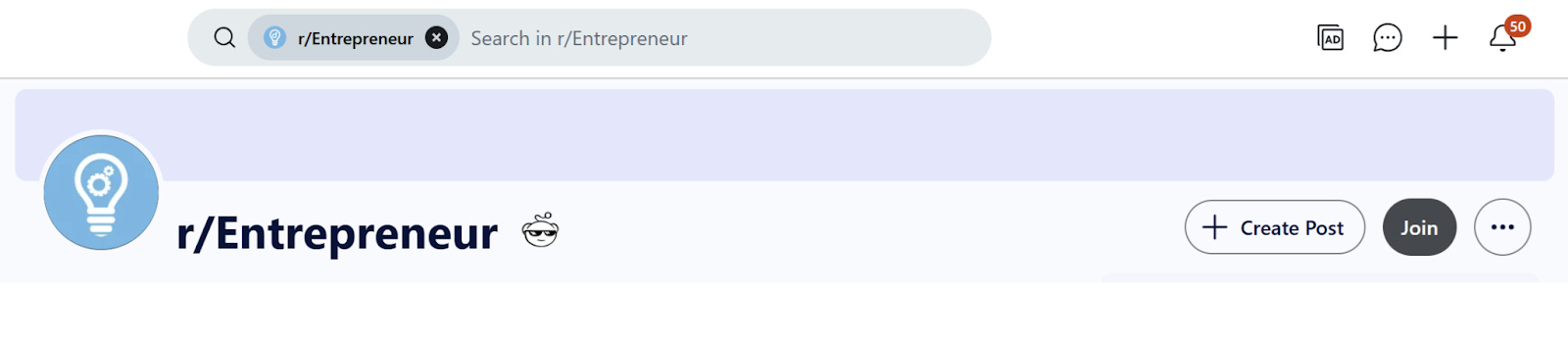
This subreddit is one of the largest business advice forums online. The tone is wide-ranging, everything from mindset shifts to scaling tips. You’ll see both gritty small wins (“first $1,000 in revenue”) and sweeping strategy discussions.
Best use case: dip in for diverse perspectives when you want to see how different types of founders would approach the same challenge. This is the definition of Reddit for entrepreneurs at scale.
r/startup (232k members)
Smaller than r/startups, but tighter in focus. Posts here lean toward the more practical side. You’ll find discussions about hiring your first engineer, choosing a payment processor, wrestling with incorporation, relocation. Less noise, more nuts-and-bolts.
Best use case: when you’re looking for operational clarity without sifting through a firehose of content.
r/EntrepreneurRideAlong (609k members)
A unique corner of Reddit where people build in public. Founders share regular progress updates, wins, and mistakes, inviting others to follow along. The culture is accountability and transparency instead of theory. “Here’s what I did and what happened.”
Best use case: if you want motivation, accountability, or even early users who discover you while tracking your updates.
r/smallbusiness (2.2M members)

This subreddit is the reality check hub. Users are talking payroll headaches, client issues, local regulations, and staffing. Pragmatic, less about unicorn chasing, more about surviving as an owner-operator.
Best use case: if you’re bootstrapping or running a service business, you’ll find practical, no-fluff advice that applies tomorrow.
Together, these hubs form a cross-section of the founder journey. r/startups and r/startup keep you focused on venture-building. r/Entrepreneur and r/EntrepreneurRideAlong give breadth and accountability. r/smallbusiness grounds you in the day-to-day.
These are a great starting point for any founder looking to start a startup in 2026 who aims to dive into Reddit’s business advice forums with clarity.
3. Idea Validation and Early Feedback
Before you scale, you need signal. You desire validation.
Reddit has a cluster of communities built for this purpose. To help you validate startup idea directions early. These subreddits are where side projects turn into real companies, and where strangers can become your first beta testers.
They’re brutally honest, sometimes harsh, but priceless if you’re willing to listen. If you’re ever wondering where to get startup feedback online, these are the subs to start with.
r/SideProject (487k members)

A friendly but honest hub for builders who are juggling full-time jobs and hobbies. Posts with screenshots, Loom demos, or Figma flows get the most traction.
Best use case: share progress updates and collect feedback that keeps you moving.
r/Startup_Ideas (178k members)

Dedicated to brainstorming. Founders pitch rough ideas and invite commentary. Best posts are structured: problem → solution → ask.
Best use case: test demand signals before you commit serious time or money.
r/startupideas (~active, no public count)
A smaller, overlapping space for ideation. People expect quick back-and-forth.
Best use case: pressure-test multiple concepts and see which sparks discussion.
r/alphaandbetausers (~23k members)

This is reddit’s version of Product Hunt. It’s the go-to subreddit for early adopters. Clear invites (“We built X to solve Y, looking for testers”) work best.
Best use case: recruit your first beta testers Reddit to stress-test usability before launch.
r/design_critiques (~115k members)

This subreddit is more focused on UI/UX. Post screenshots, landing pages, or app flows with specific asks.
Best use case: refine your MVP’s look and feel before exposing it to customers.
All of these subreddits are nice to have bookmarked, because In the early stage, speed of learning beats polish.
Think of these communities as your free lab. Tough love, yes, but a chance to validate startup idea directions, find beta testers on Reddit, and turn side projects into something with traction.
4. Growth Marketing and Distribution
Once you’ve validated an idea, the next battle is distribution. These are the best marketing subreddits where founders sharpen acquisition strategies, swap playbooks on channels, and debate the mechanics of growth marketing.
These subs should be treated as living classrooms. If you show up with humility and real questions, you’ll skip years of trial and error.
r/marketing (1.9M members)

The largest hub for all things startup growth marketing. Threads range from brand positioning to campaign breakdowns. Posts framed as case studies over here. “Here’s what we tried, here’s what worked, here’s what didn’t” type of posts draw the most engagement.
Best use case: get broad, high-level insights before doubling down on a channel.
r/AskMarketing (95k members)

This is more of a Q&A-focused subreddit, with a culture of being beginner-friendly. You’ll get tactical answers fast if your ask is specific.
Best use case: when you’re stuck on a particular challenge like CRM setup or content funnel design.
r/SEO (413k members) and r/bigseo (122k members)

If organic growth matters to you, these subs are essential. r/SEO covers fundamentals, while r/bigseo is more advanced. Think algorithm updates, technical audits, deep SERP analysis. Posts that get traction usually share detailed site issues or “here’s our ranking drop, what’s happening?”
Best use case: learn the mechanics of SEO for startups so you’re not at the mercy of agencies. You will also get nice tips on how your page can dominate google rankings.
r/PPC (223k members)

One of the key paid ads communities, dedicated to Google, Meta, TikTok, and other platforms. Expect hard-won advice on budgets, targeting quirks, and performance optimization. Posts that show numbers and specific campaign setups earn credibility.
Best use case: shorten the learning curve on paid ads and avoid burning money.
r/SocialMediaMarketing (188k members)

The place for mastering distribution on TikTok, Instagram, and emerging platforms. Culture here leans experimental, as people openly share what’s working with reels, shorts, or creator collabs.
Best use case: test scrappy campaigns that can scale into repeatable growth loops.
The Growth Bundle Roadmap:
Learn → Lurk in r/marketing, r/AskMarketing, r/SEO to understand channel basics.
Test → Post specific challenges in r/bigseo, r/PPC, r/SocialMediaMarketing and gather feedback.
Optimize → Use community insights to refine your funnel, cut wasted spend, and double down on channels that prove traction.
And as a reminder, every one of these subs enforces strict no-self-promo rules. Frame your posts as case studies or genuine questions.
“Here’s our data, what do you think?” will earn respect. “Check out my app” will earn a ban.
5. Product Development and UX
Getting customers in the door is only half the job, keeping them around requires a product that actually works.
The following communities are the founder’s “product lab.” They’re where you pressure-test roadmaps, fix onboarding leaks, and refine UX without paying for expensive consultants. Just remember: don’t dump a “rate my app” link. Redditors respond best to specific product challenges framed with context.
r/ProductManagement (227k members, top 1% engagement)

This is the go-to spot for product management questions, especially for startups. Founders can learn how product managers prioritize features, measure impact, and think about long-term product strategy. Best posts outline a problem (“We’re debating between feature A and B, what would you ship first and why?”).
Best use case: shape your roadmap with input from seasoned PMs who’ve built at scale.
r/UXDesign (204k members)

This is the main hub for UX feedback Reddit. Culture here is detail-oriented: people expect wireframes, user flows, or screenshots. Posts asking “Is this CTA clear?” or “Does this onboarding step make sense?” get practical, actionable critiques.
Best use case: refine usability and reduce friction in customer journeys before they become churn triggers.
r/ExperiencedDevs (318k members)

A community of senior engineers where technical discussions run deep. Founders can lurk to understand architectural tradeoffs, scaling decisions, or debugging approaches. If you post, frame it as a specific scenario rather than a vague “what stack should I use?”
Best use case: de-risk engineering choices by borrowing wisdom from people who’ve built production systems before.
r/SaaS (397k members)

One of the most valuable SaaS growth communities. The culture here is operator-heavy, with most founders openly discussing churn rates, pricing guides, and ARR milestones. Threads often turn into mini case studies full of lessons.
Best use case: benchmark your SaaS against others, learn how peers handle retention, and discover proven ways to reduce churn.
Together, these subs form a free, always-on product lab. Used well, they help you move beyond always having to rely on gut instinct into data-backed product choices. Whether it’s about roadmap prioritization, UX tweaks, or long-term SaaS growth, these communities cover all of it.
6. Funding and Commerce
We saved these two for last because they sit at the scale-up stage: when you’re raising money or expanding into revenue-heavy models. They’re narrower than the big founder hubs but equally critical if you want to understand investor mindset or learn the mechanics of running a store.
r/venturecapital (67k members)

This is the window into how investors actually think. It’s not the place to pitch your deck, as you’ll get ignored or banned. But it’s one of the most valuable sources of startup fundraising advice.
Threads often cover deal structures, reserve strategies, and market sentiment. Founders who lurk here pick up the subtext of what drives decisions: risk appetite, portfolio construction, and signaling.
Best use case: use this venture capital hub to get inside the head of VCs before you step into the room.
r/ecommerce (562k members)

If r/venturecapital helps you raise money, r/ecommerce shows you how to make it. It’s an ecommerce founder community where operators trade tactics on conversion rate optimization (CRO), ad spend efficiency, shipping logistics, and customer retention.
The most useful posts break down experiments such as “We changed product images, here’s the before/after CTR”, or reveal operational hacks that save time and cash.
Best use case: refine your revenue engine and scale smarter, whether you’re dropshipping or building a DTC brand.
These communities help close the founder loop. r/venturecapital gives you the investor’s lens, while r/ecommerce grounds you in the realities of monetization.
Fundraising gets you fuel and operations keep the engine running. In 2026, founders who engage with both will be better equipped to scale, diversify, and sustain growth.
7. Putting It All Together
Ultimately, Reddit is more than a collection of forums. It’s a large, unutilized playbook that requires specific handling and preparation.
The trick is not to treat it like a megaphone or an advertising platform but like a toolbox that can provide real, actionable advice, insights, lessons, and examples. Each bundle of communities serves a different stage of the journey:
Validation Bundle → r/SideProject, r/Startup_Ideas, r/startupideas, r/alphaandbetausers, r/design_critiques. Where you move from ideas to feedback to your first beta users.
SaaS Growth Bundle → r/marketing, r/AskMarketing, r/SEO, r/bigseo, r/PPC, r/SocialMediaMarketing, r/SaaS. Where you sharpen pricing, acquisition, and roadmap decisions.
Design Polish Bundle → r/UXDesign, r/design_critiques, r/ProductManagement. Where you stress-test usability and product experience.
Ops & Funding Bundle → r/smallbusiness, r/Entrepreneur, r/venturecapital, r/ecommerce. Where you ground yourself in operational reality and long-term funding strategy.
Taken together, these bundles give you something few platforms can: an always-on mix of raw feedback, tactical insight, and early signals from people building in real time.
As time goes by, and AI fills polished spaces with content that all sounds the same, candid communities are only becoming more valuable.
Reddit remains one of the few places where startup founders can cut through the noise and hear what people actually think. If you’ve ever wondered where to get startup feedback online, these are the communities that will give you answers, and often, your first users.
https://audiohubstudios.substack.com/p/astana-kazakhstan-illuminati-hq-or
What makes spaces like this valuable isn’t just the information, it’s the lack of polish around it. When feedback is unfiltered, you start seeing signals before they’re cleaned up and packaged for broader audiences.
Markets tend to move the same way. The early conversations are messy, contradictory, sometimes wrong, but they contain the first hints of where attention is shifting. By the time something feels consensus-driven and well-articulated, the move is often already well underway.
There’s real edge in being willing to sit in that raw phase a little longer than everyone else.