

The Founder’s Guide to Storytelling
The best product always wins.

This is the persistent myth that most founders and investors believe even today. Founders want to believe that if the code is clean and the unit economics make sense, the market will eventually find its way to their door.
But is that really the case?
Early-stage startups have no data, they have no history. They might barely even have a product. All they really have is a specific way of looking at the world that other people haven't caught onto yet. And storytelling is how they invite them to see it too.
Today's article is brought to you by Vanta: Scale AI Without the Risk 🤖
Building fast means taking on risk fast.

Vanta's AI Governance Checklist, developed with A-LIGN, gives you 6 clear steps to align with recognized standards, define ownership, and integrate AI risk into your existing compliance program — so you can scale AI responsibly without the guesswork.
Here’s the truth: a startup’s narrative is not the final coat of paint. Most founders think that “real work” is the engineering, the go-to-market strategy, customer acquisition and so on. But that’s only part of it. And that’s why a lot of brilliant technical teams fail to get off the ground.
Think about the reality of a pre-seed company. You are asking a talented engineer to quit a stable job with a high salary to sit in a room and build something that might not exist in a year. You are asking an investor to hand over millions of dollars based on a vision that hasn’t been proven.
What makes them say yes? It is the story. How you get them to rally to your mission.
Storytelling is a strategic operating system. It is the mechanism that turns your private conviction into a public reality. Before a startup accumulates metrics, it operates entirely on belief.
If you cannot articulate that belief, you cannot build the company.
Table of Contents
1. Venture Capital Is a Market for Stories About the Future
2. When the Story Is Confusing, the Strategy Usually Is Too
3. Startups Scale Through Shared Narratives
4. Founder Storytelling 101: Mistakes & Lessons
5. The Architecture of a Great Founder Story
6. Owning the Narrative in the Modern Startup Ecosystem
7. Storytelling Is the Bridge Between Zero and Traction
1. Venture Capital Is a Market for Stories About the Future
At the earliest stages, venture capital is not about buying equity in a product. It is about buying equity in an argument.
Early-stage venture investing operates under extreme uncertainty. Before Series A, many of the signals investors normally rely on barely exist. Revenue may not yet be meaningful, the product is still evolving, and the market itself may still be forming.
Nevertheless, investors still make consequential decisions. They commit capital, introduce founders to customers, and attach their reputations to companies whose outcomes remain uncertain.
To some this still sounds insane or too risky. But what these investors evaluate in those moments is a narrative about how the future unfolds.
This is why your narrative is the most valuable asset you own. You are not selling what you have today. You are selling a well reasoned theory about what will exist tomorrow.

Every investment is based on a theory of change. Something in the world is breaking or evolving. Maybe it is a new regulation, a sudden drop in the cost of a specific technology, or a fundamental change in how people spend their money.
A great founder does not just show a list of features. They lay out a causal chain. They explain why the status quo is dying and why their solution is the only logical conclusion.
If the logic is coherent, the investment feels like a calculated bet. If the logic is fuzzy, the investment feels like a gamble.
Investors hate gambles, but they live for calculated bets. You want them to feel like your success is the natural consequence of forces already in motion. The winners make that future intelligible before the rest of the market even sees it coming.

2. When the Story Is Confusing, the Strategy Usually Is Too
Investors notice a familiar pattern during early pitch meetings. Some founders struggle to explain what their company actually does.
The explanation becomes long, technical, and difficult to follow. Slides focus on product architecture, system components, or multiple potential use cases.

Remember: Complexity is the most common hiding place for a half baked strategy.
The technology is sophisticated, the product can solve many problems, or the market is still evolving. More often, the issue runs deeper.
If the startup cannot be explained in three sentences, it is likely because the hard choices have not been made yet. A confusing narrative is a symptom of an unresolved strategy.
A clear story, on the other hand, forces founders to answer several fundamental questions:
Who is the real customer?
Which problem matters enough to change behavior?
Why does this solution succeed where others struggle?
What does the market look like if the company works?
Until those decisions become clear, the narrative rarely holds together.
Experienced investors therefore pay close attention to the first few minutes of a pitch. A founder who can explain the company simply usually understands the strategic core of the business. A founder who needs fifteen slides before the idea becomes clear may still be exploring the space rather than defining it.
Simplifying the narrative is not just about better communication. It is about better thinking. The process of refining the story highlights the holes in the logic. Once the narrative finally clicks, it is usually because the strategy is finally settled.
3. Startups Scale Through Shared Narratives
In a tiny team sitting around one table, alignment is easy to find. That’s because everyone hears every phone call and every decision happens in real time.
But as a company grows from ten to fifty or a hundred people, that natural synchronization vanishes.
This is where a lack of a clear narrative becomes a necessity.
Without a shared story, different departments inevitably drift apart.
Sales might describe the product one way just to close a quick deal. Engineering might prioritize features based on a technical whim. Marketing might frame the value proposition for an audience the founders never intended to serve.
And talent has nothing to do with it. But talent without context is self-destructive.

A well-defined startup narrative acts as the internal compass for the entire organization. It provides a common language that explains exactly what is being built and why it matters to everyone here.
When the story is consistent, it shows up in the pitch decks, onboarding sessions, product reviews, and customer support. It helps teams make independent decisions that still point toward the same goal.
At that point, storytelling becomes more than a fundraising tool. The narrative turns into part of the company’s operating logic. It helps teams interpret opportunities, resolve disagreements, and maintain focus as the organization grows.
Without that shared story, scale introduces confusion. With it, the company retains alignment even as complexity increases.
4. Founder Storytelling 101: Mistakes & Lessons
The most common mistakes in startup narratives do not stem from a lack of public speaking ability. Instead, they come from a failure to step outside the internal bubble of the company.
When you spend eighty hours a week building a product, it is easy to lose sight of how the rest of the world perceives it. Most founders struggle because they are too close to the work to see the forest for the trees.

Leading with the How instead of the Why
Technical founders often fall into the trap of leading with architecture diagrams. They walk through the integrations, the latency improvements, and the system design with visible pride.
While these are impressive feats of engineering, they are rarely the reason a customer buys or an investor writes a check.
A narrative that leads with technology assumes the listener already cares about the problem. In reality, the most effective stories ground the audience in the pain of the status quo before ever mentioning a line of code.
Lesson #1: You have to prove the house is on fire before you try to sell the fire extinguisher.
The Sea of Sameness
The modern startup ecosystem is drowning in words like “revolutionary,” “next-generation,” and “disruptive.” These terms have become background noise for investors.
When a founder relies on interchangeable buzzwords, they are signaling that they do not have a specific, unique insight into their market.
A strong narrative trades adjectives for evidence. It avoids the temptation to sound like every other deck in the pile and focuses on the granular reality of the industry it aims to change.
Lesson #2: If your pitch could apply to three other companies in your space, you haven’t found your story yet.
The Competitive Matrix Trap
Almost every pitch includes a feature matrix where the startup sits in the top right corner. But this format is often a distraction because it implies that the company will win simply by having more features.
In reality, venture-scale winners rarely win on a feature count. They win because of a structural advantage like distribution, network effects, or a unique data set.
Lesson #3: If the story focuses on a checklist of buttons, it misses the larger point of how the company becomes a durable business.
Detached Origin Stories
There is a tendency to keep the personal “why” out of the pitch to sound more professional. This is a mistake.
Early-stage investing is fundamentally a bet on a human being. A narrative that lacks a credible origin story feels abstract and hollow. It does not need to be dramatic or involve a life-changing epiphany. It just needs to explain the specific moment of realization that made the founder dedicate the next decade of their life to solving this one specific problem.
Without that connection, the story has no heartbeat.
Lesson #4: Early-stage investors are looking for the one person whose life experiences made this specific company inevitable.
Write these lessons down and have them handy next time you head into a pitch.

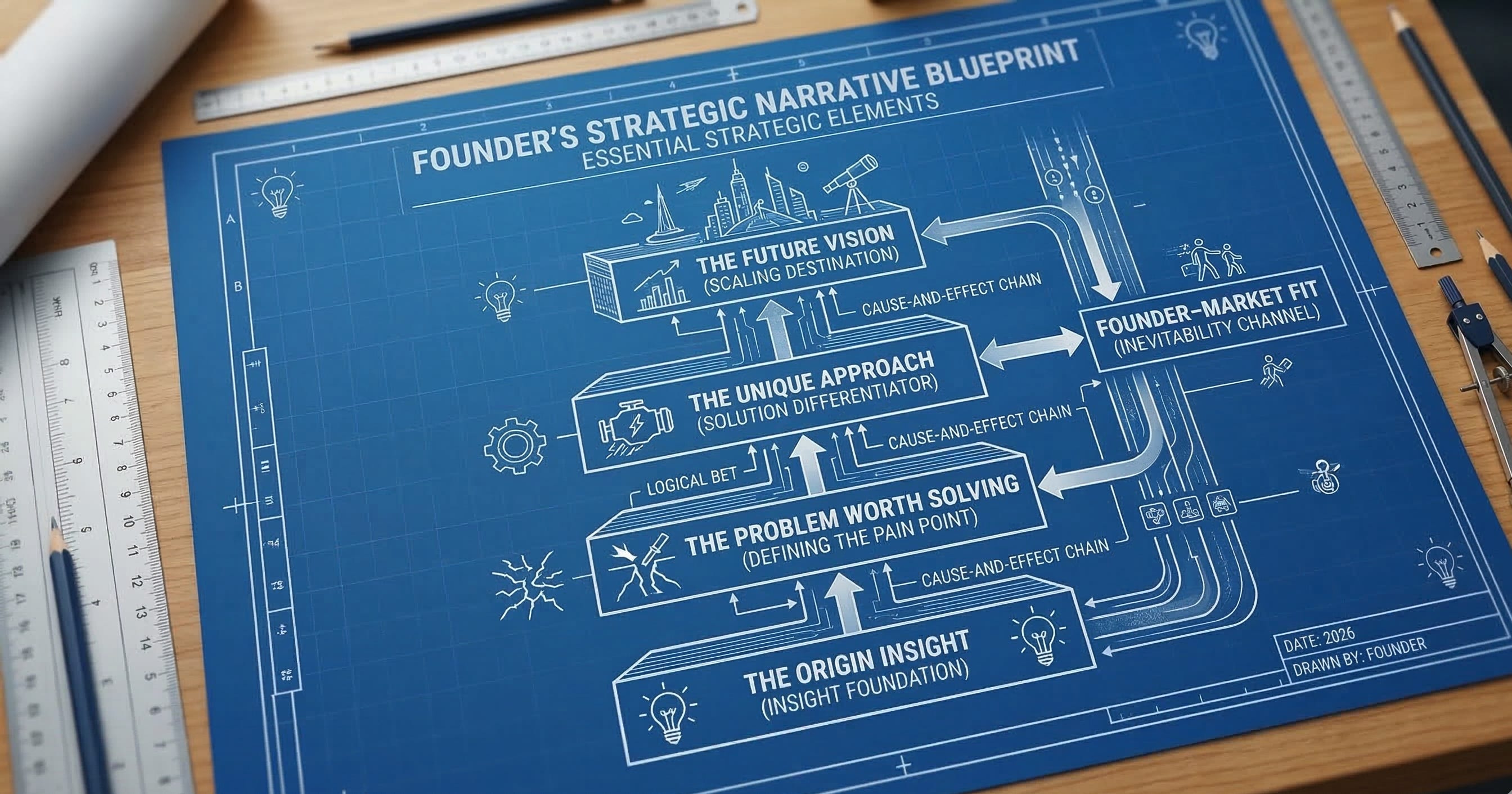
5. The Architecture of a Great Founder Story
A great narrative is not a collection of clever slogans or high production slides. It is the external evidence of a deep, rigorous understanding of a market.
When a founder has done the work, the story does not feel like a sales pitch. It feels like a logical conclusion. Although every startup is different, the best narratives share a specific structural integrity.
The origin insight
Most startups begin with a moment of recognition that others have ignored.
This is the secret at the heart of the business. It is not necessarily a dramatic epiphany. Often, it is a quiet realization born from working inside an industry and noticing a massive inefficiency that everyone else has accepted as normal.
The value of this insight is found in its logic. It establishes why the founder started looking at the problem and provides a unique lens through which to interpret the entire market.
The problem worth solving
A narrative only matters if the stakes are high.
Many industries contain minor inconveniences, but billion-dollar startups usually grow from problems that affect large groups of people or create meaningful economic friction.
This section of the story must identify who is suffering and why every current alternative is insufficient. When the problem is described with precision, the opportunity becomes undeniable.
The unique approach
This is where the narrative explains why this specific solution succeeds where others have struggled.
It is not just about what the product does, but why its design, technology, or business model creates a durable advantage. This is the moment where startup positioning becomes concrete and the technical or strategic edge is revealed.
The future vision
Effective founder stories are forward-looking and describe how behavior or industry processes might change if the solution becomes widely adopted.
No dramatic predictions are required, only a credible explanation of how the present problem connects to a larger market outcome. A clear founder vision helps listeners imagine the scale of the opportunity.
Founder–market fit
Finally, the narrative explains why this founder is suited to pursue the opportunity. That connection comes from industry experience, or from direct exposure to the problem.
This builds credibility, and the story shows that the person building the company understands the problem deeply enough to pursue it through the inevitable difficulty of building a startup.
When these elements align, the story becomes a powerful bridge that others can cross with confidence.
6. Owning the Narrative in the Modern Startup Ecosystem
Not long ago, the public narrative around a startup was shaped largely by intermediaries. A startup’s reputation was largely at the mercy of journalists, conference organizers, or high profile investors.
If those intermediaries did not understand the vision, the market simply did not hear it. Thankfully, that filter has vanished today. Founders now have the tools to distribute their logic directly through newsletters, podcasts, and social platforms.
Narrative is never a vacuum. If a company does not actively define its mission, others will do it for them. Competitors, skeptics, and the media will interpret a startup’s position based on whatever limited signals are available.
Therefore, founders must always own the narrative. Not just for marketing, but as a defensive necessity.
When founders share their perspective on an industry, they are doing more than just posting content. They are planting a flag. And this visibility has immediate, practical effects.
A talented engineer might encounter your logic months before they ever look at a job board. An investor might follow your reasoning long before you walk into their office for a Series A pitch. Early customers may even recognize their own pain points in your writing before they ever see a product demo.
The goal here is not “personal branding” in the traditional, superficial sense. It is about building a body of work that demonstrates a deep understanding of the market.
Authentic communication bypasses the noise of promotional messaging. It allows a company to remain the primary source of truth about its own future. This ensures the outside world sees the opportunity exactly as the founders do, rather than through a distorted lens.

7. Storytelling Is the Bridge Between Zero and Traction
Eventually, startup outcomes become measurable. Revenue growth, retention curves, and market share begin to describe the company more clearly than any narrative.
At that stage, data is the only story worth telling. That’s what investors care about, and customers decide based on product results rather than promises.
But the earliest days of a startup look nothing like that. Before traction exists, there is a vacuum where evidence should be.
In this fragile window, storytelling is the only bridge available. It is the mechanism that allows a company to move forward when the outcome is still invisible.
A clear narrative helps an investor see how a small idea becomes a massive business. It helps a key hire understand why a problem is worth the next five years of their life. It helps a first customer trust a product that was only a prototype a month ago.
Effective storytelling is not about drama or performance. Its purpose is to make a specific version of the future seem reasonable and inevitable. While metrics eventually provide the proof, the narrative provides the initial permission to exist.
At the end of the day, founders are not just building software or hardware. What they are truly building is a shared belief in a future that has not arrived yet.
The most successful founders are the ones who can make that future understandable long before the data proves them right.
I really resonate with this point: “Lesson #1: You have to prove the house is on fire before you try to sell the fire extinguisher.”
I was listening to the Y Combinator Startup School podcast, and one idea stood out. When crafting a strong pitch, lead with what is happening, not why it matters.
Great to read your work Ruben ☺️ Just subscribed and would mean the world if could subscribe back ☺️🫶🙏