

The Owner’s Mindset
The reality is that most people walk through life as if they are permanent residents of a hotel. If the electricity goes out or the sink leaks, they just call the front desk and wait for someone to help. They assume the system is there to take care of them, and if it fails, they stay stuck until someone else arrives to fix it.
But the best founders and investors do not live in hotels. They live in the world like they own the building. When things break, they do not look for a manager. They pick up the tools and find a way to make it work themselves.
This core difference is what we call high agency. It is the simple, quiet refusal to be a passenger in your own life. While everyone else is waiting for a manual or a permission slip, the high-agency person is already three steps ahead, testing the locks and looking for a way through. Jensen Huang is a prime example of such a person.
Nobody can emphasize this enough. In an era where everything is changing fast, having high agency isn’t a train. It’s actually the only way to ensure you are the one driving the outcome rather than just watching it happen.
One thing worth doing before you scale:
If you are building toward enterprise customers or global markets, ISO 27001 certification is increasingly the credential that opens the door. European customers, governments, and regulated industries require it. Most teams wait until a deal depends on it. The ones who move first close faster.

Vanta put together a checklist that maps every step from building your ISMS to passing your certification audit, whether you are starting from a customer request or getting ahead of it proactively:
Table of Contents
1. The Biology of Rebellion
2. Physics vs. Perception
3. The Resourcefulness Stack
4. The Capital Builder’s Razor
5. Debugging the Mental Software
6. The Great Adult Lie
7. Writing the Final Plot
1. The Biology of Rebellion
If high agency were merely a personality quirk, it would be easy to dismiss as charisma or luck. The research, however, points elsewhere.
Psychologists have studied what they call internal locus of control (a theory developed by Julian Rotter in 1954) for decades, measuring the extent to which people believe outcomes are shaped by their own actions rather than external forces.
And it’s true that across income, academic achievement, and career progression, this mindset is a major predictor of success. It is just as important as how smart or hard-working a person is.
People with an internal locus of control do not have blind confidence. They know that markets can be unfair and that bad luck exists, but they respond to setbacks differently. When something breaks, they look first for things they can actually change. They treat failure as a lesson to be learned, not as a sign that they are not good enough.
After a loss, some people give up and try to stay safe. Others search for a way to fix the situation and start adjusting. Over time, that small difference in how people react creates a massive lead.

The opposite way of living feels normal because most of us were raised that way. Our schools and offices were built to produce reliable people who follow instructions and respect the chain of command.
Society “rewards” people for staying inside the lines and punishes them for trying something new. People are taught that being “mature” means doing what you are told. But after enough years, some people stop seeing these limits as rules and start seeing them as facts of life.
High agency begins the moment you stop blaming outside forces for your situation. It is not about breaking rules just to be a rebel. It is the decision to take ownership when the future is not clear and the stakes are high. It is the moment you stop being a person that things happen to and start being the person who makes things happen.
That change usually starts the first time you realize that waiting for permission is just another way of giving up.
2. Physics vs. Perception
Once you take ownership, you have to look at the world and ask which constraints are actually real.
High-agency people have a habit that looks strange to outsiders. They only believe in the laws of physics. Gravity is real. The speed of light is real. But most other walls are just social habits that sit somewhere between convention and fear.
Things like “the industry standard,” corporate titles, or “the way it has always been done” are just ideas that people agreed on a long time ago. They feel like solid bricks because everyone else stops when they hit them.
If you want to build something new, you have to see these for what they are: suggestions, not laws.
The trick is to break every problem down to its physical parts and ignore the noise. If a goal does not break a law of science, then it is possible. It is no longer a question of whether you are allowed to do it. It is just a question of engineering.
Wilbur Wright did not wait for a university to give him a license to fly. At the time, even famous scientists said humans would never fly. Wright did not care about those opinions because he saw that flight was just a puzzle of lift and drag. He focused on the mechanics while everyone else focused on the fear of looking foolish.

At the end of the day, most institutional rules do not originate in physics, but in incentives. People optimize for safety, reputation, and incremental improvement, and over time those optimizations harden into doctrine. If you absorb those doctrines without audit, you inherit constraints that were never designed for your upside. Question them, and new design space appears.
Many of the rules you are following were drafted by people no more intelligent than you, often with less exposure to risk. The only question worth asking is whether the rule reflects a physical boundary or a social one. If it is social, it can be redesigned.
3. The Resourcefulness Stack
Understanding control and questioning perception gets you to the starting line. From there, agency either translates into behavior or it decays into theory.
To get results when the pressure is high, you need a set of skills that work together. Let’s say a “toolkit” for getting things done. It starts with how you see a problem, how fast you move, and how you handle people who try to slow you down.
Cutting Through the Fog
Clear thinking is the foundation. This is not about being the smartest person in the room. It is about the ability to cut through the mess. Every hard problem comes covered in ego, office politics, and useless details.
Most people spend their time arguing about the mess. High-agency people look for the one thing that actually changes the result. In a startup, that might be finding product-market fit while everyone else is busy fixing small bugs. The goal is to find the one handle that actually opens the door and ignore everything else.
Trading the Map for the Road
The second layer is moving fast. In big companies, people often spend weeks studying a problem before they do anything. They think they are being careful, but they are actually just stalling.
High-agency people move before they have all the answers. Founders especially use something called the “OODA loop”, which stands for Observe, Orient, Decide, Act. They try something, see what happens, and then fix it based on what they learned.
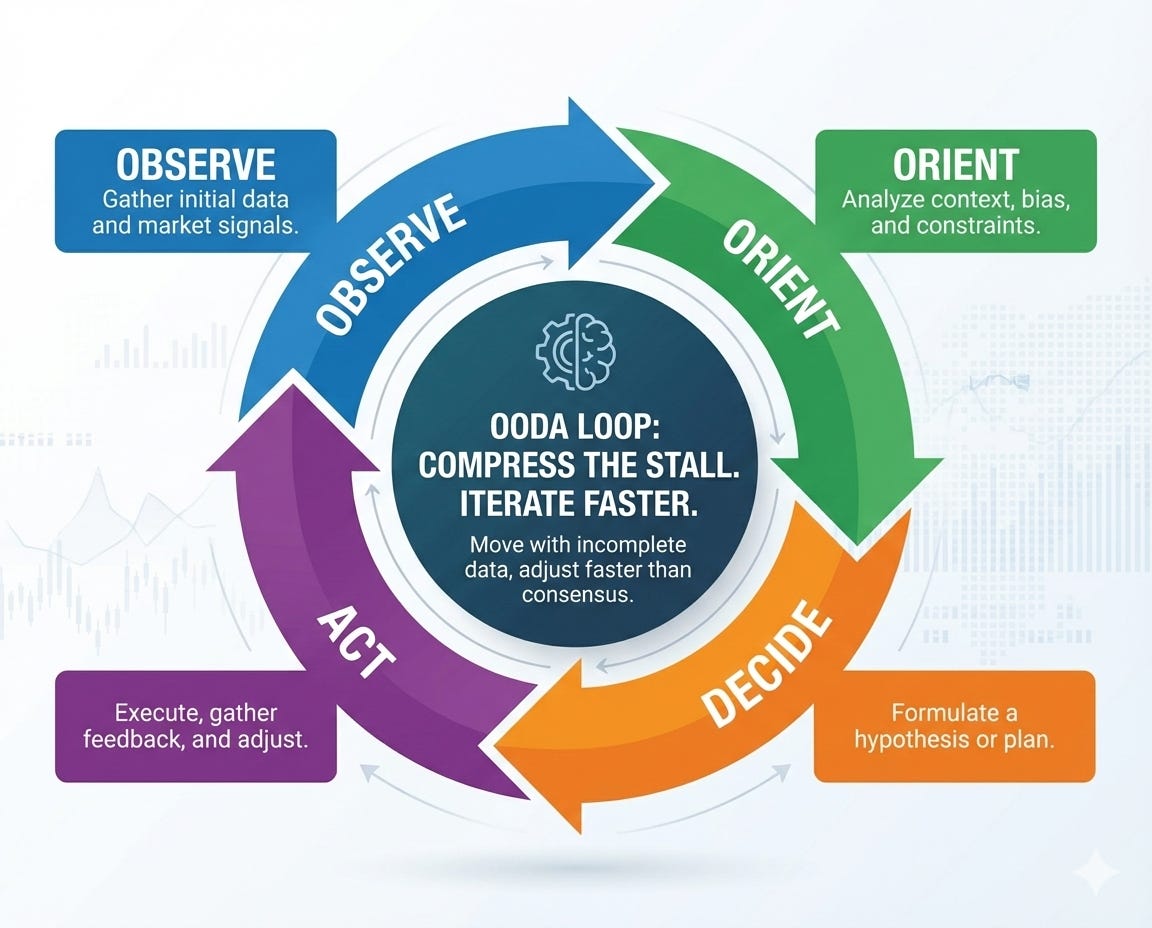
In the world of startups, things change so fast that being quick is better than being perfect. If you can try five things while your competitor is still writing a plan, you will always win.
Holding Your Ground Against the Crowd
The final layer is disagreeability, or simply being willing to say “no.” This does not mean being rude. It means refusing to let someone stop you if they do not have anything to lose if you fail.
Many people will tell you “no” because it is the safe thing to do for their own career. Founders and investors need to focus on the end result instead. Sometimes you have to push back or find a way around someone who is just trying to stay safe.
These traits do not operate independently. Clear thinking reveals the lever. Action pulls it before momentum dissipates. Disagreeability protects the move from being neutralized by low-accountability caution.
And together, they turn agency from an attitude into something that produces results under stress.
4. The Capital Builder’s Razor
In venture capital, rhetoric evaporates quickly. Markets do not care about your personality. They only care if you are right about how things actually work.
This is where high agency turns into a real advantage that investors call “alpha.” It is the ability to see the truth when everyone else is just following a trend.
Questioning the Game Everyone Is Playing
Most people in finance tend to follow the herd. They buy houses because prices are rising. They stay in a market because everyone else is there. But the information everyone sees is usually not where the profit is.
The constraint for most investors is not a lack of data but the lack of courage. The courage to be a contrarian.
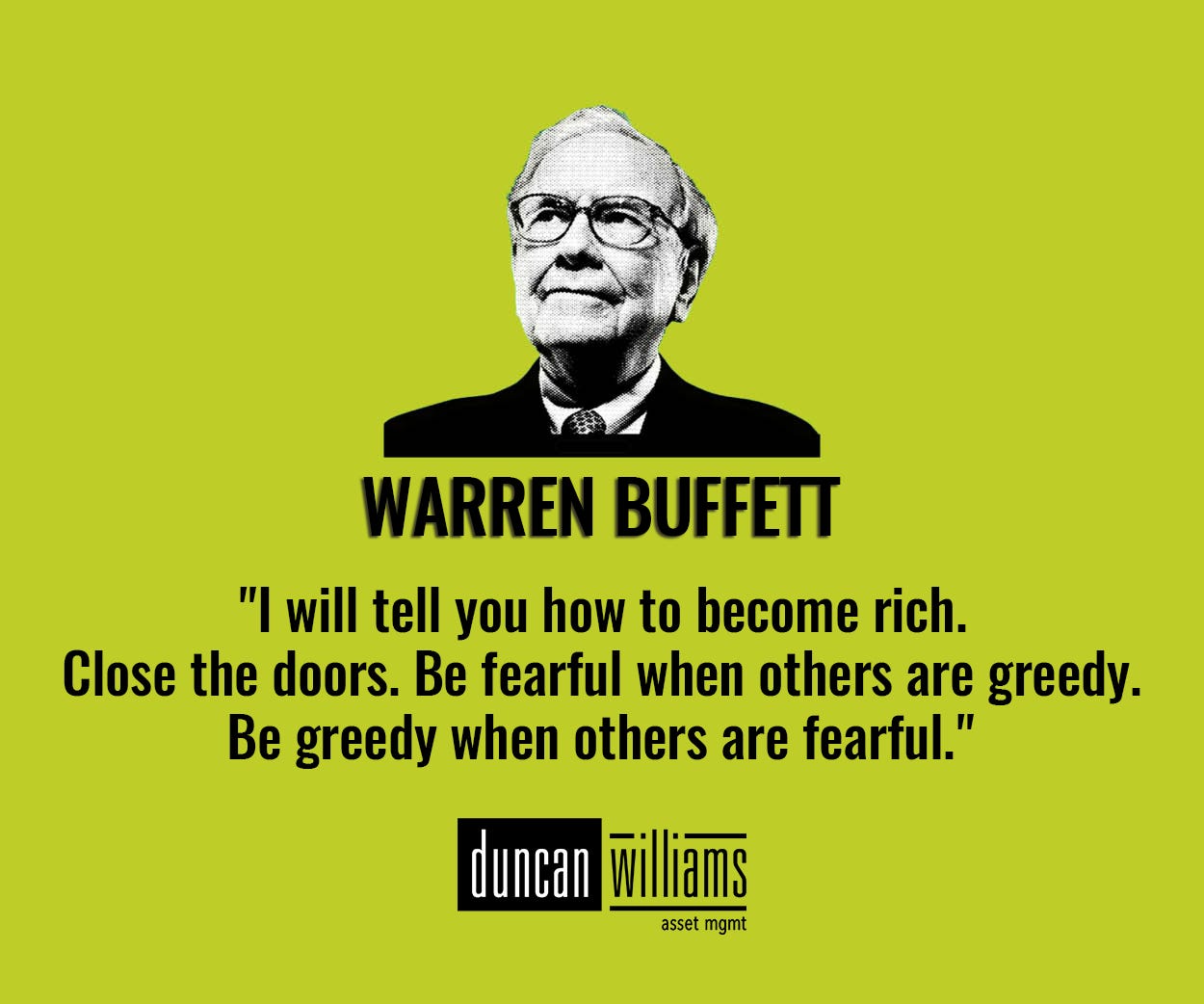
Famous investors like Warren Buffet, or Chris Sacca did not win because they had better spreadsheets or faster computers. They won because they asked if the system itself was stable.
Most experts are afraid to ask these questions because they want to protect their jobs or their reputations. High-agency investors step outside the crowd to see if the foundation is cracking. When the rest of the world is still following an old rule, they spot the difference between the price and the reality.
Reusing the Parts of a Failure
This same rule applies to people building companies. Stewart Butterfield started a gaming company called Glitch, and it failed. Most people in his shoes would have just walked away and started over.
Instead, he looked at what he had already built. He found a small internal tool his team used to talk to each other. He took that one part, isolated it, and turned it into Slack.
He did not wait for a new idea to fall from the sky. He treated his failure like a box of spare parts.
High-agency owners do not let a setback stop them. They just look for the most useful thing left in the wreckage and start building again. This is how failure becomes a tool for future success.

Becoming the First Call
At the end of the day, wealth goes to people who don’t care about the job title and instead treat their work as a series of results.
People who take responsibility for hard outcomes are very rare. Because they are hard to find, they can ask for better terms and more money. They have more power in a negotiation because they are not easy to replace.
The founders who can raise money when the market is down are the ones who show they can handle the pressure. They do not hide when things get difficult. They absorb the stress that others avoid. In the long run, this habit builds a reputation that acts like a magnet for new opportunities.
Whether you are picking a stock or building a startup, this mindset is what creates a lasting edge.
5. Debugging the Mental Software
High agency usually doesn’t disappear all at once. It wears away slowly through habits that feel like they make sense in the moment. If you want to keep your edge, you have to check your own thinking as strictly as you check your business plan and pitch deck.
You need to look for the “bugs” in your brain that keep you from acting.
Escaping the Fog of Anxiety
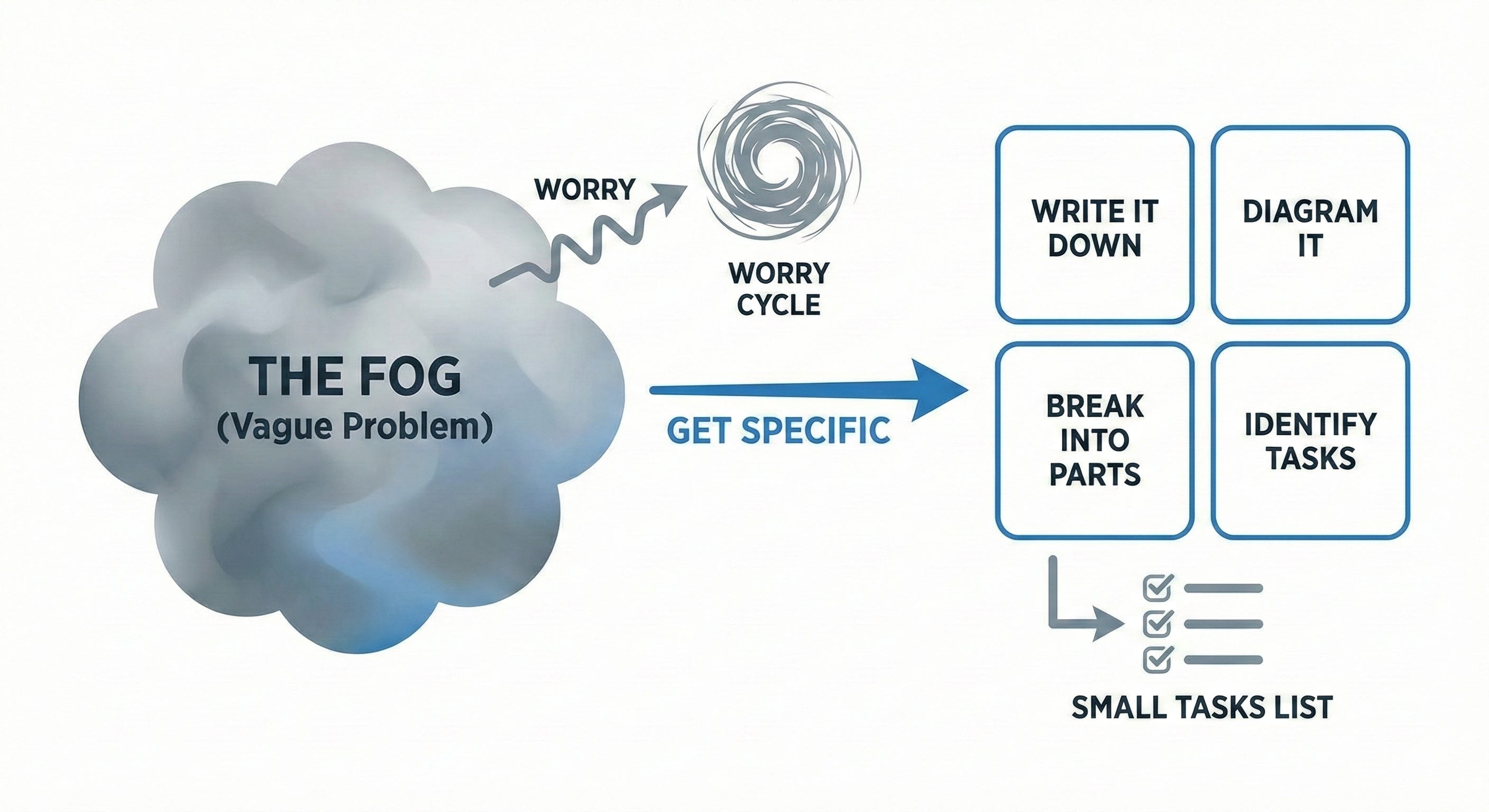
The first common bug is the “Vague Trap”. When a problem is blurry and undefined, your brain starts to worry. You imagine the worst possible result because you haven’t looked at the facts.
That worry feels like it’s coming from the outside world, but it is actually coming from a lack of detail.
The way to fix this is to get specific. Write the problem down on paper. Draw a diagram of it. Break it into parts you can control and parts you cannot. Once you name the variables and see the constraints, the problem changes size. What felt like a huge disaster often turns into a small list of tasks you can finish in an afternoon.
The Danger of Thinking Too Much
The second bug is the Midwit Trap. This is a problem that affects very smart people. Because you are intelligent, you can come up with a thousand reasons why something might fail. You can build complex models and debate every small detail forever.
This feels like being careful, but it is actually a way to avoid taking a risk.
High-agency people know when they have thought enough. They realize that over-analyzing a problem just keeps them from moving. At a certain point, more data doesn’t help; only action does.
So they simplify the problem until they have to make a choice. They would rather make a mistake and fix it quickly than spend months doing nothing at all.
Letting Go of Your Old Self
The third bug is being too attached to your status. You might be the “Founder of Company X” or a “Partner at Firm Y.” Yes, these titles give you a sense of security and power.
But what happens when the business model stops working? What happens when the portfolio underperforms? Many people stay with a sinking ship because they are afraid of losing their identity.
High agency requires you to be willing to walk away. You have to value results more than you value your title.
If a project no longer adds value, the smart move is to leave, even if it feels like a loss. You have to be able to quit a role to find a better one.
One great way to test yourself is the “10x Twin” exercise. Imagine there is another version of you that is ten times faster and braver. What would that person do right now?
They would probably send that scary email, fire that underperforming manager, or close that failing project today. The difference between you and your twin isn’t more information, but the willingness to handle a little bit of discomfort now so you can win later.

6. The Great Adult Lie
As we grow up, we are taught to believe that the people in charge have a secret plan. We assume that leaders, experts, and bosses know exactly what they are doing. This belief starts in school, where every problem has a right answer and every move requires a signature.
And we carry this into our careers, waiting for a signal that never comes.
Seeing Behind the Curtain
The truth is that most people in power are just figuring it out as they go. History shows that even the most successful people are often making guesses.
Steve Jobs changed how we use technology, but he made many mistakes in his personal life. Mozart was a genius at music, but he was terrible with money.

Competence in one area doesn’t mean someone has all the answers.
When you realize that authority figures are just humans with partial information, the world starts to look different.
You stop waiting for an endorsement before you start your own project.
You realize that most of the “experts” are just following their own set of incentives.
Hesitation is often just a way to avoid taking responsibility.
Once you see through the illusion, you realize that the only thing stopping you is the belief that you need someone else’s blessing.
Moving Without a Permission Slip
In school, you get a grade for following the rules. In the real world, the market doesn’t care about your grades. It only cares about results.
There is rarely a ceremony or a special day where someone tells you that you are finally “ready” to lead. Most important work starts before anyone else thinks it is a good idea.
High-agency people don’t wait for a title. They start building, testing, and learning in public. They release early versions of their ideas and let the real world provide the feedback.
If you wait for everyone to agree with you, you will be waiting forever. Permission is usually something you get after you have already succeeded. The goal is to stop looking for a map and start moving in the direction of the outcome you want.

7. Writing the Final Plot
In the end, none of these ideas matter if you don’t actually make a choice. High agency isn’t about big, dramatic speeches. It is about the small decisions you make on a Tuesday afternoon when nobody is watching.
It is the habit of choosing the path that requires you to take more responsibility rather than the one that lets you hide.
Using the Story Razor
When you are faced with two paths, try using a simple tool called the Story Razor. Ask yourself: “Which choice would I respect myself for making five years from now?”
Usually, that is the path that involves more friction and more work. We build our identity one step at a time. Every time you take a risk to solve a problem, you are training yourself to be a person who makes things happen.
There is a hard truth we all have to face. Playing it safe does not guarantee a happy ending. Following the rules does not mean the universe owes you a win.
Since there is no such thing as perfect safety, the most logical move is to take control of your own direction.
Turning Thought into Motion
Finally, start by picking one thing you care about and write it down in one sentence. Then, list ten things you can do this year to make it happen.
Most of those tasks will make you feel a little nervous. One of them will probably feel very uncomfortable. That is the one you should do first.
Agency becomes real the moment you stop thinking and start moving. Pick the action that carries some risk and just execute it.
Don’t do it for the drama. Do it because your life only starts moving in the right direction once you decide to be the one who steers.
Intellectually fulfilled! Learn philosophy, and you’ll set yourself free intellectually.
The piece treats high agency as a trait you can cultivate to win, and survivorship is the easy objection to that. The harder one is that the visionary and the fool make the identical move. Same conviction, same refusal to wait for permission. At the decision point they are indistinguishable.
The outcome sorts them afterward, and then we go back and award the winner the word "agency." Butterfield ignored a rule and got Slack, so we call it vision. The ones who ignored a rule that was actually holding something up, we call reckless, if we name them at all. The trait got assigned by the result, not chosen before it.
Which makes "cultivate high agency" almost circular. you're being told to develop the label we hand out to people who already won. Conviction is the cheap part. It's identical in the founder who's right and the one who's about to find out he isn't.
The only thing that separates them in advance is whether the rule they broke was load-bearing, and that's a knowledge problem, not a nerve problem. So the essay celebrates the free half, the willingness to ignore the rule, and skips the decisive half, the reading of which rules were real. Agency is the easy part. The edge was always in the audit.