

Hiring Your First Engineer in 2026
You just raised a $2M pre-seed round.
Congratulations.
Now, you’re probably about to make the most expensive mistake of your startup’s life.
Right now, a senior engineer in San Francisco costs between $250,000 and $450,000. That is up to 20% of your entire runway gone before you’ve even validated your product. Yet, most founders hire anyway.
The money is there, the pressure is on and waiting feels like losing.
But the hiring playbook we’re all running is dead. It was written for a market that closed in 2022.
Today, the leanest startups are hitting $1M ARR with just one or two engineers.

They aren’t rushing. They’re leveraging AI, hiring globally and ditching the tired “work for equity” pitch. Most importantly, they realize that hire number one isn’t just a headcount decision.
They write the DNA of your company culture.
Let’s talk about why you need to wait and how to hire when you’re actually ready.
together with Vanta:
The engineering time you protect by hiring late gets spent anyway. A prospect asks for compliance proof, the deal stalls, and your one engineer vanishes into an audit.

16,000+ companies trust Vanta, including Ramp and Harvey
🔒 Automated evidence collection
⚡ Continuous monitoring
🛠️ Works in Claude and Cursor
Table of Contents
The Assumption That Is Burning Your Runway
Where the Best Engineers Actually Come From
The Process Is Part of Your Pitch
The Equity Pitch Is Broken. Here Is What to Say Instead.
What You Are Actually Evaluating in 2026
Hire One Is a Cultural Template, Not a Headcount Decision
1. The Assumption That Is Burning Your Runway
There is a question founders almost never ask before posting their first engineering role.
What specifically cannot get built or maintained without this person, given the tools available today?
It sounds simple. In practice, most founders skip it entirely, because the assumption sitting underneath it has felt so obviously true for so long that it stopped being examined.
The AI Multiplier Changes the Math
That assumption is now worth examining. GitHub’s 2024 research found that developers using AI assistance completed tasks 55% faster than those working without it.
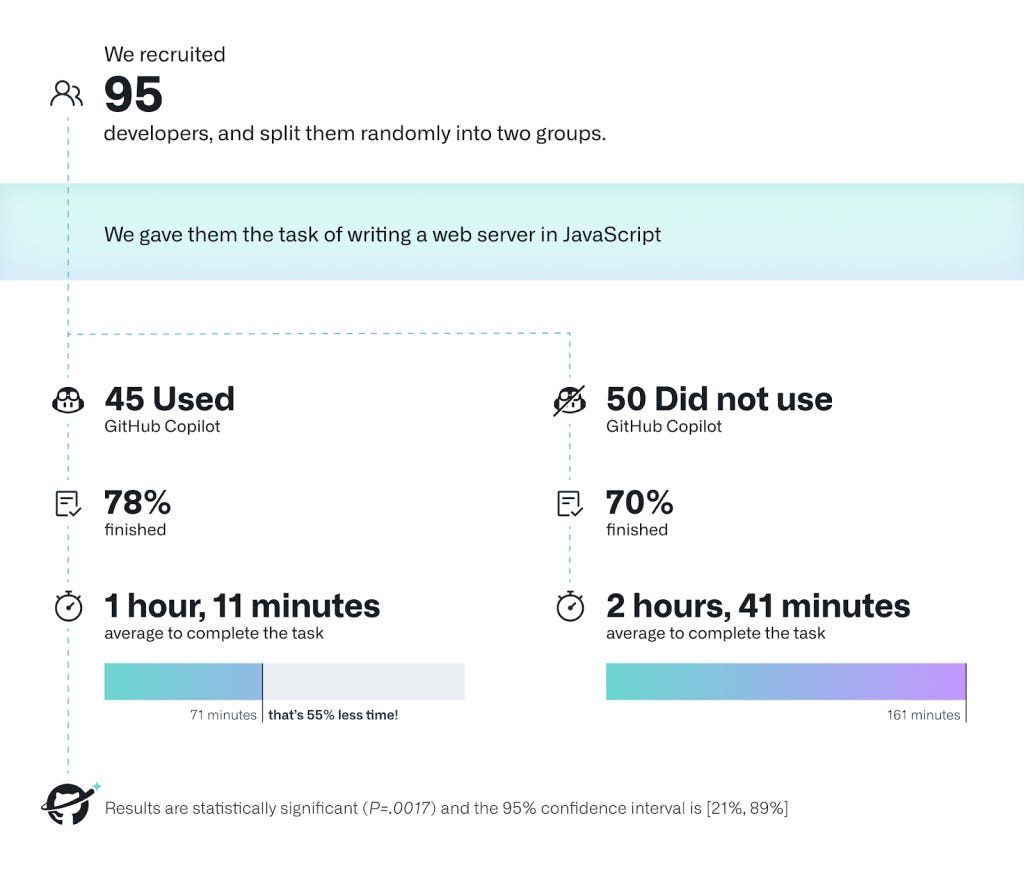
That figure understates the real-world impact for strong engineers, who are not just moving faster on individual tasks but collapsing the architecture, debugging and iteration cycles that used to require multiple people into what one person can now manage alone.
Some of the most capital-efficient seed-stage companies operating right now have one or two engineers and meaningful ARR.
A configuration that would have been implausible in 2020.
None of this means avoiding engineering hires. It means the threshold for when a hire becomes genuinely necessary has moved and founders who have not recalibrated that threshold are hiring earlier than their actual constraints require.
The Hidden Tax of Moving Too Fast
Premature hires do not just cost money. They create coordination overhead, fragment ownership and introduce management burden at the exact moment when speed and clarity matter most.
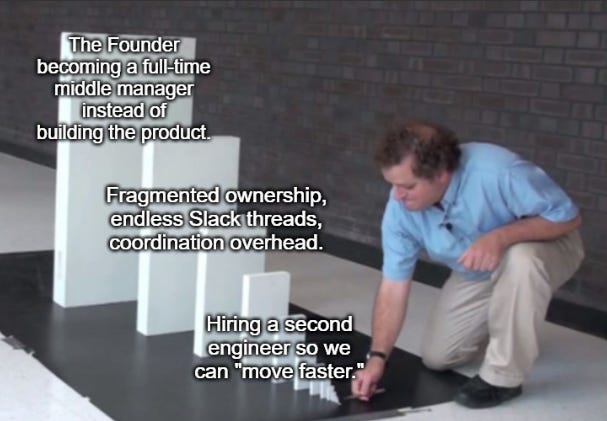
The founders getting this right are staying lean longer than their instincts tell them to, using that constraint to get sharper on what they actually need and hiring one exceptional person instead of two adequate ones when the moment arrives.
The difference in output between those two configurations consistently surprises founders who have only ever operated the other way.
2. Where the Best Engineers Actually Come From
Harj Taggar, who built Triplebyte and observed thousands of early-stage engineering hires from the inside, is unequivocal about the sourcing hierarchy.
Personal network first, by a margin that makes every other channel feel secondary.
Not because other channels cannot work, but because the information advantage that comes with hiring someone already known is irreplaceable at the stage where a single bad hire can genuinely determine whether the company survives.
Mining Your Network the Right Way
Most founders agree with this in principle and dramatically underapply it in practice.
The mental scan happens fast.
The conclusion that nobody relevant is available arrives within a few minutes and the founder moves on to job boards.
What has not happened is the actual work. Making the calls, sending the messages, sitting down with the best engineers in the network and making a direct ask.
Then, crucially, asking each of those people the same follow-up question, who are the best engineers you know and treating every referral with the same seriousness as a warm investor introduction.
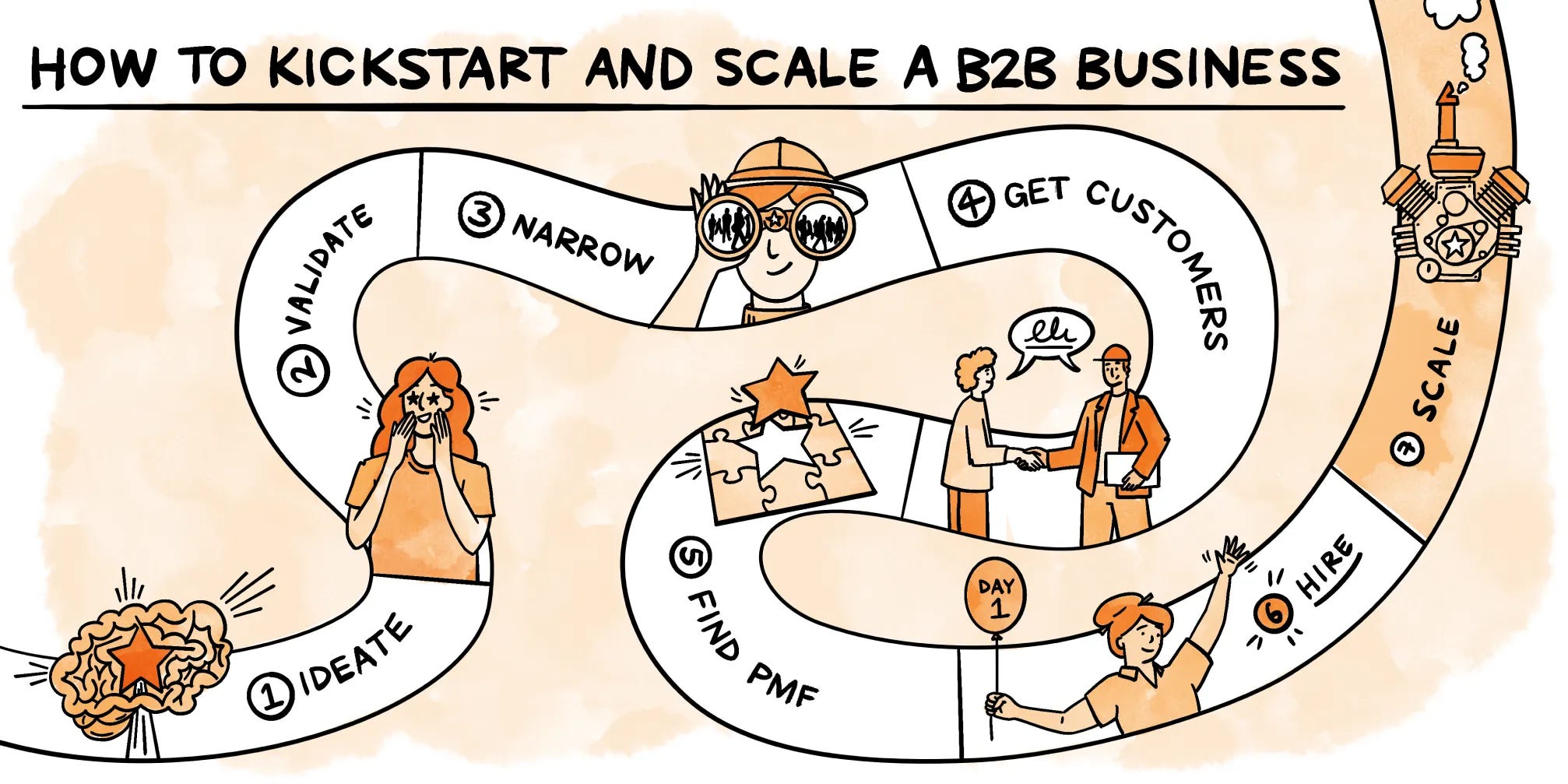
The founders who close their first great engineering hire in sixty days almost always did it this way.
The Global Talent Unlock (and Its Caveats)
Once the network is truly exhausted, the geography unlocked from remote work normalization remains dramatically underused.
World-class engineers in Warsaw, Medellín, Tbilisi, Nairobi and Manila have spent years building production systems, contributing to open source and competing globally.
According to Stack Overflow’s 2024 Developer Survey, over 40% of professional developers now work fully remotely, a figure that has held steady since 2022 and reflects a permanent structural change in where talent is accessible.
The talent in these markets has compounded fast and the compensation levels that are life-changing for engineers there extend the runway without compromising on quality.
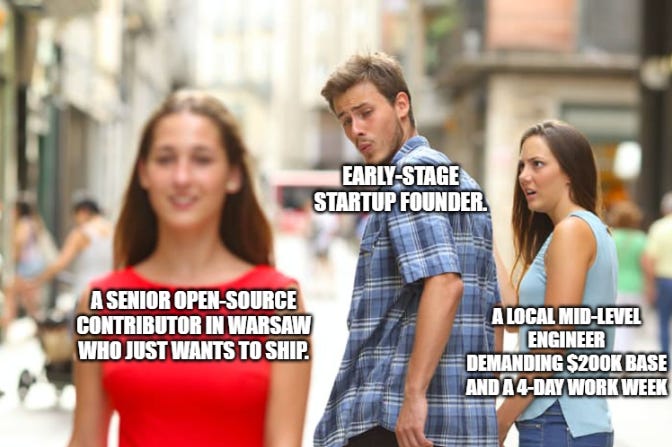
The honest caveat is that distributed hiring fails when treated as pure cost optimization.
In a remote setup, you’re not just looking for technical ability but for async communication discipline, written clarity and the capacity to operate independently across time zones.
Strong technical skills don’t guarantee any of that and those qualities need to be evaluated explicitly.
3. The Process Is Part of Your Pitch
Most founders treat the hiring process as something that happens after the pitch. Find the candidate, sell them on the company, then run them through the interviews.
The problem with that sequence is that the process itself is already sending a signal and most founders are not paying attention to what it says.
Speed Signals Conviction
A slow pipeline reads as indecision.
A candidate who submits a work sample on Tuesday and hears nothing until the following week has already started drawing conclusions about how the company operates.
The best engineers are almost always interviewing in parallel. They are not waiting.
The founders who close their best candidates move in days, not weeks.
They pre-book interview slots before the candidate is even identified, designate a single decision-maker for each role and send same-day updates at every stage. Not because it is polite, but because speed signals conviction and conviction is what a candidate needs to feel before walking away from a stable job.

Ditch the Generic Job Description
The job description is extremely important. And it’s underplayed.
Most early-stage engineering postings read like a requirements list assembled from other job postings. Generic stack requirements, vague responsibilities, a culture paragraph that could apply to any company in the world.
The job description is the first piece of writing a candidate reads from a founder.
It should read like one.
Name the specific problem the hire will own, describe what success looks like at thirty, sixty and ninety days and be honest about the constraints. Founders who do this attract candidates self-selecting into the actual role, not an idealized version of it.

4. The Equity Pitch Is Broken. Here Is What to Say Instead.
Walk into most seed stage engineering conversations and the equity pitch arrives within the first ten minutes.
Ownership is meaningful in early-stage hiring.
If this works the way it could, this is worth several million dollars. You have a chance to get in early.
Why the Old Math Fails
Engineers have heard this pitch hundreds of times. The ones worth hiring have done the math.
The expected value calculation on early stage equity, once dilution across multiple rounds is accounted for along with the liquidation preference stack that accumulates over time, rarely justifies the compensation sacrifice a candidate makes to earn it.
PitchBook puts the average time to liquidity at eight to twelve years for venture backed companies that do exit. Most never do.
The engineers most worth hiring understand this clearly.
Equity projections dressed in optimistic language do not move them.
Selling Scope, Ownership and Growth
That does not make equity irrelevant. It makes it a supporting detail rather than the main argument.

The candidates worth competing for are moved by scope, ownership and the speed of professional development that only early stage provides.
The specific technical challenges involved, described honestly and in enough detail to signal that the founders actually understand what they are asking for.
The direct access to product and business decisions that no larger company will ever offer.
These are not consolation prizes for founders who cannot afford big salaries.
For a specific type of engineer, the one who will genuinely thrive at this stage, they are more compelling than any equity projection.
The founders closing their best candidates lead with the work, not the financial scenario.
They describe the exact problem the engineer will own, why it is genuinely hard, what the product stakes are and what the person will have built twelve months from now.
That pitch wins where the equity story fails, because it respects the intelligence of the candidate and speaks to what actually motivates someone who chooses early stage over comfort.
5. What You Are Actually Evaluating in 2026
The most common engineering interview process in 2026 was designed for 2019. Algorithmic challenges, abstract whiteboard sessions, problems where the entire signal is whether someone can produce a working function from memory under artificial pressure.
The Death of the Whiteboard Interview

These formats test for skills that matter significantly less than they did five years ago.
And they screen out precisely the kind of engineer who performs best in an AI augmented environment.
Every strong engineer working today uses AI tools heavily in their daily workflow. The ones who do not are, almost definitionally, slower than their peers.
A 90-minute pairing session where AI tool usage is prohibited is not a test of rigor. It is a performance of rigor that produces misleading signal about how the candidate will actually operate on the job.
Testing for AI Augmented Reasoning
What actually matters is how someone thinks.
How they decompose an ambiguous problem.
How they review and interrogate AI generated output rather than accepting it uncritically.
Whether they know when the model is confidently wrong and can reason their way back from first principles.

The distinction between engineers who use AI as a force multiplier and engineers who use it as a crutch is the most important variable in early engineering hiring right now and most standard interview formats have no rubric for measuring it.
The practical replacement is a real pairing session on a problem that resembles actual work, with AI tools present, run as a collaboration rather than an examination.
Watch how the candidate interacts with the model.
Do they accept its first output or probe it?
Do they understand the code they end up with, or are they shipping something they cannot explain?
Do they write better prompts when the first one fails, or do they run the same one again and expect a different result?
Ninety minutes of honest pairing on real work reveals more than five rounds of abstract challenges and evaluates for the capabilities that actually determine performance.
6. Hire One Is a Cultural Template, Not a Headcount Decision
Every team has norms.
Ways of reviewing code, writing documentation, handling disagreement, shipping under pressure, communicating asynchronously across the week.
In a company of fifty, those norms exist because someone built them deliberately or because they calcified from habits nobody ever challenged. In a company of four, they exist almost entirely because of whoever was in the room at the start.

The first engineer does not join a culture.
They co author one. Whatever communication patterns they bring, whatever standard they hold their own work to, whatever relationship they have with ambiguity and ownership, those behaviors propagate forward into every hire that follows.
Early engineers have an outsized influence on what every subsequent hire perceives as normal. And normal is the hardest thing in any organization to change.
Beware the Lone Genius Trap
A founder who brings in a brilliant but isolated engineer, someone who ships fast but documents nothing and collaborates with no one, does not just solve a short term capacity problem.
They install a template.

The clearest version of this mistake is what gets called the lone genius trap.
High output, low process, no knowledge transfer. It looks like a shortcut in month one and functions as a compounding liability for years afterward, producing fragile systems, thin documentation and a team culture where isolation becomes the accepted default.
By hire five, the damage is structural.
Research from organizational psychologist Adam Grant consistently shows that early behavioral norms in small teams are significantly more durable than norms introduced later, because they become the baseline against which all subsequent behavior is measured.

The “Team of Five” Litmus Test
The right question before making the first engineering hire is not “can this person build what we need?” It is “would a team of five people who work exactly like this person be a team worth running?”
If the honest answer is uncertain, the candidate is probably wrong regardless of technical ability.
The founders who get this right treat the first engineering hire with the same deliberateness they applied to their co founder search.
Not because the stakes are identical, but because the logic is the same.
The decision is not just about today’s capacity. It is about what the company will value, how it will operate and what every person who joins afterward will walk into.
The biggest shift is not that AI lets startups hire fewer engineers. It raises the bar for the first hire. Judgment, ownership, and the ability to work with AI now matter as much as raw coding speed.
The part this understates is what waiting does to the pool you hire from later. Nomura's August report counts 83,100 AI-related hires in India against 31,921 losses since 2022, and the economists' own caveat is that displaced workers rarely move into the AI roles, so the two sides are largely different people. The same multiplier that lets a founder defer hire number one is thinning the junior rungs that produce the hire number three they will want in eighteen months. That is right for the runway and expensive for the pipeline. Who is training the engineer you plan to hire in 2028?
Zia. AI career strategist for Indian professionals. itszia.ai