

The Truth About Growing a Startup in 2026
Ideas are abundant in 2026. Founders can read a blog post, brainstorm with AI, vibecode, experiment with new playbooks and they can build from 0. They can launch a product and reach thousands of people in a single afternoon.
And exactly because of this speed, many founders get caught up in the excitement of rising numbers and busy dashboards. This creates the illusion of growth.
And it’s true that a lot of what we call growth today is just noise. It is people passing through, not people staying for good. Users testing a platform or a service for 5 minutes and then moving on to the next one.
The hardest part of running a startup now is not the work itself, but the courage to see it for what it really is.
Most teams do not struggle because they need a new tactic or a better ad, they struggle because they ignore the signals that tell them something is wrong, they focus on how many people show up, rather than how many people actually find value.
This guide is for those who want to move past the surface and build a business that can stand on its own without constant pushing. It is about learning to read the truth in your numbers before the cost of being wrong becomes too high to fix.
Before we get into it, something worth sharing:
The founders growing fastest right now all made at least one bet that looked completely wrong at the time. GTM is where most founders play it safe. That is exactly where the opportunity is.
A few things that have consistently worked for the best AI-native startups:
One distribution channel, taken to the extreme before touching a second
Launching before it feels ready and letting users shape the product
Content as infrastructure, compounding long after the ad spend stops

HubSpot for Startups just dropped a free Bold Bets Playbook with real examples of AI-native startups taking unconventional GTM risks that actually paid off.
8 companies. 8 bets that looked wrong. 8 stories worth studying before you plan your next growth move.
It is free. I genuinely recommend it!
Table of Contents
1. Traction Is Not Evidence
2. The Real Math of Keeping Users
3. Startup Growth Hacks in 2026: What Really Works Today
4. How to Strategize for Growth in 2026
5. The Unit Economics Conversation That Changes Everything
6. What VCs Actually Mean When They Say “We Need to See Scalable Growth”
7. 5 Uncomfortable Questions Every Founder Needs to Ask
1. Traction Is Not Evidence
It’s easy to mistake a busy dashboard for a healthy company nowadays. Downloads or subscriptions go up, revenues spike and you think you’re the next Jensen Huang.
But numbers can be loud without being meaningful.
A surge in traffic often just means you spent money or got lucky with an algorithm. The real question is whether that activity turns into a habit.
If thousands of people try your app but only a few return the next week, your growth is a mirage. You are filling a bucket that has a hole in the bottom.
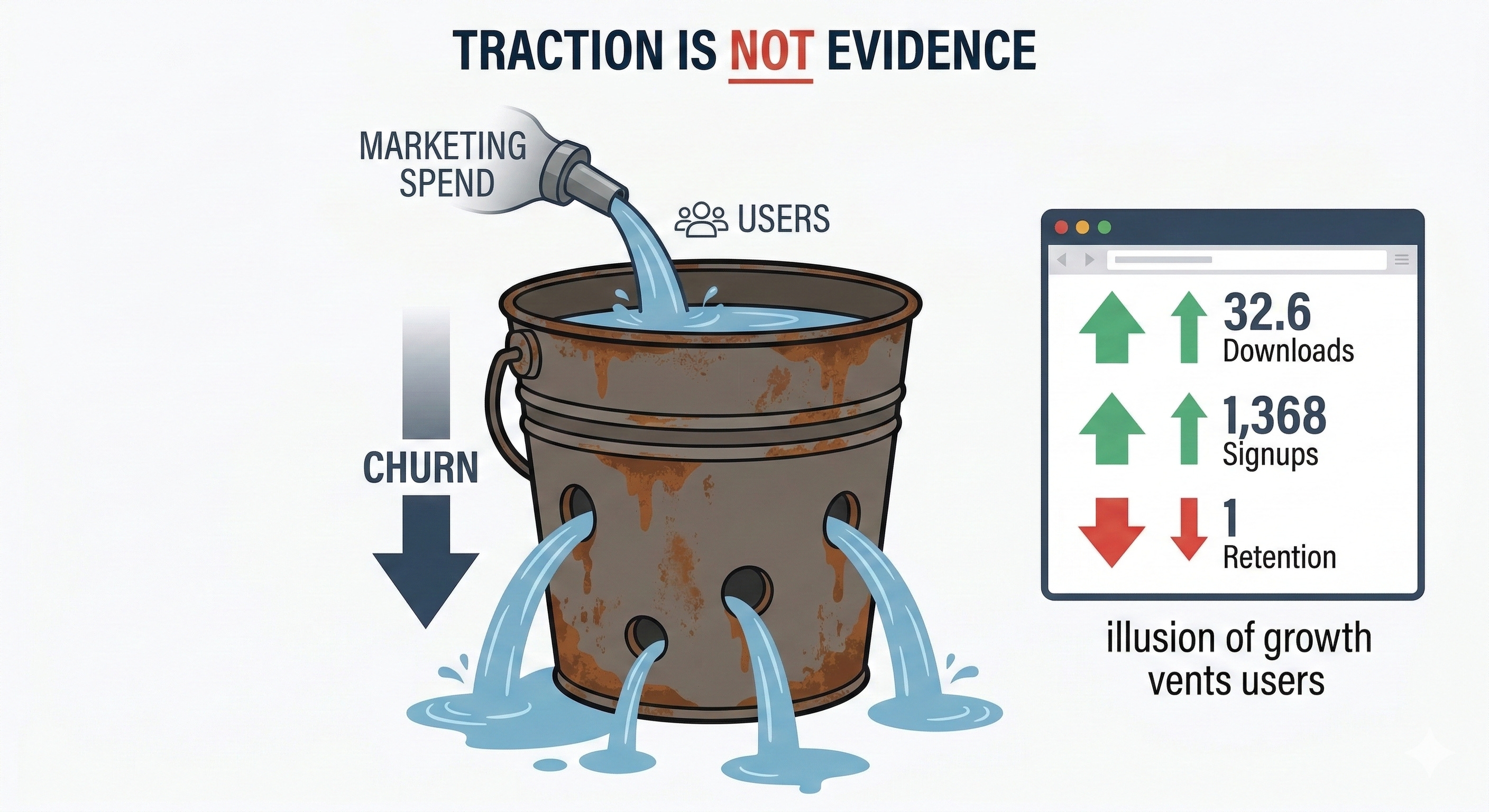
The only way to know if your growth is real is to look at how your users behave after the first day. This is why investors focus on groups of people who joined at the same time and perform a cohort analysis.
If your newest group is less active than your oldest group, you are losing ground. A strong startup is not always looking to acquire new clients. It finds people who cannot imagine going back to their old way of doing things.
So before you spend more on marketing, ask yourself what happens if you turn off the faucets. If the growth loop stops the moment the spending stops, you are renting users instead of owning a market.
2. The Real Math of Keeping Users
Most growth discussions center on customer acquisition because acquisition feels controllable. You spend money and the meter moves right away. But keeping those users is where the real value lives.
Retention moves more slowly and forces a harder question:
Does the product solve a persistent problem well enough that users return without being pushed?
If you lose 8% of your customers every month, they only stay with you for about a year. If it takes 15 months to earn back what you spent to find them, you are losing money on every single sign-up.
It is easy to hide this with a growing top line, but eventually, the math catches up.
This is where Lifetime Value (LTV) becomes a dangerous guess. Founders often look at their first few happy users and assume everyone will stay that long. They project that success forward before they have enough data from newer groups.
Without proof that people are staying, your LTV is just a hopeful number on a spreadsheet.
Reading the Retention Curve
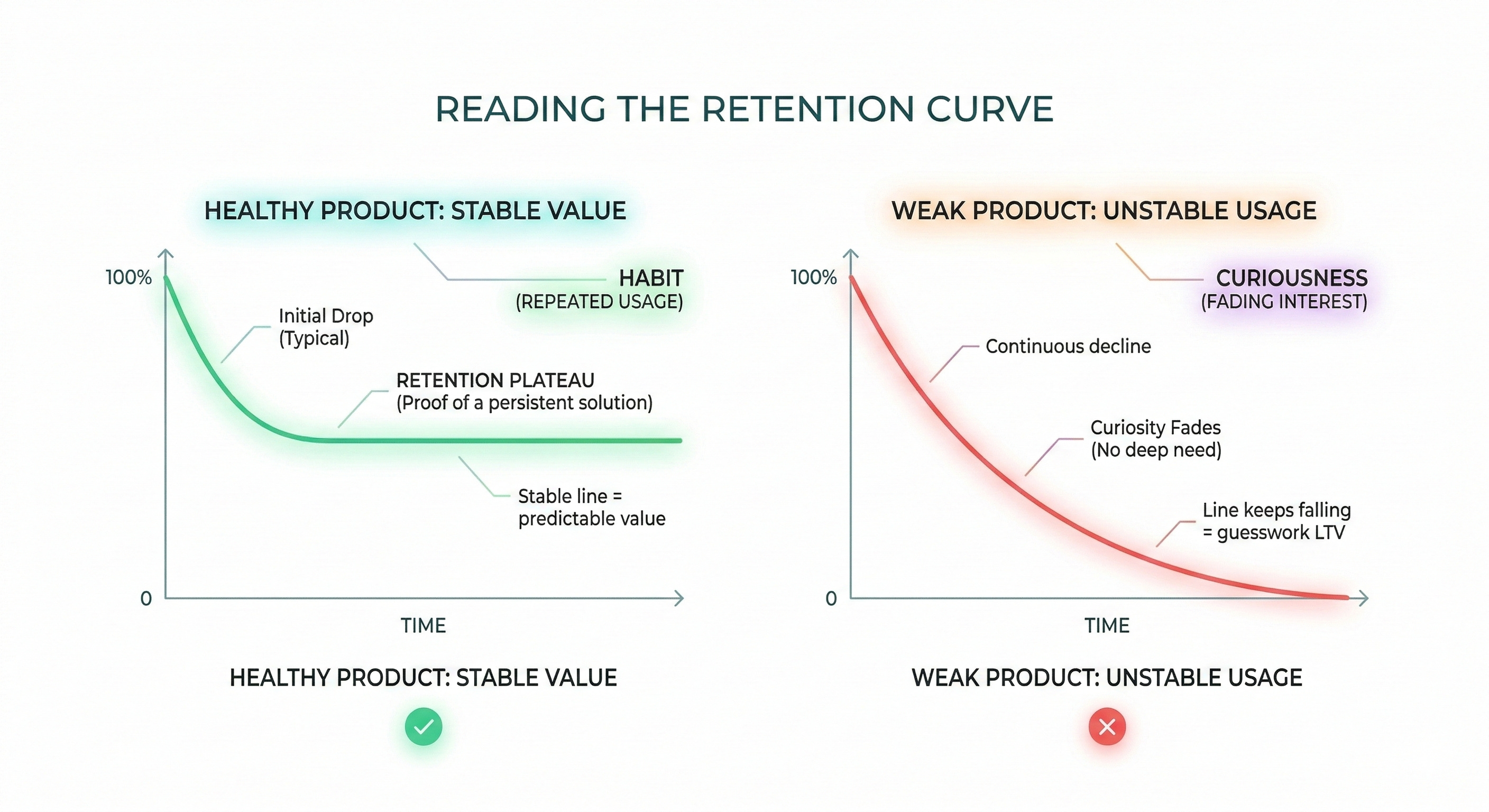
The real test of a product is whether the users who stay actually find a reason to come back. When you look at a group of people who joined at the same time, you want to see that line stop falling and stay flat.
This shows that your product has become a part of their routine. If that line keeps falling toward zero, you have a product that people are curious about but do not truly need.
No amount of new users can fix a product that people do not want to keep using.
The Risk of Passive Satisfaction
You should also be aware of the situation where users are “kind of satisfied.” They log in occasionally, offer mild praise, and do not complain loudly.
But at the end of the day, usage does not deepen, and churn accumulates quietly. Mild satisfaction feels stable until revenue decay becomes visible.
Remember: Acquisition amplifies the retention profile you already have. Strong retention compounds growth. Weak retention accelerates leakage, and the numbers eventually make that clear.
Before we continue, a quick reminder from this week’s sponsor:
HubSpot for Startups just dropped a free Bold Bets Playbook.
Eight AI-native startups. Eight unconventional GTM bets that paid off. Real stories from founders who took the risks most people talk themselves out of.

If you are serious about growth, this is worth 20 minutes of your time.
3. Startup Growth Hacks in 2026: What Really Works Today
The term “growth hacking” still gets people excited because it implies finding a shortcut.
But those shortcuts existed 10 years ago. That was when platforms were new, ads were cheap, and being early gave you a huge advantage. You could win just by being loud or finding a clever way to get in front of people.
But the world looks different today. Ad platforms have become incredibly efficient at taking your money. Algorithms now look for real engagement rather than just clicks.
Because anyone can use AI to flood the internet with content, simply being loud no longer works. What used to be a “hack” is now just the bare minimum you need to do to stay in the game.

What Actually Works Now
Real growth hacking in 2026 is less about viral tricks and more about the work inside your product.
Improving how a user experiences their first five minutes can do more for your bottom line than a massive marketing campaign. When you make it easier for people to get value, they stay longer and invite others naturally.
This is not a quick fix. It is about making sure the product does what it says it will do.
Building Sustainable Advantage
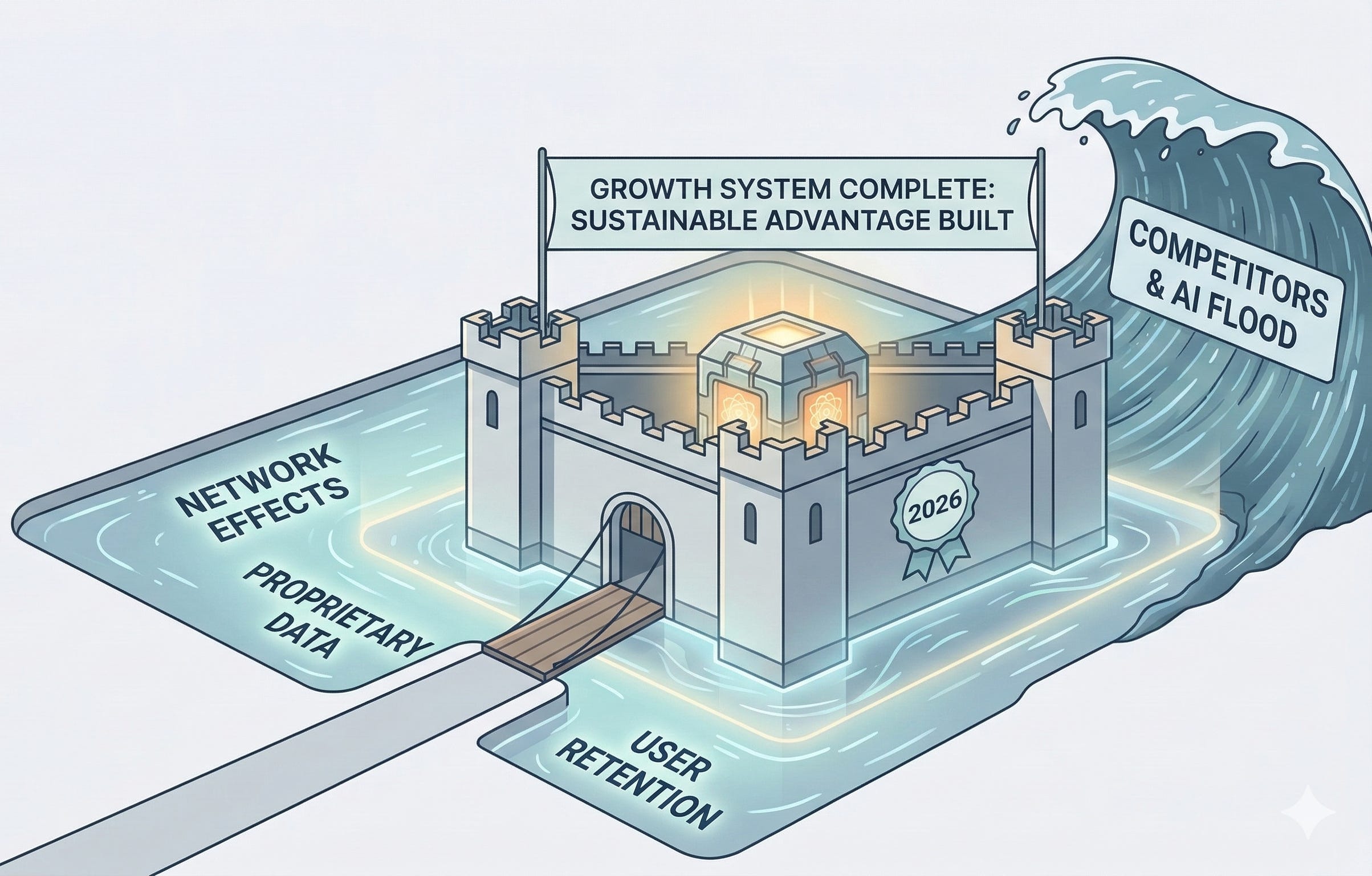
Instead of chasing the next big trend, focus on things that are hard to copy. Create a moat around your product.
Founder-led distribution works because people trust a person more than a faceless brand. Narrowing your focus to a specific group of people makes your message hit harder.
Growth happens when you stop looking for a magic button and start building a system that rewards people for staying.
The most successful founders today are the ones who treat growth as a part of the product, not something you add at the end. They win by being better, not just by being everywhere.
4. How to Strategize for Growth in 2026
When founders talk about growth plans, they often end up with a long list of social media channels, aggressive marketing, and complex models.
The companies that actually scale in 2026 do the opposite. They succeed because they choose to do fewer things better. They don’t try to be everywhere at once. Instead, they focus on the specific path that brings in their best users.
Knowing Your True Customer
A real strategy starts with a very clear picture of who you are serving. This isn’t just a broad idea of a “customer.” Ideally, it should be a specific group of people who have a problem they need to solve right now.
To find them, look at your data. See who stays with you for months and who leaves after two days. Instead of trying to convince the people who leave to stay, double down on the people who already love what you built.
Adjust your messaging and your product to fit that group perfectly. It is better to have 100 people who cannot live without your tool than 10,000 who think it is just “okay.”
The Power of One Channel
In the early days, it is healthy to try a few different ways to find users. But to grow, you eventually need to pick one primary channel and master it. This could be search, referrals, or a specific community.
Scalable teams refine their main channel until they know exactly how much it costs to bring in a new user (CAC) and how long that user will stay. They don’t move on to a second or third channel until the first one is working like a machine. Spreading your team too thin across five different platforms is a fast way to get average results everywhere.
Growth Is a Product Feature
Inside the company, growth should not be a separate department. Every new feature should be tied to a specific goal:
Does this help a user get started faster?
Does it make the product more useful for a team?
Does it encourage a user to invite a colleague?
If a change doesn’t make your current users more active or more likely to stay, it isn’t helping you grow. The strongest companies build growth into the product itself, so that the more people use it, the better it becomes for everyone.
5. The Unit Economics Conversation That Changes Everything
Growth talk changes the moment you look at the money with total honesty. It is easy to show a chart where revenue goes up, but the picture looks different when you subtract what it actually cost to get there. Many founders use top-line growth to hide a business that does not actually work yet.
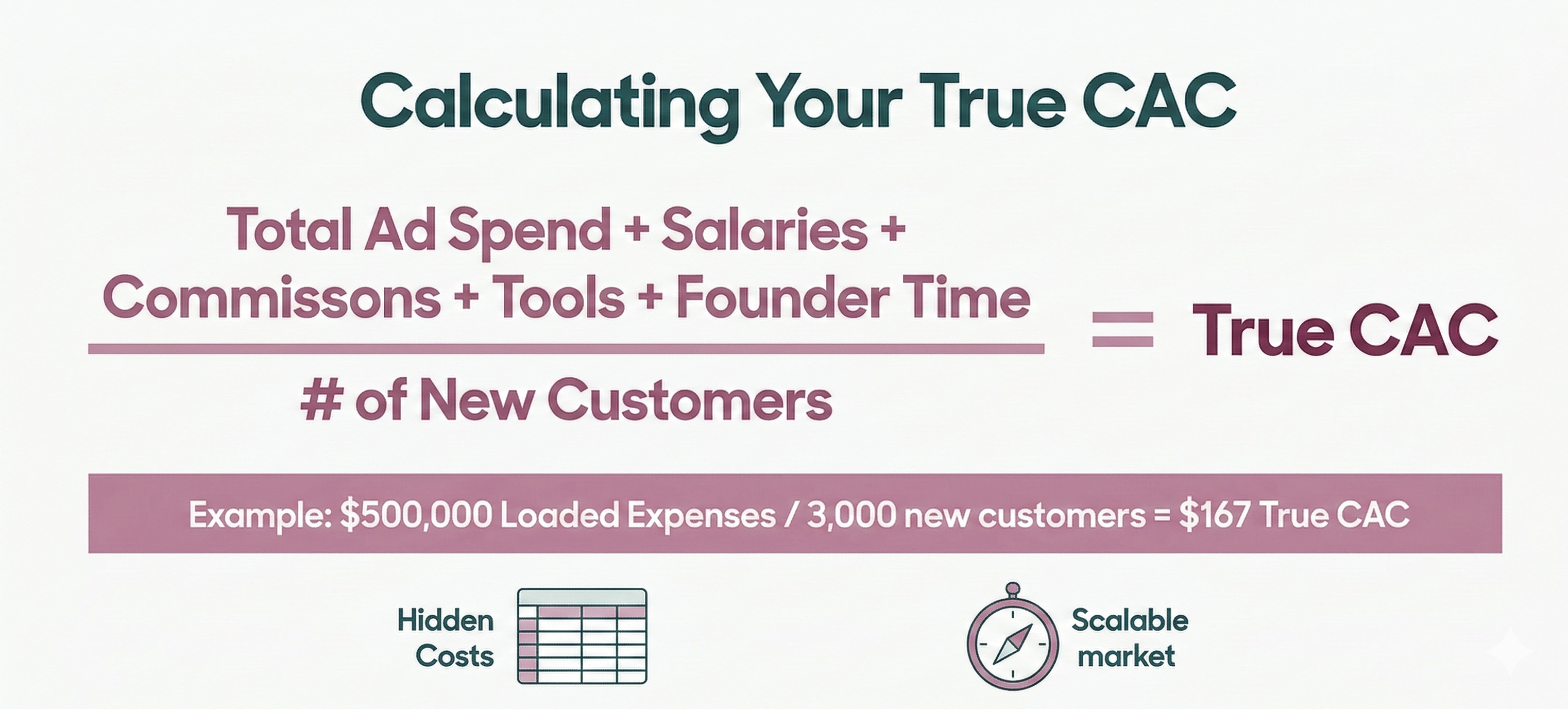
Calculating Your True CAC
Start with customer acquisition cost (CAC). Many teams calculate CAC as ad spend divided by new customers and stop there. A more realistic view treats fully loaded CAC as every expense tied to acquisition. These can be marketing salaries, sales commissions, software tools, agency fees, onboarding time, and a portion of founder effort if the founder drives early sales.
When you add these up, the cost to get a user is usually much higher than you thought. If you ignore these inputs, you are actually just buying users.
The Payback Clock
Knowing your Lifetime Value is often a guess, but knowing your payback period is a fact.
You need to know exactly how many months it takes to earn back the money you spent to find a customer. If your users tend to leave after ten months, but it takes fourteen months to break even on them, your business loses money every day it grows.
The Margin of Truth
Gross margin requires similar discipline. As you get more users, you need more support and better infrastructure. If you ignore these costs, your profit looks better on paper than it is in the bank.
Real growth happens when you build a system that earns more than it spends, rather than using outside capital to hide a leaky boat.
Time is Money
Founder time is another hidden variable that needs to be accounted for. In early stages, founders close deals, nurture key accounts, and resolve onboarding friction themselves. If that effort is not costed, scalability looks better than it is, but it’s the founder who ends up paying for it.
So, viewing growth through unit economics instead of headline revenue clarifies which companies are building durable leverage and which are financing momentum with capital.

6. What VCs Actually Mean When They Say “We Need to See Scalable Growth”
When investors ask for scalable growth, they are not just looking for a chart that goes up and to the right. They want to see if that success is something you can repeat.
Can you put a dollar in and get a predictable result out, month after month? Or did you just get lucky once?
Founders need to showcase these 3 things.
The Test of Repeatability
Scalability means your growth isn’t an accident.
If you grew because of one viral post or a single big partnership, you don’t have a repeatable motion yet.
What investors look for is a primary way of finding customers that works consistently. They want to see that your costs stay steady even as you bring in more people. If it gets much more expensive to find every new user as you scale, the business will eventually run out of room to grow.
Improving with Age
A healthy startup gets better as it grows. Investors look at your newest groups of users to see if they are finding value faster than the people who joined a year ago.
If your onboarding is getting tighter and your retention is getting stronger, it shows the product is maturing. If new users are leaving faster than your early fans, you might be reaching for people who don’t actually need what you built.
The Pull of the Product
Finally, they look for “pull.” This is growth that happens without you having to pay for it.
Whether it is through word of mouth or a product that becomes more useful as more people join, this natural momentum is what makes a company truly valuable.
Scalable growth happens when capital acts as fuel for a fire that is already burning, rather than trying to start a fire from scratch.
7. 5 Uncomfortable Questions Every Founder Needs to Ask
Before you add another channel, hire another growth lead, or raise on the strength of a rising chart, step back and pressure-test the business with a few direct questions.
If you stopped paid marketing tomorrow, what would happen over the next quarter? Would signups collapse, or would organic demand and referrals continue bringing in users who behave like your current base?
The answer shows whether you are building pull or renting attention.
Are your strongest cohorts improving over time?
Compare recent cohorts to earlier ones at the same age. If activation, engagement depth, and retention curves strengthen with each iteration, the product is maturing. If they weaken, growth may be stretching beyond real fit.
Does retention stabilize at a meaningful level, or does it keep decaying?
A plateau at a very low percentage signals narrow relevance, not strength.
Are you solving a painful, urgent problem, or one that is merely convenient?
Urgent problems generate repeat usage and willingness to pay without constant persuasion.
Does growth come from users discovering value on their own, or from your team pushing harder each month?
Sustainable companies require less effort per unit of revenue over time.
Yes, these questions are uncomfortable, but they will give you an honest look of where you stand and how much you can grow.
Distribution. 74 subscribers in, content quality is not the bottleneck. Getting the right people to see it is.The honest pitch is the one that actually converts. Most newsletters bury the real outcome under vague promises. Saying it plainly builds more trust than saying it perfectly.The invite-a-friend mechanic is underrated. Most newsletters treat referrals as a feature, not a core loop. The ones that grow fastest bake it into the experience from day one.