

The “SaaSpocalypse” Was a Panic, Not a Prophecy
Remember February? In just 48 hours, $300 billion vanished from software stocks.
The media quickly crowned it the “SaaSpocalypse.”
It’s easy to see why the story stuck. AI is getting incredibly good, buyers are sick of paying per-seat, and the market was already exhausted from the 2021 hangover.
When the selloff hit, it felt like the final nail in the coffin.

But panics have a funny way of twisting the truth. SaaS isn’t dying.
What actually died in February was a lazy business model.
The assumption that you could build a shallow app and just tax a company’s headcount growth forever.
That is a harsh reality check, but it is far from an obituary.
The real question is who adapts fast enough to win in what comes next. And right now, the founders pulling ahead share one thing: they figured out distribution before everyone else did.
speaking of which:
HubSpot for Startups and Clay are running a live build-along workshop on June 18 at 11am ET for seed and pre-seed founders.

You leave with an actual prospect list enriched in Clay and an outbound sequence live in HubSpot. Real pipeline, built during the session:
▫️ Define your ICP using real signals
▫️ Build and enrich a prospect list in Clay
▫️ Launch AI-personalized outbound in HubSpot
Registrants who apply to HubSpot for Startups are eligible for up to 90% off, plus a chance to win $1,000 in Clay credits:
If you’re building, operating, or investing in software, the real story is much more interesting than a doomsday headline.
Let’s dig into what actually comes next.
Table of Contents
1. Tech Has a Ritual for This
2. What the Bears Actually Get Right
3. The Spending Data Nobody Wants to Talk About
4. The Production Reality of Agentic AI Is Not What the Demos Suggest
5. What Is Actually Dying And Why That’s Healthy
6. What Founders and Investors Should Actually Do With This
1. Tech Has a Ritual for This
The Graveyard of Premature Obituaries
Every major software cycle eventually produces its own funeral language.
When SaaS arrived, on-premise software was supposed to disappear. When cloud computing scaled, it was supposed to render every earlier deployment model obsolete.
Each claim captured something real about where buyer behavior was heading, but each one badly overstated how fast and how completely the transition would run.
Technology markets rarely move as cleanly as the slogans around them.
Buyers do not wake up one morning and abandon entire systems because a better architecture exists. They migrate when the new model solves enough of the old pain without introducing too much operational risk.
In the meantime, old models shrink, adapt, or get pushed into narrower but still profitable corners of the market.
Pressure Is Not the Same as Collapse
The same discipline is needed with the “SaaSpocalypse” narrative: the useful question is not whether AI changes SaaS, but which parts of the SaaS business model were fragile enough to break first.
That is where the conversation becomes more productive.
A generic claim about the death of SaaS hides the real mechanics, from per-seat pricing pressure to buyer fatigue with tools that never became core systems.
None of this means the current anxiety is imaginary.
AI disruption is already forcing software companies to defend pricing power, prove workflow depth, and explain why their product remains necessary when AI agents can perform more tasks directly.
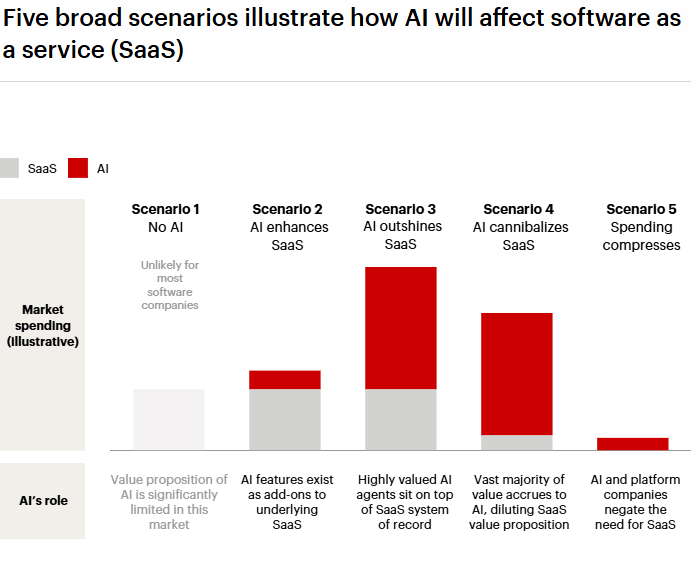
The mistake is treating that pressure as proof of total collapse before we have looked at how customers are actually spending.
2. What the Bears Actually Get Right
Per-Seat Pricing Was Always a Headcount Bet
The bear case deserves more than a polite nod because parts of it are clearly true.
Per-seat pricing is under pressure for a simple reason. If AI agents can produce the output of several employees, software contracts tied to employee count start to look exposed.
For years, SaaS companies benefited from customer headcount growth almost automatically.

When headcount stops being the cleanest proxy for value, that pricing logic weakens.
You can already see the pressure in the operating signals.
Zylo’s 2026 SaaS Management Index found that the average enterprise portfolio had already shrunk from 374 to 342 applications, a sign that buyers are consolidating rather than expanding their vendor footprint. Workday’s decision to cut 8.5% of its own workforce in early 2025 also landed awkwardly for the sector, because it came from a company whose products sit close to the very headcount systems now being questioned.
These are not abstract fears dressed up as market commentary.
The Build-vs-Buy Equation Is Shifting at the Margin

The build-versus-buy equation is also changing at the margin.
Coding agents make it cheaper for companies to build internal tools that once would have required vendor contracts, procurement cycles, and dedicated engineering teams.
That does not mean every enterprise will rebuild its software stack from scratch, but it does make weak horizontal tools harder to defend.
A product that mostly organizes information, routes simple tasks, or wraps a thin workflow now faces a harsher buyer question.
Why pay a vendor every year when an internal team can reproduce enough of the value quickly?
The strongest bear argument is not that SaaS disappears, but that the old SaaS business model loses some of its easiest expansion math.
That is a serious point, and investors should not wave it away.
But a model under pressure is different from an industry in terminal decline.
That distinction matters because it separates companies whose economics were inflated by headcount assumptions from companies still embedded in work customers cannot easily replace.
3. The Spending Data Nobody Wants to Talk About
The Contracts Still Say Seats
The cleanest problem with the SaaSpocalypse story is that the spending data does not behave like an obituary.
Ramp’s contract data shows seat-based contracts still representing roughly 65% to 75% of SaaS spend, with flat platform subscriptions sitting around 20% to 30%.
Consumption-based spend, the model many people assume will rapidly replace seats, remains only 4% to 6% of the total.
Those lines barely moved over twelve months.
That is the part the death of SaaS argument has to explain and usually does not.
If enterprise buyers were already abandoning seat-based software at scale, the first evidence would not appear in a founder thread or a product keynote. It would show up in contracts, renewals, and actual payment behavior across the SaaS market.
Why the Narrative Is Running Ahead of the Money
The company-level examples tell the same story.
Adobe still shows roughly 99% seat-based billing in Ramp’s spend panel even after adding Firefly AI credits, which suggests that AI features can be absorbed into existing pricing before they force a complete rewrite of the contract model.
HubSpot’s entire non-subscription revenue line sits around 2% of FY2025 total, which means Breeze AI’s usage-based contribution is a rounding error by any reasonable read of the filings, despite the product launching in spring 2025.
That gap is where the narrative gets ahead of the evidence.
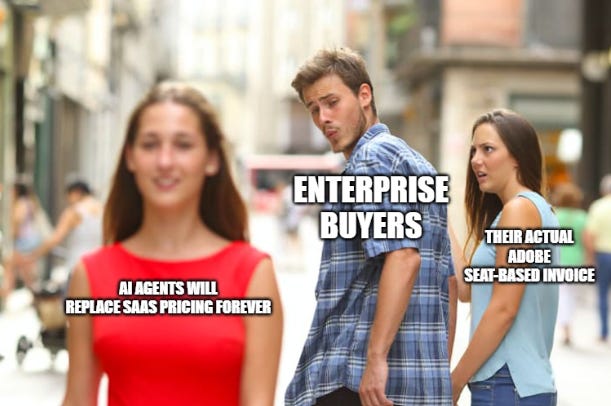
Product leaders are rightly preparing for AI agents, usage credits, workflow automation, and outcome-based pricing.
Buyers, meanwhile, are still paying for access, permissions, collaboration, compliance, support, and embedded workflows in ways that look much closer to traditional SaaS than the market panic suggests.
The spending data shows a category being interrogated, not abandoned.
That does not make the bear case irrelevant. It does make the timing of the collapse argument difficult to defend.
If the great pricing migration were already moving through enterprise software at speed, it would be visible in the money by now. It is not.
4. The Production Reality of Agentic AI Is Not What the Demos Suggest
The replacement thesis depends on a demanding assumption. AI agents must work reliably, securely, and economically inside real enterprise environments.
That is a much higher bar than producing an impressive demo, generating a clean workflow video, or completing a narrow task under controlled conditions.
Enterprise software earns its place through requirements that rarely make it into a product demo: permissioning, audit trails, uptime, governance, integrations, and predictable failure modes.
The three constraints the demos don’t show
Security is where enterprise deployment stalls most immediately.
A 2025 arXiv paper on LLM agent vulnerabilities found 94.4% of tested agents susceptible to prompt injection, 83.3% to retrieval-based backdoors, and 100% to inter-agent trust exploits.
The EchoLeak vulnerability in Microsoft Copilot made the risk feel less theoretical, because it showed how sensitive enterprise data could be exposed through the systems companies are now being asked to trust more deeply.
For regulated industries, that is not a mild adoption concern. It can block deployment entirely.
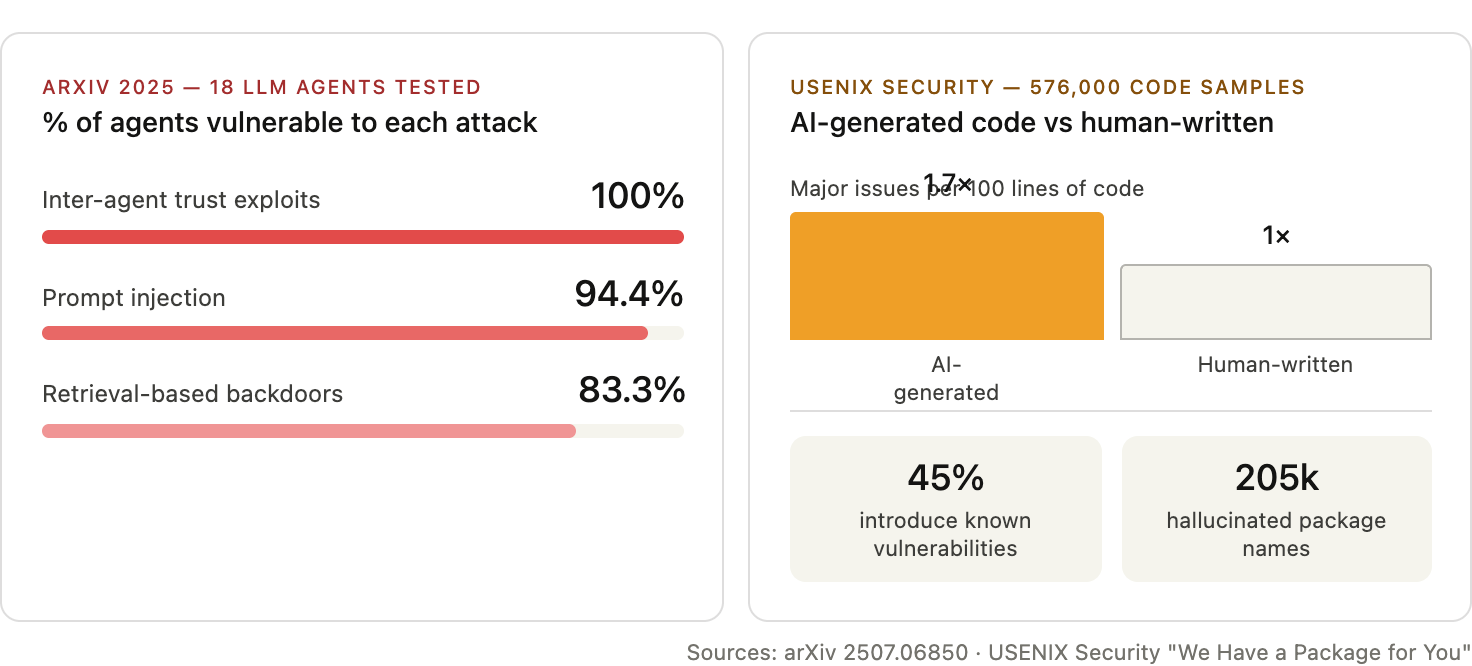
The quality of AI-generated code has become harder to ignore as a separate argument against rapid replacement, particularly after the speed-first enthusiasm around vibe coding ran into production realities in 2026.
AI-generated code has been found to contain 1.7 times more major issues than human-written code, with 45% introducing known security vulnerabilities. A USENIX Security paper titled “We Have a Package for You” found 205,474 unique hallucinated package names across 576,000 generated code samples, a pattern attackers have learned to exploit because fake dependencies become real attack surfaces once developers copy them into production.
That does not mean AI coding tools are useless. It means their output still needs review, context, and accountability.
Beneath both of those problems sits the cost question, which lands closer to the business model than most product demos acknowledge.
Agentic AI workflows can burn tokens unpredictably when tasks branch, loop, or require repeated calls across tools. That creates denial-of-wallet risk, where a broken or manipulated agent consumes far more compute than intended.
A seat-based contract may look old-fashioned, but it gives CFOs a cost ceiling they understand. Enterprise agent deployment often replaces that comfort with variable usage that can be difficult to forecast.
The Gap Between Demo-Ready and Enterprise-Ready
The SaaSpocalypse narrative prices future agentic AI capability as if it already exists in production form.
Some of these problems will improve, and the best software companies are already building around that future.
But in 2026, the gap between what AI agents can demonstrate and what enterprises can safely rely on remains wide enough to matter.
That gap is one reason the SaaS market is not moving as fast as the panic suggests.
5. What Is Actually Dying And Why That’s Healthy
The Thin End of SaaS Has Lost Its Cover
The part of SaaS most exposed to AI was never the strongest part of the category.
It was the thin end. Project management tools that behaved like prettier spreadsheets, workflow automation products that mostly moved information between forms, and form-builders charging enterprise prices for jobs a capable AI agent can now imitate in minutes.
These products were not protected by deep data, complex workflows, or institutional dependency. They were protected by distribution, inertia, and the fact that internal software used to be annoying to build.
AI disruption changes that bargain. When coding agents lower the cost of building internal tools, buyers become less tolerant of software that feels shallow, expensive, or too loosely connected to business outcomes.
A weak SaaS business model can no longer hide behind the old argument that custom software is always too slow, too expensive, or too painful to maintain.
That argument still holds in many complex categories, but it no longer protects every horizontal tool with a login page and a subscription plan.

Where Depth and Data Tell a Different Story
The other side of the SaaS market looks very different.
Vertical SaaS with proprietary data, deep workflow integration, and compliance-heavy customer environments remains much harder to replace.
Healthcare platforms like Epic and Cerner sit so deep inside clinical operations, billing flows, records, compliance requirements, and institutional memory that replacing them is less a software decision than an institutional one.
Life sciences infrastructure like IQVIA has a similar kind of depth, where data networks and regulatory context matter as much as software features.
What is dying is not SaaS, but the idea that every thin software wrapper deserves durable SaaS valuations.
That is why the correction is healthier than the panic suggests.
The vertical SaaS market is still projected to grow from $133.5 billion in 2025 to $194 billion by 2029, which is difficult to square with a true category death.
AI is forcing weak SaaS to defend itself, while the durable end of the market keeps compounding because customers are still paying for systems they cannot safely rip out.
6. What Founders and Investors Should Actually Do With This
For Founders: Stop Defending Assumptions, Start Stress-Testing Them
For founders, debating whether SaaS is dead is the wrong use of the moment.
The question is whether your product depends on assumptions that AI is already weakening. If your revenue expands mainly because customers hire more people, if your product has no proprietary data advantage, and if the workflow can be copied by an internal team using AI agents, the market is going to ask harder questions.

Better to ask them yourself while you still have room to adjust.
That adjustment does not mean abandoning per-seat pricing overnight.
In some products, seats still map cleanly to governance, access control, collaboration, and accountability. But founders need to know where pricing reflects real customer value and where it merely reflects headcount.
If the value sits closer to completed tasks, reduced labor, faster throughput, or measurable business outcomes, then outcome based pricing should become part of the contract conversation before renewal pressure forces the issue.

For Investors: Separate Embedded Software from Dressed-Up Features
For investors, the selloff created noise and opportunity at the same time. Some weak companies deserved lower SaaS valuations because their business model had been overprotected by cheap capital and lazy expansion math.
But high-quality vertical SaaS caught in the same broad derating deserves a more careful read.
The companies worth studying are the ones with proprietary data networks, deep operational workflows, high switching costs, and enough pricing flexibility to absorb AI disruption without losing the customer relationship.
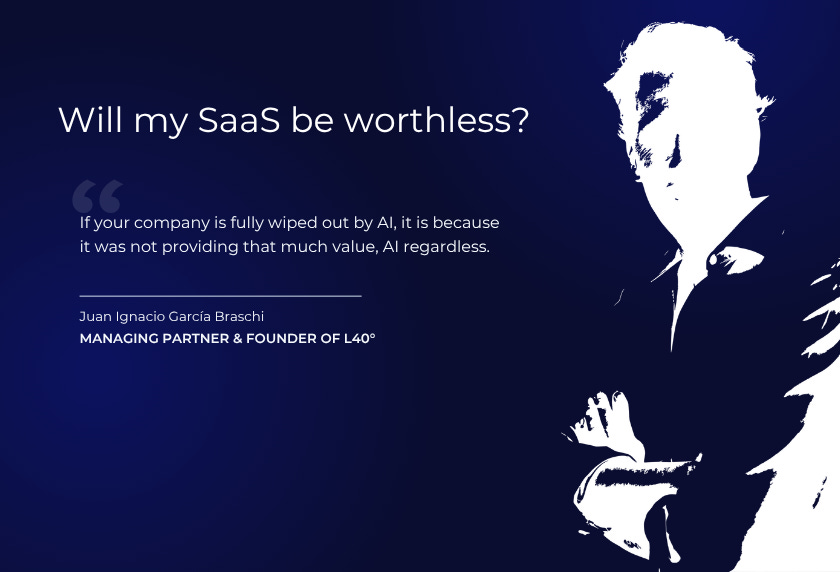
The right response to the SaaSpocalypse is underwriting discipline, not category panic.
Founders should harden the parts of the product that AI cannot cheaply reproduce. Investors should separate software that was merely sold well from software that is genuinely embedded.
What the selloff actually surfaced was a misclassification that had been building for years: software priced as infrastructure that was really just a feature with a subscription attached.
Często mylimy presję z końcem epoki. Być może AI nie oznacza śmierci SaaS, lecz koniec produktów, które rozwiązywały zbyt mało problemów za zbyt wysoką cenę.
Sharp take, thanks for cutting through the panic. The per seat fatigue point is the one I hear most from small service businesses. It is less that they hate software and more that per seat pricing punishes them for growing. When a new hire adds cost before it adds output, buying stops feeling like leverage. Curious whether you think per seat is the model that actually breaks first.