

The New Rules of Attention
For the majority of people, trends are felt only in hindsight. When something big changes, nobody notices immediately, especially since we are so used to the status quo.
And right now, social media is in a transition period.
Over the past two years the word “follow” stopped meaning on the major platforms what it meant when most of us learned to use them. That you may have noticed.
But to this day, most businesses are still optimizing for a number that had already been demoted.
The change arrived slowly enough to miss and completely enough to reorganize everything downstream of it.
What used to behave like a subscription list now behaves like a recommendation engine, one that treats every post as a fresh audition in front of an audience it selects rather than an audience you earned.
Whether that ruins your year or makes it depends entirely on what you do
Table of Contents
1. The Feed Stopped Being a Feed
2. What a Follower Is Actually Worth Now
3. Why Posting More Is Only Half Right
4. The Front Door Is an Answer, Not a List
5. Writing Became the Format Machines Quote
6. The Half Almost Nobody Is Doing
1. The Feed Stopped Being a Feed
The mechanics changed before the vocabulary did, which is why so many people are still describing a product that no longer exists.
How AI and the push for freshness killed the feed
Meta’s January 2026 newsroom post put numbers on the current machinery. Ranking changes in Q4 2025 produced a 7% lift in views of organic feed and video posts, and Facebook was surfacing over 25% more same-day Reels than a quarter earlier.
Read that second figure twice, because it describes a compounding problem rather than a feature. The system is being tuned toward freshness, which shortens the useful life of everything you publish while widening the pool of posts competing for each slot.
The direction was set years ago. Mark Zuckerberg told Meta’s Q1 2024 earnings call that more than half of what people saw on Instagram was recommended by AI, alongside roughly 30% of the Facebook feed. Those were majority figures two years ago, and everything since has moved one way.
Why YouTube is beating Disney without relying on followers
Video moved somewhere most boardrooms still do not track properly. Nielsen’s May 2026 Gauge put streaming at 48.6% of all US television watch-time, with broadcast down at 19.2% and cable at 20.4% and YouTube alone taking a platform-record 13.8% to lead every distributor in the country for a third consecutive month.
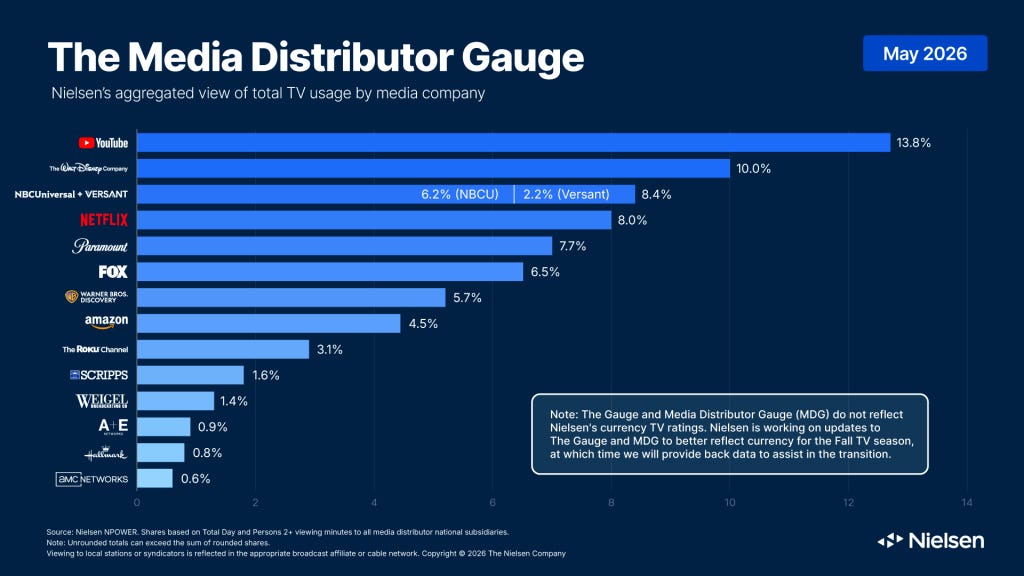
A platform that commissions almost none of its own supply now out-watches the company that owns Star Wars, Marvel and ESPN and it got there without a single follower relationship doing the work.
That is the entire argument about modern distribution compressed into one comparison and it explains why the follower number on your profile deserves a demotion.
2. What a Follower Is Actually Worth Now
A follower has not become worthless. It has become a weak prior rather than a promise and the difference between those two things is where most content budgets are currently being wasted.
The myth of follower analytics and organic reach
Here is the part that requires honesty, because it is the number everyone wants and the number nobody has. No platform publishes organic reach broken down by follower count.
Every figure you have ever seen on the subject comes from third-party tools sampling accounts that happened to buy analytics software, which is a survey of a customer base rather than a measurement of the internet.
So when somebody tells you followers no longer matter, they are stating a direction that is probably correct while dressing it up as a finding that has not been made.
Why sends per reach is the ultimate algorithmic taste test
What can be said with confidence is narrower and considerably more useful.
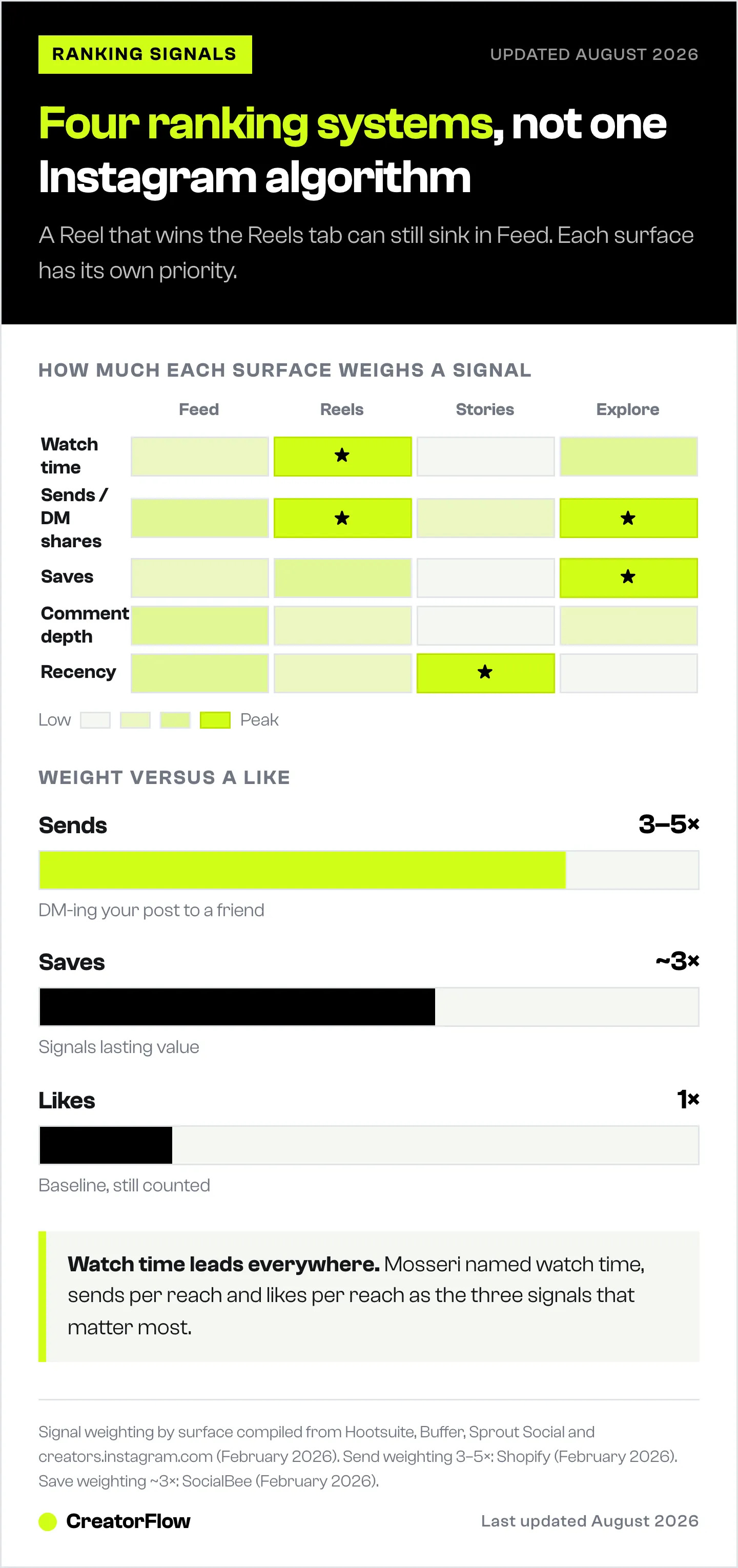
Adam Mosseri has been consistent in public about which signals carry the most weight on Instagram and the one he keeps returning to is sends per reach, the rate at which people forward a post into a private conversation.
Watch time sits alongside it, while likes come last and count for least.
Sends per reach is the interesting one, because of what it actually measures. The platform is checking whether your content survived contact with a human relationship, which is a fundamentally different question from whether it held someone’s thumb still for four seconds.
Everything else in the ranking stack is behaviour toward a screen. That single metric is behaviour toward another person and it is the closest thing the machinery has to a taste test.
Which raises the obvious follow-up question and it is the one most people answer wrong.
3. Why Posting More Is Only Half Right
The case for enormous volume is mechanically sound and I have no quarrel with the arithmetic behind it.
If distribution gets decided per post by a system with a short memory, then every post is a separate draw and more draws produce more chances. The arithmetic holds. The cost sits elsewhere.
The hidden algorithmic penalty of low-quality volume
It sits in what high-volume publishing does to the publisher. Content produced at the ceiling of your ability compounds, while content produced at the floor of it teaches an audience to scroll past your face and teaches the ranking system that people who encounter your work do not forward it to anyone.
You are not neutral in the eyes of the algorithm when you post badly. You are generating evidence against yourself, at scale, with a schedule.
Why cheap competence has failed and taste is the new barrier
There is a supply-side problem underneath this that the volume advice tends to skip.
Several studies through 2025 and 2026 have put a very large share of what now circulates on the major platforms in the machine-generated column, with image categories running higher than text and I would treat any specific percentage with suspicion because detection methods are contested and an alarming number is commercially useful to whoever publishes it.
The direction, though, is not seriously in dispute.
When the marginal cost of producing plausible content falls toward zero, the marginal value of plausible content follows it down, which is the mechanism behind the widely shared observation that being loud stopped working as a strategy some time in the last eighteen months.
Competence is table stakes now and table stakes are free.
What remains scarce is a point of view somebody could disagree with, which is roughly what Rick Rubin has spent four decades demonstrating in a business where technical skill was never the constraint and a career built on taste outlasted every producer who had more of it.

None of which helps if the customer never reaches a feed at all and increasingly they do not.
4. The Front Door Is an Answer, Not a List
The most consequential change for anyone who sells something is not happening inside social platforms. It is happening in the box people type questions into.
The collapse of search clicks in the age of AI answers
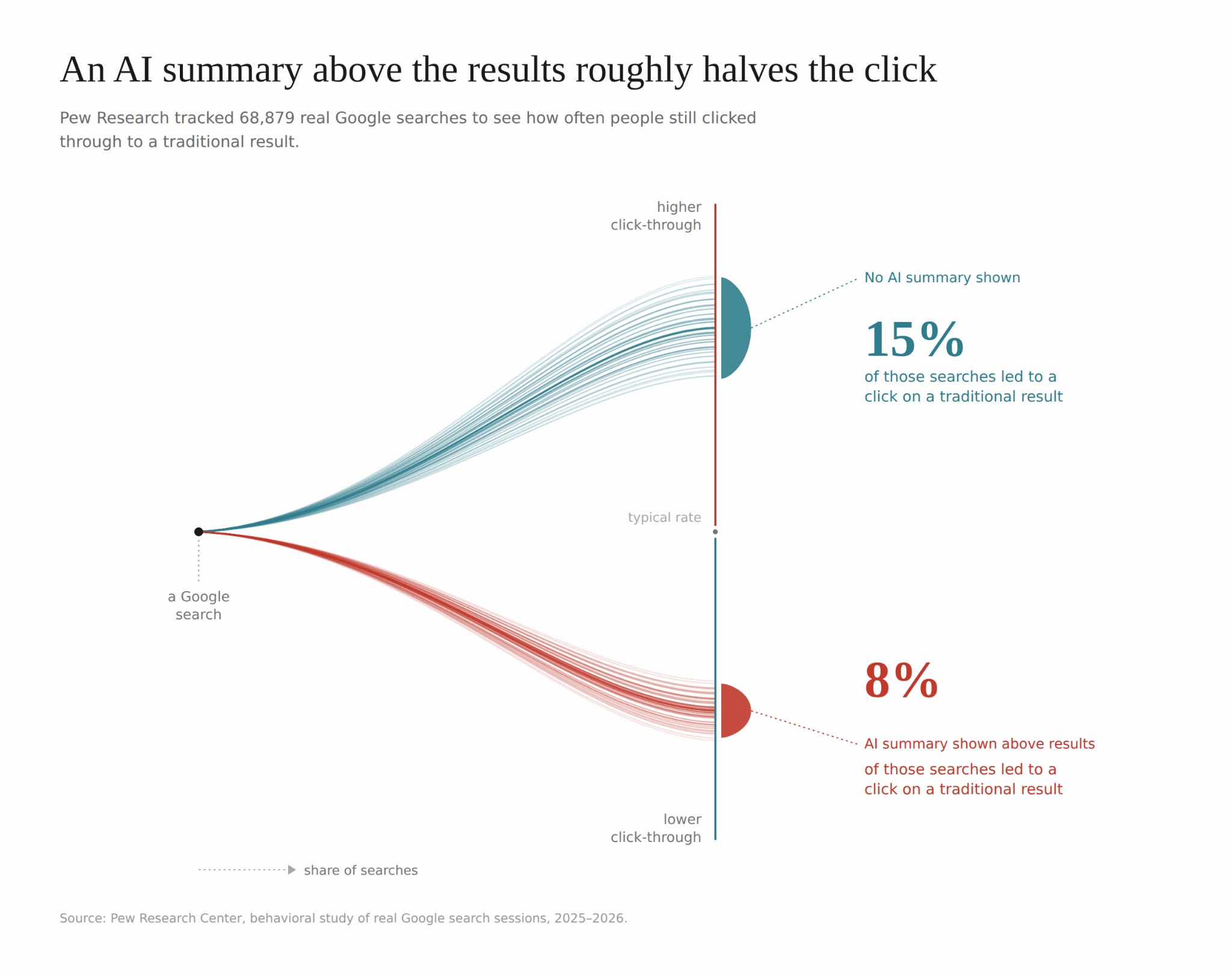
Pew Research ran a behavioural study of 68,879 real Google searches rather than modelling it from keyword tools and found that people clicked a traditional result 8% of the time when an AI summary sat above it, against 15% when it did not. Roughly half the click rate, measured from actual browsing rather than inference.
The wider picture is genuinely contested and pretending otherwise would be dishonest.
SparkToro, working from Similarweb clickstream data, put US zero-click searches at 68.01% for the first four months of 2026, up from 60.45% in 2024. Datos, using its own strict clickstream methodology, published a figure of 22.4% for March 2026 and reported it falling.
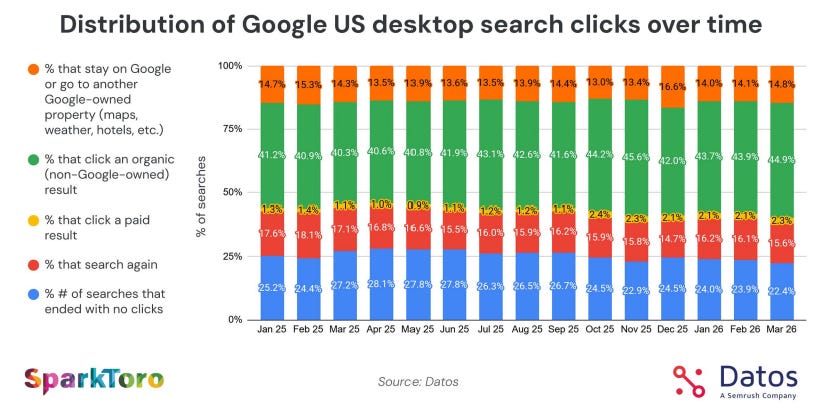
Same country, same quarter, a gap of roughly three times and every strategy deck in circulation quoting whichever number flatters the argument.
What is not contested is the scale of the new surface. Google told I/O 2026 that AI Mode had passed one billion monthly users with query volume more than doubling each quarter.
OpenAI reported 900 million weekly active users in February 2026 and Reuters reported the ChatGPT app crossing a billion monthly actives in June, faster than any application before it. In January 2026 OpenAI started selling advertising inside the answers.
Why being named as an entity matters more than ranking
Put that together and the structural change becomes obvious. A growing share of purchase-adjacent questions now resolves into a recommendation naming two or three companies, rather than a page of ten links a determined buyer can scroll past.
Ranking and being named are different disciplines and the overlap between them has been falling sharply across several independent trackers over the past year.
A business can hold every position it had and still watch enquiries decline, which is a particularly cruel way to lose, because the dashboard keeps reporting success.
What earns a mention is being the traceable origin of something specific: a number nobody else published, a distinction nobody else drew, a method with your name attached to it.
Retrieval systems index entities rather than pages and an entity is simply something described consistently enough, by enough other people, to be worth citing.
Which is a technical restatement of a very old idea about reputation and it points at the format that machines find easiest to quote.
5. Writing Became the Format Machines Quote
Text is having a commercial revival that most video-first advice has not caught up with and the honest version of the numbers is more interesting than the promotional version.
The reality behind the Substack boom and creator revenue
Substack passed 50 million active subscriptions by the first quarter of 2026, around 5 million of them paid. Gross writer revenue reached roughly $450 million in 2025, up from $375 million the year before and by April 2026 close to 100,000 publications were earning money globally, double the figure from May 2025, with almost 30,000 of those outside the United States.
Now do the arithmetic the announcements skip. Spread $450 million across a hundred thousand earning publications and the average lands near $4,500 a year, while eight publications have crossed a million subscribers and the top ten take north of $25 million between them.
The median earning publication is making a few hundred dollars and the median publication overall is making nothing. Substack itself notes that its paid figure counts subscriptions rather than people, since one reader can hold several.
I run two of those publications, so treat everything above as a disclosure rather than analysis from the stands. The reason I keep writing anyway is in the next paragraph, and it has little to do with subscription revenue.
Why written argument is your highest-fidelity lead generator
I am not raising this to talk anybody out of writing. I am raising it because the case for writing is stronger once you stop pretending it is a salary.
Written argument is currently the highest-fidelity demonstration available of how a person actually thinks, it is the format retrieval systems index and quote most readily and it is the one medium where somebody with no camera presence and no editing budget competes on level terms with a full production team.
If money arrives it tends to arrive sideways, through the client who read four essays before booking a call and it will never appear in any platform statistic. That is also the shape of a content engine worth running, which is a lead system that happens to look like a publication rather than a publication that hopes to become a business.
All of which describes one end of what your 2026 should look like. The other end is being ignored almost universally.
6. The Half Almost Nobody Is Doing
Everything described so far is a machine for lowering the cost of reaching a stranger and the second-order consequence of that is the part people keep missing.
Why unscalable personal outreach beats cheap distribution
Nielsen’s 2021 global Trust in Advertising study surveyed 40,000 people across 56 countries and found 88% trusted recommendations from people they knew above every other channel available to them. Reporting on the same research puts trust in advertising delivered through influencers at 23%.
Nearly four to one, in favour of the least scalable channel that exists.
The word-of-mouth number has moved across the survey’s history, sitting at 92% in 2012 and 83% in 2015, so treat the exact figure as soft. The ranking has never moved at all.
Reaching a stranger has never been cheaper, which is exactly why reaching a stranger has never been worth less. A message that visibly cost you something is now the only kind that lands, because the recipient knows precisely what the cheap version costs to produce and knows you did not send it.
So the recommendation is unglamorous and I would do it before anything else on this list. Go through your records, find every person who has paid you, worked with you, referred you or turned you down politely and contact them individually with no ask attached.
Not a newsletter. Not a campaign with a merge field where their first name goes. Something that could not plausibly have been sent to anybody else.
This works for the same reason retention work beats acquisition work when it happens long before the cancel button. The relationship was already there and attending to it early costs a fraction of rebuilding it later.
The barbell strategy and the death of the middle ground
The strategy underneath all six sections is a barbell and both ends carry load. On one end, publish with enough specificity and consistency that you become the citable source in your corner of the market, accepting that machines will read most of it before humans do, which is the same logic behind treating speed and surface area as a first-order product decision rather than a marketing afterthought.
On the other end, do the slow human work that nothing can imitate at scale and no competitor can automate away from you. The founders who get this right rarely spread themselves thin and the ones who win usually pick one channel done properly over five run badly.
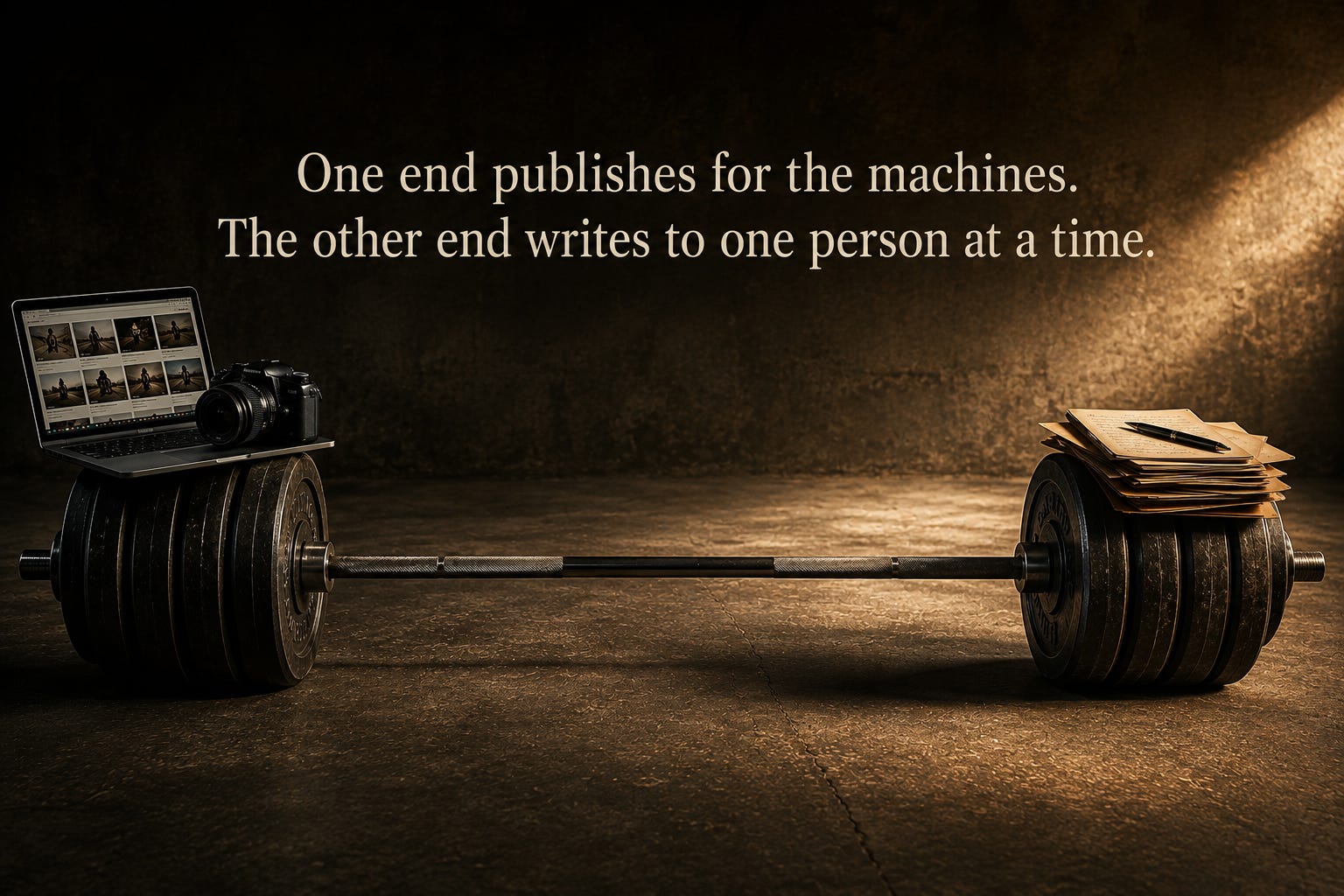
The middle is where almost all professional communication currently sits. Polite, plausible, scalable, perfectly competent and increasingly invisible to both the machines and the people.
Pick your ends. Every competitor you have is currently producing perfectly competent work that nobody forwards to anybody, and they will keep producing it for at least another year.
The Distribution Barbell: A 90-Day Build
Everything above described the shape. This is the build, with the numbers from running it across 340,000+ Substack subscribers and 150 million annual LinkedIn views.
Two warnings before you start. The first is that this takes a quarter, and most of the compounding shows up in month four. The second is that the outreach half looks like a waste of an afternoon every single time you sit down to do it, and it produces more revenue per hour than anything else here.