Welcome to the AI Distribution Singularity
The best AI product rarely wins anymore.
Instead, the one that shows up everywhere, moves faster than the feed can forget, and plants itself inside the user’s daily reflexes is the one that breaks out.
Founders will ship something clever, someone else will clone it within days, and everybody moves on before the next release is ready.
What used to feel like an arms race in model quality now feels like a collision of products, platforms, and audiences inside the same shrinking attention window. This is the distribution singularity, the point where everything competes in the same lane and at the same speed.
Part of this is technical decay. Features that felt novel a month ago are suddenly baseline because open-weight models level the field, compute costs are rising, user bases are growing, and marketing channels are closing faster than they open.
In this environment, the old idea of a product moat collapses under the weight of rapid imitation and evolving platforms, so defensibility now comes from something else entirely.
Distribution.
The only advantage that lasts is distribution power, the ability to reach, convert, and retain users faster and cheaper than anyone around you. Not in a marketing sense, but in a structural one.
Today, a real distribution strategy should be the spine of every tech company. It’s the ultimate decider of momentum, cycle survival, and whether , whether you survive the platform cycles, and whether a business model will hold up once the cost curves start pushing back.
When distribution compounds, a startup’s growth compounds with it, but when distribution stalls, no amount of funding will save the product.
this issue is brought to you by DigitalOcean Deploy:

Distribution only compounds when your infrastructure can keep up. On April 28 in SF, the teams actually running AI in production are going on stage to show how they do it:
▫️ Real customer stories from Character, Workato, VAST Data, Arcee, and vLLM on inference at scale
▫️ Fireside chat with NVIDIA’s Kari Briski and DigitalOcean’s Salman Paracha on the agentic AI revolution
▫️ First look at DigitalOcean’s next-gen inference products
Free to attend:
Table of Contents
1. Why Product Moats Are Dying, And What’s Replacing Them
2. The New Power Law: Distribution Compounds, Features Evaporate
3. Momentum Is the Moat: Velocity, Visibility, and Feedback Loops
4. Designing for Distribution: How to Build Products That Spread Themselves
5. The Platform Trap and How to Survive the Open
6. Building the Distribution Engine Inside Your Company
7. The Founder’s Framework: Playing to Win in the Distribution Era
1. Why Product Moats Are Dying, And What’s Replacing Them
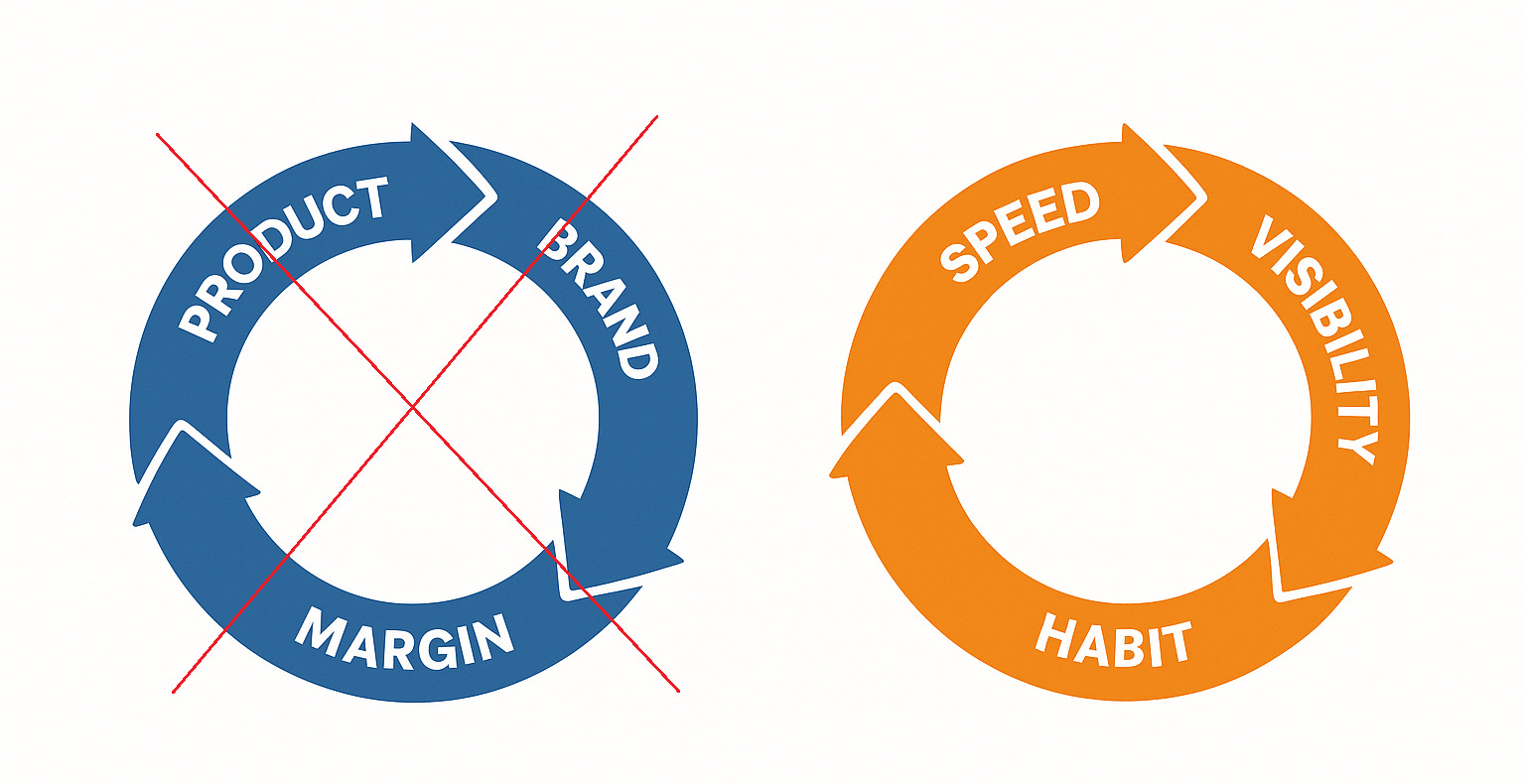
In the old SaaS world, companies won by stacking advantages in a predictable order. You built a better product, that product shaped your brand, and the brand justified your margin. It was a slow, steady growth loop that rewarded patience and precision.
But thanks to AI, that loop no longer applies.
The feedback cycle is no longer product → brand → margin. It behaves more like speed → visibility → habit, and the winners are the ones who move through that cycle before anyone else realizes the race has started.
Traditional product moat thinking falls apart because the foundations no longer hold. Models are now open, interchangeable, and often separated by margins too thin to matter.
A clever UX pattern might buy you attention for a week, but open-source repos erase that advantage almost instantly. Compute costs push against you as you grow, not in your favor.
Every new user invokes a bill, so product-led growth in AI fights the laws of economics in a way SaaS never had to. And the platforms you rely on can absorb your best idea overnight.
One update to a system prompt, one UI tweak in a major model interface, and the feature you spent months polishing becomes a native option somewhere else. So everything is changing while you are busy building.
Founders feel this most acutely when they watch their work evaporate faster than they can package it. Imagine shipping a sharp AI notetaker. People love it for a week. But then…a larger interface bundles automatic transcription and action items, and overnight you’re one tab away from irrelevance.
Or think of an image generator tuned for a niche style. It has a moment, maybe even a small wave of virality, but then the next model update rolls out with a more flexible baseline and your differentiation dissolves.
We are seeing such examples on a daily basis from AI startups trying to build defensibility in an environment where novelty decays on contact.
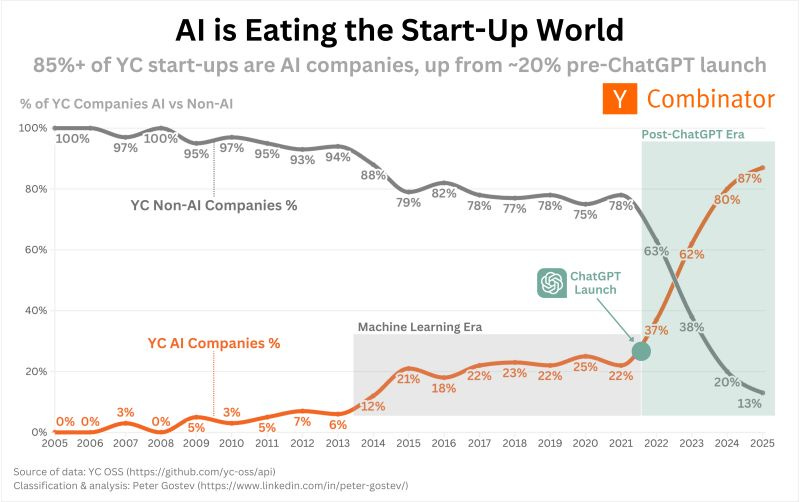
This is why founders are transitioning from product defensibility to distribution defensibility. The advantage lives in the pathways that deliver it. It lives in the speed at which you reach users, the visibility you earn before the feed resets, the habits you cultivate while competitors are still polishing their next release.
A strong distribution strategy creates pull that competitors can’t mimic by copying your code.
2. The New Power Law: Distribution Compounds, Features Evaporate
Distribution used to be something founders thought about after product-market fit. In AI, it becomes the thing you build first, because distribution power behaves like a force of nature.
It is the ability to repeatedly access, influence, and retain your users without negotiating with algorithms, ad networks, or platform rules every time you need attention. When you control that access directly, you control the rate at which your company compounds.
The Physics of Compounding
The compounding is the part most founders underestimate. Every artifact your product creates can become a permanent acquisition surface.
A shared document, a generated image, a neatly formatted answer, a prompt template, a workflow that slots neatly into someone’s day; each of these lives on long after the initial interaction. They carry your signature and they travel across teams and social feeds. They introduce your tool to people you never paid to reach.

This is why distribution strategy in AI behaves less like marketing and more like infrastructure. You set it up once, and it continues to produce motion long after the original effort is spent.
Why Technical Moats Fade but Distribution Doesn’t
Technical moats rarely offer that kind of persistence and features evaporate as soon as someone retrains a model or ships an update. But distribution moats outlast those shifts because channels evolve slower than features.
A strong community, a recognizable workflow pattern, a habitual insertion point in a team’s routine; these remain even as the underlying models reshuffle.
Trust is another key component.
When your outputs consistently deliver value, users start to rely on them. They cite them, forward them, and attach their own credibility to them, over time, this repeated exposure turns into a form of social and professional capital that competitors can’t replicate with a single clever release.
Borrowed Reach vs. Owned Gravity
It also helps to distinguish between borrowed distribution and owned distribution. Borrowed distribution is what you get from platforms, ads, or algorithmic boosts. Yes, it works, but it can also be taken away.
Owned distribution is what you build yourself, that’s your community, audience, a workflow that becomes second nature, a brand identity shaped by repeated usefulness.
This is the new power law.
Features evaporate, channels persist, and distribution compounds, but when you build distribution as infrastructure rather than a campaign, your startup growth becomes something the market recognizes and remembers.
3. Momentum Is the Moat: Velocity, Visibility, and Feedback Loops
Momentum has become one of the few forces in AI that resists erosion. It is compounding motion that creates a perception of inevitability, a feeling in the market that your product is moving so quickly and showing up in so many places that you must be the one pulling away.
In an environment where feature novelty evaporates and competitors look interchangeable, momentum becomes its own form of distribution strategy, it multiplies touchpoints, shapes expectations, and turns movement into memory.
Before breaking it down, what you need to know is that momentum is not a vibe, but a system made of three interacting pillars.
1. Velocity: The Market Rewards Motion
Velocity is the pulse that tells users you’re alive.
Teams that ship quickly create a sense of forward motion, and that motion becomes a signal of competence. When AI startups release improvements weekly, the market forms an expectation that something new is always around the corner.
Think about it: baseline capabilities are available to everyone. So the real edge comes from how fast you interpret signals and turn them into product reality. Each release becomes proof that the team understands where the category is heading. It makes growth feel earned rather than accidental.
2. Visibility: Staying in the Feed
Visibility amplifies velocity. A product that appears across feeds, group chats, and team workflows begins to feel larger than it is.
Founders who share prototypes, build-in-public clips, small breakthroughs, or user stories keep the brand present in the conversation. The repetition creates familiarity; familiarity becomes trust; trust becomes preference.
This isn’t about marketing. You are the architecture of a narrative layered on product motion. Every appearance reinforces the idea that something important is happening behind the scenes.
3. Feedback: Turning Market Signals Into Narrative
Momentum accelerates when teams close the loop, and feedback becomes raw material.
Users try something, react, critique, and remix, so each cycle tightens the relationship. It makes users feel like collaborators rather than customers. Over time, that rhythm becomes a flywheel where releases create content, content creates discussion, discussion reveals insight, insight shapes the next release.
The loop compounds because everyone involved can see it operating in the open.
Momentum builds a form of defensibility that outlasts any short-lived product moat, and it ensures your tool stays recognizable even when platforms blur into each other.
Speaking of distribution compounding:
Deploy by DigitalOcean is April 28 in San Francisco.

One day on how teams actually run AI in production. Engineers from Character.ai, vLLM, VAST Data, and Arcee on stage 🔥
4. Designing for Distribution: How to Build Products That Spread Themselves
Most founders still design features as isolated units of utility. In the AI vertical, that mindset leaves too much value on the table.
A distribution-first approach asks a different question before even a line of code is written:
Will this feature create motion?
Motion inside a workflow, motion across teams, motion across feeds, motion across the broader network. When every feature carries its own surface area, your product stops relying on external promotion. It spreads because its outputs travel farther than its launch announcements ever could.
This is the core of the “distribution-first” mindset. You design mechanics that create reach, instead of just utility. You build features that generate their own circulation. And you architect your product so that adoption creates visibility by default and not by accident.
Below are the five principles that define a distribution-first approach.
Embed Where Intent Already Exists
Distribution begins by meeting users in the places where their intent naturally surfaces.
Places like email, CRM dashboards, chat windows, browser tabs, spreadsheets, internal wikis. These are the environments where work actually happens.
So when your AI product’s feature appears right at the moment a user is thinking, deciding, or drafting, friction drops to zero. The tool feels native. It feels inevitable.
Embedding in these surfaces also strengthens go-to-market motion because it lets you piggyback on existing workflows instead of creating new ones. This is essentially the fastest way to build early defensibility without a heavy brand footprint.
Generate Outputs That Travel
Distribution compounds when the product produces artifacts that move on their own.
Objects such as well-formatted reports, clean transcripts, polished images, structured summaries, and reusable templates, carry your signature across teams and platforms.
Imagine a feature that creates a document someone forwards to ten colleagues. Each forward is a free surface for awareness. When outputs travel farther than your marketing can, your distribution strategy becomes structural. It strengthens your growth because each output serves as an invitation for someone new to try the tool.
Signal User Status
Adoption grows when users see themselves reflected in the product.
Status signals like certifications, visible artifacts, unique templates, and personalized badges turn usage into identity. People want to be associated with the tools that make them look competent or forward-leaning.

This is especially true in AI, where early adopters gain social capital for being ahead of the curve. These signals don’t need to be loud. They just need to be recognizable.
A watermark, a signature style, a formatting pattern; each becomes a small marker of belonging. Status becomes a distribution accelerant because people naturally share the things that elevate how they appear to others.
Feed a Community Loop
Communities are engines of circulation.
When your product creates assets people remix, improve, teach, or discuss, the community does the work of expansion for you.
Prompt libraries, workflows, template galleries, demonstration clips, and best-practice threads become the resources for long-term reach. The more a community builds on your foundation, the more durable your product moat becomes, because the value shifts from feature novelty to ecosystem participation.
This is distribution as collaboration. It strengthens AI business models by turning users into contributors who help the product spread far beyond your direct reach.
Stay Cost-Aware
Distribution fails when economics break.
Caching, routing, tiering, and precomputing lightly transform a product from fragile to scalable. Cost-aware features help you grow without burning through margins, which is critical for long-term startup momentum.
Aligning unit economics with user behavior ensures that distribution doesn’t punish you as adoption rises. This is part of defensibility too: when your economics are healthier than the competition’s, you can outlast platform shifts and market noise.
Ultimately, a “distribution-first” product doesn’t wait for downstream promotion, it spreads because the design makes spreading inevitable.
5. The Platform Trap and How to Survive the Open
Every major platform follows the same arc - it starts wide open, invites everyone in, accelerates growth through third-party innovation, then slowly closes the walls as it consolidates power.
The pattern is predictable:
Open → Grow → Close → Monetize → Tax
Anyone who has built through a platform transition has watched this cycle unfold like clockwork.
In AI, the speed is even more aggressive. Large models launch with generous access, friendly rate limits, and broad surfaces. Then, as usage climbs, they tighten control, reclaim key interactions, and monetize the very context developers once relied on.
This acceleration creates a dangerous illusion for AI startups where the early phase feels like a permanent opportunity.
You get distribution for free because the platform promotes you. Your tool shows up in search panes, chat extensions, sidebars, or app directories. It feels like you’ve hacked go-to-market.
But the open phase is only a runway, once the platform begins closing, the surfaces shrink, the incentives change, and the economics shift in its favor. Suddenly the feature you depended on becomes a paid add-on, a limited endpoint, or a native capability built directly into the interface. What looked like defensibility at first, ends up becoming exposure.
But there’s a winning strategy here, you ride the open and prepare for the close.
Build While the Gate Is Open, Fly When It Closes
Use the growth phase to gather what the platform can’t take away from you. Capture your own user base. Collect emails and community presence while you still have reach. Lead users into channels you control.
A strong distribution strategy during the open phase becomes your lifeline once the platform evolves into monetization mode. Think of it as building your own runway before the current one disappears beneath you.
Partial independence matters as well, don’t anchor your entire product to a single model or API. Routing, fallback logic, multi-model support, and modular architecture give you flexibility when pricing or access changes.
They also improve the economics of your business model, especially once context becomes a billable asset. When the platform begins gating usage, you want to be in a position where you’re not negotiating for survival, but you’re choosing the best path forward instead.
Think of platform as an airport. It’s perfect for takeoff, but you shouldn’t try to build your house on the runway.
6. Building the Distribution Engine Inside Your Company
Most founders still treat distribution as something that happens after the product ships. But that separation is fatal for AI startups.
Distribution is not a marketing department, it’s an operating system, the connective tissue that determines whether your product moves through the world with force or fades into the noise. When distribution becomes a shared responsibility across engineering, product, design, and storytelling, the company starts moving like a single organism geared toward momentum.
A distribution engine has to be built intentionally. Below are the structural elements that turn distribution from a hope into a system.
Growth Engineering: Turning Discovery Into a Product Problem
Discovery is no longer a challenge for marketing to solve alone. It’s a design and engineering challenge.
Growth engineers experiment with surfaces, routes, and interaction patterns the way traditional teams experiment with features. They test where users encounter intent, where the product can embed itself, and where shareable outputs can travel.
For AI startups, this technical integration of distribution creates early defensibility because it rewires the product around motion instead of static utility.
Product + Storytelling: Turning Launches Into Media Events
A feature release that goes unnoticed is a missed opportunity. When product and storytelling teams operate as one, launches feel like events rather than updates.
A short video, a behind-the-scenes build clip, a narrative thread about why the feature matters; all of these turn a release into a repeatable spike of visibility.
This alignment strengthens your distribution strategy because every piece of progress becomes a small pulse in the market. It shapes your startup’s growth by repeatedly pulling attention back to the product’s motion.

Operational Rituals: Creating a Cadence the Market Can Feel
Rituals shape behavior inside teams and expectations outside them.
A visible cadence is created through weekly drops, public dashboards, narrative updates, open-roadmap discussions.
Users begin to anticipate movement. Investors begin to track your rhythm. The team develops internal momentum because the structure forces progress. Rituals keep the organism warm. They prevent stagnation.
Novelty decays weekly in AI, so rhythm is all about survival.
Momentum Metrics: Measuring the Energy, Not Just the Output
Traditional analytics miss the signals that matter most in fast-moving categories. Momentum metrics fill that gap.
Numbers such as time-to-launch, engagement velocity, community expansion, workflow insertion, and share-rate of outputs, measure whether the product is generating motion.
When you track these signals consistently, you can see momentum forming before the market recognizes it. You can adjust direction faster. You can ship with intention rather than instinct.
A company that builds distribution into its operating system ultimately ends up building a flywheel of visibility and trust that lasts longer than any temporary product moat. And most importantly, it behaves like one coordinated organism, where every function contributes to the same kinetic goal: sustained momentum.
7. The Founder’s Framework: Playing to Win in the Distribution Era
Founders building in AI are now playing in an industry where advantage materializes and evaporates faster than any previous generation of software.
What follows are the operating truths that keep showing up across teams that break out, survive platform cycles, and build defensibility long after their first feature is copied. Keep these in mind when the noise gets loud.
Speed compounds, perfection decays.
Momentum rewards motion.
The teams shipping weekly end up learning faster than the teams polishing monthly. When models are improving independently of your roadmap, waiting for perfect execution only delays the compounding effects of presence.
Every launch is a story; every story is a growth event.
Features don’t create movement on their own. The narrative around them does.
When you tie product releases to clear reasons, clean demos, and a visible moment, your distribution strategy gains another surface. It pulls the market back into your orbit.
If your outputs don’t spread, your product is silent.
The new product moat isn’t hidden in the interface.
It lives in the artifacts users share, like the reports, images, transcripts, templates. When outputs travel, they create reach without budget. When they don’t, even good ideas stay contained.
Own the relationship, not just the reach.
Borrowed distribution can vanish overnight.
Platform boosts, app directories, feed algorithms; these help early, but they don’t belong to you. What you own is your email list, your community, your workflow insertion points. These support durable startup growth because they remain even when the landscape changes.
Momentum is the new monopoly.
In a category where capabilities converge quickly, the perception that you’re moving faster than everyone else creates its own gravitational field. Users gather around momentum. Investors follow it. Teams trust it. It becomes a moat because it rewrites expectations about who will win.
Platforms are partners until they’re landlords.
They open the runway, then close the gates. Use them for takeoff, but never mistake their generosity for permanence.
Healthy AI business models prepare for the moment the platform begins to charge rent on the distribution it once gave away.
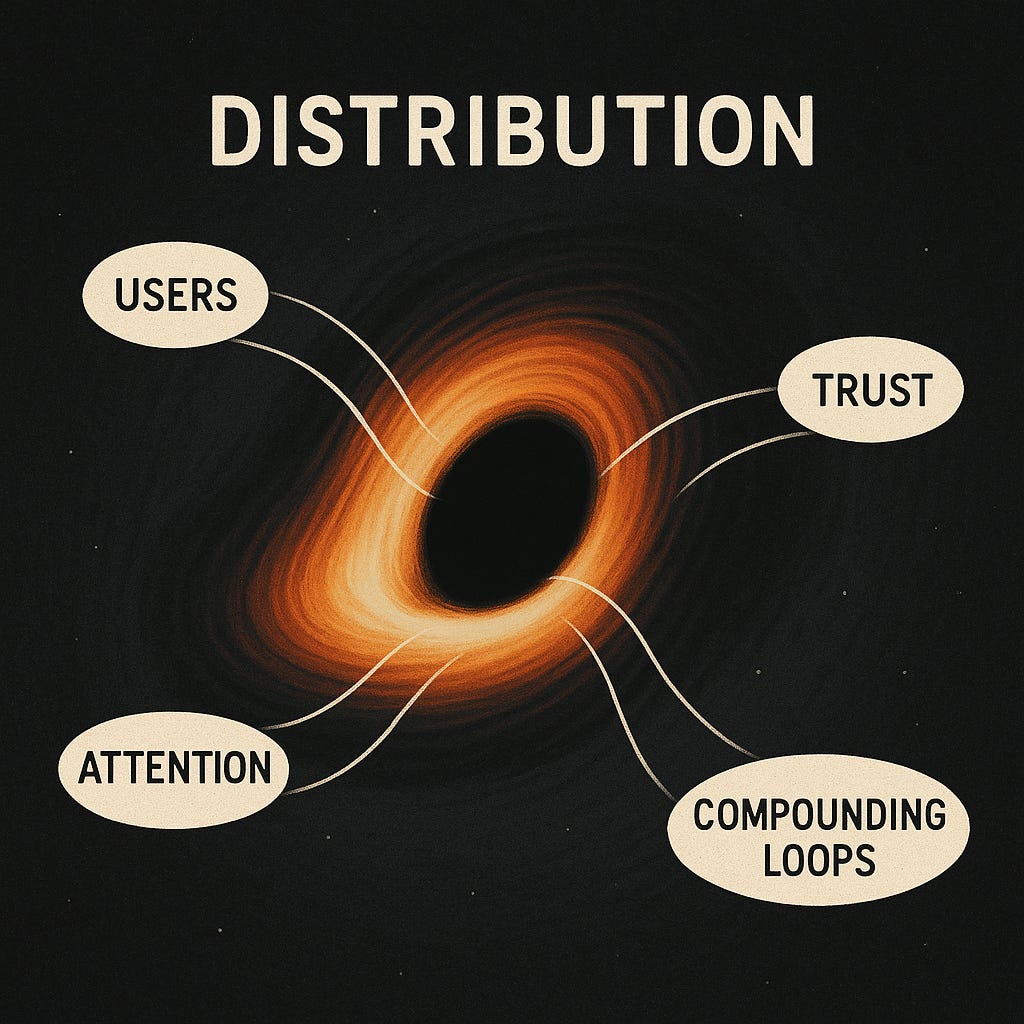
Distribution is not growth, it’s gravity.
Growth is the outcome, but distribution is the force that pulls users, attention, trust, and compounding loops toward you. When the force is strong enough, everything around it begins to bend in your direction.
This is the framework founders need to navigate the distribution era. It’s focused, practical, and anchored in the realities of building in an environment where novelty disappears quickly, but motion endures.