

This holiday season, AI shopping agents will read your product page and your reviews before many shoppers do. Much of what marketers publish in 2026 gets judged by a machine first.
Almost every marketing team now uses AI, and few can show it pays. Here’s what the 2026 data says, and the 5-step playbook small teams can run this quarter.
Sponsored by HubSpot for Startups
AI is rewriting the marketing playbook, and the founders who win are the ones who turn it into a repeatable go-to-market motion.
IGNITION 2026 by HubSpot for Startups: the company-building summit for AI founders, Nov 10 in San Francisco

Who’s there: 150 Seed and Series A founders and GTM leaders, plus 50 VCs and operators
What you get: mainstage talks on repeatable GTM and raising your next round, plus 1:1 clinics
It’s free for approved applicants, and applying through this link gets you priority review:
The Short Answer
Adoption: over 90% of marketers use AI, according to MarTech’s Q4 2026 review.
Return: 41% can prove AI ROI, down from 49% a year earlier, according to Jasper’s State of AI in Marketing 2026.
Holiday 2026: shoppers expect gen AI to influence 45% of holiday category spend, according to Accenture.
What works: rebuilding one workflow end to end on clean data, then writing pages that AI assistants can read.
Table of Contents
Why Has AI in Marketing Paid Off for So Few Teams?
Why Does More AI Content Lower Trust?
What Should Marketers Know About the 2026 AI Holiday Season?
Where Are Marketing Budgets and Jobs Going in 2026?
How Should Small Teams Rebuild Marketing Around AI?
FAQ
1. Why Has AI in Marketing Paid Off for So Few Teams?
According to Mike Pastore, head of content at MarTech, adoption sits above 90%. His October 2026 review also finds the gap sits in the workflow: most marketers prompt a chatbot, then paste the answer into the next tool.
History has seen this before. When factories first got electricity, owners swapped the steam engine for one big electric motor and kept the floor exactly as it was. Productivity stayed flat.
The payoff came decades later, once every machine got its own small motor and the floor was redesigned around the flow of work. Economist Paul David documented this in his 1990 paper The Dynamo and the Computer.

Most marketing teams are in that first phase. The motor (AI) is new, and the factory (the workflow) is the same.
According to McKinsey’s State of AI survey, 80% of respondents say AI improved their productivity, and less than half can tie it to an effect on earnings.
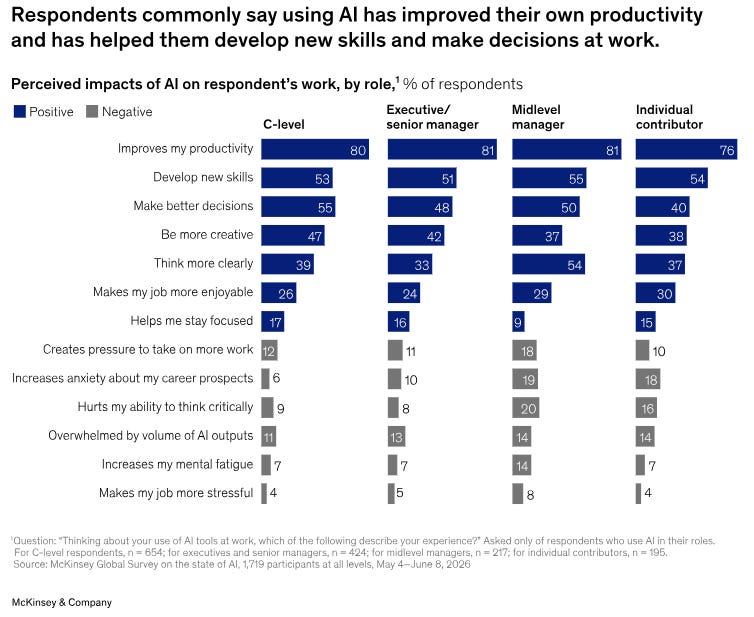
3 habits keep the old floor plan in place:
Copy and paste: connecting a model to the rest of the stack takes engineering time and IT approval, so most people paste outputs by hand and the workflow stays the same.
Assistants trapped in apps: every tool ships its own AI assistant, and each one only helps inside its own window.
Low trust in the data: marketers worry a model will amplify weak numbers and cost them credibility, so they keep AI away from the metrics that matter.
The fix starts with your go-to-market playbook, since the workflow is where the return lives.
2. Why Does More AI Content Lower Trust?
Most AI use in marketing goes to content creation, the step that needs the least integration work.
Before AI, a well-written article or campaign signaled care and effort. Now that a draft costs almost nothing, that signal has faded.
According to a Gartner survey of 1,539 US consumers, 50% would prefer to buy from brands that avoid gen AI in their messages, ads and content.

The same buyers use AI every day. They want an assistant working for them and a human voice from the brands they buy from.
That matters most for lean, AI-native teams. Fast, cheap content is exactly what buyers trust least, so the work that stands out carries a human fingerprint: a founder with a real opinion, or a customer who puts their name on a result. Our guide to writing with Claude and ChatGPT in your own voice shows how to keep that fingerprint while still moving fast.
3. What Should Marketers Know About the 2026 AI Holiday Season?
This could be the first agentic holiday shopping season. The data points that way:
Shoppers using AI: almost a third of US consumers plan to use AI for holiday shopping, according to PwC’s survey of more than 4,000 US consumers.
AI referrals: Adobe expects AI-referred traffic to US retail sites to grow 130% this season.
Spend influenced: shoppers expect gen AI to influence 45% of holiday category spend, according to Accenture’s 2026 Holiday Shopping Survey.
The shopper’s assistant reads your product page first. That changes who you write for.
Accenture also finds that nearly 3 in 4 shoppers want agents to buy only from brands they already know, so familiarity still wins ties.
An assistant can only repeat what it reads clearly. A small brand with the sharpest, most consistent explanation of what it does, identical on every page, now has a real shot at the incumbent. Our guide to GEO and AEO in 2026 covers how to become the answer an assistant quotes.

4. Where Are Marketing Budgets and Jobs Going in 2026?
Budgets show what companies believe.
According to Gartner’s 2026 CMO Spend Survey of 400 CMOs, 70% call AI leadership critical, and 70% say their processes are too immature to scale it.
The CMO Survey from Duke and Deloitte reports that marketing training fell to 3.8% of spend, from 5.8% before the pandemic.
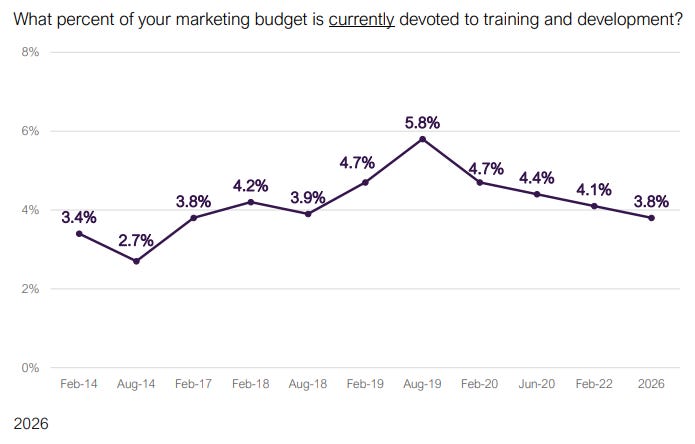
CMOs are moving money into AI tools and taking it out of training and hiring. Our Agent Workforce Kit maps which roles agents are absorbing first.
Early-career workers feel it first. According to Stanford’s Digital Economy Lab, employment for 22 to 25 year olds in highly AI-exposed jobs sits about 19% below trend. It’s still early to call that displacement.
Hire Bots.

It’s Sunday night. The investor update is due tomorrow, and the sponsor who emailed on Tuesday is still waiting for a reply.
The teams that rebuild their workflow will have the clearest answer on whether trading people for tools pays off.
5. How Should Small Teams Rebuild Marketing Around AI?
The factory owners who struggled had an old floor plan to protect. Startups raising right now can design theirs from scratch, which puts small teams in the best position to build marketing around AI.
Here’s the 5-step playbook.
Step 1: Rebuild one workflow end to end
Pick a repeated job, such as the weekly report or lead follow-ups, and remove every copy and paste from it.
Let the model read straight from your CRM or analytics tool, and keep a human for judgment calls, timing and final checks. If lead follow-up is the job, our 5-agent sales team build is a ready blueprint.
Step 2: Clean your data first
Your reputation rides on the numbers a model repeats.
Keep one source of truth for analytics, pricing, plans and product facts. Read 100 CRM records by hand before you automate anything, and fix what you find. Our context engineering guide shows how to feed a model clean, current facts.
Step 3: Write pages machines can read
Many AI crawlers read raw HTML, so check that your price and key claims show up in “view source.” Add schema.org markup that matches the page, and allow AI crawlers in robots.txt if you want assistants to find you. The GEO playbook for 2026 walks through each fix.

Build plain pages for the questions buyers ask, like pricing, “X vs Y” and “who is this for?” Assistants quote whoever answers those questions clearly.
Step 4: Keep a human behind what people trust
Let AI handle research and transcripts. Keep the final opinion and the customer story human, because generic copy reads as commodity content.
Ask customers why they chose you, and publish their words. Your own voice is the one asset that stays yours, and assistants repeat customer sentences.
Step 5: Ask the assistants about yourself every month
Put 15 buyer questions to the AI assistants your buyers use, and log what they say about you. Then fix wrong answers at the source, such as an outdated pricing page. Our Claude Cowork SEO prompts turn this audit into a monthly routine.
The motor is already everywhere. The return goes to the teams that rebuild the factory around it, and startups can start this week.
FAQ
What is the state of AI in marketing in 2026?
Adoption is near universal and the return is uneven. Over 90% of marketers use AI, according to MarTech, and 41% can prove its ROI, according to Jasper’s 2026 report.
Why do so few marketing teams see ROI from AI?
Most teams added AI to the same workflow, mainly for content, and pasted outputs between tools. The return shows up when a team rebuilds a full workflow around the model and measures business outcomes.
How will AI shopping agents change the 2026 holiday season?
Shoppers expect gen AI to influence 45% of holiday category spend, according to Accenture. Assistants read product pages and reviews first, so clear, consistent pages decide which brands they recommend.
What should a small marketing team do first?
Rebuild one repeated workflow end to end on clean data, and make your key pages readable by AI crawlers. Then ask AI assistants 15 buyer questions every month and fix what they get wrong.
How do you get your brand recommended by ChatGPT and other AI assistants?
Publish plain pages that answer buyer questions, keep facts identical across your site, add matching schema.org markup and let AI crawlers in. Customer quotes with real names help, because assistants repeat them.
Keep reading:
If this helped, send it to the marketer or founder on your team who owns growth.
The audit needs a few “who shouldn’t buy this?” questions too. An assistant that recommends you to the wrong buyer can look like a visibility win while sending your team leads it can’t help.