

Union Square Ventures Was Not Inevitable
When you think of successful VCs, names like Sequoia, a16z, General Catalyst or Accel come to mind, right? And for most of these, success felt inevitable in hindsight. We are talking about successful founders or early investors who turned their skill into businesses.
But there’s one specific fund that defines the industry, and does not look like the ones above. That fund is named Union Square Ventures.

USV is easy to admire in hindsight and easy to misunderstand.
When USV was formed, nothing about it looked inevitable. Not the timing, not the geography, not the founders’ recent track record, and certainly not the idea that another internet-focused venture fund was what the moment required.
This story is worth telling precisely because it begins after failure, in a market that had turned hostile to the very category USV chose to pursue.
Before we get into the USV story:
Walking into an audit unprepared costs real time, money, and engineering hours. But audits don’t have to be a plot twist

In this 30-minute Free live event, Vanta will cover:
What audits are and what drives up cost and time
Why continuous compliance separates smooth audits from painful ones
What to look for in a trusted audit partner
Arti Lalwani, Managing Director of Trust at Armanino, will also bring an auditor’s honest take on what separates teams that sail through audits from those that don’t.
Table of Contents
1. Before USV: Why Failure Shaped the Firm More Than Success
2. Rebuilding Under Adversity: Raising a Fund When the Category Was Unloved
3. The Real Thesis: Networks First, Everything Else Later
4. Fund Design as Strategy: Size, Ownership, and Reserves
5. Being Outside the Center and Winning Anyway
6. Judgment Over Time: Why Early Narratives Were Often Wrong
7. USV Today: Continuity, Not Reinvention
8. Closing: What the USV Story Actually Teaches
1. Before USV: Why Failure Shaped the Firm More Than Success
USV’s origin story is extremely important because it produced scar tissue, and scar tissue changes behavior in ways confidence never does.
Before USV, there was Flatiron Partners. Fred Wilson, the co-founder, lived the dotcom cycle up close, including the parts people politely omit when they summarize it.
There was early success, there was excess, and then there was the institutional shutdown that forced a reckoning. That experience surfaced a set of anti-patterns that only look obvious now because the industry has spent years pretending they always were.

Three Failure Modes from Flatiron
One failure mode was scaling the firm too quickly. When headcount and operational complexity grow faster than judgment, investing turns into meetings, meetings turn into process, and process becomes cover for the fact that fewer hard calls are being made.
Another was pricing risk incorrectly in frothy markets. In boom cycles, speed is easy to mistake for skill. You do a deal, it marks up, and the environment whispers that you’re seeing the future. Often, you’re just seeing liquidity.
The third was allowing external validation to replace internal standards. When momentum is rewarded, everyone stops questioning the durability because they are too busy worrying if the next round can be cleared.
That is when portfolios are built for continuation rather than endurance.
The Result: Intentional Restraint
USV wasn’t built on naïveté, but on a refusal to repeat those mistakes. What emerged from that period was intentional restraint.
Not performative humility or brand positioning, but a hard-edged understanding of what a venture firm is actually responsible for. The job isn’t to do more deals, raise more money, or look busier. It is to construct a system where a small number of correct judgments can meaningfully change outcomes, and where being wrong doesn’t trigger panic.
That’s the foundation where everything else in the USV story rests on.
2. Rebuilding Under Adversity: Raising a Fund When the Category Was Unloved
USV’s first fundraise took place after the dotcom bust, when internet investing had become an unfashionable category. This period is often misread in hindsight.
It’s tempting to say that they were contrarian because that’s only a small part of the story. The more accurate explanation is that skepticism was rational. The bubble had burst, firms had blown up, and LPs had been burned by managers who confused cycle tailwinds with capability.
By that point, caution was a reasonable response to recent pain.
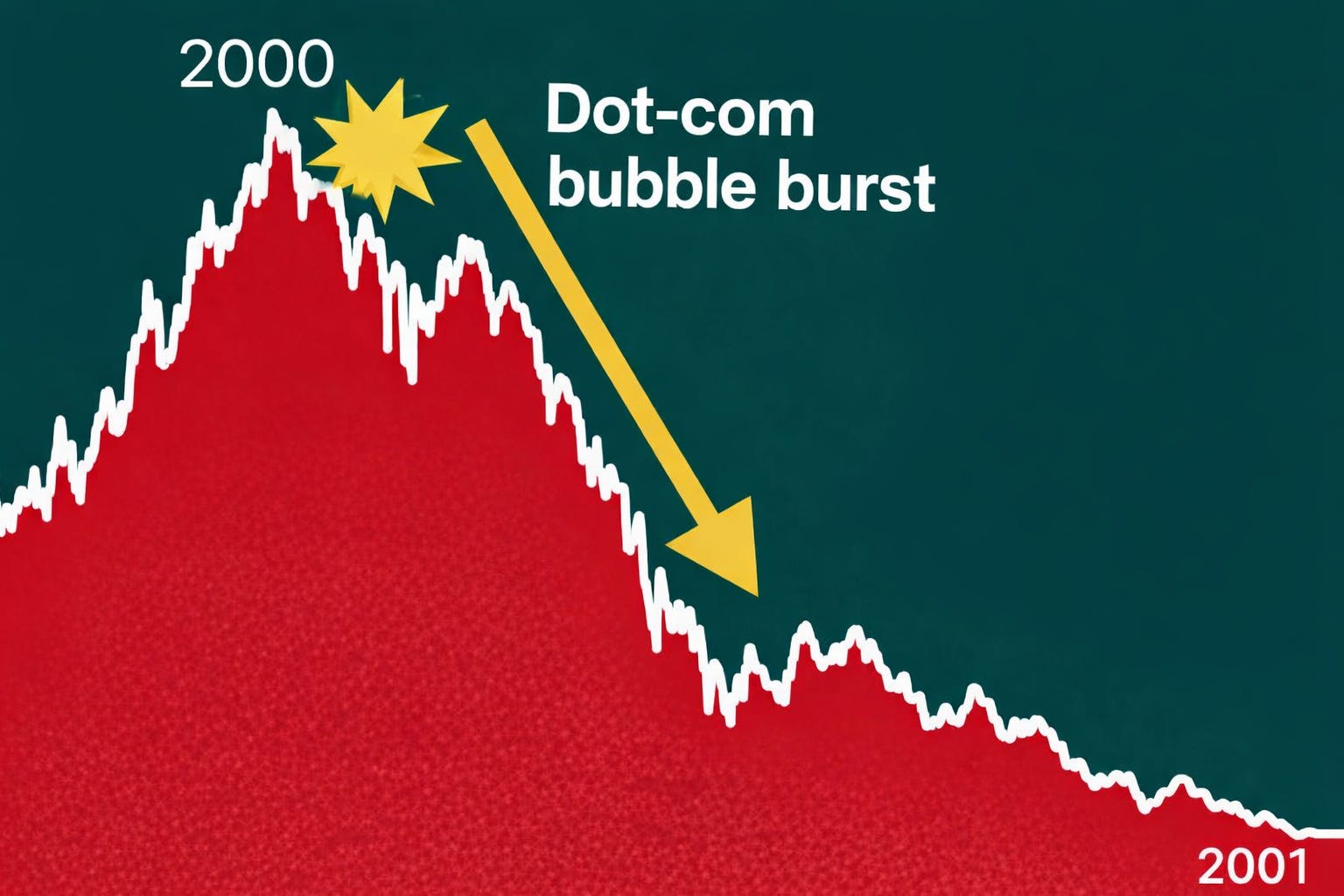
That’s what makes the early USV raise instructive. It wasn’t difficult because the thesis was too advanced, but because trust had been eroded by history.
The Whitepaper That Failed
The initial pitch leaned heavily on a long, thesis-dense whitepaper. It failed because fundraising is not an essay contest, especially during fearful markets. When an idea needs twenty pages to convince, the room hears uncertainty and unresolved thinking.
So USV responded by compressing the message. The thesis was simplified into a short deck that could be remembered and repeated. That adjustment sounds tactical, but it was strategic. Constraint forced legibility, and legibility sharpened conviction.

Why the LP Base Mattered More Than the Narrative
An under-discussed element of this period is who actually backed the fund. Many established firms avoided LPs subject to disclosure requirements, worried that FOIA exposure would create scrutiny.
But USV leaned in. Public institutional LPs became early backers at a moment when many doors were closed.
This pattern shows up repeatedly across venture capital history. In difficult cycles, the firms that survive are rarely the ones complaining that the market “doesn’t get it.” They adapt their message, choose the right backers, and preserve internal standards while everything external feels unstable.
The hard raise did something else as well. It hardened the thesis. USV was forced to articulate what it believed about the next era of the internet without leaning on optimism or momentum.
That kind of discipline is hard to retrofit later, when success makes every story sound intentional. In a hard raise however, discipline is visible.
USV began with rejection, and used that rejection to refine its thinking rather than to romanticize itself.
Read: Fred Wilson on “The Hard Raise”
3. The Real Thesis: Networks First, Everything Else Later
Most VCs at the time were focused on capturing network effects. But USV was playing a different game.
USV’s core bet was a specific form of network effects investing that treated networks as the primary source of compounding advantage, with products and monetization as secondary. This wasn’t a slogan about social being big. It was a structural view of how value would accumulate in a more connected world.
The Question That Changed Everything
In the early 2000s, much of venture thinking was still linear.
What does this company do? How does it make money? How do we forecast the outcome?
That model breaks down when you’re underwriting systems that strengthen as participation grows and defend themselves through behavior rather than features.
USV looked at startup investing in a completely different way. In a way that was inconceivable back then. The questions were:
What if the durable asset isn’t the product itself, but the behavior it coordinates?
What if value accrues because the network becomes the default place where an action happens, and leaving becomes costly not because of features, but because of lost context and connection?
This is why adoption and engagement were far more important than early monetization. Not out of romanticism about users, but because in networked markets, charging is often easier than becoming the place where coordination lives.
Underwriting Uncertainty, Not Optimism
This worldview changed how USV underwrote risk. In enterprise deals, uncertainty often lives in sales cycles or pricing. In network-driven businesses, uncertainty lives in formation, tipping, and retention. Those risks resolve differently, on different timelines, and with different signals.
USV was being precise, not optimistic. The firm bet that a small number of networks would become category-defining and produce outcomes large enough to return an entire fund. That belief was a fund design constraint and not a narrative flourish.
A quiet implication followed. If upside depends on emergence, control becomes a liability. Premature constraints can strangle the very behavior that creates value. Alignment, patience, and room for iteration matter more than rigid oversight.
That’s why USV’s reputation with founders was less about platforms or playbooks and more about understanding the type of company being built.
4. Fund Design as Strategy: Size, Ownership, and Reserves
Many firms have had good theses. Far fewer have built venture capital funds that allow a good thesis to compound. USV treated fund design as part of its core strategy.
Why Size Was Deliberate
Many VCs have a single goal: to raise as much capital as possible. The best VCs however, know exactly how much to raise.
USV raised a $125M fund in the mid 2000s. That was the exact amount needed to allow meaningful ownership and follow-on participation without pushing the firm into late-stage behavior or forcing it to chase scale for scale’s sake.
Fund size affects the partner’s behavior. When a fund grows too large, being right is no longer enough. You need statistically rare outcomes just to move the needle, and that pressure quietly distorts decision-making. Firms drift toward momentum, later stages, or dilution-heavy participation while telling themselves the strategy hasn’t changed.
USV resisted that drift. Even as an elite firm, it kept its core funds relatively contained. That choice preserved alignment with founders and allowed correct early calls to matter.
Reserves: Where Discipline Becomes Operational
Reserves are where this discipline becomes operational. In a power-law world, the goal isn’t to support everything, but to maintain the ability to materially support the winners once evidence appears, without inflating the fund just to have follow-on capital.
Many firms get this wrong. They pick the right companies and still fail to compound because their structure doesn’t let them stay relevant. Ownership erodes, influence fades, the outcome happens, but not for them.
USV designed against that failure mode. Being right early could translate into meaningful ownership later, without violating the firm’s principles.
Opportunity Funds as Architecture, Not Expansion
This is where Opportunity Funds enter the picture. And Fred Wilson was one of the earliest architects of this type.
These vehicles were not a pivot away from early-stage conviction, they were an extension that allowed USV to support breakout companies as they scaled, build later-stage positions through long relationships rather than auctions, and participate meaningfully even when the initial entry point wasn’t at seed.
That is VC fund strategy as architecture. It isn’t flashy, but it’s how success compounds instead of leaking away.
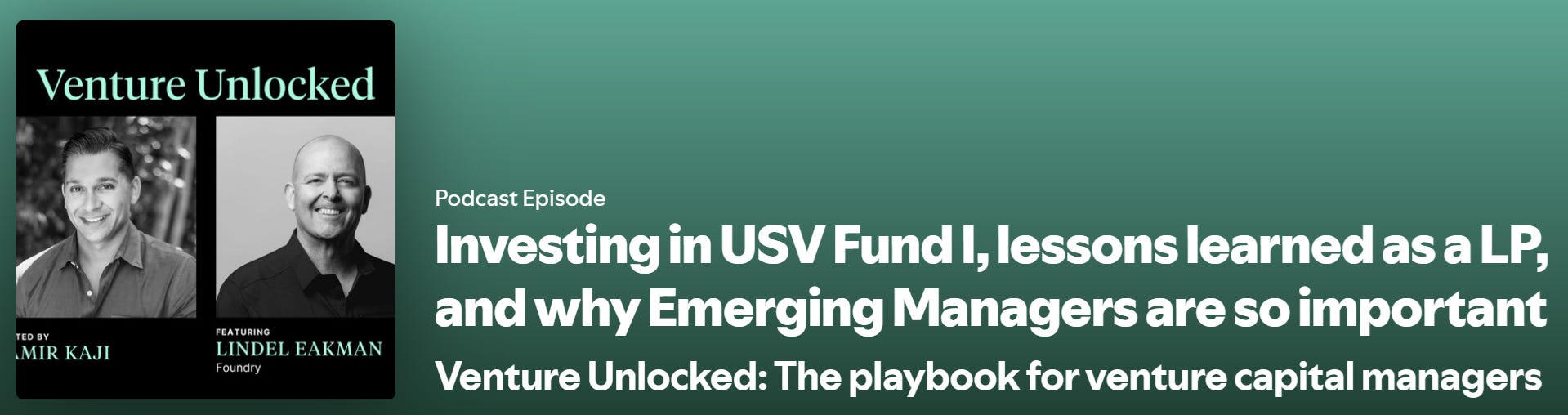
If you want to learn more about USV Fund I, this podcast episode hosts Lindel Eakman, one of the first LPs to back Union Square Ventures.
5. Being Outside the Center and Winning Anyway
The VC industry has a habit of treating geography as destiny. If you’re not in the Bay Area, you’re downstream. If you’re not at the center, you miss the best deals.
USV’s early years challenge that assumption without turning it into a rivalry story. Being based in New York in the early 2000s was not a conventional advantage. It meant fewer default meetings and less ambient access to the “latest thing.”
And that outsider position forced differentiation. The differentiation took the form of mindshare built through ideas rather than proximity.
Fred Wilson’s writing, and later USV’s broader practice of thinking in public, functioned as cognition and distribution combined. It sharpened internal thinking, made the firm legible to founders before a meeting ever happened, and built credibility by showing uncertainty alongside conviction.

Founder alignment flowed naturally from that visibility. When founders already understood how the firm thought, conversations started from shared language rather than persuasion. Competitive rounds became less about brand gravity and more about fit.
USV still invested heavily in Silicon Valley companies. That’s the point. The firm didn’t win because it was local, but because it was coherent. In venture, coherence travels better than proximity.
Read: Fred Wilson’s 2005 post on location.
6. Judgment Over Time: Why Early Narratives Were Often Wrong
If you want to understand whether a venture firm takes uncertainty seriously, look at how it reacts to being wrong.
Most firms curate a mythology of correctness. They acknowledge mistakes only in ways that preserve the aura. Real portfolios are messier, early favorites fail, and many times, awkward bets mature into defining outcomes.
Short-term correctness is a poor proxy for long-term judgment.
This connects directly to USV’s thesis. Networks emerge on their own schedules. They ignore board decks and financing calendars. Sometimes they look like chaos before they look inevitable.
USV’s willingness to acknowledge uncertainty publicly, and to revise views without pretending that revision was always the plan, gave its voice weight. It constrained hindsight rewriting and reinforced intellectual honesty.
The real arc of the firm includes missed bets and wrong instincts. It includes scenarios where outcomes could have broken differently.
But that doesn’t weaken the story. It strengthens it, because it shows that USV actually built a system for making high-conviction decisions under uncertainty and staying coherent long enough for nonlinear outcomes to emerge.
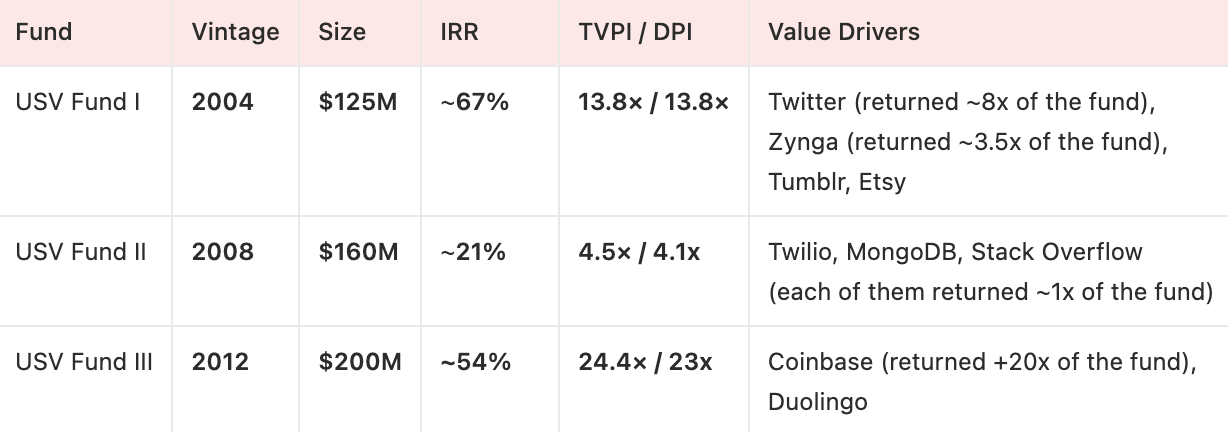
Read: Fred Wilson’s take on why past performance is actually a good predictor of future returns in venture.
7. USV Today: Continuity, Not Reinvention
Success often causes drift, especially as funds get larger, mandates widen, platforms appear, and headcount balloons. USV evolved without abandoning its constraints.
The firm now operates across core early-stage funds, opportunity vehicles, and climate-focused funds. And although this might look like expansion, in reality it’s more of a modular modular extension of the same worldview.
The core remains thesis-driven, fund sizes remain controlled, and the partnership stays small and collaborative. Those choices preserve generalist thinking, shared accountability, and the ability to act with conviction without internal politics.
The thesis has expanded across web, fintech, crypto, and climate, but the connective tissue remains networks and systems that broaden access to foundational primitives. Crypto fits as a network with different rails. Climate fits as a structural pressure that forces new systems into existence.
The important point is continuity. USV did not grow into a different firm, but kept its constraints intact and built adjacent structures to serve founders across stages without breaking alignment. Constraint remained identity, not nostalgia.
8. Closing: What the USV Story Actually Teaches
If you reduce the Union Square Ventures story to them being early, you miss 99% of it. Many people were early, but few built enduring firms.
If you reduce it to great deals, you miss the system underneath. Deals are outcomes, but it is the systems that determine whether outcomes compound.
What USV demonstrates is that second acts matter more than origin myths. A first act can be powered by timing and tailwinds, but a second act only works if you revise assumptions and narrow your operating surface.
Constraint is not restraint. When used properly, it is part of strategy. Fund size, reserves, and follow-on architecture decide whether being right compounds or dissipates.
Legibility compounds as well. Thinking in public, building a partnership founders can understand, and maintaining coherence under stress created durable mindshare that often outperformed raw proximity.
Don’t be mistaken, because the power law does not reward impatience. It rewards coherence and patience applied together.
The USV story is about a partnership that chose a game, built the mechanics to play it, and stayed disciplined through enough uncertainty for outcomes to arrive. That is not inevitability, but construction.
And for fund managers, LPs, and founders trying to understand investor judgment, that is the part worth studying.