

How a Normal Startup Becomes an AI-Native One
Hiring has been the default answer for so long that founders stopped questioning it.
When product fell behind, founders hired more engineers. When growth stalled, they hired salespeople, then a project manager to manage the project managers.

That math has stopped working. Stripe’s data on AI companies shows AI-native startups reaching $30M in annualized revenue in roughly 20 months, against more than 60 months for traditional SaaS peers, with revenue per employee close to six times higher.
Those companies run on a different operational architecture, where agents do work that used to need a hire. That changes what your software has to handle, because agents use it very differently from people.
together with Attio
Most CRMs grew up around people clicking through records, while agents query constantly and in parallel.
Today Attio launched its answer: a CRM built for people and agents in equal measure:

▫️ SQL engine: query your whole workspace with SQL, right inside Attio
▫️ Data connectors: bring the rest of your stack into one place
▫️ Agent scale: up to 100 million records per object, and what Attio says is 1,000x the agent traffic of a legacy CRM
Activities and interactions are live in beta too.
The CRM is one layer of that architecture. Here’s the blueprint for building the rest.
Table of Contents
What Your Startup Is Actually Running On
The Five Transformations
The Three People Left in the Room
The Starting Point
The Moat You Are Actually Building
1. What Your Startup Is Actually Running On
Most startups believe they are running on software, process, or culture.
In practice, many of them are running on memory.
Not institutional memory in the durable sense, but fragmented memory spread across founders, early employees, Slack threads, undocumented decisions and verbal context that only survives because certain people still happen to work at the company.

Three Questions to Diagnose Your Operational Drag
Three questions expose how deep that problem runs.
Can a new hire reconstruct a six-month-old pricing decision without pulling three people into a meeting?
How much operational logic would walk out the door if two senior operators left tomorrow?
How many steps in your core workflows genuinely require human judgment versus a human simply moving information from one system to another?
Most teams accept this as normal startup behavior.
Speed creates chaos, they tell themselves and scaling means hiring more people to absorb the coordination burden.
But watch how work actually moves through most organizations and an uncomfortable amount of it is humans transporting information without adding much judgment. Context that already exists somewhere, moving manually to somewhere else, losing fidelity at every step.
That drag accumulates gradually enough that companies mistake it for growth complexity.
Onboarding slows, product iteration slows. Founders who once spent most of their time building become operators of communication infrastructure instead.
The Systems Divide and the True Cost of the Coordination Tax
The companies pulling ahead treat coordination overhead as a systems problem, not an unavoidable side effect of growth.
The real divide is between companies still dependent on human coordination as their primary infrastructure layer and companies actively reducing that dependency.
That coordination tax is where most of the speed and efficiency gap now comes from.

2. The Five Transformations
AI adoption cannot be seen as a collection of separate improvements.
A support automation here, a coding assistant there, maybe an internal chatbot layered on top of company documents do not equal adoption.
You can see it in the way the “outliers“ do it. These companies are rebuilding how information moves, how decisions accumulate and how work gets executed across the organization.
These transformations build on each other in sequence, not as a menu of options.
Reliable agent orchestration requires reliable context first, durable workflow automation cannot exist while information still depends on human memory and manual handoffs and the advantage compounds because each layer strengthens the next.
1. From Human Memory to Company Intelligence
In most startups, critical context lives in people’s heads.
A founder remembers why a pricing exception was made. A senior engineer knows why a workflow was patched a certain way.
When those people are out of reach, everyone else is left guessing.
AI-native startups treat that context as infrastructure.
Strategic conversations move into searchable environments. Internal calls get transcribed automatically, not just customer calls. Decisions are documented alongside the alternatives that were ruled out and the reasoning behind the final call.
A new hire can get full context on any decision in minutes, not weeks.
Access Partnership found that 51% of SMBs using generative AI reported revenue increases of at least 10%.

The gains were concentrated in companies that embedded AI into repeatable operational workflows, not those using it as an occasional productivity tool. The queryable company is what makes that integration systematic.
Smart organizations are building reusable operational intelligence instead of solving the same problems over and over.
2. From Linear Processes to Closed Loops
The friction in most startup workflows hides inside the handoffs. A complaint becomes a Slack message, the Slack message becomes a ticket and the ticket becomes a meeting.
By the time leadership reviews a problem, the original signal has passed through several layers of interpretation, delay and compression.
Closed-loop workflows cut most of that transit out.
Customer inputs are captured in structured form straight away. Context gets surfaced automatically. Routing happens based on issue type, history and prior outcomes.
Once resolved, the result feeds back into the system so the workflow improves rather than restarting from zero.
Judgment, escalation and prioritization stay human.
What changes is that people stop spending large portions of the day moving information between systems without adding anything meaningful to it. HubSpot’s Customer Agent is now resolving 70% of support conversations autonomously across its customer base, with some customers clearing 90% or higher.
That figure reflects a workflow redesigned around feedback loops, not AI layered on top of existing bottlenecks.
HubSpot’s CEO Yamini Rangan said the two dominant use cases driving that adoption are familiar ones for contact center leaders:

(Image source: https://www.cxtoday.com/contact-center/hubspot-customer-agent-resolution-rate/)
Founders can usually spot these opportunities by asking one uncomfortable question. Which parts of this workflow genuinely require human judgment and which parts only exist because the company got used to doing them manually?
3. From Tool Usage to an Operating System
Treating AI as a feature layer means a writing assistant here, a summarization tool there.
The workflow stays unchanged and AI assists the work occasionally without the company actually running through it.
AI-native companies are built differently. AI is the layer through which work moves.
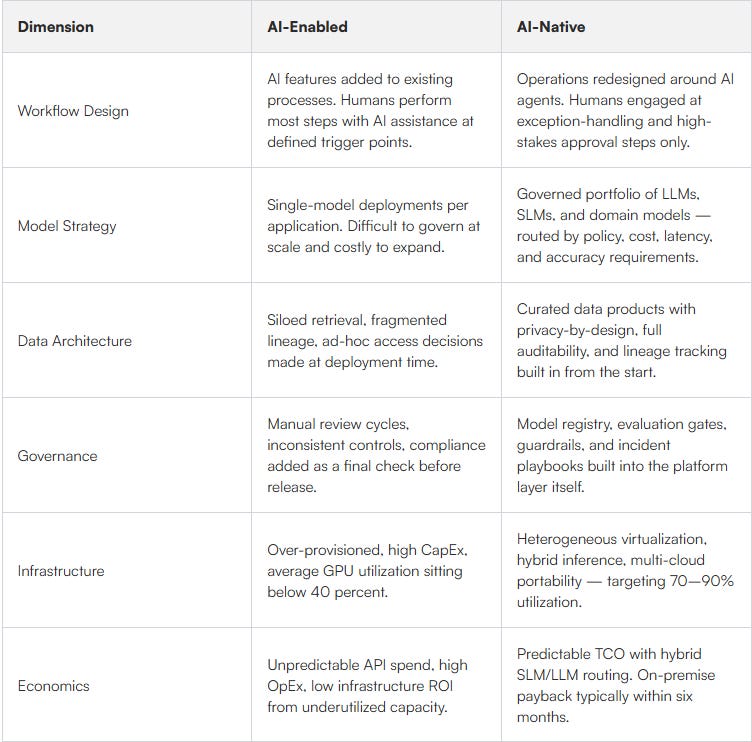
Every customer interaction is context, every meeting is data and every sales objection is a signal routing into onboarding, retention and pricing rather than disappearing into a shared inbox.
The practical entry point is one department, thirty days, every workflow routed through an AI layer with every input and output logged.
That exercise tends to reveal the same thing. Large portions of operational activity exist because older workflows assumed human mediation was necessary at every stage, not because it actually was.
Menlo Ventures reported that AI-native startups captured 63% of the enterprise AI application-layer market in 2025, up from 36% the previous year. Architecture was the winning variable, not product velocity.
4. From Agent Usage to Agent Orchestration
Startups are good at deploying agents that execute.
The layer that supervises is where most fall short. Execution without oversight degrades in ways that are easy to miss. A sales workflow produces weaker personalization after a model update.
A support agent generates plausible edge-case responses that slip past reviews because aggregate metrics still look healthy. A recruiting workflow introduces filtering errors nobody catches for weeks.
The orchestration layer monitors output quality, tracks drift, surfaces anomalies and routes edge cases before failures spread. Before scaling any agent deployment, three questions need clear answers.
How will declining output quality be detected, what mechanism catches it automatically and what is the recovery path that does not require immediate manual intervention from the core team. If any of those remain unanswered, the workflow is not ready to scale.

The difference between a team running isolated agents and a team running a well-orchestrated swarm is not incremental. It is exponential.
5. From Headcount Efficiency to Token Efficiency
Traditionally, revenue per employee was one of the clearest signals of operational quality because human labor was the primary scarce resource inside software businesses. AI-native startups are making that metric insufficient on its own.
A more useful question is revenue per 1,000 tokens. How efficiently does the company convert computational intelligence into business output?
A $50,000 monthly API bill that enables $2 million in operational output is not overhead.
Build-versus-buy decisions change when token consumption is easier to measure than human coordination cost.
Investors in 2026 are increasingly asking for concrete efficiency metrics that prove AI is doing the work, not just assisting it.
Some are framing this as “Unit Economics of Intelligence”, though it is not yet a standardized benchmark and founders should treat it as an internal working metric rather than settled doctrine. The direction is real either way.
AI-native startups are increasingly expected to outperform traditional SaaS benchmarks on revenue per employee by 300% or more. Token efficiency is how founders demonstrate they are actually getting there.
3. The Three People Left in the Room
Why New Workflows Demand a New Breed of Operator
One of the biggest mistakes founders make is assuming they can redesign workflows while keeping the organization structurally unchanged.
The old structure usually reintroduces the very coordination overhead the new systems were supposed to remove. Teams continue operating through layered approvals and fragmented ownership even after large portions of execution have become automatable.
The role that surfaces most visibly in this model is the Builder-Operator. Not always an engineer and often not deeply technical in the traditional sense.
What distinguishes them is operational instinct. They think naturally in workflows, routing logic and feedback loops. When they encounter repetitive work, their first reaction is not “how do I do this faster?“ but “why is a human still doing this at all?“
Collapsing Handoffs and Redefining the Founder Role
Once those Builder-Operators are in place, the DRI becomes a more powerful role than the traditional manager. AI-native startups collapse human handoffs.
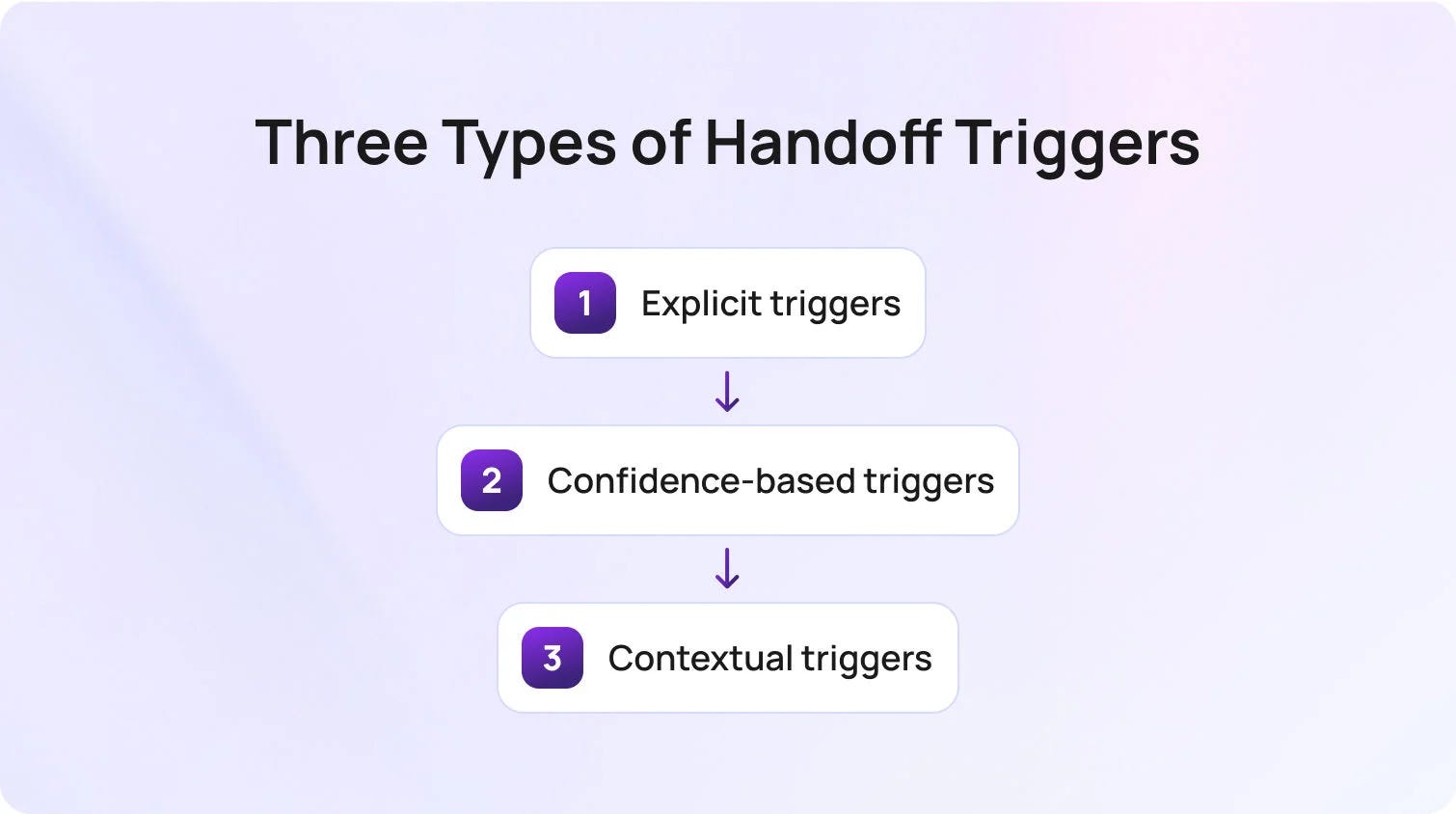
One person owns one outcome and the machine handles context retrieval, routing and repetitive execution underneath them. That frees the DRI to focus on directional decisions rather than information-gathering.
The founder’s role changes most of all.
Rather than becoming an escalation point for communication, the founder becomes the person who defines how the system operates. What gets captured, what gets escalated and where the system can act autonomously.
AI strategy and company strategy stop being separable things.
None of this happens overnight.
A few “Builder-Operators” begin redesigning workflows, produce disproportionate results and other employees start noticing that certain teams are moving faster with less overhead. Over time, the results make the cultural argument more convincingly than any presentation could.
4. The Starting Point
Laying the Foundation with a Ninety Day On Ramp
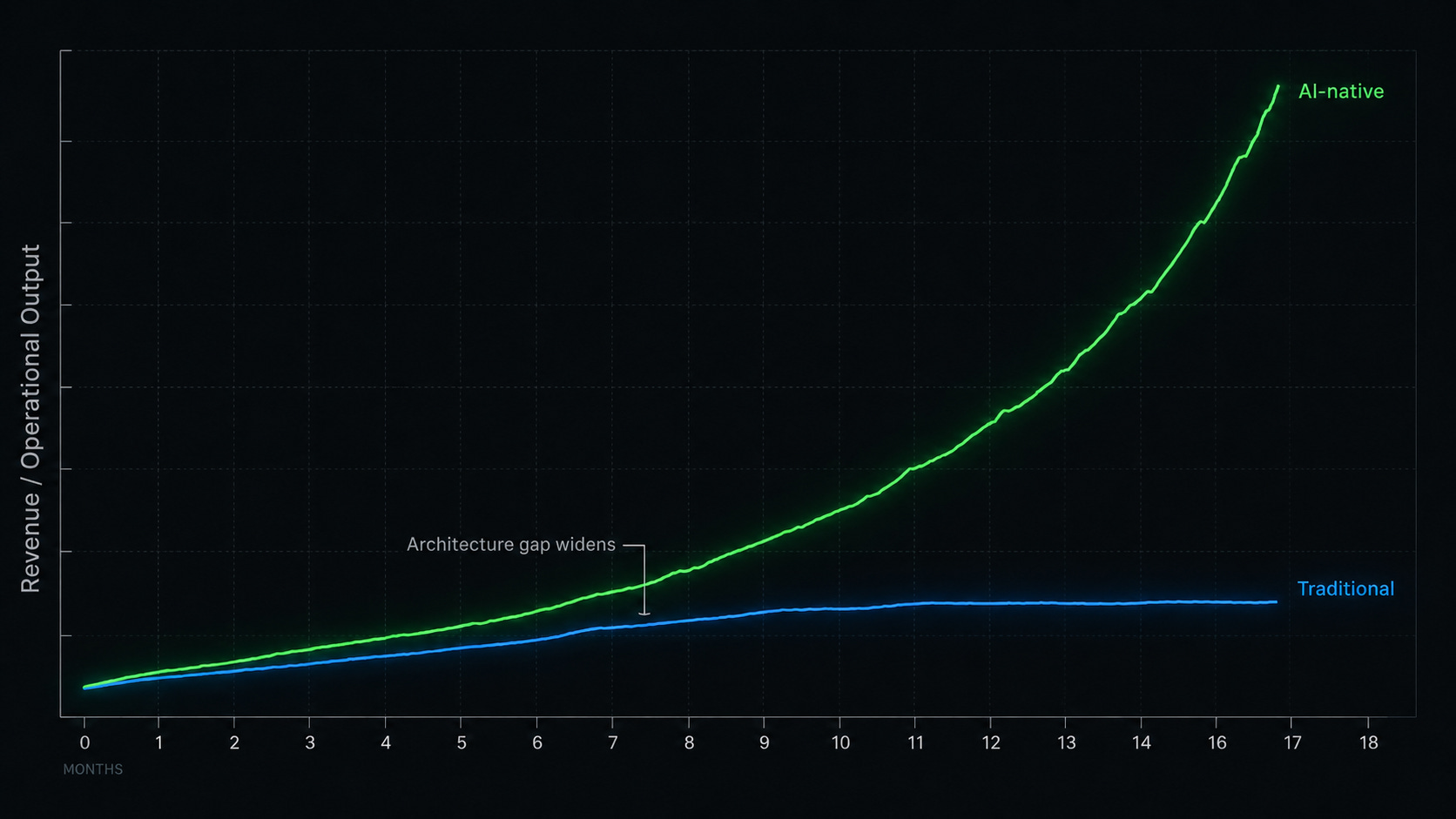
Founders should think about this as an 18-month operational rebuild with a 90-day on-ramp.
One of the fastest ways to fail is trying to redesign the entire company at once. The goal of the first three months is not full automation. It is building the first architectural layer everything else can eventually build on top of.
The first thirty days are about making the company queryable.
Strategic discussions move into searchable environments. Internal meetings get transcribed automatically, not only customer-facing calls. Product decisions, pricing changes and customer objections stop disappearing into fragmented conversations and start becoming structured operational memory.
Many founders underestimate the resistance this creates. Teams are accustomed to treating information as temporary conversation rather than reusable infrastructure and changing that habit is harder than changing any tool.
Scaling the System and Reorganizing Around Outcomes
Days thirty-one through sixty become more revealing. Most companies pick a single department and run its workflows through an AI layer for the first time.
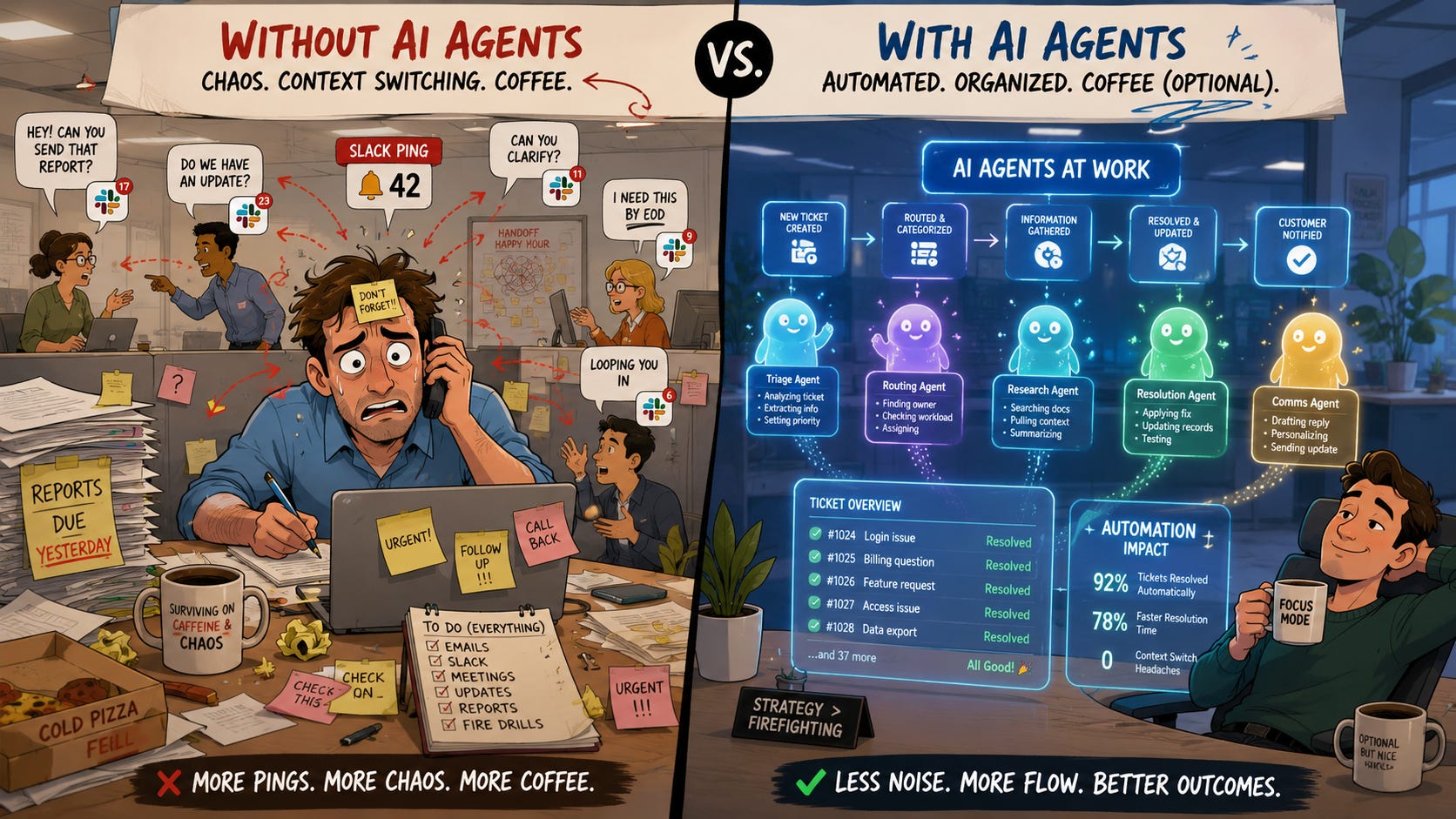
Support teams are common starting points because repetitive workflows expose coordination inefficiencies quickly.
The objective is observation as much as automation. Teams begin identifying where human judgment genuinely improves outcomes and where humans are mainly acting as routing mechanisms between disconnected systems.
The final thirty days are where the company starts measuring itself differently.
Founders build visibility into token usage, workflow throughput, escalation frequency and response quality. This is also where the first Builder-Operators become obvious.
Certain employees adapt toward systems thinking far faster than others and those people are worth organizing around.
Months four through eighteen are where the deeper changes take shape.
Roles reorganize around outcomes, closed-loop systems expand across departments and the operational memory captured in month one starts compounding into something competitors cannot easily replicate.
Every day the system runs, the gap widens.
5. The Moat You Are Actually Building
Every founder building right now is sitting with some version of the same question.
If large language models continue making software easier and cheaper to build, does the traditional software moat still hold up?
When product development accelerates for everyone simultaneously, feature velocity stops looking like durable protection.
The moat still exists, but it has moved lower into the operating system of the company itself.
AI-native startups are not only building products. They are building proprietary intelligence layers generated through daily operation.
Every support interaction, sales objection and decision record feeds back into the system and over time the company develops a contextual understanding of customers and workflows that no public foundation model can replicate from the outside.
Competitors can copy visible features quickly.
What they cannot reproduce is accumulated operational context. Workflow history, internal reasoning patterns and customer-specific signals already embedded into the execution layer.
The more an AI-native startup operates, the more intelligently its systems function, because the business continuously produces new context through normal execution.
The Compounding Advantage and the True Risk of Waiting
Startups building these systems early accumulate context every day the company operates.
Startups that wait tend to discover not a gap in features but years of organizational intelligence already embedded inside competitors’ workflows and a gap that size cannot be closed without rebuilding from the ground up.
The resistance is real.
Teams built around human coordination resist changing workflows they have relied on for years and companies built for an older set of assumptions do not naturally reorganize around new ones.
But the calculus is becoming harder to ignore. Remaining a traditional startup in a market that rewards AI-native ones at six times the revenue efficiency is not the cautious choice.
It is the riskier one.