

Here’s the uncomfortable math of startup distribution.
The companies that need attention the most are the ones that can afford it the least.
Notion can pay for a post that reaches 422,000 people. Oracle can pay for one that reaches 410,000. Vanta has renewed with me for two years straight. Good for them, and good for me. But the seed-stage founder with a better product, a top-tier investor and eighteen months of runway has been locked out of the exact same audience, for one reason: the budget.
For two years, that’s how my business worked. If you wanted The VC Corner, The AI Corner and my LinkedIn behind your launch, you needed a marketing line big enough to pay for it.
Starting today, you also need a great company.

I’m opening my platform to early-stage startups. I’ll take equity instead of cash, put skin in the game, and give you the same distribution the biggest brands in tech pay for. It’s called The Corner Partner Program, and I’m taking two companies a month.

What’s on the table
The exact channels that Notion, Oracle, Vanta, HubSpot, Attio and Granola pay cash for:
▫️ 300,000 newsletter subscribers across The VC Corner and The AI Corner, read by founders, operators and the investors who fund them
▫️ 340,000 LinkedIn followers, where single partner posts have passed 400,000 impressions
▫️ Deep Dives: a full article about your company, your story and why I invested, sent to the entire list
▫️ X, plus a content strategy call for the founders on the longest program
Papermark ran one Deep Dive: 60,000 people read it and more than 1,000 clicked through. Granola's three-month campaign passed 700,000 views, and the Deep Dive was its best-performing piece. A placement gets you seen. A Deep Dive gets you understood, and understood is what turns a reader into a customer, a hire or an investor.
Why the first year decides so much
At Series B, a company can buy attention with a marketing team. At seed, attention compounds from whatever you earn in year one, and it feeds everything:
▫️ Hiring. The engineer you want already knows the names of the companies she’s choosing between. Being one of them saves you months.
▫️ Fundraising. Investors move faster when they’ve already seen you in their feed. Momentum you can point to beats momentum you have to explain.
▫️ Sales. Your buyer googles you before the second call. A full story, written by someone they already read, changes that conversation.
▫️ Partnerships. Bigger companies say yes to startups their own teams have already heard of.
The startups that win this early get a head start that grows with every round. The ones that wait for a marketing budget usually get it after the window has moved.
Skin in the game
A cash sponsor buys a placement. A partner gets an investor.
When I own a piece of your company, your next round is my next round. I want the Deep Dive to land, the launch to travel and the follow-up post to bring in the hire you need, because that’s how my SAFE becomes worth something. Every incentive in this program points the same direction as yours.
That’s also why I’m selective. Every Deep Dive explains why I invested, and that sentence only works if it’s true. I’ll only take companies I’d back with my own money.

Three ways in
Every program is one SAFE, signed before the first placement goes live, converting at the terms of your last round. Delivery dates go into the agreement.
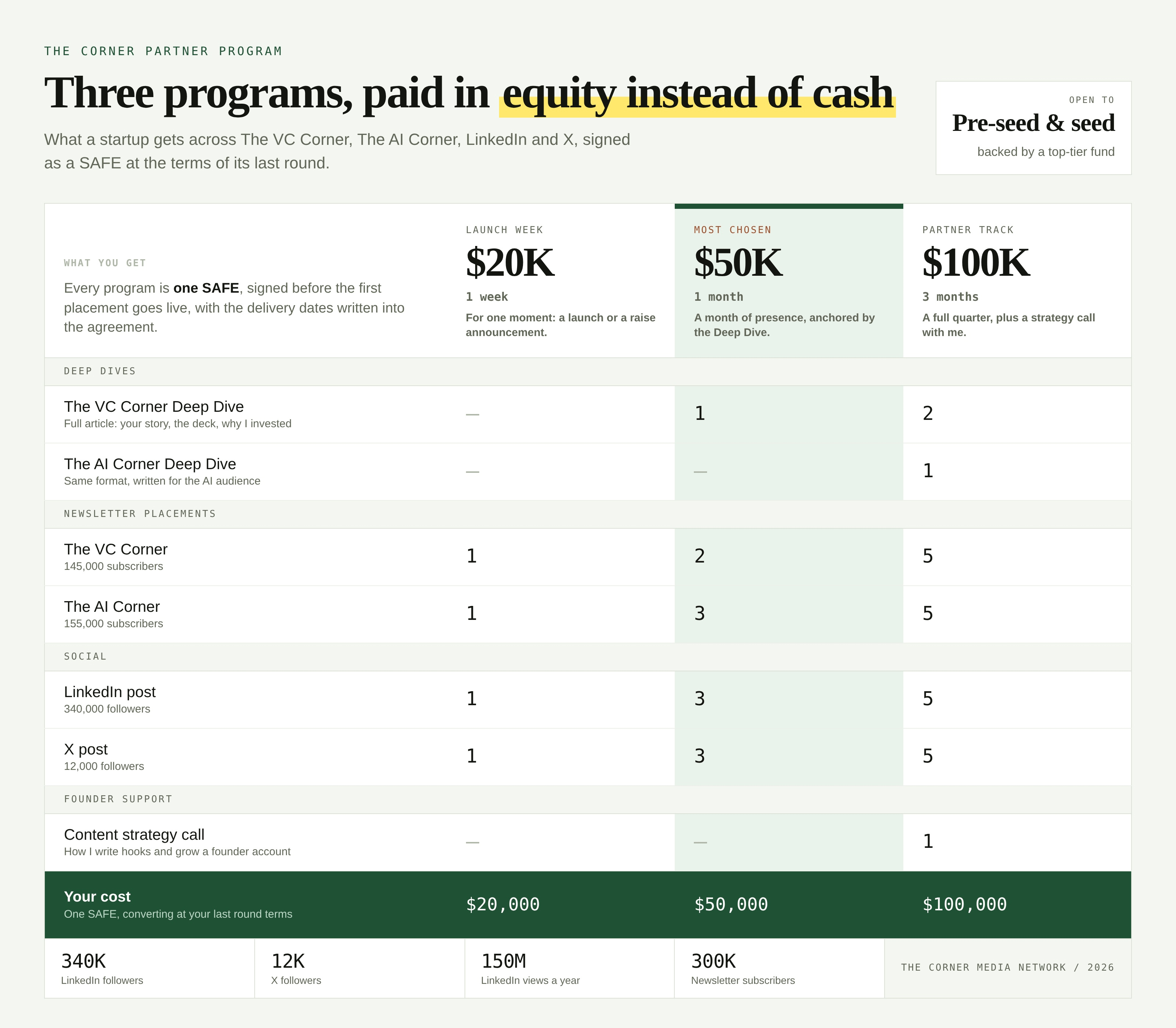
Launch Week · $20K
Built for one moment: a launch or a raise announcement. One placement in each newsletter, one LinkedIn post, one X post, all in the same week.
Partner Month · $50K
A month of presence, anchored by a VC Corner Deep Dive on your story and why I invested. Five newsletter placements, three LinkedIn posts and three X posts around it.
Partner Track · $100K
A full quarter. Three Deep Dives across both newsletters, ten placements, five LinkedIn posts, five X posts, and a strategy call where I show you how I write hooks and grow a founder account.
Two seats a month. Here’s why.
I write every Deep Dive myself, and I won’t hand a partner’s story to anyone else. That sets a hard ceiling: two new partners a month, and three Partner Track seats a quarter.
When a month fills, the next approved company waits for the next month. If you’re raising, launching or hiring in the next 90 days, the timing of your application matters as much as the application itself.
Who gets a seat:
▫️ Pre-seed and seed companies
▫️ Backed by a top-tier fund or accelerator, such as Y Combinator or a16z
▫️ A product people can use today, with a story worth telling to founders, operators or investors
The application takes ten minutes. Have your deck or memo, your last round’s terms and your investors ready. I read every application myself.
The work, live
Here’s the work itself, so you can judge the reach and the writing before you apply.
Deep Dives: one full article on one company
▫️ Granola's Growth Playbook in The VC Corner, noted as the piece with the best click-through rate of Granola's whole campaign.
▫️ How Lovable hit $400M ARR in 14 months in The AI Corner (the-ai-corner.com/p/lovable-growth-playbook-0-to-400m-arr-14-months).
▫️ Perplexity: hybrid compute, cloud plus local AI (The AI Corner)
▫️ Ant International: AMP, Know Your Agent and its AI-native payments stack (The VC Corner)
LinkedIn posts with a partner
▫️ Notion · the AI Founder’s Kit: 422K impressions, 1.8K comments
▫️ Oracle · memory for AI agents: 410K impressions
▫️ Granola · meeting notes: 202K impressions
▫️ Notion · AI fundraising agents: 172K impressions
▫️ Deel · The Pitch: 84K impressions
▫️ Airwallex · its $320M Series H announcement: 72K impressions
▫️ HubSpot · the LinkedIn growth playbook: 48K impressions
▫️ Notion · the AI hiring kit: 44K impressions
That Airwallex post is the Launch Week format exactly: one raise, one moment, told to the people who care about it. Imagine it with your company’s name.
Newsletter placements
The VC Corner
▫️ HubSpot in the Startup Marketing Playbook
▫️ Attio in The AI Layoff Trap
▫️ Vanta in AI’s Biggest Winners
▫️ Granola in The Future of Venture Capital
The AI Corner
▫️ Granola in Where AI Value Lives Now
▫️ Oracle in the Managed AI Agents playbook
▫️ Vanta in the Legora founders breakdown
▫️ DigitalOcean in the SpaceX and Cursor breakdown
▫️ Deel in 25 Claude Skills for Startup Marketing
▫️ Jack and Jill in the Jensen Huang profile
▫️ Granola in the Kimi and Yang Zhilin playbook
▫️ Granola in the Boris Cherny Claude Code playbook
Every one of these is a placement a company paid cash for. Your company gets the same formats, in the same newsletters, for a SAFE.
Questions founders ask first
Why equity instead of cash? Cash is the scarcest thing you have at seed, so it should go to engineers. A SAFE lets you keep it there and still get the launch the company deserves. And it means I only win when you do.
What does “converting at your last round terms” mean? The SAFE converts on the same terms as your most recent round, so you pay in equity priced the way your investors priced it. Your lawyer will recognize the structure in a minute.
Is partner content disclosed? Yes. Every partner placement carries a disclosure, exactly like cash sponsorships. Readers trust this audience because I’m upfront about who I work with, and that trust is what you’re getting access to.
Can I start small and upgrade later? Apply for the program that fits the moment you’re in, and mention in the application if you’re planning something bigger. Seats get allocated month by month.
One last thing
For two years, the only question that decided who got this audience was budget. From today, it’s the company.
If you’re building something that deserves to be seen, this is the shortest path I know from “nobody knows us” to “everyone in our market just read about us.”
Two seats this month.
Investors and operators: know a seed founder who should be on this list? Forward them this email. It might be the most useful thing you send them this quarter.