

What Nobody Tells You About Startup Marketing
In 2020, PostHog published its entire employee handbook on its own website. Internal processes, company values, how decisions got made, all of it sitting in public view for a company almost nobody had heard of.

This was not just a transparency stunt.
Charles Cook, who runs marketing there, later explained that the reasoning was that early users doubted a real company existed behind the open source project and a handbook was the fastest credibility they could buy for free.
Nobody in the building called that marketing.
Together with HubSpot for Startups:
PostHog knew exactly who doubted them. Most founders skip that step, then blame the copy.
“Our copy isn’t converting” is usually a targeting problem in a copy costume. You rewrite the cold email six times when the issue is who receives it.
HubSpot for Startups built a free ICP Builder.

Drop your URL, answer a few questions, get a first-draft ICP from your actual product:
▫️ Firmographics
▫️ Buying triggers
▫️ Red flags worth disqualifying on
Takes 2 minutes:
Meanwhile the advice founders actually receive has barely moved in 10 years.
Start a blog, build a content calendar, hire an agency, buy some ads, wait for the funnel to fill.
That advice was mediocre in 2016, and now it’s redundant.
With the majority of content published online now being AI-generated, competent writing stopped being scarce and every playbook built on producing more of it inherited a problem it was never designed to solve.

Table of Contents
1. You Already Started Marketing Without Realising It
2. Competent Content Became Free, Which Made It Worthless
3. The First Channel Picks You
4. Positioning Works by Subtraction
5. Attribution Lies and the Cheapest Fix Beats the Expensive One
6. Your Best Copy Is Already Written, in Your Sales Calls
7. Nobody Can Do the Thinking For You
1. You Already Started Marketing Without Realising It
Founders email about marketing as though it were a switch nobody has flipped yet, when the evidence usually says otherwise.
Closing the Distance by Saying Interesting Things Out Loud
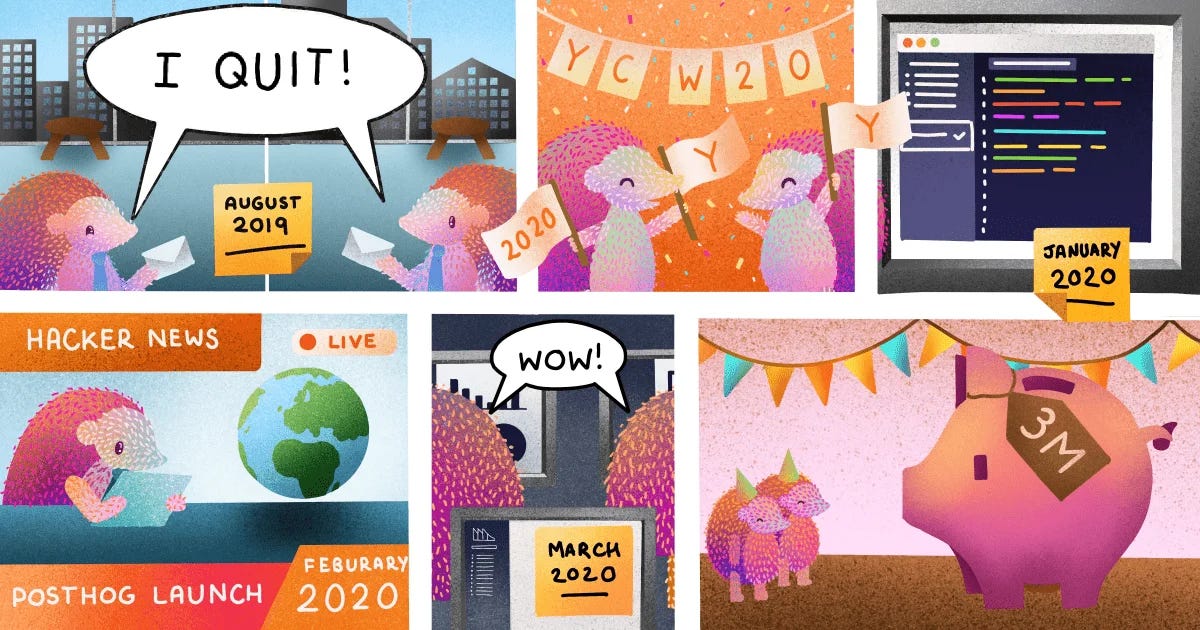
PostHog launched on Hacker News, published the handbook and then ran what amounted to a public diary of the company.
Each of those was a deliberate attempt to close the distance between a product and the people who might care about it, which is the entire job description.
The founder blog covered the mechanics of raising a $3 million seed round as an open source company and a retrospective on the 6 product ideas the team abandoned before landing on product analytics.
None of it required a strategy document, brand guidelines, or a budget line. It required deciding what an audience of engineers would find genuinely interesting and then saying it out loud.
The Expensive Trap of Making It Official
So the question founders ask is usually the wrong one.
They are not asking how to start marketing, since they already have, but how to make it look official and the officialising step is where most of the money gets wasted.
This matters more than it used to, given that distribution is the moat that most early companies are missing entirely, which raises the harder question of what is actually worth publishing now.

2. Competent Content Became Free, Which Made It Worthless
Every piece of content marketing advice written before 2023 rests on an assumption that no longer holds, which is that producing clear, well-structured writing costs real money and real time.
The AI Content Flood and the Death of Basic Competence
It does not. Graphite sampled 65,000 English-language articles and found AI-generated pieces overtook human-written ones in November 2024, settling at roughly half of everything published.
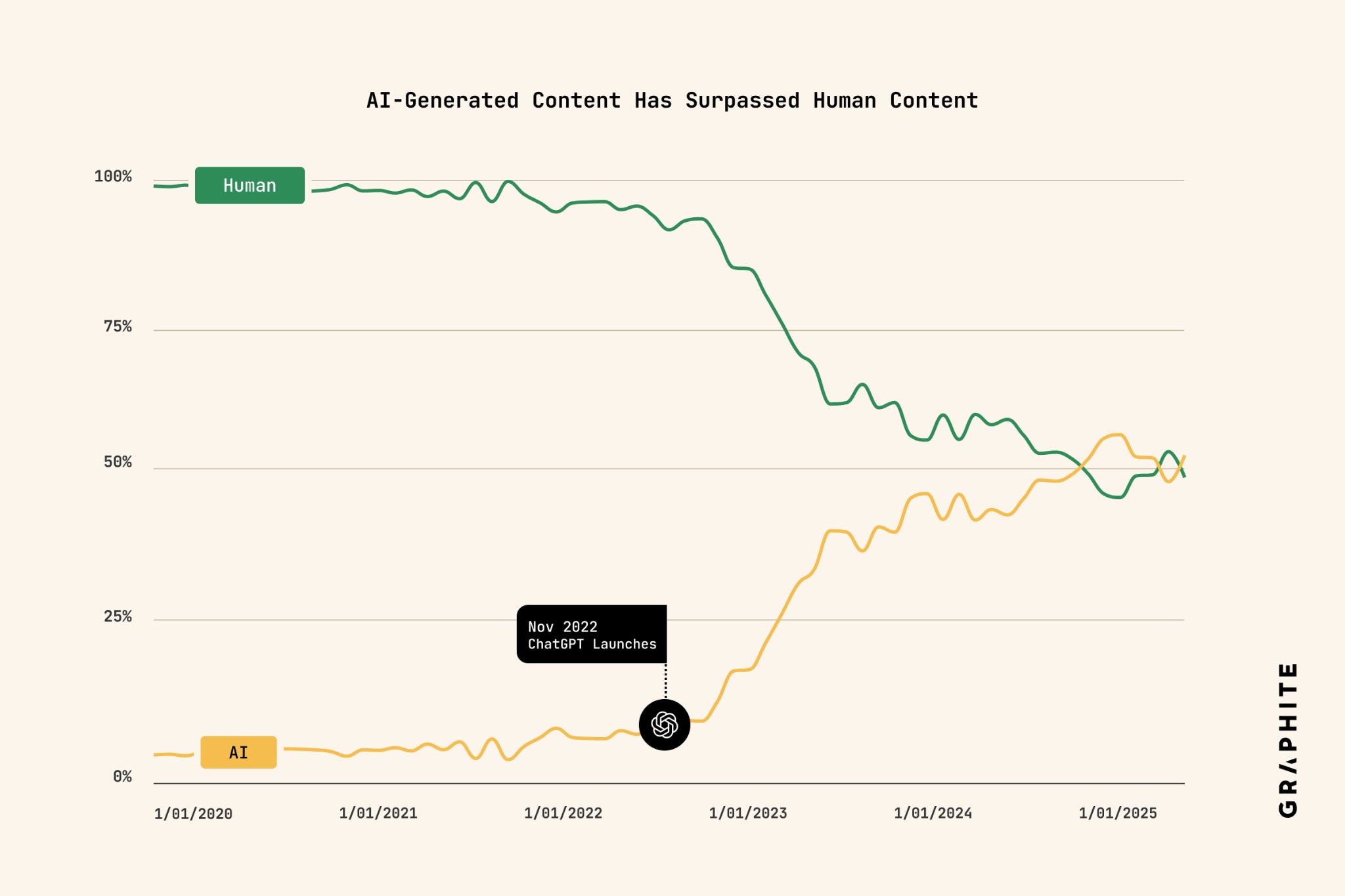
The interesting half of their research came second.
A follow-up Graphite analysis found that 86% of articles actually ranking in Google Search were written by humans, against 14% generated by AI, so the flood arrived and largely sank.
The New Premium on Access and Raw Failure
The scarce thing moved rather than disappeared.
It is no longer the ability to write clearly, because that now costs nothing and what is left is access, meaning your numbers, your customers’ actual sentences and your failures described in enough detail to be useful to someone else.
There is a blunt test for this before publishing anything.
If a competitor with a $20 subscription and 20 minutes could have produced the same piece, it is not worth your afternoon and the reader can tell.
PostHog’s founder blog worked precisely because a large incumbent could not have written it.
Being small, unproven and willing to publish the seed round paperwork was the qualification rather than the handicap.
Knowing what to publish still leaves the question of where and that is where most early marketing budgets quietly disappear.
3. The First Channel Picks You
By the time a founder starts thinking about channels, something has usually already worked slightly better than everything else and the standard response is to ignore it.
Depth Beats Breadth and It Is Not Close
The instinct after one small win is to write a list of 5 to 10 other channels and try them all, on the theory that one more might also work. 6 months later there is a pile of half-run experiments and no diagnosis, because none of them ever received enough volume to produce a signal worth reading.
Cook’s account of PostHog’s first 1,000 users describes the opposite move.
The Hacker News launch worked, so the team kept writing founder posts on the same channel, one after another, until it stopped working.
You are not selecting a channel from a menu. You are noticing which accident already worked and then pressing on it hard enough to find out where it breaks.
Companies further along can afford to run a portfolio of bets across several channels at once, but that is a luxury purchased with data you do not have yet.

Do Not Start With SEO
SEO looks like the responsible, grown-up choice and it is close to the worst possible first channel for a company under 2 years old.
Ahrefs analysed over 1 million URLs in their 2025 study and found that only 1.74% of newly published pages reached Google’s top 10 within a year, down sharply from 5.7% in their 2017 version.
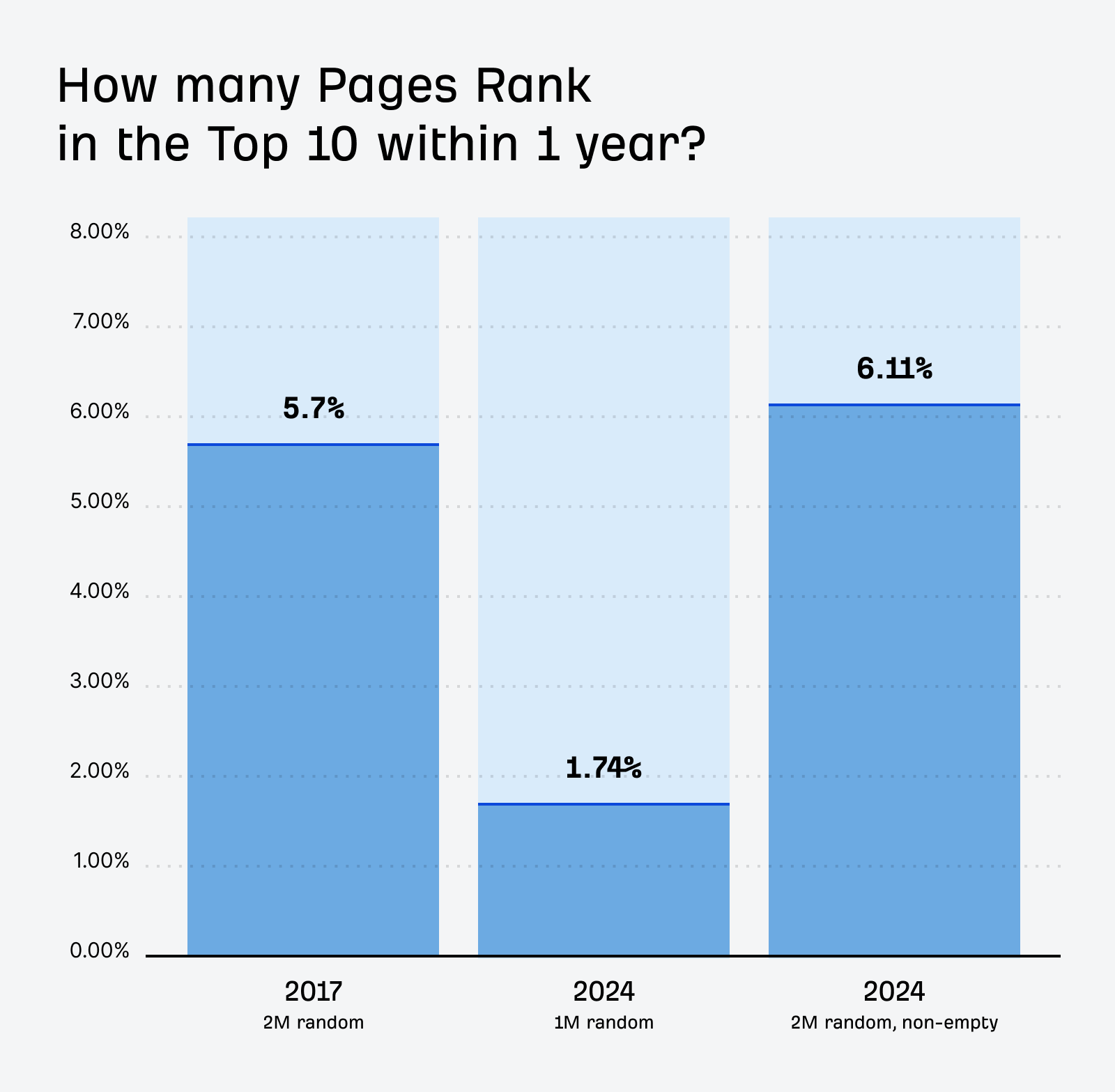
The average page sitting at position 1 is now 5 years old.
A seed-stage company starting SEO is therefore entering a race where the leaders have a half-decade head start and a compounding backlink profile.
The same structural problem is already appearing in answer engines, so the workaround is not as new as it sounds.
Whereas communities like Reddit can produce a signal in weeks rather than years, provided the founder shows up as a participant instead of a marketing department.
A channel only pays off if what travels down it is sharp and sharpness comes from what a company refuses to say.
4. Positioning Works by Subtraction
Positioning is mostly a list of people you are willing to disappoint, which is why founders find it so uncomfortable and so easy to postpone.
Naming Who You Are Not For
Most founders write positioning as addition, stacking adjectives and use cases until the description technically covers everybody who might ever buy.
The result is a sentence that survives every internal review and persuades nobody, because a claim that fits any buyer describes none of them.
The useful version is shorter and costs something. It names a specific buyer, a specific situation and an alternative you are explicitly better than, which means accepting that a real share of the market will read it and correctly walk away.
A positioning statement nobody could disagree with is not positioning and getting this right early also fixes positioning and pricing downstream, since a price is a claim about who you are for.

A New Category Is a Bill, Not a Moat
Founders invent categories because the payoff genuinely is enormous.
Older research verified by the HBR found that category kings captured 76% of the market capitalisation of their entire categories.
That number is real, but it is also survivorship bias wearing a suit, because it counts the winners and says nothing about the far larger group who named a category, spent 3 years explaining a problem buyers did not recognise and ran out of runway during the education phase.
Category creation is a bet that you can fund market education for several years before pipeline arrives. Positioning against a reference point the buyer already understands is cheaper, faster and available this week.
Sharper positioning produces better experiments and better experiments still get ruined by bad measurement.

5. Attribution Lies and the Cheapest Fix Beats the Expensive One
A buyer reads a post, remembers the company name a week later, searches for it, clicks a paid ad and signs up.
How Software Attribution Misunderstands Demand Generation
The analytics credits the ad and gives the post nothing, so budget migrates toward the channel that captured the demand and away from the one that created it.
Refine Labs published an analysis comparing their software attribution against what their own customers said when asked directly. Software reported that 78% of conversions came from web search, while customers reported web search only 12% of the time.
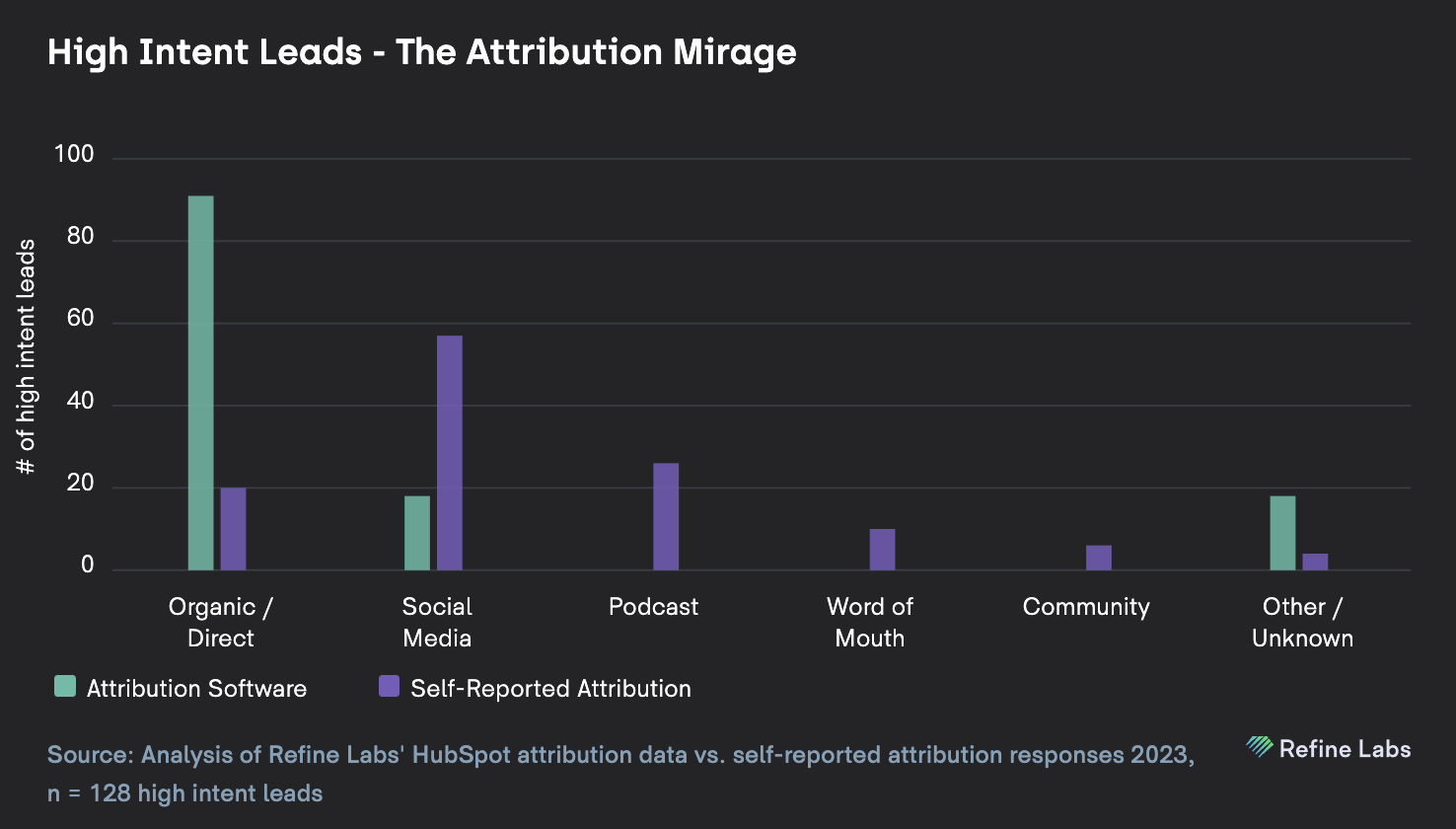
In the same analysis, 85% of conversions were self-reported as dark social, which covers social posts, podcasts, communities and plain word of mouth. Software measures where demand gets captured, not where it gets created.
The Low-Tech Fix That Outperforms Expensive Analytics
The fix is not a multi-touch attribution platform and buying one at this stage is an expensive way to formalise the same error.
It is an optional free-text box in the signup flow asking where someone heard about you. Between 5% and 10% of people fill it in, which is more than enough and reading them every week costs nothing but attention.
There are 2 rules that make the data usable. When the box and the analytics agree, believe both and when they disagree, believe the box, because a human remembering a podcast is more trustworthy than a cookie that only witnessed the final click.
Cook notes that PostHog’s answers surfaced something no dashboard would have produced, which is that developers disliked being sold to but were genuinely interested in the company’s own story. That single finding shaped years of what got published next.
Those free-text answers are the smaller half of a larger point about where a company’s language should come from.
6. Your Best Copy Is Already Written, in Your Sales Calls
The sharpest sentence about most products was said out loud by a customer and never written down by anyone.
The Gap Between Inside-Out Copy and Customer Reality
Founders write copy from the inside out, starting with the architecture, the feature set and the reason the technical decisions were hard. Buyers describe the same product in terms of the specific Tuesday afternoon it saves them.
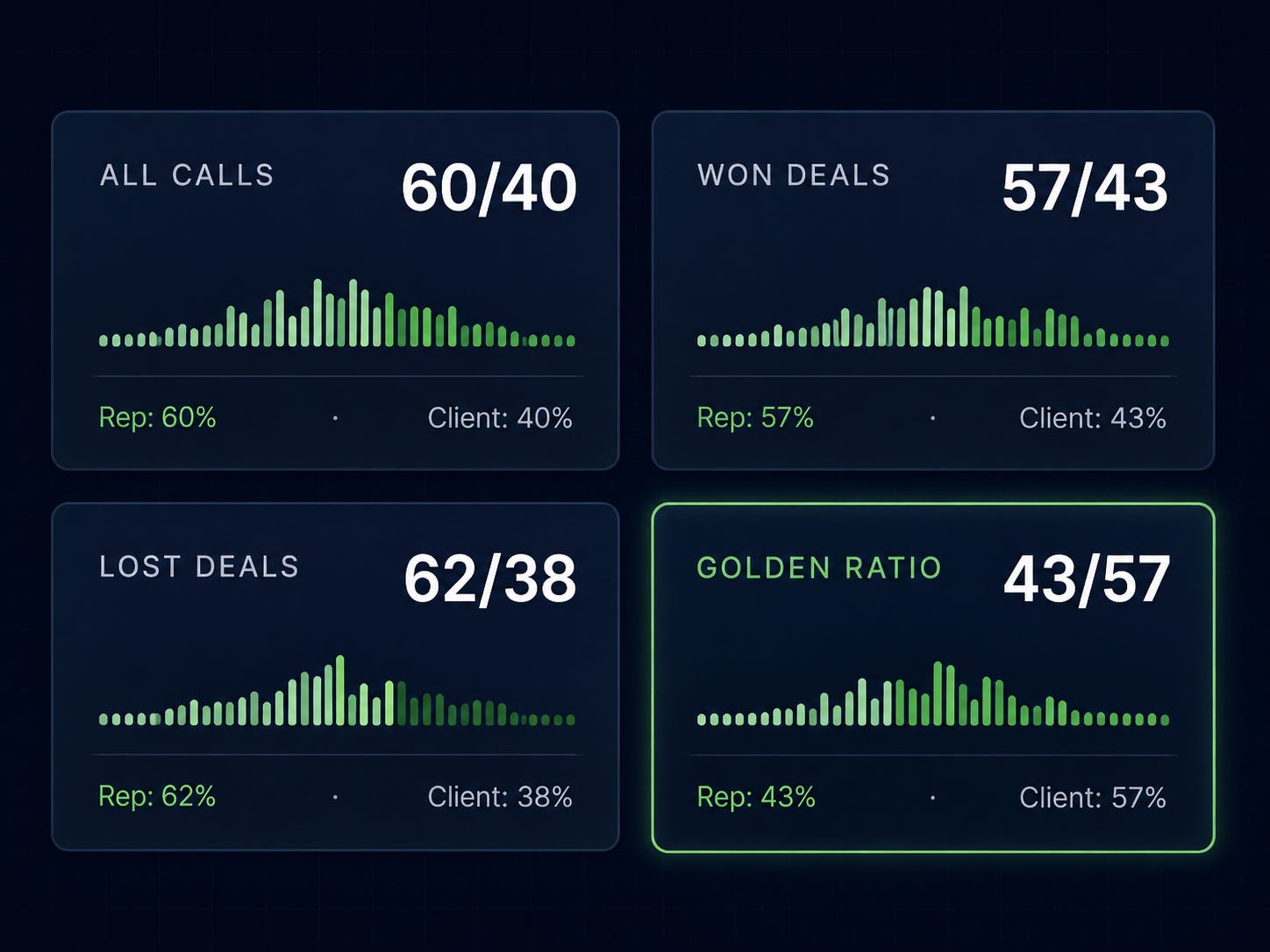
Gong Labs analysed 25,537 recorded B2B sales conversations and found the highest performers held roughly a 43:57 talk-to-listen ratio, while their 2025 update showed the average call still runs closer to 60% talking. Most founders sit on the wrong side of that split by a wide margin.
Mining Transcripts for Verbatim Copywriting Gold
The material is already recorded, sitting in transcripts nobody has opened since the call ended.
Pull them, find the moment the buyer explains their problem unprompted and take the phrasing verbatim rather than tidying it up. It will be blunter, more specific and less flattering than anything written internally, which is precisely why it converts.
This habit also improves product decisions, because noticing which framing lands is an extension of talking to users rather than a separate marketing activity bolted on beside it.
All of which explains why the 2 most common early spending decisions tend to go so badly.

7. Nobody Can Do the Thinking For You
The 2 questions founders ask most often are whether to hire an agency and when to hire a marketer and the honest answer to both is later than anyone wants to hear.

Agencies Cannot Do Work You Have Not Done
An agency can execute a positioning statement and cannot write one, because writing one requires deciding which customers to disappoint and that judgement only exists inside the company.
Hand over the earliest marketing and the output arrives generic, the feedback loop stretches from days to weeks and the founder learns nothing about their own buyers in the process.
PostHog did eventually outsource paid ads at roughly $5,000 a month and that worked because ad management is time-intensive, needs almost no company-specific context and rewards years of accumulated repetition.
The test generalises cleanly. Outsource execution you already understand and never outsource thinking you have not done.
Hire Late and Hire a Generalist
The prerequisites for a first marketing hire are unglamorous. Users who actually use the product, users who recommend it without being asked and users who pay for it, ideally all 3 while the product is still visibly rough around the edges.
Titles are close to useless in the search, since the same person might be called a content marketer, a product marketer, or a growth marketer depending on where they last worked.
What matters is whether they can write, think in funnels, talk to users and operate without a playbook, because a GTM system is something they will have to build rather than inherit.
Specialists arrive with a channel already chosen, which is a liability when nobody yet knows which channel matters. Hire someone experienced too, given that the most you can hand them is context on what has worked so far.
PostHog’s first marketing hire spent as much time interviewing engineers as writing copy, because working out what the company actually needed turned out to be most of the job.
That is the pattern sitting underneath all 7 points. Marketing at this stage is not a function to be installed, staffed, or purchased and every attempt to shortcut it with an agency, a content calendar, or a channel that worked for somebody else produces the same forgettable output that half the internet is already generating for free.
What survives is narrower and slightly uncomfortable. Say the specific thing only your company is in a position to say, to the specific people who would care and keep saying it until something in the data tells you to stop.
Great post. The gap between software-reported and customer-reported attribution interests me, and I think the problem is more nuanced than the multiple-choice options allow.
A few others stated this concisely. But I think this is also shifting with the increased use of AI tools.
At it's core, what is meaningful or helpful information to a new potential customer?
How a customer tried to find you and how they eventually engaged with you can be entirely different. I search for a product, fail to find one, ask around, and someone in a forum recommends you. I report "word of mouth." The founder reads that as a signal to spend more on social, when the actual failure was that the product wasn't discoverable through search — or that I found the site but couldn't get the information I needed to shortlist or disqualify you. The survey attempts to answer the founder's question ("which channel deserves budget?") with the least possible context, and the answer misleads. Free-form responses with LLM aggregation, random sampling, and outlier highlighting would produce a far better signal.
Blogs build trust and search ranking, and a good post mortem gets cited and (hopefully) builds confidence. But that's secondary. I have to find companies that match my requirements before I start ruling them out on anything else, and what I need for that is product detail, not content.
Consider two competitors.
Company A publishes product summaries, technical specifications, and an API reference I can exercise (Swagger or similar) without talking to anyone. Pricing is published and predictable as I scale. Uptime, incidents, and post mortems are public. The privacy policy is readable. The roadmap, support channels, and known issues are visible. GitLab is the reference case — they publish docs.gitlab.com and their entire company handbook (handbook.gitlab.com). Any startup that can do this competently already has their foot in the door.
Company B spends its budget convincing a VP the solution is right for them without saying what the solution is technically. Pages of marketing copy and case studies, no architecture, no feature breakdown, no knowledge base without a support contract, and the only path to learning or testing anything is "speak with sales."
If Company B redirected a fraction of that spend toward transparency and a frictionless trial, their chance of winning my business would go up considerably. Frequent marketing emails, bold claims, "customers don't know what they want, it's our job to convince them"... this is precisely why engineers go to great lengths to avoid sales conversations.
Help me find you, not the other way around.
And the discovery mechanics are shifting under all of this. I'm now more likely to hand an LLM a list of requirements and let it crunch whatever is publicly available than to type keywords into a search engine. Or maybe I ask the model to build a working draft of a workflow. A company gating its product information gets no representation in that answer; it will simply be ignored at that stage. Machine-readable product information like feature tables, published specs, open docs, are all cheap to create, cheap to maintain, and it's free marketing.
Software said 78% of signups came from search. Ask the customers directly and only 12% said search the rest pointed at podcasts, communities, someone mentioning it in a group chat.
That gap isn't a measurement error. It's a budget mechanism. The channel that captures demand gets credited, the channel that created it gets nothing, and next quarter money moves from the second to the first. Do that for two years and you've defunded the thing that was actually working while every dashboard tells you performance improved.
I ran marketing inside a commercial P&L and this is the fight I lost most often. Brand spend shows up as cost with no attributable revenue, so it dies in every review, and by the time the search volume dries up nobody connects the two.
The free-text box beats an attribution platform for the same reason. It measures memory, and memory is where the decision was made. The cookie only saw the last click