

There are deals that make sense on paper, and then there are deals that stop people mid-scroll and re-read a headline. There are deals that spark reactions before the details even come out, and a $20B headline has a way of doing that.
This specific deal however, touched something deeper in the startup world. People did not just pause to admire the size of the outcome, but because it surfaced anxieties many had been carrying without saying out loud.
This deal touched a nerve because it arrived at a moment when the ecosystem feels tense. This wasn’t one of those stories where the ending feels obvious in hindsight. It didn’t arrive through a predictable procedure, and it wasn’t about hype, momentum or timing.
Exits feel harder to imagine, long-term conviction feels risky to defend, contrarian thinking is becoming unpopular, and infrastructure power appears to be concentrating rather than diffusing.
Ultimately, this deal was about power, patience, and one of the clearest reminders in years of what venture capital looks like when it actually works.
A quick note before we dive in
One thing this deal made clear is that the best-positioned companies move before the conditions feel comfortable. They build, ship, and show up while everyone else is still waiting for the right moment.
That’s exactly the kind of speed Framer unlocks for early-stage founders.
If you’re pre-seed or seed-stage, you can go from zero to a polished, production-ready website in hours, without needing a dev team or weeks of back-and-forth. Hundreds of YC-backed startups have launched on Framer and scaled their sites all the way from MVP to full product, using built-in CMS, analytics, and AI localization.

If you’ve been postponing your site or living on a half-baked landing page, this is a very good moment to fix it: Framer is offering a full year free, worth $360, for early-stage startups that are new to the platform.
Now, let’s get into the deal.
Table of Contents
1. Why Big Companies Pay Huge Prices for Small Startups
2. Why Groq Was a Problem Nvidia Couldn’t Wait On
3. This Wasn’t About Buying a Company
4. The Real Winner of the Groq–Nvidia Deal
5. What Founders Should Actually Learn From This
6. What This Says About the Current VC and Startup Market
7. Why Most People Will Misread This Deal
1. Why Big Companies Pay Huge Prices for Small Startups
Most founders assume acquisitions happen because revenue lines up neatly or because growth curves finally look convincing. In reality however, revenue is rarely the deciding factor. What pushes large companies to pay outsized prices is when they sense a coming loss of control.
Control shows up in subtle ways, especially when it comes to companies of massive scale. For them, control lives in the default assumptions customers make, in procurement conversations that stay short because there are no real alternatives, and in roadmaps that do not have to account for outside pressure.
Once those conditions start to weaken, uncertainty enters the system. And the biggest companies manage to stay in power by preventing the erosion of control.
This is why acquisitions often function as purchases of time. They narrow the range of futures an incumbent must actively prepare for. Big companies are not reacting to competition in the traditional sense, but more to the possibility that choice itself may expand beyond their control.
So when it comes to Nvidia, it did not wake up one day looking for a new growth vector. It reacted to a more subtle risk that large customers, over time, might gain credible alternatives. Even the hint of that possibility forces uncomfortable internal questions about leverage and dependence.

Startups that create credible alternatives, even at an early stage, introduce asymmetry into that equation. They do not need to replace the incumbent, they only need to make exclusivity feel fragile. Once that happens, incumbents stop choosing from a position of calm and start choosing under pressure.
Founders do not need to beat giants at their own game. They need to carefully design situations giants cannot safely ignore.
2. Why Groq Was a Problem Nvidia Couldn’t Wait On
Once Google showed it could meaningfully reduce internal dependence on GPUs for certain workloads, a psychological threshold was crossed. That proof did not need to scale across the industry to matter; it only needed to exist. If one hyperscaler could do it, others would eventually ask the same question:
“Should we build our own?”
That question alone weakens long-term leverage. It changes how large buyers think about commitments, pricing, and timelines. The certainty that once anchored negotiations begins to loosen.
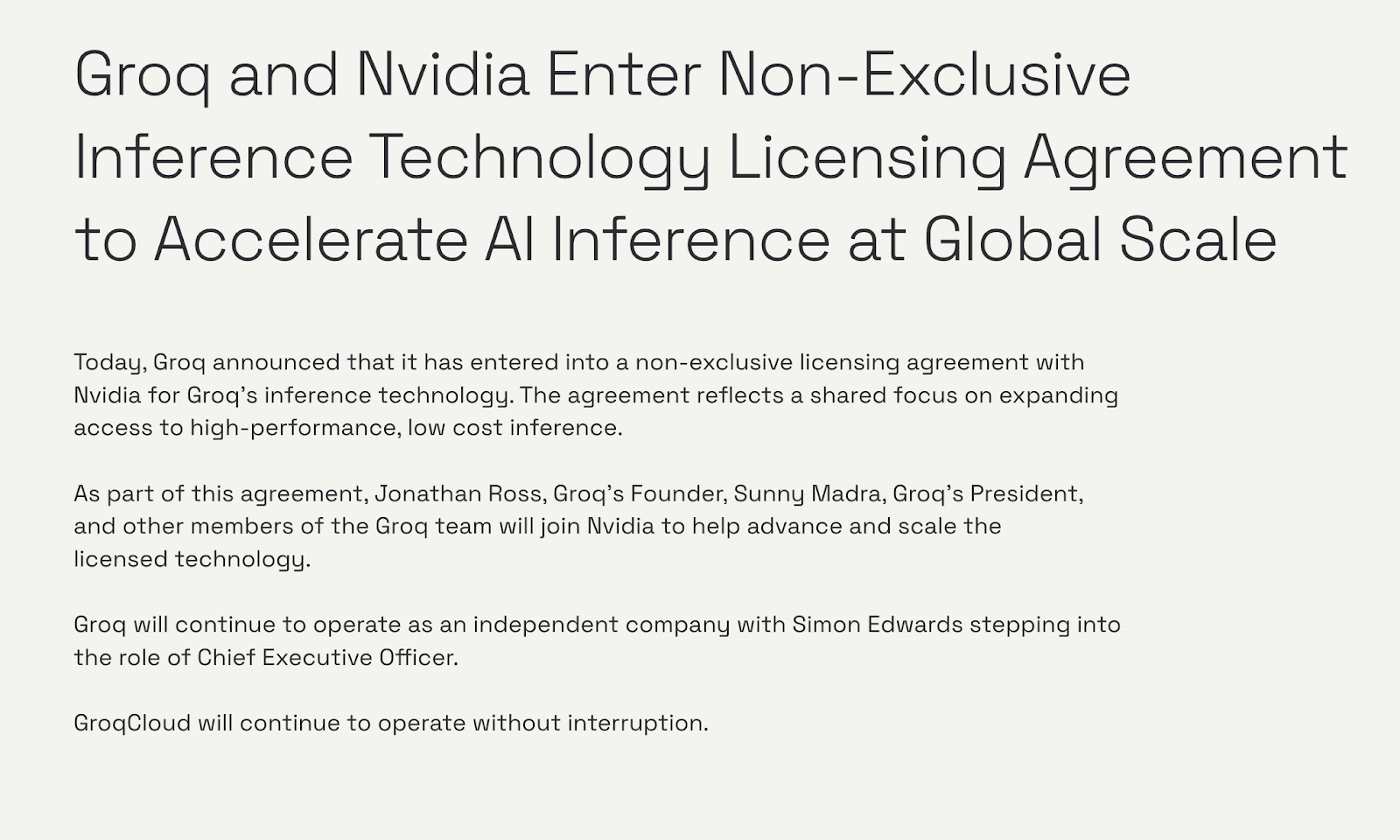
What made this question newly credible was the nature of the alternative itself. Groq was not trying to compete with GPUs at everything. It built chips specifically for running models once they were trained, with a design that prioritized predictable speed and efficiency over flexibility.
Instead of spreading work across many cores and managing complexity in software, Groq ran inference in a simpler, deterministic way. That translated into lower latency, clearer performance characteristics, and a more straightforward path to scaling real applications.
As inference costs began to dominate real deployments, this approach made a quiet but consequential point. That GPUs were no longer the only sensible way to run large models at scale.
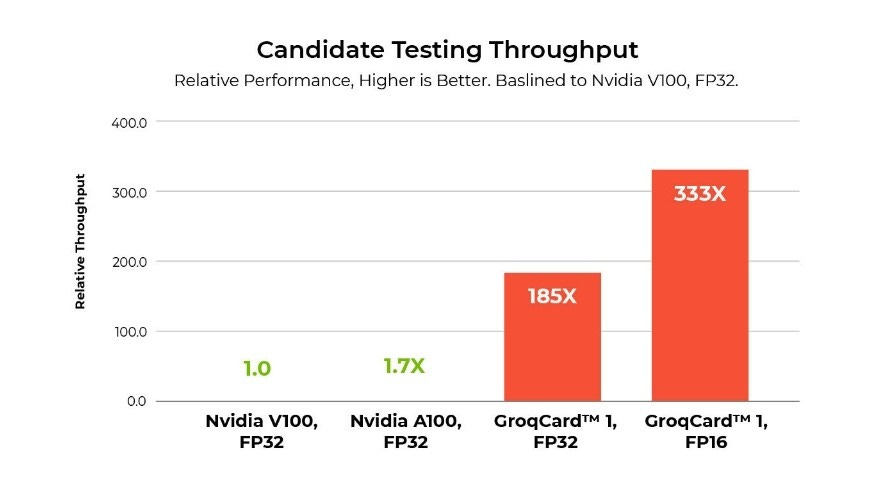
This is where Groq became strategically uncomfortable for NVIDIA. It did not need to dominate the market or replace GPUs outright. It only needed to make the idea of “Nvidia or nothing” feel false. Once a plausible alternative exists, exclusivity becomes fragile.
In infrastructure markets, plausible alternatives are often more destabilizing than direct competitors. Competitors declare intent and invite response. Alternatives spread slowly, behind the scenes, giving buyers room to test, wait, and rethink commitments.
That optionality compounds over time, especially when architectural choices around AI inference shape cost structures for years.
From that perspective, acting early was a way to contain uncertainty before it widened.
The most valuable startups are rarely the loudest. They are the ones that make incumbents uneasy by turning certainty into a question.
3. This Wasn’t About Buying a Company
Every large AI buyer eventually runs into a dilemma that can make or break them.
Do we build internally and accept the time and execution risk that comes with it? Do we buy externally and absorb the cost upfront? Or do we allow alternatives to exist and live with the uncertainty they introduce?
Those options are not as symmetrical as they appear at first. First of all, building stretches timelines and exposes gaps in internal capability.
Secondly, allowing alternatives gives customers room to wait, test, and negotiate.
So ultimately, what buying offers is peace of mind. It compresses uncertainty, but only if it reshapes the field rather than simply adding another product to the shelf.
This deal worked because it collapsed that decision space. What could have remained an external alternative became a controlled option. Buyers could still segment workloads, experiment with architectures, and optimize for different use cases, but those choices now sat inside a framework Nvidia could own.
This is where the price tag often gets misunderstood. Paying a premium is not about enthusiasm for growth, but about preventing fragmentation that weakens leverage. Different customer needs and performance profiles can coexist without eroding control, as long as they exist within a system that feels inevitable.
That is the deeper logic behind Nvidia’s strategy in AI infrastructure. Dominance is brittle and inevitability is durable. The smartest platforms do not eliminate choice; they define the boundaries within which choice safely exists.
4. The Real Winner of the Groq–Nvidia Deal
If you step away from the platform dynamics and look at this from the venture capital perspective, you’ll get a whole new story.
The outcome emerged from early conviction, long stretches of doubt, and a willingness to stay concentrated when doing so felt uncomfortable.
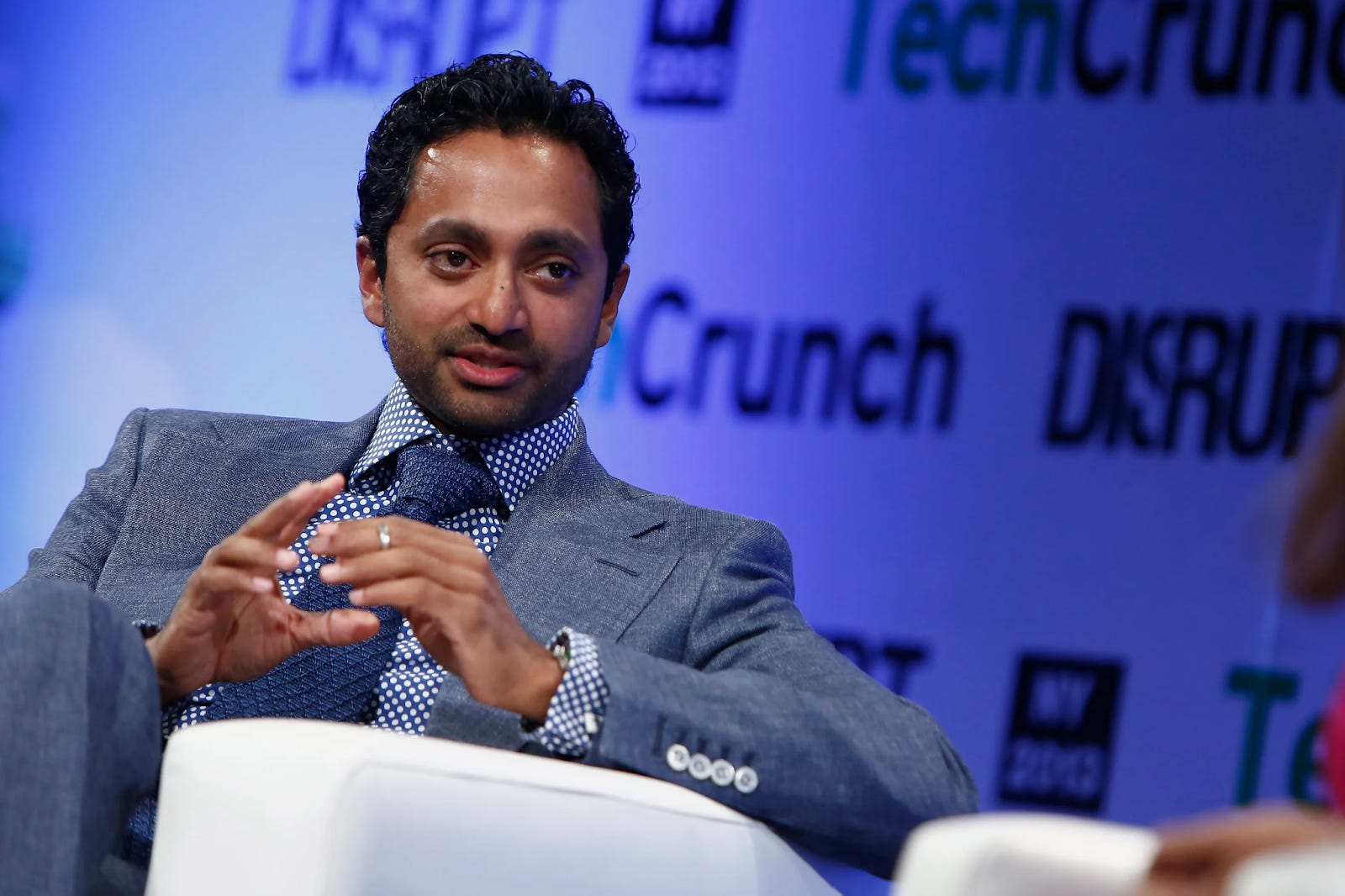
The bet traces back to a 2017 seed check written by Chamath Palihapitiya through Social Capital. Roughly $10M went in at a valuation around $30M, translating to meaningful (~33%) early ownership. A later convertible added roughly $52M more, bringing total exposure to about $62M.
And all of this happened years before ChatGPT completely re-wrote public imagination, before AI hype cycles became a default fundraising narrative, and before AI inference was widely discussed as a central constraint.
What made this bet unusual was not enthusiasm for artificial intelligence in the abstract. It was specific and narrow. It centered on custom silicon, on the belief that inference would become a bottleneck as models scaled, and on confidence in a particular technical founder.
Groq’s founder, Jonathan Ross, was not building a general-purpose alternative, but pursuing an architecture many believed was too early, too specialized, or too risky to matter.
That in itself made the bet inherently risky. Chamath Palihapitiya’s position was highly concentrated, and progress did not arrive in the form most investment committees are trained to trust. There were no flashy usage charts, no rapid adoption curves, and long stretches where external validation was thin.
Inside a typical fund, that situation would’ve created pressure to rebalance, hedge, or outright reduce exposure, especially when nothing seems to be happening on the surface. Being right this early rarely feels reassuring while it is unfolding. In reality, it feels isolating, invites second-guessing, and tests patience in ways few people can really endure.
In hindsight, the outcome looks dramatic. Ownership at exit likely sat in the mid-teens to low-twenties, translating into a result somewhere in the low single-digit billions. One position may have outweighed an entire fund vintage.
That is not how most modern VC portfolios are constructed, and it helps explain why outcomes like this feel so unfamiliar when they finally appear.
What stands out here is the structure of the bet itself. This is what venture returns look like when conviction is narrow, time horizons are long, and concentration is tolerated rather than optimized away.
The rarity of the outcome says less about the opportunity and more about how few investors are still willing, or able, to sit through the path required to reach it.
5. What Founders Should Actually Learn From This
The temptation after a deal like this is to hunt for surface-level lessons. Those usually point in the wrong direction, because the useful takeaways sit one layer deeper.
Mass adoption is not a prerequisite for strategic relevance. In infrastructure markets, what matters early is not how many customers you have, but which assumptions you force powerful buyers to revisit.
If your product changes how they think about what is possible or necessary, you manage to capture leverage long before you even care about scale. That is especially true in AI infrastructure, where architectural choices lock in years of cost and performance tradeoffs.
Alignment is also easy to misread. Founders often chase acquirers who sound philosophically aligned or publicly enthusiastic. In practice, the perfect acquirer is usually the one under pressure. When risk becomes tangible, attention follows, and alignment often emerges as a consequence rather than a prerequisite.

In these markets, architecture matters more than momentum. Short-term traction can look impressive and still be irrelevant if it does not influence long-term decisions. Debates like GPU vs inference may generate headlines, but their significance lies in how they influence the systems that are being built, optimized, and paid for over time.
Strong exits rarely come from chasing the prevailing narrative. They come from shaping futures incumbents cannot safely postpone. The best startups do not try to win loudly. They create conditions that make waiting uncomfortable.
6. What This Says About the Current VC and Startup Market
The intensity of the reaction to the Nvidia Groq deal says as much about the moment as it does about the transaction. There is a cloud of frustration above the industry at the moment.
Exits feel harder to picture. Long-horizon bets feel exposed rather than celebrated. When a large outcome finally appears, it triggers recognition as much as excitement.
What made this deal resonate even more is that it fits into a broader pattern. Nvidia has become one of the most consistent sources of real liquidity in AI infrastructure, repeatedly acquiring startups and, in the process, rewarding a relatively small group of venture firms.
Firms like Tiger Global and Insight Partners have each had multiple portfolio companies acquired by Nvidia over the past two years. This is not a wide-open exit market. It is a narrow one, where outcomes increasingly cluster around a handful of strategic buyers with both the balance sheet and the urgency to act.
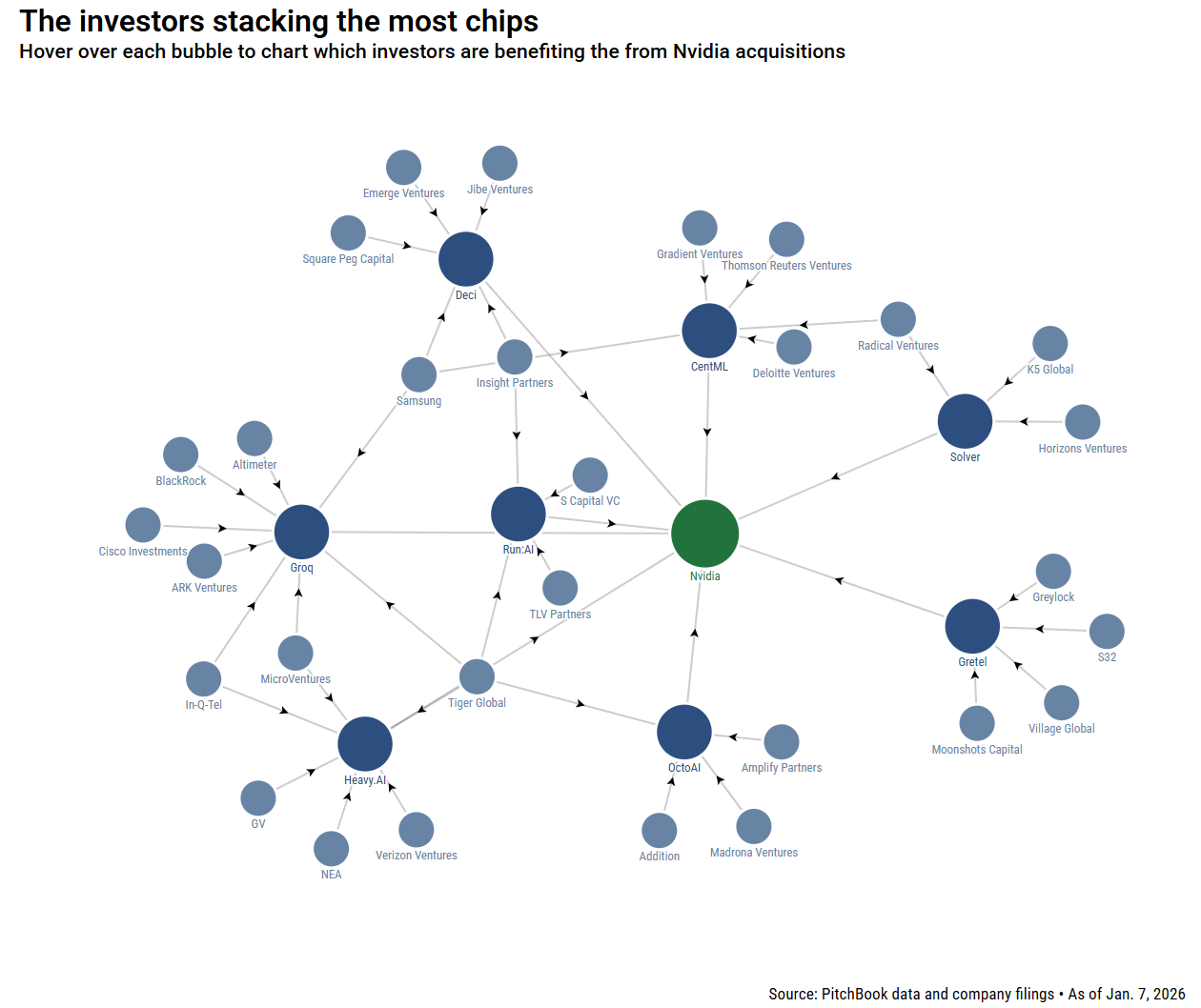
This concentration reinforces the sense that venture has grown more cautious, not just because markets are tighter, but because the paths to liquidity feel fewer and more controlled.
Safety has become easier to defend than belief. Portfolios have tilted toward signals that reduce discomfort rather than toward positions that require sitting through long periods of ambiguity. Big wins start to feel nostalgic not because opportunity disappeared, but because fewer people are willing to endure the path that leads to them.
At the same time, this outcome should not be misread as a market reset. It does not mean capital will suddenly loosen or that infrastructure bets will become fashionable again. What it shows is simpler and harder: venture still works when conviction is grounded in real technical shifts and held through unfriendly cycles.
Returns still flow to those who are willing to be early, specific, and patient. What has narrowed is tolerance for comfort. This deal reminded people what venture is meant to reward when it is practiced as intended.
7. Why Most People Will Misread This Deal
Most readings will circle the same details. The $20B figure will dominate the conversation and deal mechanics will be debated. Some will argue about who overpaid and who timed it well.
And that’s how you end up missing the real takeaway.
The number was never the point, and neither was the structure. What mattered was how power shifts when timing and leverage align.
This deal was a response to a narrowing window, not an expression of exuberance. It was about acting before optionality spread too far to contain.
The takeaway is not about valuation math or acquisition tactics, what one needs to understand and appreciate here is how startups become valuable before they are large, and how venture works when it leans into that reality.
For founders, that reframes what progress looks like. For investors, it reframes what patience actually demands.
The discomfort many felt reading about this deal is part of the lesson. Some outcomes only make sense once they are already behind us, and by then the path that led there tends to look simpler than it ever felt at the time.
Thanks for sharing my piece. Always interesting to see which ideas people decide to circulate. That signal usually tells you more than any metric.