

Rippling’s $17B GTM Playbook

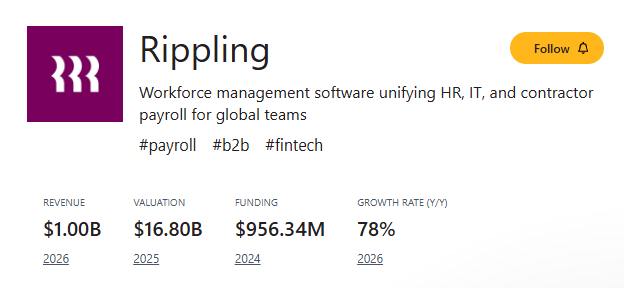
Parker Conrad co-founded Rippling in 2016 as HR and payroll software. Today it sells more than 20 products, and last year it raised $450 million at a $16.8 billion valuation from Y Combinator, Baillie Gifford, Elad Gil and Goldman Sachs.
The engine behind that number is old-school outbound, built call by call.
together with Hard Skill Exchange
Fixed sequences and playbooks are giving way to GTM systems that rewrite themselves, account by account.
Recursive GTM is a free virtual event this Thursday, October 15, where the CROs of ZoomInfo and Outreach and Dialpad’s CTO show how to finally get a return on your AI investments.

You’ll leave with:
▫️ A map from systems of record to systems that grow top-line revenue
▫️ Agent playbooks for marketing, sales and CS that make money and save it
▫️ AI-native GTM operating models, compared by the KPIs they move
It’s free and takes a minute to register
Table of Contents
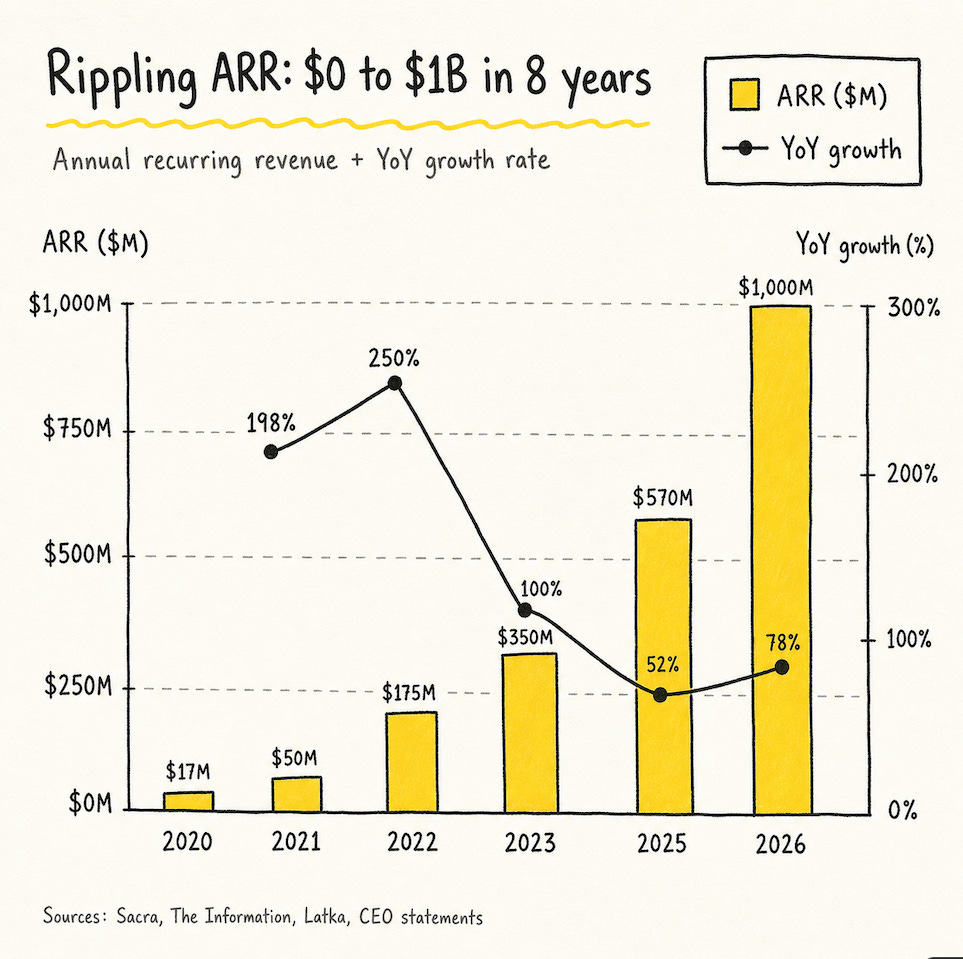
1. Rippling Hit A Wall at $100M ARR
2. Hiring The Right People At The Right Place
3. Same List, Different Conversion
4. Why the Compound Startup Pays the Phone Bill
5. The Second Engine Nobody Copies
6. Does the Math Actually Work?
1. Rippling Hit A Wall at $100M ARR
The craziest thing is that Rippling grew for years without an outbound team. In fact, up until 2022, the company grew the way most software companies grow now, which is through sequencing software that pushes large volumes of email at large lists of companies.
But the conversation of such strategy is around 1%, because that strategy only grows when new names keep entering the database.
So, what happens when every account worth contacting is already contacted several times over, and contacting them again only puts you in the spam folder?

Matt Plank is the company’s CRO and he recently said on Harry Stebbing’s podcast that waiting that long to build a real outbound team was a mistake.
Since an an outbound organization takes 6 to 12 months of hiring, training and data work before it produces pipeline worth counting, so a company that starts building one at the moment it needs pipeline is already 2 or 3 quarters late.
Is it the end of cold outreach as we know it?
If you talk to the average person today, they’ll probably tell you that cold outreach doesn’t really work anymore.
Mostly because inboxes have become a nightmare of LLM-written emails, and spam filters have gotten much better at catching sequenced sends, plus there’s a whole category of startups that will sell an AI agent that books meetings for a fraction of what a person costs.
But, Ashley Kelly, who runs global sales development at Rippling, doesn’t think so, pointing to her own headcount of more than 200 people.

2. Hiring The Right People At The Right Place
Kelly herself says that she knows exactly what she’s looking for when hiring.
She wants roughly 6 months of work experience (not necessarily in sales) and she will not take fresh graduates into a first sales development role at all, on the reasoning that the job is mostly organisation and tolerance for rejection rather than charisma.
She recruits heavily out of recruiting, because recruiters spend their days chasing people who do not want to be chased and keep careful track of who they have already spoken to.
Candidates run a roleplay that about half of them fail, then a written test where they answer a prospect’s email by mirroring that prospect’s own language rather than pasting in something prepared.
How the money works
Median on target earnings in the United States is approx. $150,000, and the interesting part of the design is that the variable portion gets paid on meetings rather than on closed revenue, specifically on a demo an account executive actually held with somebody able to make a decision.
Kelly ran revenue-based compensation for sales development at Brex and says it fails in businesses with long sales cycles, because a rep rarely stays in the seat long enough to watch the deal they created close, so the money lands on somebody else entirely.
Rippling has also gone back to hiring into offices rather than remotely, because Kelly believes that in-office reps outperform remote ones, especially on outbound. She works out of Dallas herself and travels monthly to the other offices, Dublin among them.
The reporting line and the data team
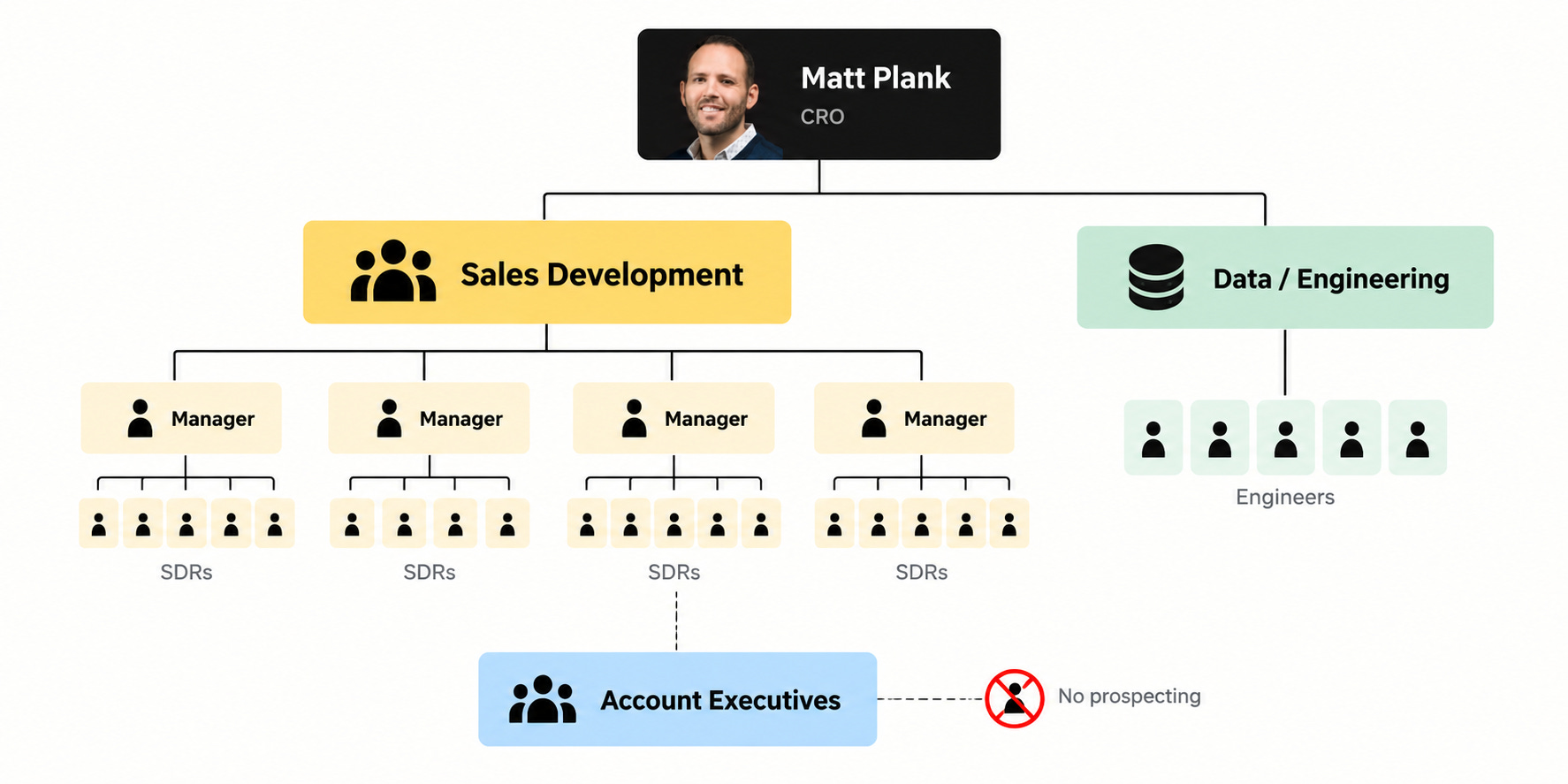
Sales development reports straight to Plank rather than into marketing or to a VP of sales carrying a closing number, which ends the perennial argument about whose pipeline problem it is.
Account executives do not prospect at all, on the theory that people trained for volume beat closers at finding meetings and closers ought to be closing.
The management layer is expensive on purpose, running about 1 frontline manager for every 4 or 5 reps, and that is the part almost everyone copying this arrangement quietly skips before concluding outbound does not work for them.
Behind the reps sits a data team of 5 engineers that scores the addressable market and pushes accounts into the queue on signals like a recent funding round or an executive changing jobs.
They draw on bought data from ZoomInfo and Demandbase alongside an internal warehouse the company calls Mozart.
The detail worth stealing is not the tooling but the exclusions, since manufacturing is flagged red and nobody calls it, and being that specific about which industries never get contacted is rarer than it ought to be.
3. Same List, Different Conversion
The base of this playbook is the conversion rate and not a headcount metric.
When Rippling replaced sequencing software with people working the same accounts, that rate moved from roughly 1% to somewhere between 3% and 7%.
And it happened using the exact same list as before.
The only variable was that a human being had looked at the account, worked out who actually held the decision, and then called them.
Outbound Kitchen published a detailed breakdown of the motion, showing that a set of tier 1 accounts producing roughly 10 meetings under automation produced somewhere between 30 and 70 once people were doing the work.
Ultimately, Rippling did not solve a targeting problem and did not buy a better list, which is what most companies end up doing when pipeline dries up. It solved a conversion problem on a list it already owned, which is both cheaper and considerably harder.
Roughly half of the 1,300 meetings the team books each month still get arranged over the phone, and Plank has said outbound already drives more than half of Rippling’s revenue.
The reasoning inside the company is that software is good at filtering and scoring accounts and bad at nearly everything downstream of that.
Judging whether a company genuinely fits, confirming the person on the other end still works there, and finding a reason to call that does not read as generated are all things people still do better.
4. Why the Compound Startup Pays the Phone Bill
Rippling’s own Series G announcement says the company offers over two dozen products across HR, IT and Spend, all sitting on a single employee data model.
More products on one logo means higher contract value and a longer revenue tail per customer.
Higher lifetime value raises the ceiling on what a company can rationally spend to acquire that customer.
That ceiling is what buys the phone calls, because a single-product rival selling a $6,000 tool cannot fund a 350-person sales development organisation, however badly it wants one.
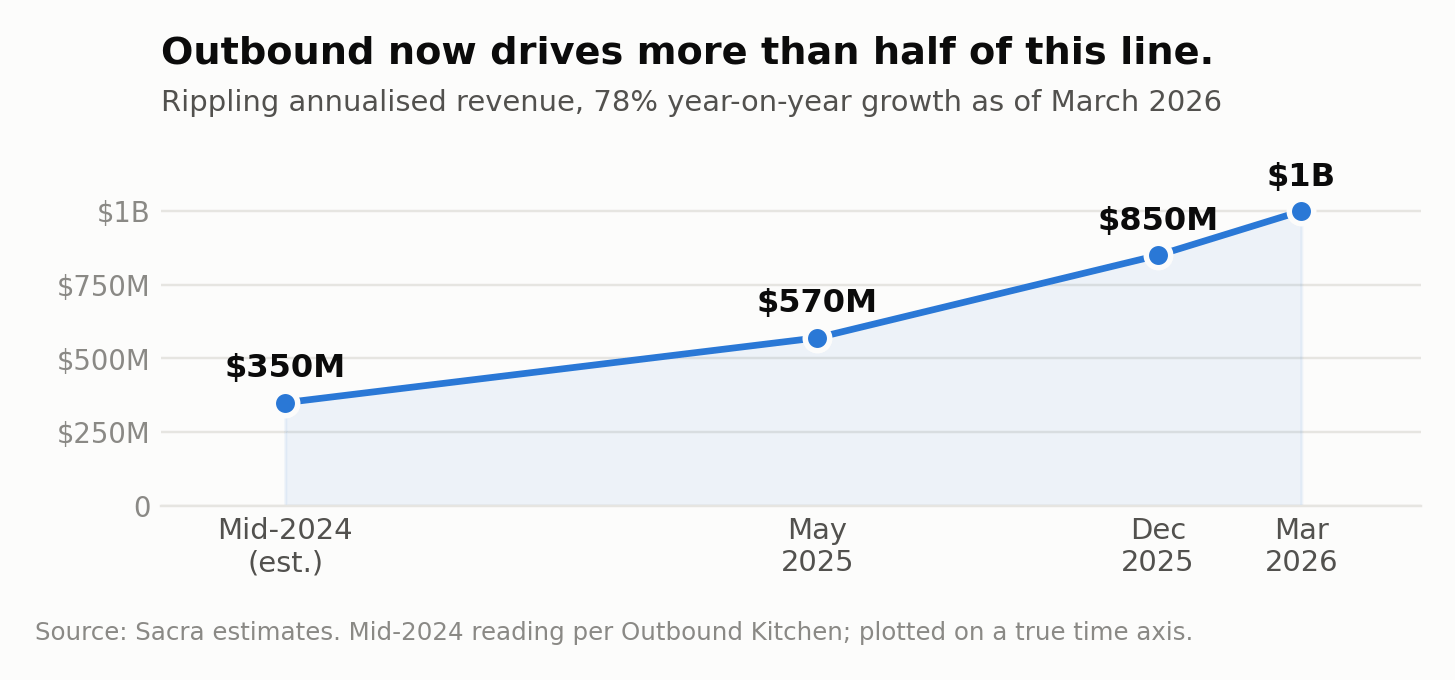
Sacra puts the company at roughly $570 million annualised in May 2025, $850 million by the end of that year, and $1 billion by March 2026, growing 78% year on year.
Conrad has claimed that growth rate rose for three straight quarters, and the growth numbers behind claims like that are worth reading carefully rather than taking at face value.
At the end of the day, the products exist so the company can outspend point solutions at the top of the funnel, while the funnel exists to sell more products.
5. The Second Engine Nobody Copies
Landing the logo is roughly half the model at a company selling two dozen products.
Rippling converted traditional customer success into account management carrying dual quotas for retention and expansion.
Plank says behaviour changed the moment compensation tied to retention, and that the restructured model has beaten baseline churn every month since.
Complex expansion selling does not sit with the account manager. Dedicated product account executives act as co-sellers, because a generalist rep cannot beat a specialist point solution on its own ground.
New products that clear internal criteria get what Plank calls a mini-CRO structure, a dedicated leader owning that product’s growth across product, marketing and sales.
His line on the conversion is the one worth writing down. It is easier to teach a salesperson empathy than to teach a customer success manager to generate revenue.
That is a contestable claim about people, and it is also why the expansion motion produces revenue instead of goodwill.
Which leaves the only question that decides whether any of this is worth imitating.
6. Does the Math Actually Work?
We are in a “$350 million era” and this is the snapshot the public numbers actually describe.
200 outbound SDRs at $150,000 on-target earnings is roughly $30 million in compensation.
Load in 60 managers, 5 data engineers, bought data, tooling and offices, and a defensible all-in figure comes at about somewhere between $35 million and $45 million a year.
Against that, $41.6 million in monthly pipeline at a 10% win rate implies roughly $50 million in new ARR annually.
That is close to a one-year payback on the sales development layer alone, before AE compensation, implementation cost or a dollar of marketing, which is thinner than the metrics investors score would suggest for a company at this valuation.
On its own that is a mediocre business. Nobody builds a $16.8 billion company on a motion that returns its own cost in twelve months and then stops.
What makes it work is the expansion layer sitting behind it. A $45,000 land inside a company selling over two dozen products is an opening balance, not a deal.
Strip out multi-product expansion and the arithmetic collapses. The outbound machine is only rational because of what the product strategy does to lifetime value afterwards, which is also how that valuation gets built.
Which is the real lesson, and it is not the one most teams take away from Rippling.
The transferable parts are cheap. Fix conversion before buying more list. Spend in proportion to deal size. Put pipeline generation under the person who owns revenue. Pay SDRs on meetings when the cycle is long. Be specific about who you refuse to call.
The part that does not transfer is the 350-person army. That is a function of Rippling’s contract values and expansion profile, not of its nerve.
A company selling one product at $6,000 that copies this will burn eighteen months of runway and conclude that cold calling is dead. It isn’t dead. It is expensive, and Rippling spent a decade building a product portfolio that could afford it.
thanks for including me in your breakdown! it means a lot. cheers
I wonder how much of this comes down to the quality of the reps versus the fact that most outbound teams are optimized for activity metrics. If you pay people to book meetings instead of just hitting call volume, you probably get a very different sales culture.