

What Actually Changed in GTM in 2026
There are moments where a whole market gets rewritten. The best GTM playbooks were built in 2021, when cheap capital and predictable pipelines made scaling simple: add reps, buy leads.
The ICONIQ State of Go-to-Market 2026 report, built on a survey of 150+ B2B GTM executives, shows that broke. Two numbers sit side by side and look like a contradiction:
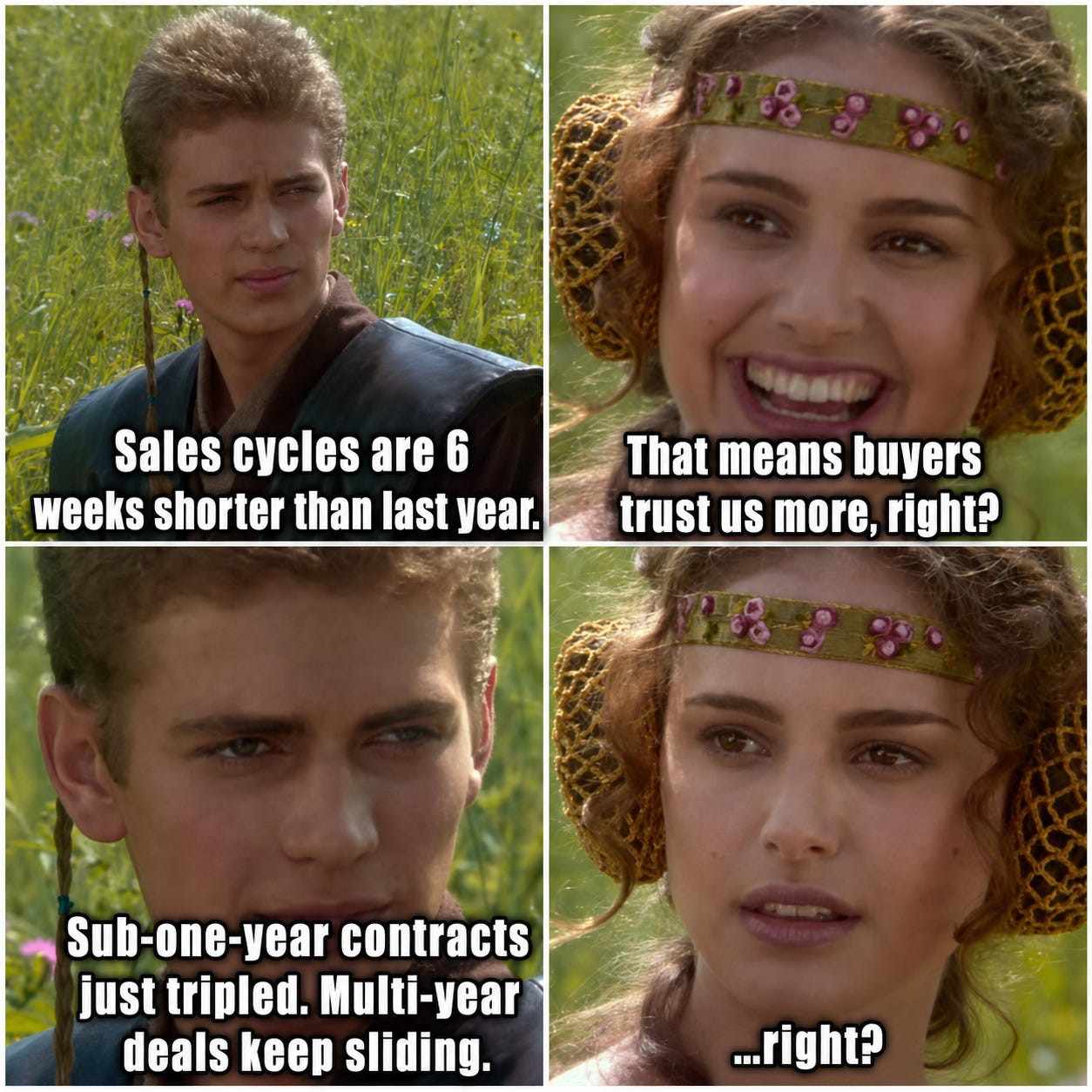
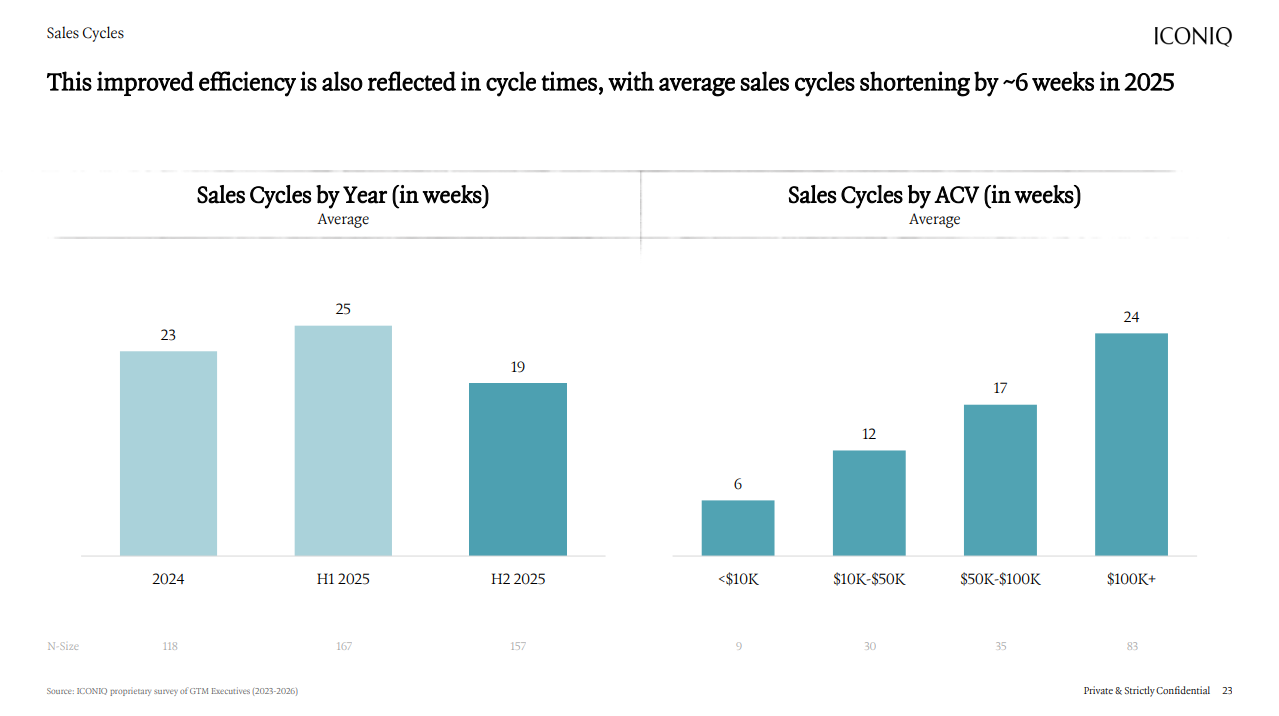
▫️ Sales cycles fell from 25 weeks to 19 in a single year.
▫️ Sub-one-year contracts climbed from 4% of deals to 13%, while three-year deals slid from 28% to 23%.
Buyers got faster and less committed at the same time. More deals moving at once, and every call now has to earn the next one.
Which is exactly why the seller who remembers what call one asked for is the one who wins call two.
together with Granola: the AI notepad for back-to-back sales calls
When cycles compress and buyers hedge, your day fills with calls and the margin for error on each one shrinks. Miss the objection a prospect raised on Tuesday and you have handed a hesitant buyer a reason to stall.
In a market where confidence is the whole game, the details are the deal.

Granola captures them for you, in the background:
Platform agnostic. Granola takes notes in the background wherever your meetings happen: Zoom, Slack, Google Meet, Teams, even in person
Get a refresher before each call, with instant context on who you're meeting and what came up last time
Clean summaries and action items the moment you hang up
Always follow up: Granola drafts a follow-up email seconds after the call, or pulls it from your CRM via MCP
Walk into call two remembering exactly what call one asked for. That is what buyer confidence is built on
One month free with code THEVCCORNER.
Table of Contents
1. The Cost of Producing a Signal Collapsed
2. Buyers Are Signing Faster and Committing to Less
3. Pipeline Moved to the Sellers,and Marketing Got Misread
4. The Proof of Concept Became the Whole Sales Process
5. Lean Teams Win Because Handoffs Destroy Conviction
6. Pricing Is Now the GTM Decision That Decides Everything
7. What to Actually Do, Depending on Where You Are
1. The Cost of Producing a Signal Collapsed
Almost every artifact your buyer once read as evidence of effort now costs nothing to produce.
The personalized cold email, the landing page, the case study, the competitive battlecard, the ROI calculator, the tailored demo script.
A competent operator can generate all of it before lunch and so can every one of your competitors.
When a signal becomes free to fake, buyers stop reading it as a signal.
Outbound worked in 2019 because sending ten thousand relevant emails was genuinely hard.
Now it is trivial, so the binding constraint is inbox capacity rather than your creativity and volume plays collapse together instead of decaying gracefully.
Justified Confidence as the Scarce Good
Attention was the scarce resource in 2021 and it is still hard to win.
What your buyer is actually short of in 2026 is justified confidence. They can produce a competent-sounding summary of your entire category in an afternoon. What they cannot produce is proof that your product works on their data, in their stack, under their compliance requirements.
Once you accept conviction as the scarce good, the strange behavior in the buying data starts to make sense.
2. Buyers Are Signing Faster and Committing to Less
The Hesitation is a Hedge
Speed and commitment used to move together and in 2026 they came apart.
ICONIQ recorded a roughly six-week compression in average sales cycles across 2025.
At the same time, sub-one-year contracts more than tripled as a share of new logo deals and multi-year commitments kept sliding.
Read those together and the story is not a budget freeze. Money is pouring into AI. The hesitation is a hedge.
Surviving the Next Model Release
The question in the buying committee is no longer whether they can afford this. It is whether you will still be the right answer in twelve months, or whether their platform vendor ships an adequate version of you for free in the next release.
That fear does not respond to a discount, a mutual action plan, or a better closing sequence.
It responds to a demonstrated reason your value survives the next model release. The workflow you own, the customer-specific data that accumulates in your system, the integration surface, the accountability you carry for the result. The playbook rewriting itself around non-reproducible assets is not a philosophical exercise, it is now a sales objection you have to answer in the room.
If your process does not explicitly answer why this does not get commoditized, procurement is answering it for you in a room you are not in.
Your biggest competitor in 2026 is a sentence and the sentence is ‘Let us wait six months, this space is moving fast.’
That same fear explains why demand looks healthy while revenue does not.
3. Pipeline Moved to the Sellers and Marketing Got Misread
The most quoted number in the report is also the one being misused most aggressively.
Sales Now Owns the Top of the Funnel
Among high-growth companies under $100M ARR, sales generates 62% of new logo pipeline while marketing generates 19%. For their slower-growing peers, those figures are 47% and 34%.
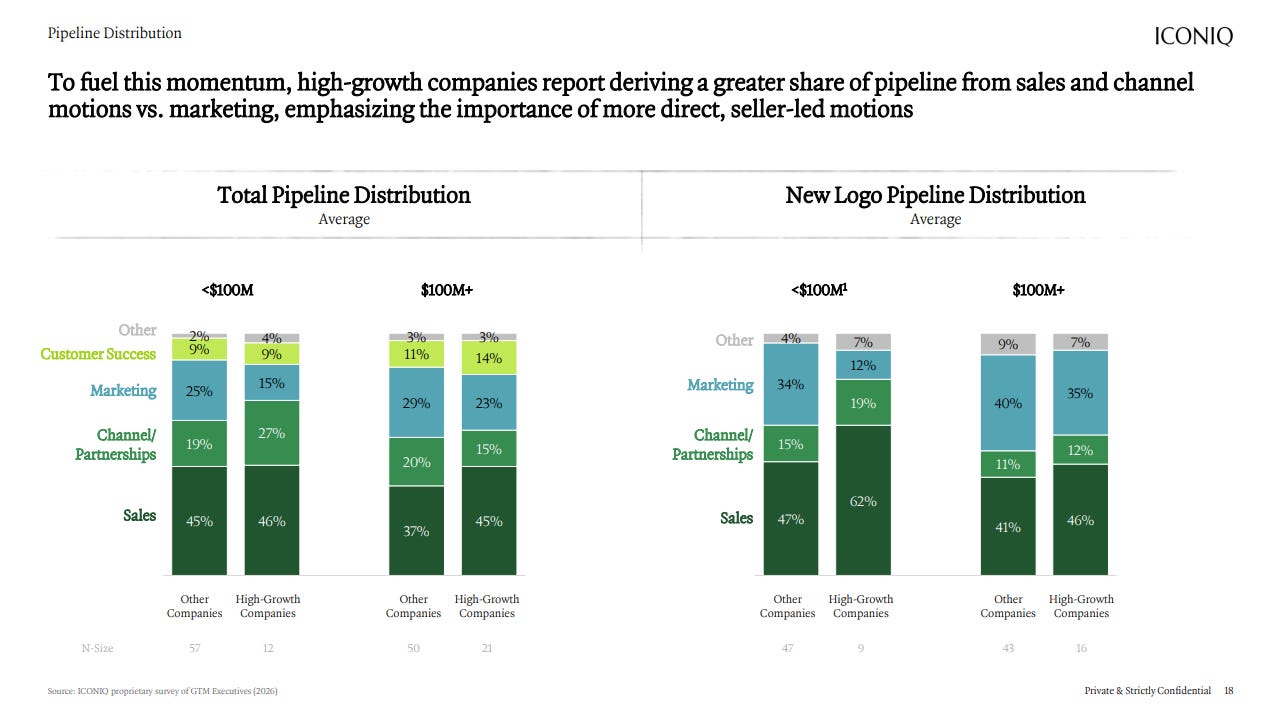
The pattern holds across revenue bands.
The fastest-growing B2B companies are seller-led at the new logo stage, with channel as a secondary lever and marketing as something else entirely.
If your forecast still assumes marketing fills the top of the funnel, the forecast is describing a company that no longer exists.
The Attribution Trap
The trap is reading 19% as a verdict on marketing’s competence.
Buyers now educate themselves through content, peer communities, private Slack groups and language models and then surface inside an outbound reply or a contact form.
Marketing did not stop working. It stopped being attributable.
Gut marketing on the strength of a sourcing statistic and you starve the credibility that makes seller-led outbound land in the first place. You will look efficient for two quarters, then spend the third wondering why nobody replies.
The mandate that actually works is moving marketing from lead volume to buyer conviction.
Public results, hard benchmarks, named references, founder presence, category narrative. If you are rebuilding that engine from a standing start, a GTM system to start from beats improvising channel by channel.
Conviction has one decisive moment and the ICONIQ data is unusually blunt about where it sits.
4. The Proof of Concept Became the Whole Sales Process
Proof Converts Better than Persuasion
One number in the funnel outruns everything else in the report.
Free trial and proof-of-concept motions now convert to paid at roughly 50%, up from about 36% a year earlier. Traditional SQL and demo paths convert at 30% to 40%.

Two forces are producing that gap simultaneously. Proof converts better than persuasion and only serious buyers agree to a real pilot, so the motion selects hard for intent. Both are arguments for treating the pilot as a gate rather than a favor.
Most teams still run POCs informally. No written success criteria, no owner, no clock. That is not a sales stage, it is free consulting that teaches a prospect how to stall.
Designing a Pilot as a Product
A pilot designed as a product looks like this:
Written success criteria, agreed before anything starts. If the buyer will not put in writing what working means, they are not buying.
A hard timebox of two to four weeks. Long pilots rarely fail cleanly. They dissolve, which is worse, because nobody learns anything from a dissolution.
A named owner on the customer side whose internal reputation is attached to the outcome.
Time to first value, instrumented. Measured from kickoff to the first moment the customer sees something they could not have gotten any other way.
ICONIQ also found that companies scale POC support by contract size, with larger deals receiving dedicated one-to-one help from solutions architects. For AI products this is close to non-negotiable, because a working, well-trained agent running inside the trial window is the entire proof.
Stop qualifying on budget and authority. Qualify on willingness to run a scoped, timeboxed pilot.
A motion that depends on depth rather than volume changes what the team around it should look like.
5. Lean Teams Win Because Handoffs Destroy Conviction
Leaner Teams Also Perform Better
The headcount gap in the ICONIQ data is wide enough that cost discipline cannot be the whole explanation.
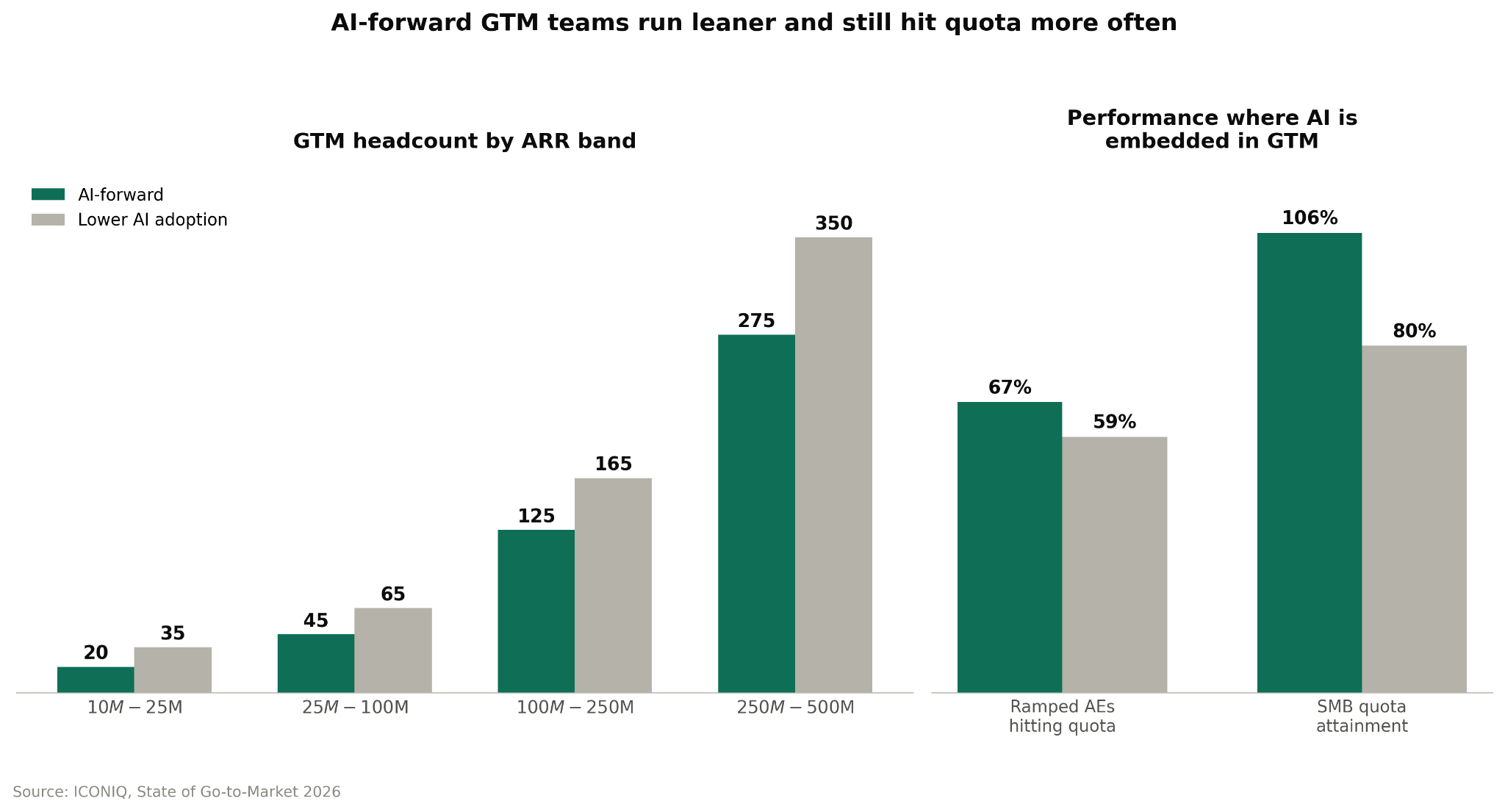
At $10M to $25M ARR, AI-forward companies run about 20 GTM full-time employees against 35 for lower-adoption peers, a 43% difference.
The gap holds at every band: roughly 45 versus 65 at $25M to $100M, 125 versus 165 at $100M to $250M and 275 versus 350 at $250M to $500M.
The leaner teams also perform better. Where AI is fully embedded in the GTM process, 67% of ramped account executives hit quota, against 59% where it is not. In SMB the spread is wider still, with high-adoption teams averaging 106% quota attainment against 80%.
Every Handoff is Where Context Leaks
The SDR to AE to SE to CSM assembly line solved an industrial problem, which is too many touches, not enough hands.
It bought throughput by splitting the work into narrow, cheap-to-train roles.
Once the bottleneck moves from touches to depth of conviction, that same division of labor turns hostile, because every handoff is a place where context leaks and context is now the product.
Which is why a smaller number of senior sellers carrying a deal end to end beats a larger relay team. AI absorbs the research, the prep, the notes, the follow-up, the CRM hygiene and the first draft of everything and that is precisely the work the extra headcount used to do.
The failure mode is bolting AI onto a bloated organization. You do not get a lean team out of that. You get a bloated team sending more email.
One honest caveat before anyone screenshots the headcount table: this is a correlation. Good companies adopt AI, run lean and hit quota because they are good companies. Buying the tools will not turn a mediocre org into an elite one.
Efficiency only compounds when the revenue underneath it is durable and that is where the 2026 data gets uncomfortable.
6. Pricing Is Now the GTM Decision That Decides Everything
The compensation shifts in the report are a symptom. Pricing is the disease.
Net New Recurring Revenue as a component of AE compensation rose from 25% of companies in 2025 to 33% in 2026, the largest single-year change ICONIQ tracked and Net Dollar Retention as an AE metric climbed another five points. Median NRR now sits between 108% and 110%, with the top quartile holding above 123%.
The Seat Problem Nobody Says Out Loud
If your product replaces human labor, seat-based expansion is structurally broken. Your ROI story is that the customer will need fewer people. Your revenue model asks them to hire more.

Compressing NRR is the first tremor of that contradiction and no compensation plan repairs a pricing model that punishes you for working.
Outcome Pricing Is the Most Seductive Trap in the Category
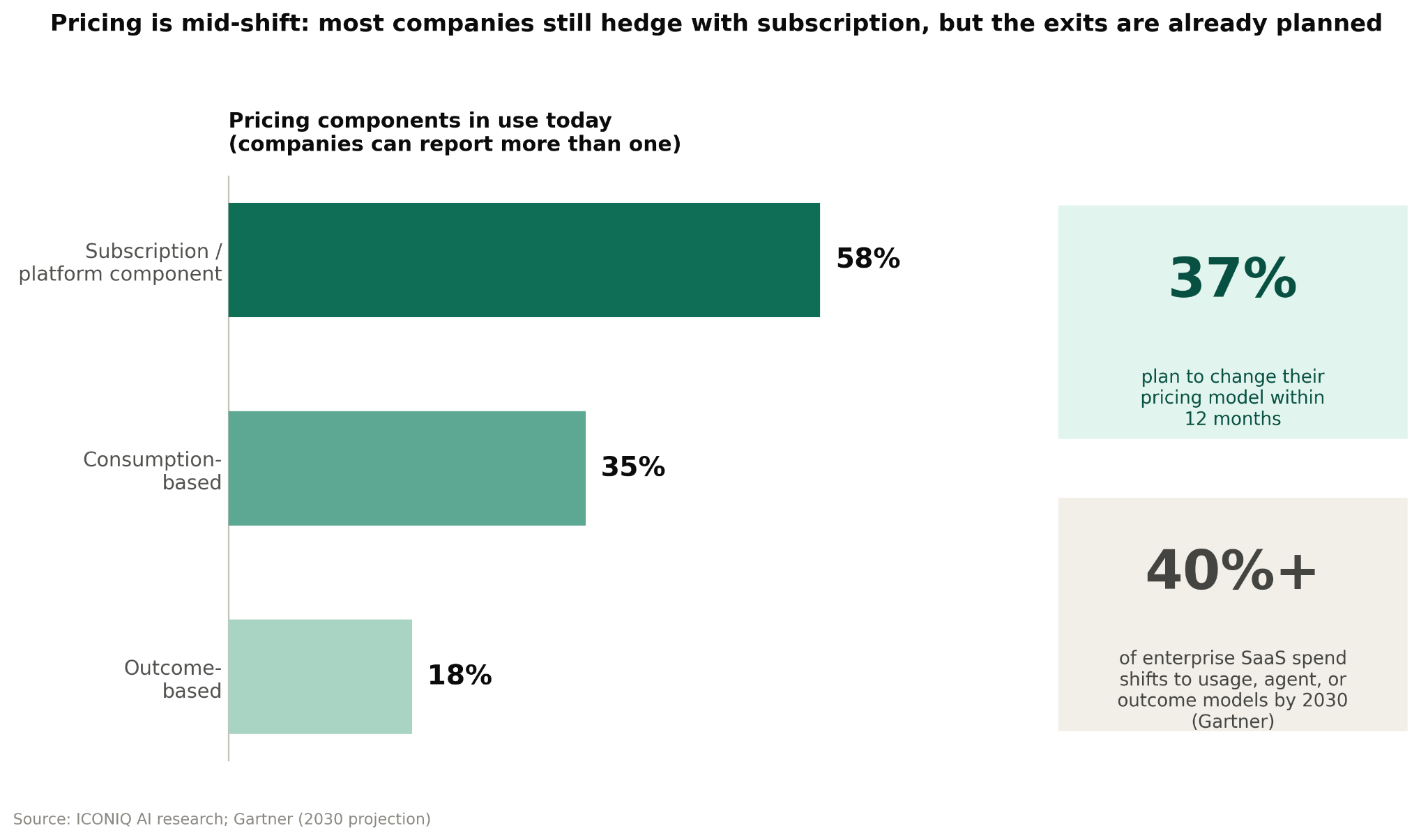
ICONIQ’s parallel AI research found 58% of companies still keep a subscription or platform component, with consumption-based structures at 35% and outcome-based at 18% and 37% planning to change their model within twelve months.
Gartner projects that by 2030 at least 40% of enterprise SaaS spend will move toward usage, agent or outcome-based structures.
The catch arrives quietly. When you charge per resolved ticket or per closed deal, you are underwriting the result. Your cost of goods becomes inference and your margin becomes the spread between what you charge and what failure costs you.
That is an insurance business wearing software’s clothes and software multiples get paid for software margins. The tradeoffs across hybrid, usage and outcome-driven models deserve more scrutiny than most founders give them and if you are still setting the number for the first time, get that right before you touch anything else in this article.
One question settles most of it. When this customer succeeds wildly, does my revenue go up? If the honest answer is no, you do not have a go-to-market problem.
Which leaves the only question that matters on Monday morning.
7. What to Actually Do, Depending on Where You Are
ICONIQ surveys well-funded, AI-adjacent, mostly growth-stage companies, so applying these benchmarks uniformly across stages is its own mistake.
Before $5M ARR
Ignore the headcount tables completely. They describe companies ten to a hundred times your size and survivorship bias is doing real work in those numbers.
Your job is a repeatable conviction motion rather than a repeatable lead motion. The founder sells, the founder implements, the founder watches the first ten customers actually use the thing.
Hiring a VP of Sales to discover a motion you have not found yourself was expensive in 2021. In 2026 it is fatal, because the motion itself is still moving.

$5M to $20M ARR
This is where the pilot becomes a gated stage with criteria, an owner and a clock and where you build a loss-reason taxonomy that separates three very different failures: lost to a competitor, lost to no decision, lost to a budget that went somewhere else.
Those are three diseases with three treatments and most revenue leaders prescribe more pipeline for all of them. Rebuilding the funnel math stage by stage against two years ago usually shows the damage sitting late, in the numbers nobody wants to read honestly, not at the top.
Start building the reputation surface here too, because public proof is what makes seller-led outbound land at the next stage.
$20M ARR and Up
Now the benchmarks bite. Audit headcount against the leanest team that could hit the number, not against what your category looked like in 2022.
Audit the comp plan against durability and phase changes in rather than performing mid-year surgery that costs you more in trust than it recovers in behavior.
Then retire the 2021 scorecard. MQLs and marketing-sourced percentages go. Pipeline per rep, pilots started with written success criteria, time to first value, NRR by cohort, gross margin per customer and loss-reason mix take their place and the dashboard that tracks them is worth more than another quarter of activity reporting.
Every finding in the ICONIQ report points at the same place. Demand stopped being the constraint.
Your buyer knows they have the problem, has almost certainly heard of you and can generate a passable analysis of your whole category before the first call ever happens.
What they cannot manufacture for themselves is confidence that choosing you is a safe bet in a market that keeps moving under their feet.
Build the go-to-market around producing that confidence quickly and provably and the numbers in that report start moving in your favor all at once.
So here’s the takeaway: Keep optimizing for volume and you will spend 2026 pouring leads into the top of a funnel that leaks at the exact point where nobody believes you yet.
Seeing the need for this shift again & again -- and I think the key is figuring out the minimum viable pilot to deliver success and then pushing for that. Speed is king right now! "Stop qualifying on budget and authority. Qualify on willingness to run a scoped, timeboxed pilot."