

When Viktor hit $10 million ARR in just a few months, everyone wanted the secret.
But in a recent thread, the founder shared something deeply unsatisfying for anyone looking for a clean playbook. There was no silver bullet. Just a messy, unpredictable mix of word-of-mouth, paid ads, and creator partnerships, managed like a trading desk: constantly reallocating before good channels became expensive habits.

Fast growth is rarely about finding one perfect channel. It is about managing a portfolio of bets and staying rational when the math changes.
Here is what their journey actually looks like, stripped of the startup fluff.
One thing before we get into Viktor’s playbook.
GTM is changing faster than any playbook written before 2025 can handle. Your next customer might not be human. Literally.
Hard Skill Exchange is running a free 3-day virtual AI summit on June 23–25 on exactly this. I am attending.

The lineup is the kind you’d expect to pay for:
▫️ CRO of Vercel
▫️ GTM lead at ElevenLabs
▫️ Researchers from Google and Harvard Business School
▫️ Managing Director at Insight Partners
3 days, virtual, completely free.
Table of Contents
1. Why Average ROI Is the Wrong Number to Optimize
2. Every Channel Has a Ceiling. The Skill Is Knowing When You Are Near It.
3. The Product Is Your Starting Basis (And Not Every Founder Gets the Same One)
4. The Case for Performance Marketing (Even When Everyone Says It Is Dead)
5. What This Means for Who You Hire
6. The Part of the Story Viktor’s Founder Admits He Got Wrong
1. Why Average ROI Is the Wrong Number to Optimize
Growth dashboards create a subtle problem.
They compress history into one number and then ask teams to make future decisions with it.
The Trap of the Healthy Dashboard
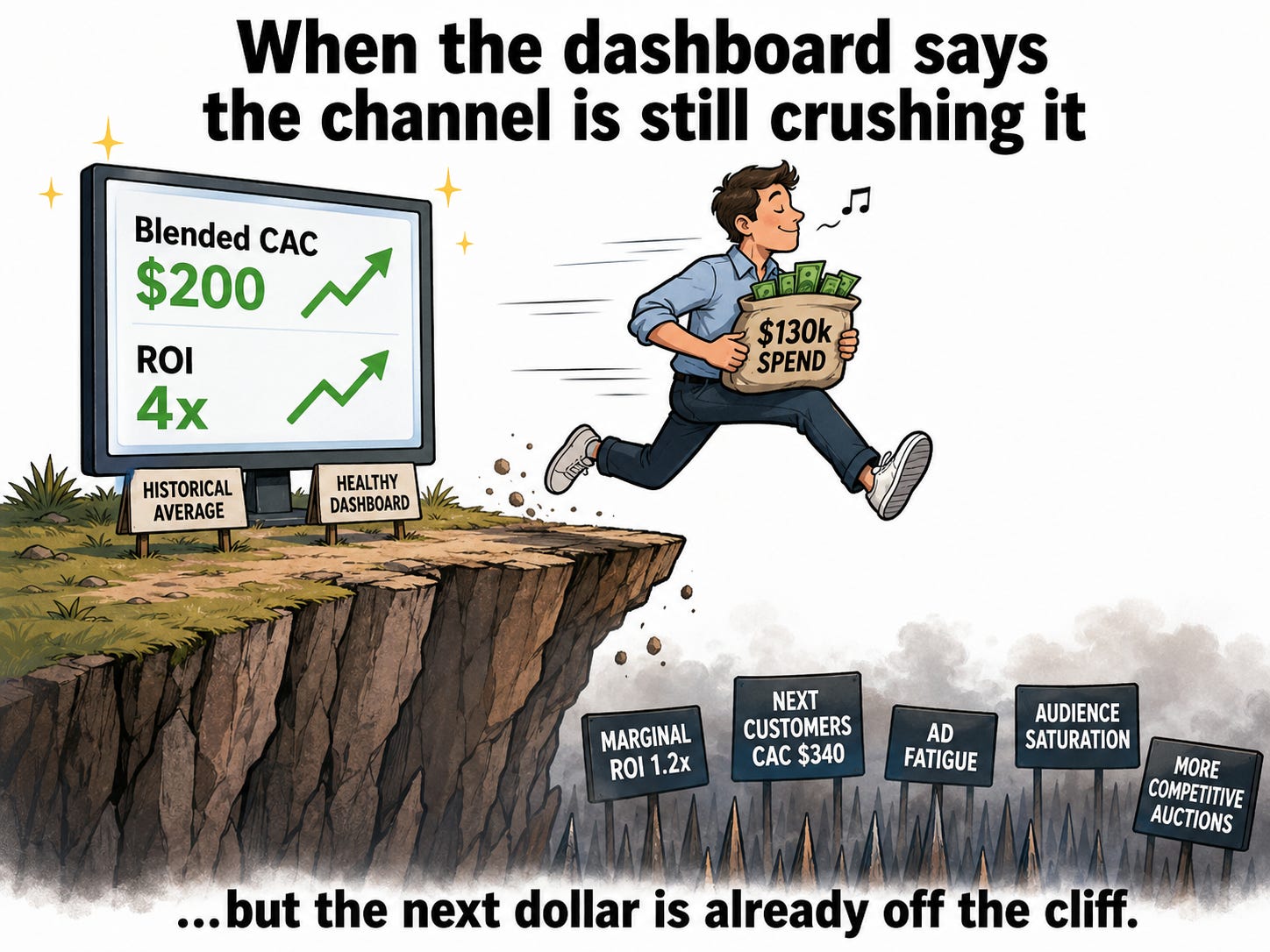
Suppose a startup spends $100,000 a month across paid acquisition. Over six months, customer acquisition cost settles at $200 and the blended return looks excellent.
Most teams see that number, conclude the channel is healthy and increase spend.
The problem is that channels do not experience averages.
Budgets experience increments and those two things produce very different numbers as spend scales. Imagine that same company increases monthly spend from $100,000 to $130,000.
The historical CAC still shows $200 because earlier spend was efficient, but the next tranche of customers now costs $340 each.
Audiences have already seen the ads multiple times, high-intent segments have been harvested and auctions have become more competitive. The dashboard still says one thing while the next dollar is saying something else entirely.
This is where many growth teams drift into inefficient spending without noticing.
A channel showing 4x blended return can already be producing 1.2x returns on incremental spend.
By the time the reporting catches up, the budget has already been allocated, campaigns expanded and targets reset around economics that no longer exist.
Optimizing for the Next Dollar, Not the Last
Marginal ROI is the number you actually make decisions against.
In practice, most teams still optimize for averages because averages are easier to measure.
Reporting systems reinforce this behavior where attribution tools reward channels that historically performed well, monthly reviews smooth out short-term deterioration and blended CAC becomes the KPI because it is cleaner than asking what the next $10,000 of spend will actually produce.
The implication is larger than marketing measurement.
Once teams start optimizing for next-dollar returns instead of historical averages, another reality appears quickly.
Every channel eventually becomes harder to scale and some hit their limits much sooner than founders expect.
2. Every Channel Has a Ceiling. The Skill Is Knowing When You Are Near It.
Once you start thinking in marginal returns, an uncomfortable pattern appears.
Channels rarely fail suddenly.
When Discovery Turns into Capacity
They degrade slowly while dashboards keep telling reassuring stories. A creator in a tightly defined niche might generate acquisition costs 8x better than your baseline, but what feels like discovery often turns out to be capacity.
There are only so many creators in that category, only so much audience overlap you can avoid and only so many times you can repeat the same creative before performance slips.
Performance marketing behaves differently but arrives at the same destination.
Scale budgets long enough and you move beyond high-intent audiences into more expensive inventory, frequency rises, auctions get competitive and CPAs drift upward.
The channel keeps working, just not at the economics that made you excited initially.
Referrals and word of mouth create a different problem.
These channels often produce the best economics because trust compounds faster than paid impressions, but they resist operational control.
You can encourage referrals and improve the product experience, but you cannot force recommendations on command.
Moving Capital Before the Cliff
Growth channels behave like liquidity pools.
The creator program producing exceptional returns today may simply lack the capacity to absorb another $500,000 of spend, while the performance channel producing average economics absorbs it comfortably.
Most founders try to scale what works until it stops working, rather than rotating before it does.

That changes how channels should be viewed.
The goal is to build a portfolio of edges with different characteristics, capacities and failure modes, not to find the one channel that scales infinitely, because that channel does not exist.
Viktor’s channel mix illustrates this tension well.
Word of mouth appears to be their highest-return engine and also the least controllable.
Creator marketing is producing unusually strong numbers, strong enough that even the founder admits measurement still needs validation. Performance marketing looks steadier, easier to scale and easier to measure, even if returns are less spectacular.
None of these channels alone explains the ARR trajectory, but together they create something more durable.
They create a system where capital can move as conditions change.
3. The Product Is Your Starting Basis (And Not Every Founder Gets the Same One)
Frameworks become dangerous when people assume everyone starts from the same position and growth stories are especially vulnerable to this because headline metrics flatten context.
Two companies can report similar CAC, similar growth rates and similar ARR expansion while playing entirely different games underneath.
Built-In Distribution vs. Manufactured Awareness
Zoom and Monday.com illustrate this well.
Every time someone sends a meeting invite through Zoom, the product creates distribution.
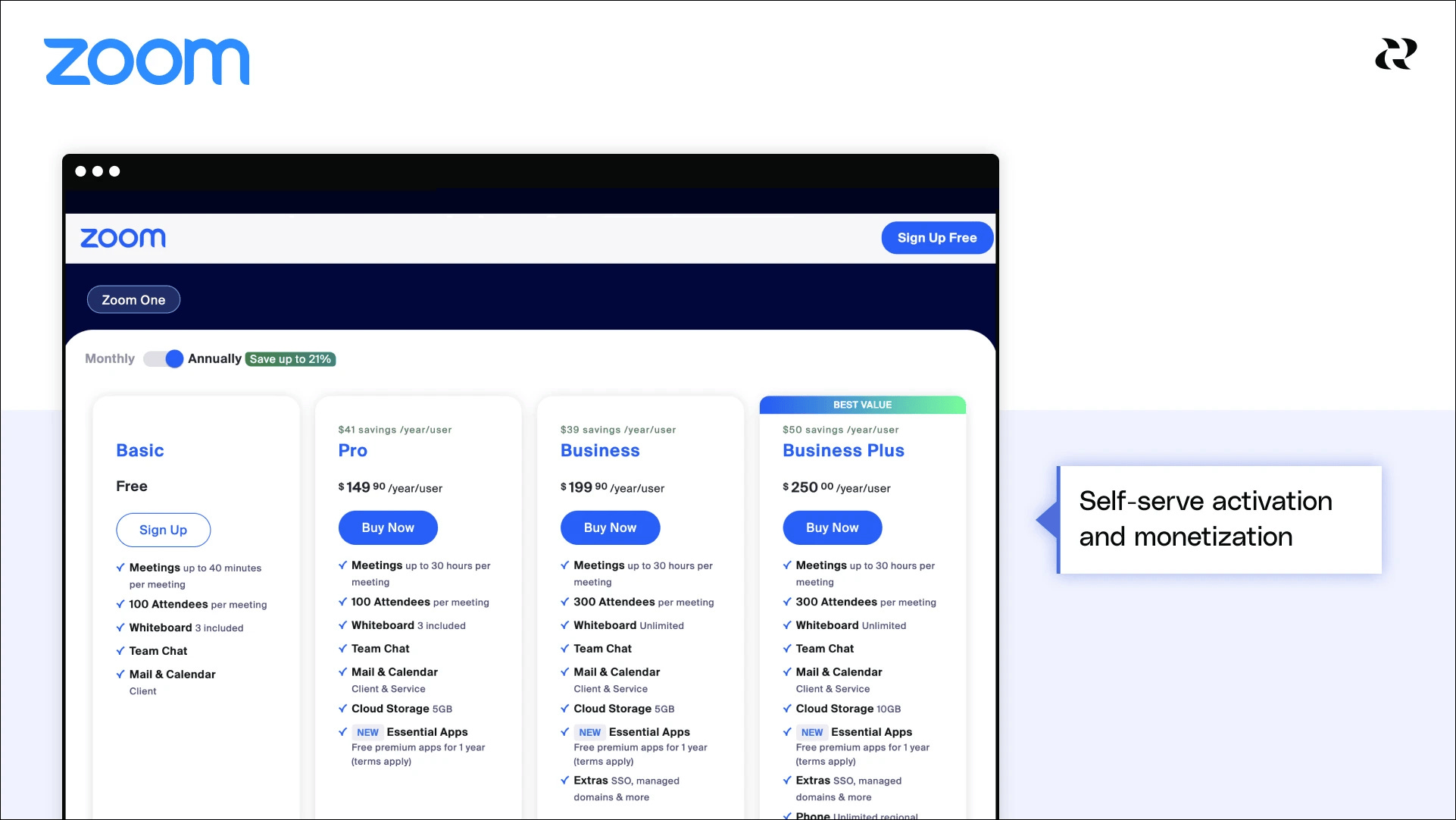
Recipients see the brand before the marketing team spends another dollar, meaning the product itself participates in acquisition before any campaign launches.
Monday.com does not get that advantage.
If the team wants awareness, it buys awareness. If it wants acquisition, it manufactures acquisition.

The work required to produce that growth is fundamentally different and distribution advantages compound invisibly over time.
Products with embedded exposure, network effects, or invitation mechanics begin every quarter with free impressions already flowing into the funnel. Products without those mechanics start closer to zero each time.
The Head Start You Didn’t See
Viktor’s company did not build its growth operation from scratch.
Much of the infrastructure already existed from Jace, a previous product whose economics reportedly struggled to support meaningful marketing investment.
The ad accounts, creator relationships, creative production systems and measurement workflows were already in place. The team had already paid many of the learning costs.
A company operating near breakeven acquisition economics can look mediocre even with a capable team. Move the same team, same processes and same infrastructure onto a product where unit economics improve materially and the numbers can change quickly.
The playbook transferred and the basis improved. Both things drove the result.
Before copying a growth system, it is worth asking a less exciting question first.
Are you copying the playbook, or are you trying to copy the starting position?
Creator programs that work for one company may depend on relationships built over years.
Strong paid acquisition performance may rely on historical conversion data, creative libraries, or attribution systems that took hundreds of experiments to build.
The distinction also changes how performance marketing should be evaluated, because good channels still fail when product economics cannot support them.

4. The Case for Performance Marketing (Even When Everyone Says It Is Dead)
An Aesthetic Objection to Math
Performance marketing has a strange reputation in startup circles.
Founders often describe it as commoditized, expensive, or somehow less sophisticated than organic growth, yet many of those same companies would gladly invest more money into any other system that reliably returned capital in under a year, which suggests the objection is more aesthetic than strategic.

If customer acquisition spend comes back in five months, the decision is not particularly complicated.
You are deploying capital into a system with measurable inputs, measurable outputs and relatively short feedback cycles and few growth mechanisms offer that combination.
The argument the thread makes is refreshingly blunt, if you have fast payback economics and still refuse to scale performance marketing, you are probably not making a strategic decision but an emotional one.
The Hard Rules of the Payback Game
The objection that paid channels are crowded misses how auctions work. Of course they are crowded. That is precisely why prices exist.
Competitive auctions push acquisition costs toward market clearing rates, which means your advantage rarely comes from discovering hidden inventory.
It comes from having stronger economics, better conversion, stronger retention, or a product valuable enough to absorb those acquisition costs profitably.
Viewed through that lens, performance marketing becomes less romantic and more useful.
The only question worth asking is whether the next dollar deployed still produces acceptable returns.
LTV/CAC above 3, payback under 12 months, run it. Below that, fix the product first.
Those boundaries are important because positive return channels can still destroy companies when economics are weak.
A startup with poor retention or thin contribution margins can scale acquisition and still create a larger problem, since faster growth only shortens the timeline.
Five month payback economics are attractive because capital recycles quickly, but beyond twelve months, acquisition stops behaving like efficient deployment and starts behaving like a financing decision.
Performance marketing is neither dead nor magical, it is simply a position. If the economics work, underinvesting becomes hard to defend.
5. What This Means for Who You Hire
The Trap of Channel-Based Hiring
Once growth becomes an allocation problem, hiring starts looking different and the “influencer guru” problem illustrates why.
Many startups still organize growth around channels, one person owns paid, another owns creators, someone else owns partnerships and the structure feels logical because channels are visible.

The problem is that channels are not where the hardest decisions happen.
The hardest decisions involve uncertainty , should another $50,000 go into paid acquisition when marginal returns are slipping?

Should creator budgets expand despite noisy attribution?
Is referral performance improving because of product improvements or seasonality?
Those are allocation questions and allocation questions require a different skillset from execution.
Take creator marketing.
Founders often hire one person expecting them to manage the entire system, but creator programs usually split into at least two jobs that rarely live comfortably in the same person.
The first is the operational job of finding creators, negotiating rates, managing contracts and maintaining systems.
The second is the creative job of understanding audience behavior, writing briefs and knowing why one creator converts while another with identical reach fails completely.
These capabilities rarely cluster neatly in one person.
When companies force them together, they often end up with someone strong in one dimension and weak in the other, so execution suffers, or creative quality suffers and often enough it is both.
Staffing Like a Trading Desk
Staff the growth book the way you’d staff a trading desk.
That means execution roles executing, creative roles creating and allocation decisions sitting with whoever demonstrates the strongest analytical judgment, not whoever is most enthusiastic about a particular channel.
In early-stage companies, allocation authority often defaults to the founder, the most senior marketer, or the person whose channel worked last quarter, none of which are automatically the right choice.
For a ten person startup, this does not mean hiring someone from a trading firm or building a complex growth organization.
It means separating channel ownership from capital allocation.
The person deciding where resources move should probably be the most analytically rigorous person in the room, not the person most emotionally attached to a channel.
Because the uncomfortable truth is that channels rarely fail because teams cannot execute them.
They fail because teams keep allocating resources long after the edge disappeared.
6. The Part of the Story Viktor’s Founder Admits He Got Wrong
The Hidden Cost of Clean Numbers
Most public growth stories become less useful the moment founders start sanding off the rough edges and what makes the Viktor thread credible is that it leaves them in.
The creator channel, by the founder’s own description, delivered exceptional results while also producing meaningful brand damage in the same stretch.
That tension deserves more than a footnote, because it refuses easy categorization.
A channel can outperform financially and simultaneously create problems that dashboards do not capture. Reputation risk, customer trust, community backlash, low-quality attention drawn in by content that no longer represents where the company wants to be.
The numbers look clean.
The brand takes a hit.
Both are true at the same time and no attribution model reconciles them.

There is also a quieter admission in the thread. Some of the creator economics may still be measured imperfectly, which is less a Viktor-specific problem than a structural one.
Creator programs often produce attribution disputes because exposure spreads across channels.
Someone watches a creator video, searches later, converts through paid search and appears in the dashboard as a different acquisition source entirely.
Teams can under-credit creators. They can also over credit them.
Sometimes both happen simultaneously.
The measurement problem is not unique to Viktor. It is structural to how creator marketing works.
Spectacular numbers in that channel should always be held with a slightly looser grip than spectacular numbers in paid, simply because the chain is harder to close.
Embracing the Decay of Every Edge
That point is worth sitting with, because frameworks have a way of creating false confidence.
Viktor itself is apparently far from where the company wants to be and reading enough growth threads can make you believe that strong systems create predictable outcomes when all they really create is better odds.
Every edge decays and teams overallocate into yesterday’s winners because pulling capital away feels like admitting failure.
The value of the trading-desk approach was never that it removed losses from the system, but that it gives teams a principled way to size, rotate and recover when things go wrong rather than waiting until they already have.
The founders who benefit most from this framework are probably not the ones who execute it perfectly.
They are the ones who use it to make faster, less emotional decisions when a channel stops working or a campaign lands badly.
The book keeps moving.
The advantage goes to whoever stays rational while it does.

Viktor's founder is right about how brutal the rotation is: pulling spend off a 4x blended channel because the next dollar only returns 1.2x feels insane until you watch a "winning" channel quietly turn into an expensive habit. The discipline to stay still while everyone reacts, then move capital before the cliff, is the part nobody can copy off a slide.