The Great Divergence

In 2008, the economic output of the United States and Europe sat in roughly the same range. Nominal GDP differed, but purchasing-power comparisons kept the gap narrow enough. Disposable income was close. Two large, advanced economies moving along parallel tracks.
Things look entirely different today.
Measured in nominal terms, the U.S. economy is now much, much larger. Even after adjusting for exchange rates, demographics, and cost-of-living differences, Europe does not come close…
this issue is brought to you by Vanta:
Speaking of systems that scale and ones that stall: if your team is still reviewing AI tools for risk and compliance manually, that process is already behind….

Vanta’s free AI Security Assessment Template helps IT and governance teams streamline approvals while keeping security and accountability in place.
▫️ Assess AI tools before deployment
▫️ Align with GRC best practices
▫️ Standardize internal risk reviews across your org
Built for fast-moving security, privacy, and risk teams. Ready to use today.
…the US-EU divergence did not appear overnight. It widened gradually, then accelerated in distinct phases, until it became large enough to dominate headlines.
What caused it? Some point to policy choices or culture. Others say geopolitics, energy, or fiscal mismanagement. The truth is more layered than any single explanation. This article focuses on how two similar starting points produced very different results, and which forces kept mattering long after the obvious factors were accounted for.
Table of Contents
1. The Headline Gap And Why It Confuses People
2. Productivity: The Part That Refuses To Go Away
3. Adam Smith’s Old Framework Still Works
4. Peace And Predictability As Economic Inputs
5. Taxes Are Less About Rates And More About Friction
6. Justice Systems And The Speed Of Resolution
7. Capital, Power Laws, And Why Scale Decides Everything
8. Europe’s Misunderstood Position
9. What The Divergence Actually Tells Us
1. The Headline Gap And Why It Confuses People
The most common way this divergence is described starts with a single number. By recent nominal measures, the U.S. economy appears roughly 50% larger than Europe’s. The figure is striking, and often cited as evidence that something fundamental has gone wrong on one side of the Atlantic.
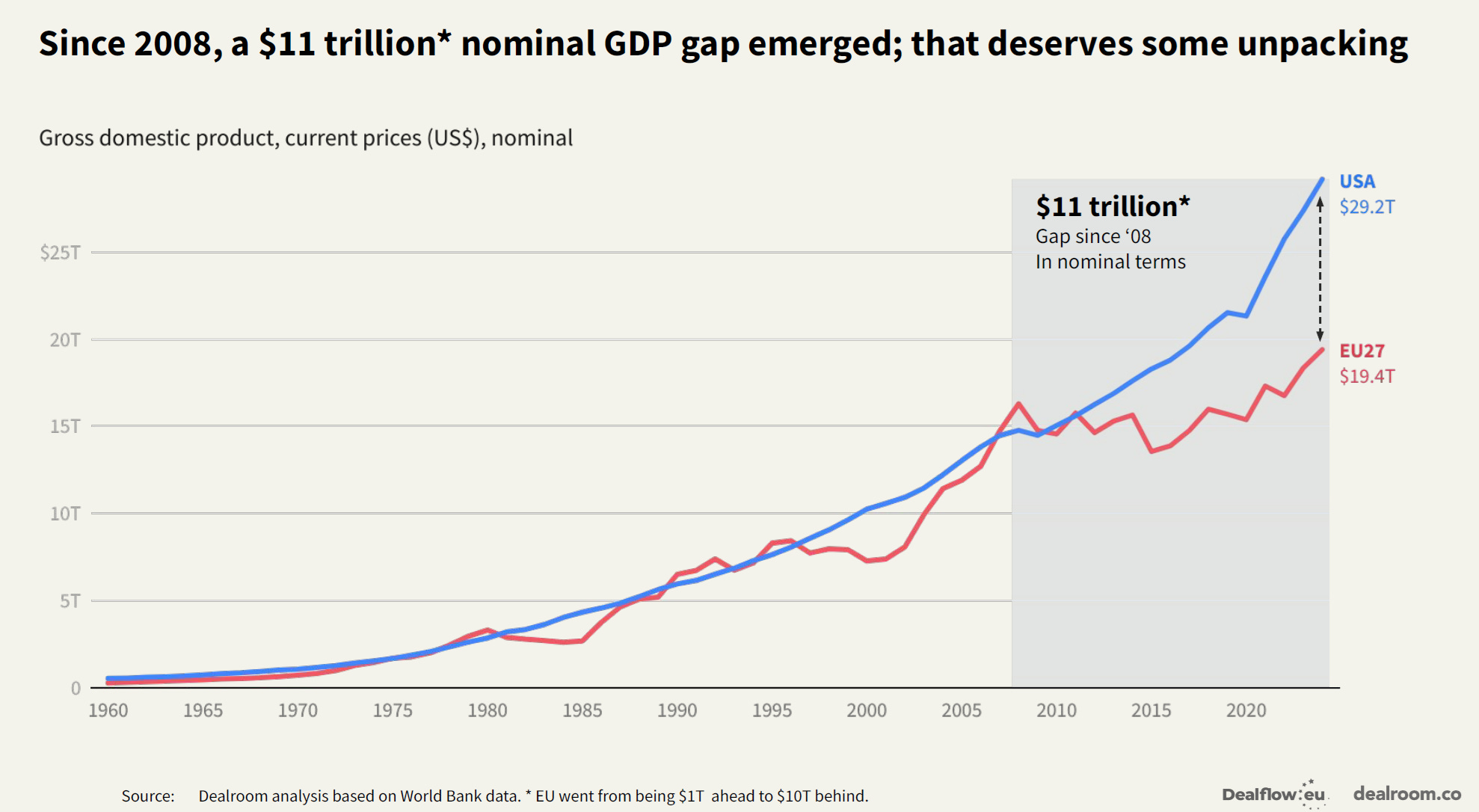
The problem is that nominal GDP is a blunt instrument. It converts output into dollars at prevailing exchange rates, which makes it useful for comparing global scale, but unreliable for understanding underlying performance.
When currencies move sharply, as they have over the past decade, nominal comparisons exaggerate changes that are partly financial rather than economic.
Once basic adjustments are applied, the picture becomes more nuanced. First of all, exchange rates account for a significant share of the apparent gap.
Then we have demographics playing a big role, as the U.S. working-age population has grown faster, adding steady incremental output over time.
Energy also plays a role. The shale boom reduced input costs and improved trade balances for years, providing a temporary lift.
Finally, the fiscal posture differs dramatically, with sustained U.S. deficits supporting higher near-term demand than Europe’s more restrained approach.
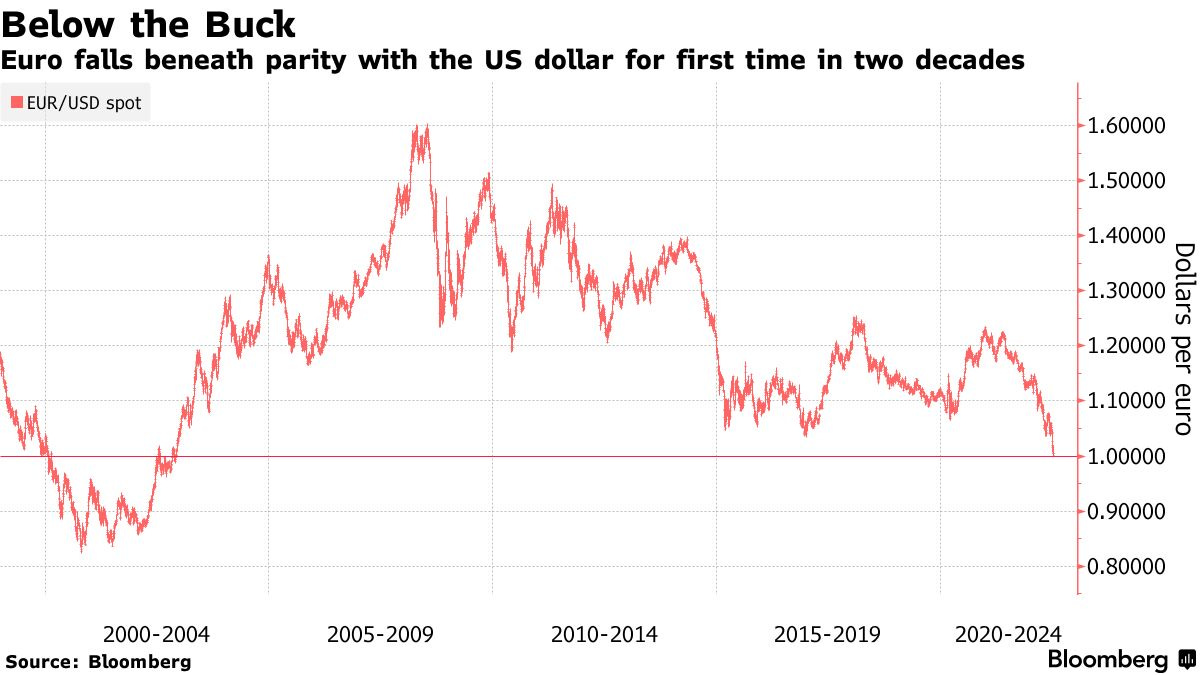
So, taken together, these factors explain much of the headline difference and make the story way less dramatic than most discussions make it out to be.
But the truth is that even after these adjustments, the divergence does not disappear. That residue is the real puzzle. Once currency movements, population trends, energy cycles, and fiscal choices are set aside, what continues to push the two trajectories apart?
2. Productivity: The Part That Refuses To Go Away
Productivity, in its simplest form, measures how much output an economy produces for each hour of work. It does not describe effort, hours spent, or educational attainment, but captures how effectively labor, capital, and systems convert time into value.
Productivity paths began to separate in the mid-1990s, during the early phases of the digital transition. The gap was initially narrow, then widened modestly over the following decade. After the global financial crisis, the separation became more pronounced.
And unlike exchange rates that are cyclical or demographic trends that move slowly, productivity gains are stickier once they are achieved. They raise the baseline from which future growth compounds.
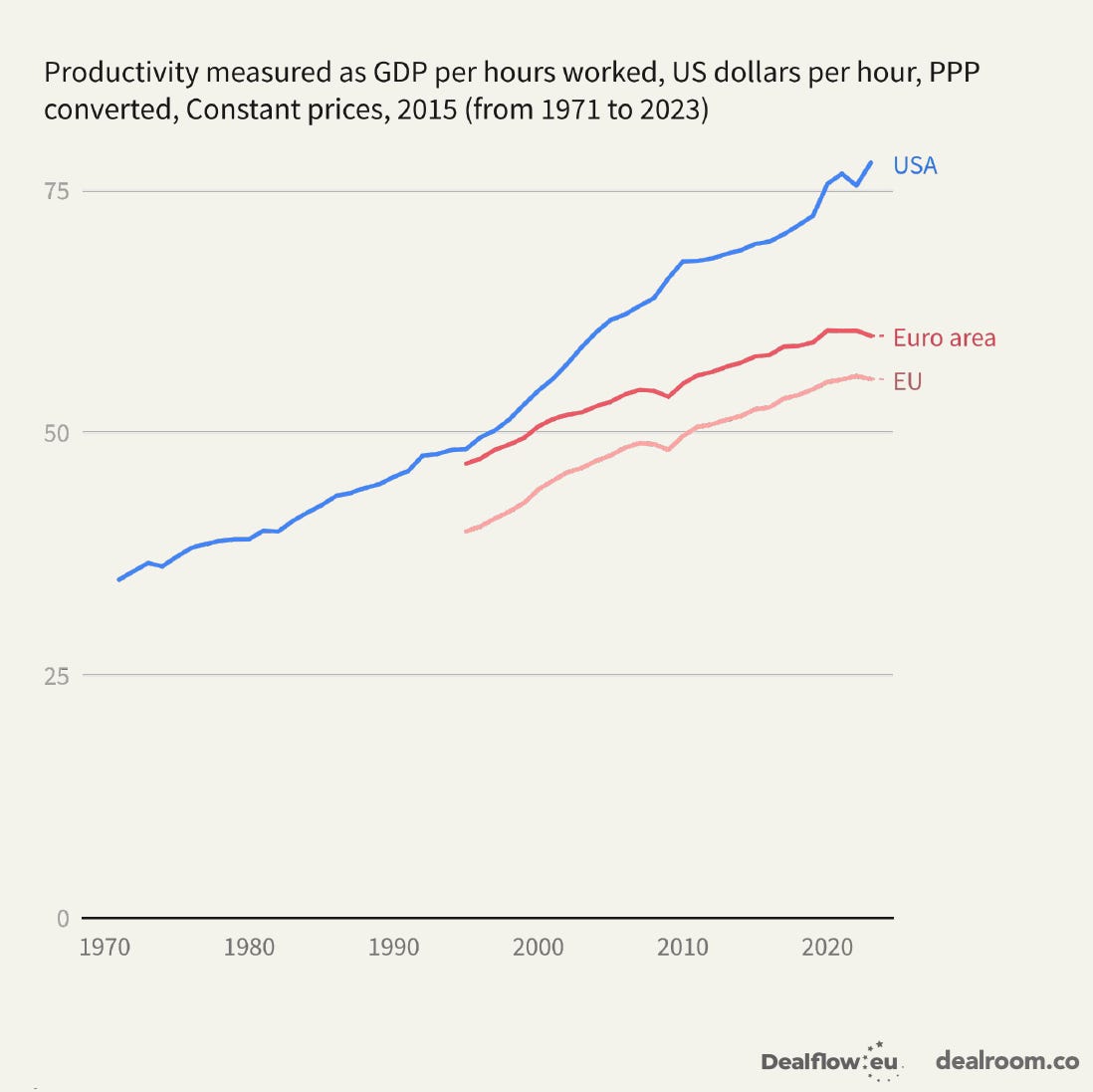
That compounding effect is easy to underestimate. Annual differences measured in fractions of a percent can feel trivial in isolation, however, they become marginal over 20 or 30 years. An economy that improves output per hour slightly faster carries that advantage through downturns, recoveries, and subsequent cycles.
It is also important to be clear about what productivity is not. The divergence does not reflect differences in effort or capability.
That’s why average hours worked do not track the gap. Labor force participation in parts of Europe has increased over time, even as productivity growth slowed. Education levels and technical depth remain high on both sides. These inputs are not absent.
But after accounting for all the above factors, the difference that remains is how effectively economic systems convert inputs into output. And the United States is the best when it comes to that.
3. Adam Smith’s Old Framework Still Works
More than two centuries ago, Adam Smith offered a simple way to think about economic growth. He argued that prosperity depended less on grand strategy, and more on a small set of conditions that allowed ordinary economic activity to proceed with confidence. He summarized them as peace, light taxation, and a tolerable administration of justice.

Those ideas were written in 1776 but are still relevant today. Smith was not prescribing outcomes or endorsing a political program, but describing background conditions that reduce uncertainty and friction enough for specialization, investment, and coordination to take hold.
His concern was not whether systems were fair in principle, but whether they were predictable in practice.
Translated into modern terms, the logic still holds. Peace describes continuity, extending beyond the absence of conflict to the stability of institutions and expectations over time.
Light taxation points less to rates than to the burden imposed by compliance, fragmentation, and delay.
Justice refers to the speed, cost, and reliability with which disputes are resolved, not the elegance of the legal code.
Ultimately, Smith’s framework asks whether an economy makes it easier or harder for firms to form, grow, fail, and try again. It focuses attention on systems that affect behaviors over long horizons, rather than on policies designed to signal values.
4. Peace And Predictability As Economic Inputs
When peace is discussed in an economic context, it is often reduced to defense or geopolitics. But when it comes to actual growth, economic peace describes the degree to which firms, workers, and investors can make plans without having to constantly hedge against disruption.
This goes beyond basic domestic safety all the way to institutional predictability. Stable rules, consistent enforcement, and clear expectations reduce delay and defensive decision-making.
When these conditions hold, economic actors spend less time protecting themselves and more time coordinating with others.
Predictability also affects how shocks are absorbed. Crises are unavoidable in large economies, but their effects depend on market structure.
Integrated internal markets can redirect capital and labor more easily when conditions change. Fragmented systems, such as Europe’s, tend to localize disruption but struggle to reallocate resources quickly across borders or regulatory regimes. Over time, this affects how resilient growth feels in practice.
International posture is also relevant here. Confidence in external relationships influences trade, investment horizons, and the willingness to build long-lived assets. This does not require dominance or insulation from global forces, but depends on whether participants expect continuity or frequent renegotiation of the rules governing cross-border activity.
Although peace and predictability do not generate innovation or productivity on their own, they operate as background conditions. When they are present, experimentation carries lower perceived risk and recovery from setbacks is faster. When they are uneven, caution becomes the norm.
5. Taxes Are Less About Rates And More About Friction
When we refer to taxes, it doesn’t always have to be about headline rates. Yes, rates are visible and easy to compare which provides a quick idea of how supportive or hostile a system might be.
But when it comes to growth, rates alone are insignificant, what matters more is friction.
This includes the time, cost, and uncertainty involved in complying with tax rules, as well as the number of distinct systems a firm must navigate as it grows.
Complexity shows up as a fixed cost. It requires legal advice, accounting infrastructure, and ongoing attention, regardless of whether a company is profitable or still experimenting.
And fixed costs affect firms unevenly. Large incumbents absorb them with relative ease, while small and growing firms feel them immediately. Each additional layer of compliance stretches limited resources, slows decision-making, and guides behavior toward safer paths. This means things tend to slow down, in addition to financial burdens.
Fragmentation makes things worse. In multi-jurisdictional environments (EU), scaling often means adapting to overlapping tax regimes with different definitions, reporting requirements, and enforcement norms.
So expansion becomes a series of discrete projects rather than a marginal step. Firms respond by growing more cautiously, limiting reach, or delaying investment until uncertainty is resolved.
At the end of the day, neither the U.S. nor Europe is frictionless. The difference lies in how quickly complexity rises as firms move from local to national or cross-border scale.

6. Justice Systems And The Speed Of Resolution
Legal systems tend to be ignored in this case but they do affect economic behavior long before disputes reach a courtroom. It’s not about the elegance of the law, but how accessible, predictable, and timely resolution tends to be when conflicts arise.
It all boils down to speed. When disputes are resolved quickly and outcomes are reasonably foreseeable, contracts become less risky.
Firms can price uncertainty, investors can assess downside exposure, and capital can move on once issues are settled.
When resolution is slow or unpredictable, it causes uncertainty to spike. So resources remain tied up, decisions are deferred, and caution becomes the default posture for every business.
And then there’s the cost element. Legal processes that require extended time, specialized expertise, or prolonged appeals raise the effective price of enforcing agreements. These costs weigh more heavily on smaller and younger firms, which lack the balance sheets to absorb prolonged uncertainty.
And if the environment is not fertile for startups to thrive, then who gets to innovate?
Variation across jurisdictions doesn’t help at all. When legal rules, timelines, and enforcement standards differ from one market to the next, scaling becomes a legal exercise rather than a purely economic one.
Each expansion introduces a new set of unknowns, forcing firms to reassess risk repeatedly instead of building on prior experience.
While this doesn’t stop investment outright, it changes its structure. Capital flows toward projects with shorter horizons, simpler structures, and clearer exit paths, while more ambitious or interdependent efforts are deferred.
In that way, legal infrastructure doesn’t just resolve disputes, rather it sets the pace of economic activity, and pace matters when advantages accumulate over decades.

7. Capital, Power Laws, And Why Scale Decides Everything
Modern economies do not grow in smooth increments. Value creation follows power-law patterns, where a small number of firms account for a disproportionate share of outcomes.
Most companies contribute modestly to aggregate growth. But a select few generate extraordinary returns, reshape sectors, and pull national statistics upward with them.
The systems that expect it behave differently from systems that try to smooth it out. When value concentrates in the tails, the central question becomes how many attempts are funded, how long support lasts, and whether capital remains committed until outliers reveal themselves.
Power laws and concentrated outcomes
In a power-law environment, averages mislead. The typical firm is not representative of what ultimately drives impact. A single company reaching global scale can outweigh thousands of smaller successes combined. Over time, national growth reflects the presence or absence of these rare outcomes more than the median experience of businesses.
Scale is decisive because large firms are not just bigger versions of small ones. They operate on different curves, with stronger network effects, fixed costs spread across wider revenue bases, and the ability to reinvest internally at speed. Once they emerge, advantages compound quickly.
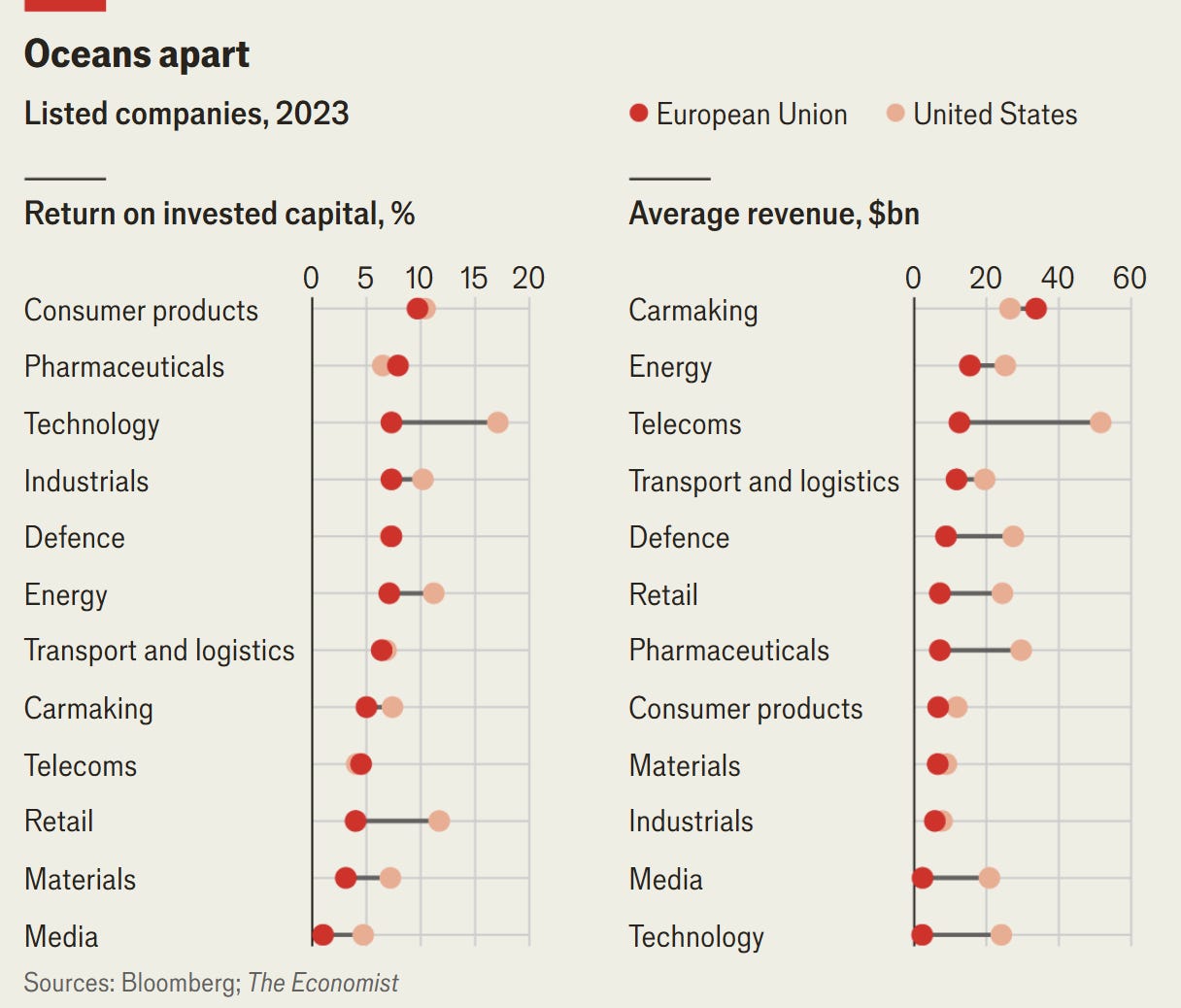
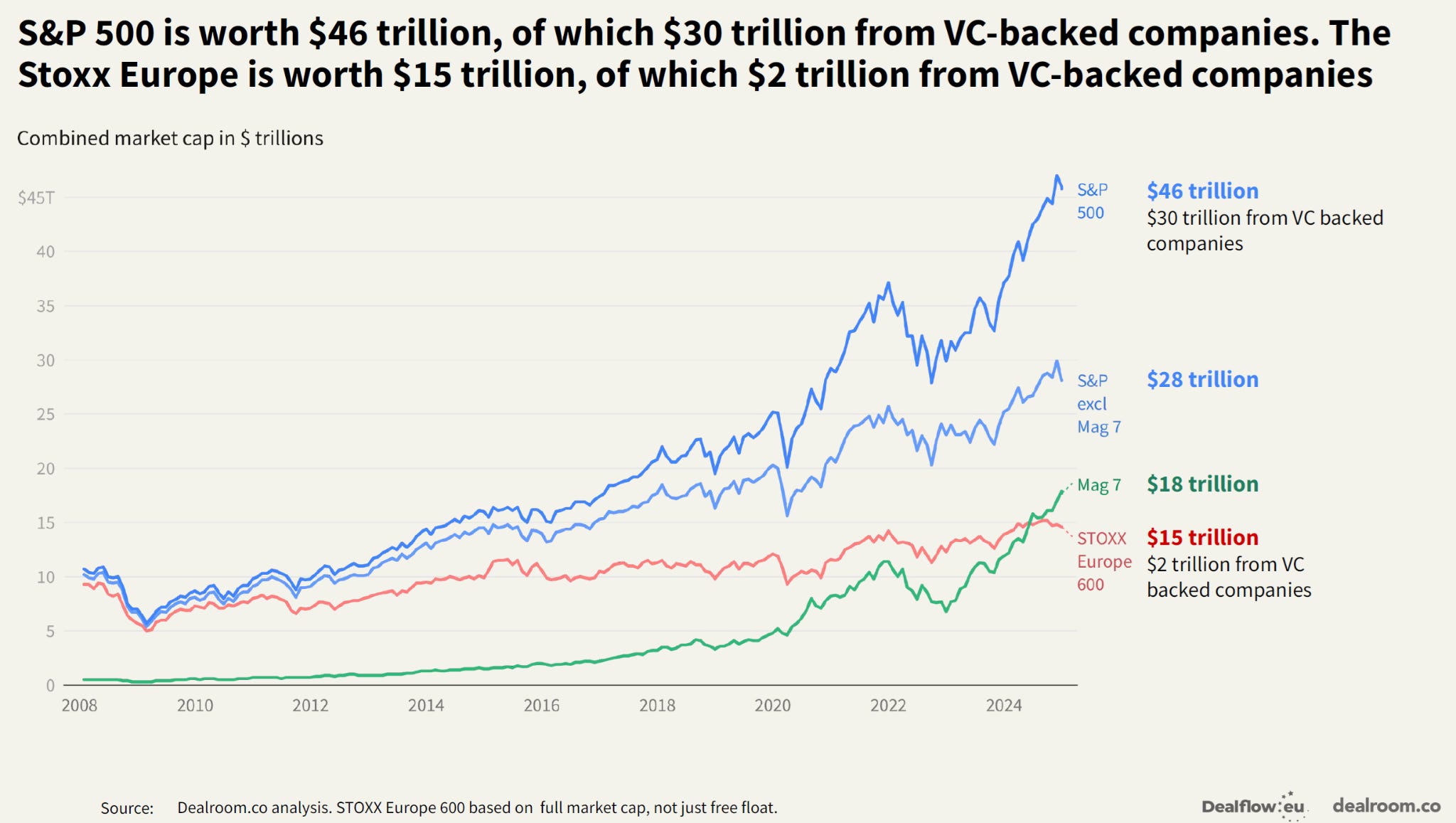
And the data proves it. A 2023 analysis found that EU firms were smaller and less profitable than U.S. firms.
Funding experimentation and staying power
The U.S. capital ecosystem evolved in a way that accommodates this distribution. Early-stage experimentation is funded broadly, even though most attempts fail. More importantly, late-stage capital is deep enough to continue backing the few firms that begin to separate from the pack.
Capital does not need to be precise early if it can remain patient later.
This posture can look inefficient when judged by hit rates. Large amounts of capital appear misallocated. In a power-law system, that appearance is misleading. The cost of overfunding experimentation is outweighed by the payoff from carrying a small number of extreme successes to full scale.
Scale constraints in Europe
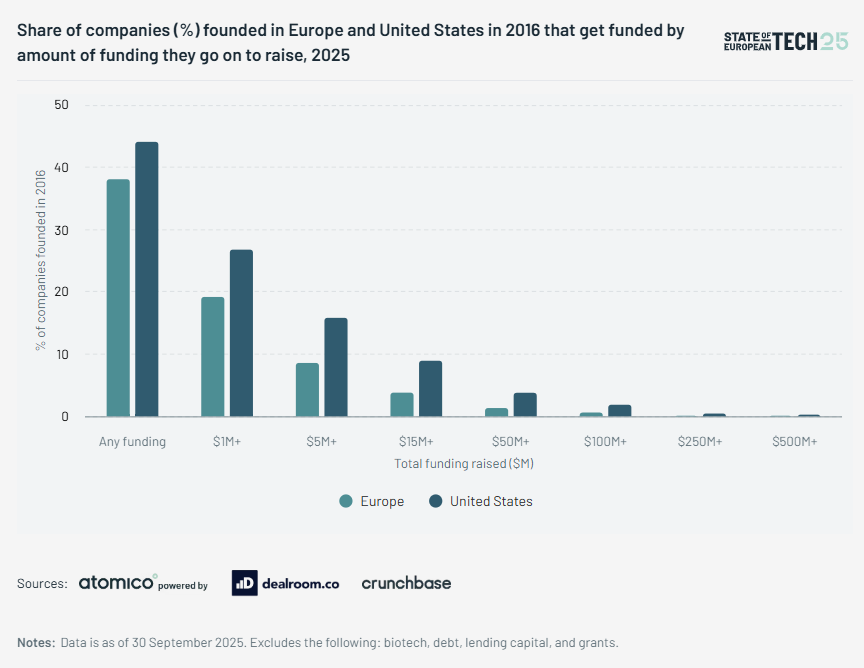
Europe’s venture ecosystem follows a different pattern. Early-stage formation is strong, and capital efficiency is high. European startups convert early funding into credible companies at rates comparable to their U.S. counterparts. The constraint appears later, as access to large, sustained pools of capital thins out.
The result is a scaling bottleneck rather than a lack of capability. Promising companies face pressure to sell earlier, grow more cautiously, or relocate to markets with deeper capital. Over time, fewer firms reach the size required to dominate global categories, and fewer power-law outcomes materialize locally.
At the end of the day, systems that carry firms through late stages generate more extreme outcomes. Systems that narrow support earlier generate more mid-sized successes. Both are coherent but only one produces the concentration that drives large aggregate gaps.
8. Europe’s Misunderstood Position
Let’s take the facts.
Europe has a large and active startup base. Early-stage company formation is broad, and technical depth is strong across domains such as industrial technology, software, life sciences, and energy.
Early capital is deployed efficiently. On a per-euro basis, European startups convert funding into viable businesses at rates comparable to those seen elsewhere. Talent quality is not the limiting factor.
Where outcomes begin to separate is after initial success. As companies move beyond product validation and early revenue, the demands change. Scaling requires sustained capital, tolerance for prolonged losses, and access to markets large enough to support rapid expansion. At this stage, constraints become more visible.
Late-stage funding is thinner and more fragmented. Growth capital often arrives in smaller tranches, under tighter conditions, and with greater emphasis on near-term discipline. Incentives shift, expansion becomes more cautious, geographic reach narrows, and strategic options close earlier than they otherwise would.
Founders respond rationally to these conditions. Some choose earlier exits while others prioritize profitability over scale. Some relocate operations or listings to access deeper capital pools.
At the end of the day, this is a system that produces many solid, technically capable companies, but fewer extreme outcomes. Europe’s position is better understood as constrained by structural features that shape scaling paths, rather than by an absence of innovation or execution ability.
9. What The Divergence Actually Tells Us
Taken together, the factors discussed so far form a system rather than a set of independent explanations. None dominates on its own. Each influences how the others behave, and the effects accumulate gradually rather than arriving all at once.
Ultimately, what matters is how incentives, constraints, and institutional design interact over time. This is what decides which actions feel viable and which fall away.
Patient capital makes longer horizons possible. Lower friction reduces the cost of experimentation. Predictable resolution allows failure to be absorbed rather than feared.
None of these guarantee better outcomes, but they are tried and tested factors that have resulted in growth, time after time.
Talent and capital respond to those signals. Skilled individuals tend to move toward environments where effort translates more directly into impact. Capital follows opportunities where early advantages can be reinforced and reinvested.
As those dynamics repeat, productivity gains lift the baseline from which future growth compounds. The process is gradual and often imperceptible year to year, but its effects accumulate.
Systems that allow a small number of firms to reach scale establish reference points that determine future expectations, investment patterns, and career choices.
Systems that emphasize stability and risk containment establish different reference points. Once formed, these patterns persist even as conditions evolve.
What we can conclude is that the divergence between the United States and Europe is less a verdict than an outcome. Similar starting points were shaped by different combinations of incentives and institutional choices.
Those differences influenced how risk was priced, how scale emerged, and how productivity gains were retained. The results appear dramatic in hindsight, but they arose from steady reinforcement rather than decisive moments.
The value of this comparison lies not in assigning blame or prescribing imitation, but in the mental model it offers. Economic growth follows from how systems reward effort, absorb uncertainty, and allow scale to develop. When those mechanisms are understood, the outcome becomes easier to explain, even if it remains difficult to change.