

Earlier this year, the software market quietly suffered its worst panic on record.
In just four weeks, two trillion dollars vanished.
This was not a normal market correction. It was a collective realization that the rules we spent twenty years memorizing just broke.

Salesforce is the cleanest example of how strange it got. They launched Agentforce, the fastest-growing product in their history, scaling to a massive $1.2 billion in ARR. Yet their stock still tanked to a 52-week low.
The market realized that simply building software is no longer a moat.
Speaking of which:
Lovable just published a study on who is actually building software right now. The numbers tell the story better than I can:

Most builders on the platform come from non-technical backgrounds. A third are already earning revenue. 720 million monthly visits to products built by people who could not have shipped a line of code 3 years ago.
The old gatekeepers are gone. If you have been sitting on an idea, this is the moment.
Readers of this newsletter get an exclusive 10% discount to get started.
While we were busy polishing interfaces, upstarts like Clay and Cursor rewrote the rules, scaling at speeds that should not be physically possible.
The ground has moved.
We are not just adding chatbots to old databases. We are redefining what software is actually worth.
Here is the new playbook:
Table of Contents
Why the Old Playbook Stopped Working Overnight
The Four Things You Still Cannot Build for Free
Outcome Pricing Is Underwriting, Not Billing
The Pie Is Getting Bigger, Not Smaller
Distribution Just Inverted and PLG Is the Casualty
The New Three Acts
1. Why the Old Playbook Stopped Working Overnight
The classic enterprise software playbook had three acts and every act assumed that building was the hard part.
The Classic Three Acts Where Time Was the Moat
Act one was the wedge, a single feature made ten times better than the incumbent, defensible precisely because it took years to replicate.
Act two was the suite, adjacent products cross-sold to the same buyer to push past $100 million in ARR.
Act three was the platform, where enough heft earned you the right to rip out the system underneath and own it.
Each act took three to five years of calendar time and that time was the moat as much as the code was.
Take production cost to near zero and the whole structure loses its load-bearing walls. If a competitor can rebuild your headline feature in a weekend, that feature is not a moat. It is a commodity with a marketing budget attached.
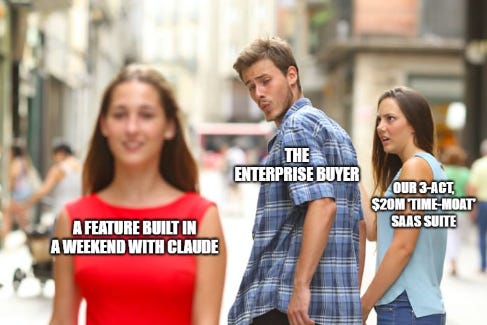
The fear that gets repeated as a warning, the idea of competing against thousands of small AI-built tools instead of a few large vendors, is better understood as a law than a threat.
When building is free, the half-life of any product-surface advantage falls toward zero.
The 90-Degree Rotation from What You Build to What You Own
So the meaningful change is not that companies now build the same things faster. It is that the axis of competition rotated ninety degrees, away from the product you can build and toward the assets you cannot.
The old game rewarded the best builder. The new game rewards whoever owns the thing that stays scarce after building becomes free.
That single rotation explains the stock carnage better than any seat-compression spreadsheet.
The market is not punishing software for bad numbers. It is repricing companies whose entire value was the product surface and rewarding the handful sitting on something underneath that cannot be copied.
So, stop asking what you need to build and start asking what you need to own.
2. The Four Things You Still Cannot Build for Free
If product surface is no longer defensible, defensibility has to live somewhere production cannot reach.

There are only four such places and the new playbook is a race to capture at least one of them before someone else does.
Proprietary Data Loops and the Earned Right to Act
The first is proprietary data with a compounding feedback loop. Not data you bought, but data your product generates by being used, that makes the next result better and that a competitor cannot bootstrap from scratch.
This moat deepens as agents proliferate, since they’re voracious data consumers.
If your usage creates an irreplicable loop, you have an asset. If not, you have a UI waiting to be commoditized.
The second is the right to act.
The “you cannot vibe-code twenty years of enterprise compliance” argument is correct and it goes further than integrations.
The scarce thing is permission to take consequential action. Read-access is cheap. The right to move money, sign a contract, change a medical record, or push code to production is earned over years and revoked in seconds and no amount of cheap engineering manufactures it.
In an agent world, the most valuable position is being the agent the enterprise trusts to write, not just read.
Agentic Distribution and the Deterministic Core
The third is distribution into the agent’s decision, which gets its own section below, because it is the most under-priced change in the whole transition.
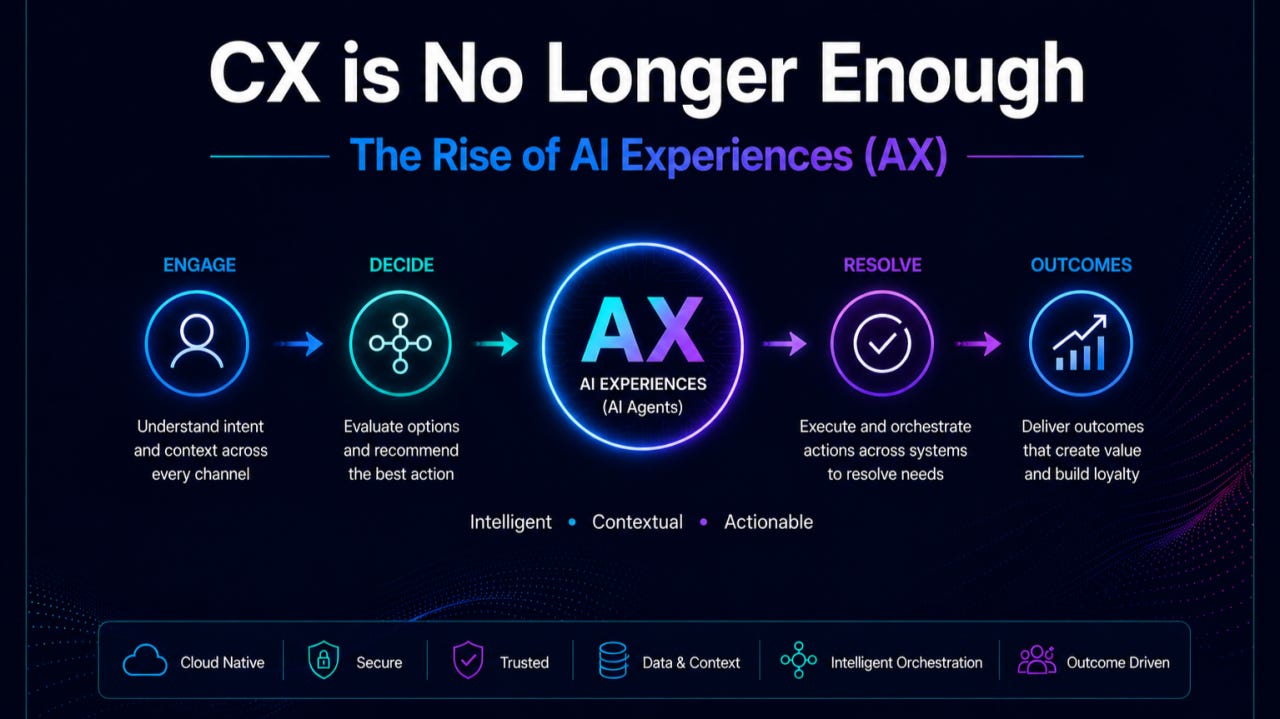
The fourth is the deterministic core, the system of record. ERPs, ledgers, identity and compliance platforms get safer, not weaker, because agents need a ground truth to act against and a model that is right six times out of ten is disqualifying for anything with legal or financial consequence.
The orchestration gets built on top of these systems, not instead of them.
The lesson cuts cleanly.
The most exposed companies are the ones whose whole value was a polished interface over someone else’s data.
The safest are the ones sitting on a non-reproducible asset who happened to also sell software.
Owning the asset was always the point. We forgot that only because, for twenty years, the software itself was the scarce part.
3. Outcome Pricing Is Underwriting, Not Billing
Everyone notes the move from per-seat to per-outcome pricing and treats it as a billing detail. It is the single most consequential change to the SaaS business model in this entire transition and treating it as a line-item swap badly underestimates it.
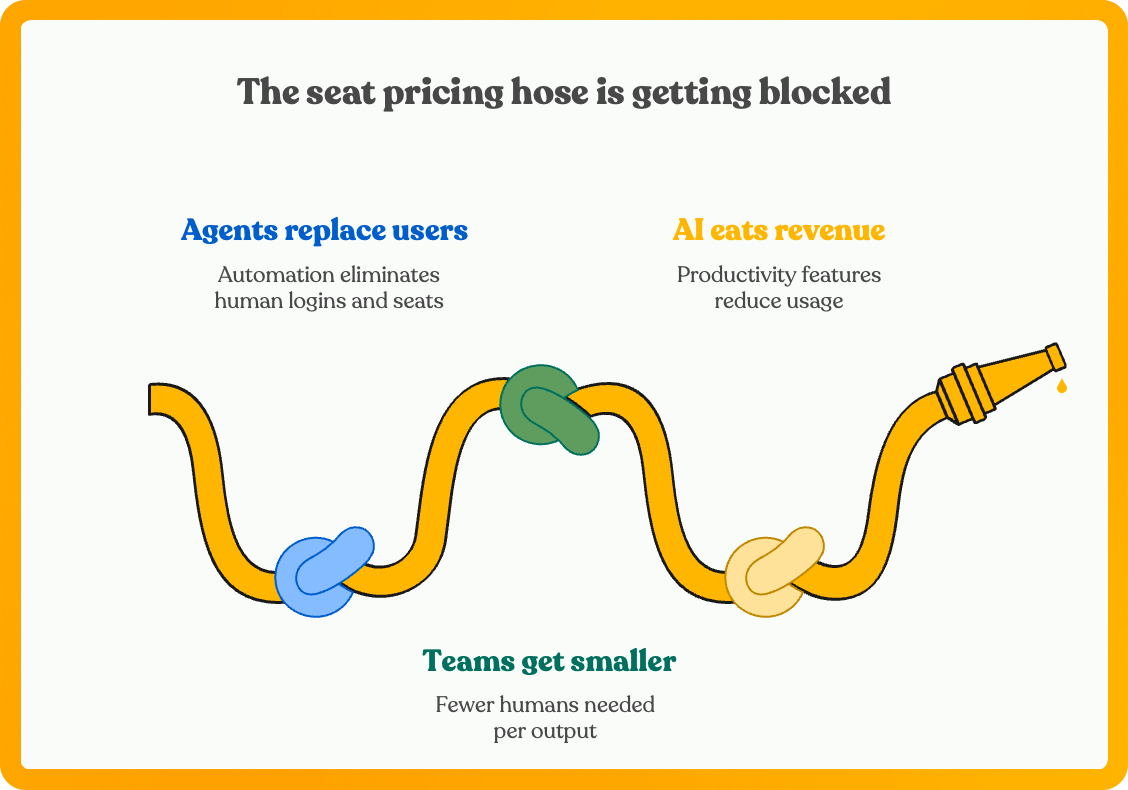
The Great Inversion of Risk from Customer to Vendor
Seat pricing put the risk on the customer. You bought 500 licenses and whether your people actually used them was your problem.
The vendor got paid for access regardless of value delivered, which is a large part of why the best SaaS names traded at 18 to 19 times revenue during peak years. The vendor bore almost no delivery risk.
Outcome pricing inverts that. When you charge per resolved ticket, per closed deal, or per completed task, you are now underwriting the outcome.
If the agent fails, you absorb the cost.
You have stopped selling a tool and started selling a result you are on the hook for.
That makes an outcome-priced company look far less like classic software and far more like an insurer. Your margin becomes the spread between what you charge for the outcome and what it costs in compute and failure rate to deliver it.
The New Math of Software Margins and Risk Pricing
That has consequences the market has not finished pricing. Gross margins stop being a clean 80% and become model-dependent and noisy, because your cost of goods is now inference.
The winner becomes whoever can underwrite the risk best, which means whoever has the data to price the outcome accurately, looping straight back to the first moat.
Gartner projects that by 2030, at least 40% of enterprise SaaS spend will move toward usage-based, agent-based, or outcome-based pricing.
Most of the industry is about to learn underwriting whether it wants to or not.
The companies that own the data to price risk will compound. The ones guessing will give their margin away one failed outcome at a time.
4. The Pie Is Getting Bigger, Not Smaller
The bear case rests on an assumption it never states out loud, which is that the amount of work is fixed.
If the work is fixed and agents do it with fewer humans, then fewer seats must mean less revenue and the whole sector deserves to be repriced down.
The Flawed Assumption of Fixed Enterprise Work
That is the logic that erased close to $2 trillion of software market value in a single month between mid-January and mid-February 2026, by the count cited in the analysis that followed.
The assumption is wrong and outcome pricing is what breaks it.
Once revenue is tied to work completed rather than humans logged in, the relevant variable stops being how many people work and becomes how much work gets done.
Agents do not do the same volume of work humans did.
They do orders of magnitude more, including vast categories of analysis, monitoring, reconciliation and follow up that no enterprise ever staffed because human attention is expensive and finite.
The backlog of work that was simply never done is enormous and agents are about to attack it.
Why the Volume of Work Expands Faster Than Price Falls
So the real economic question of this era is not whether seat counts shrink, because for some companies they will. It is whether the volume of newly automatable work expands faster than the per-unit price of doing it falls.
For most categories, the answer is yes, which means the software pie grows even as the per-seat model dies underneath it.
The strongest evidence is hiding in the company everyone is shorting.
Seven of Salesforce’s ten largest deals in its fiscal first quarter added seats, even while Agentforce tripled toward that $1.2 billion ARR figure, according to the earnings detail The Motley Fool laid out.
That is not a company being eaten. That is the pie expanding faster than the old model is decaying. The bears are pattern-matching “fewer seats” to “less revenue” and skipping the step where the denominator changes.
They may be right about the model and badly wrong about the terminal size of the market.
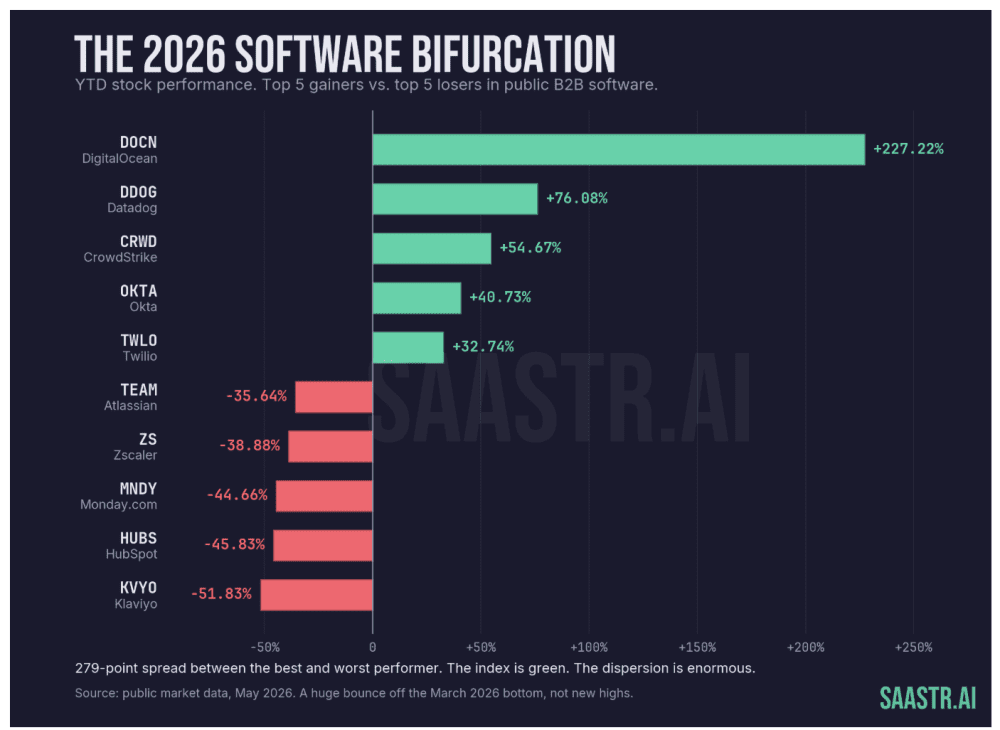
5. Distribution Just Inverted and PLG Is the Casualty
The Collapse of Human Centered Viral Loops
For fifteen years, the dominant way to sell software was bottoms-up product-led growth.
You landed with one human user, delighted them with a clean onboarding and expanded seat by seat as they told their coworkers.
The free tier, the viral loop, the obsessive attention to interface polish, all of it was engineered to win a human’s attention and habit.
If the agent is the user, that entire motion is in serious trouble. Agents do not form habits. They are not delighted by your onboarding flow and they do not mention you to a colleague over lunch.
An agent picks a tool based on capability, reliability, cost and whether it can find you at the moment of need.
Distribution stops being “be viral with humans” and becomes being the default, trusted tool in the agent’s tool-belt the moment it decides to act.

The Return of Top Down Enterprise Architecture
This cuts in a direction almost nobody is positioned for. It re-enowers top-down enterprise selling at the expense of bottoms-up PLG, because the person who decides which tools an entire agent fleet is allowed to call is a platform, security, or architecture buyer, not a self-serve end user.
A decade of conventional wisdom that PLG beats enterprise sales could reverse inside two or three years.
The companies that win distribution in this world treat being callable by an agent as the primary go-to-market surface. Being discoverable and trusted at the agent’s decision point is the new equivalent of ranking on the first page of search.
Salesforce understood this when it launched Headless 360 and effectively told customers they no longer need to log in, because agents will.
The dashboard is no longer the product. The system underneath it and its place in the agent’s set of approved tools, is the product.
Most founders are still polishing a UI that the actual buyer of the future will never open.
6. The New Three Acts
Put it together and the playbook rewrites itself. The old three acts of wedge, suite and platform assumed building was slow and defensibility came from the product surface.
The new three acts assume building is nearly free and defensibility comes from owning what software cannot manufacture.
The New Playbook from Seizing Assets to Pricing Outcomes
Act one is to seize the non-reproducible. Do not look for a safe niche to defend, because the niche is no longer safe and the wedge now reads as timid.
Pick the deepest data loop, the highest-trust right to act, or the system-of-record position you can plausibly reach and sprint at that. The product wrapped around it is cheap.
The asset is not.
Act two is to price the outcome and underwrite it. Get off seats and build the data advantage that lets you price the risk of that outcome better than anyone else. Outcome pricing is an underwriting business and the best underwriter wins.
Act three is to become the thing agents are compelled to call. Win distribution at the orchestration layer so that as work volume explodes, it routes through you by necessity, not because a human remembered your brand.
The Timeline Caveat and the Scramble for the Prize
The honest caveat is that this could be early by years.
Agent reliability might plateau below the trust threshold for consequential action, in which case the human-gated core stays human-gated for a long time and incumbents get all the time they need to adapt.
Enterprises move at the speed of procurement, not at the speed of a launch announcement. The violent recovery after the spring sell-off, when SaaStr’s Jason Lemkin noted forward software multiples bottomed at 22.7 times, below the S&P 500 for the first time in the cloud era, looks a lot more like an overreaction correcting than a structural death finalizing.
The direction is high-confidence. The timeline is nearly unknowable and most people shorting software are confusing the two.
What is not in doubt is the demotion. SaaS is not dying. It is being moved from the prize to the packaging.
For twenty years, the software was the scarce thing, so the software captured the value. The prize moved underneath it, into the data, the trust, the right to act and the agent’s choice of who to call.
The entire scramble of 2026 is the market figuring out who is standing on top of the prize and who is just holding the wrapper.

The founders who internalize that and build for the world after the rewrite instead of defending the one before it, are the ones who will own the next decade of enterprise software.
Love your posts! Thank you!
Agentic AI has contributed to disruptions and decline. Factors such as budget shifts towards AI and investor fears about AI agents potentially replacing jobs have influenced this transition. However, this change has brought opportunities for founders who can develop products tied to outcomes or consumption rather than simply focusing on headcount. Success now hinges on having strong proprietary data, deep workflow integration, and a clear strategy for monetizing and using AI