

Going to market is getting harder.
AI has scaled everything, and small teams can now write outreach and marketing at a pace that was unthinkable a few years ago.

But every team has the same tools, including bigger companies with larger audiences and budgets. And on the other side, customers are buried in messages, deciding which ones deserve their attention.
So most founders just send more: more outreach, more events, more sales hires. It’s a losing game. What wins is focus, and these 5 GTM frameworks show you exactly how to get it.
together with HSE:
Where are B2B’s leading CXOs and VCs placing their bets for 2027?
At the Agentic Strategy Summit, 100+ GTM leaders and investors share how they’ll plan, sell and grow with AI next year: ServiceNow’s Brian Solis, Parloa’s CMO, ZoomInfo’s CRO and Harvard’s Mark Roberge.

Benchmark your 2027 priorities and budget against the people running the best sales teams in B2B.
▫️ December 8-10
▫️ Virtual and free
Table of Contents
1. Show Buyers You Truly Understand Their Problem
2. Make the Product Easier to Buy Than to Postpone
3. Keep the Person Who Signs Informed
4. If You Want to Sell, Pay Up
5. Know When to Revisit Old Leads and How
6. The Ultimate 2026 GTM Playbook
1. Show Buyers You Truly Understand Their Problem
Before anyone agrees to a meeting, they usually need a reason to trust or believe the other person can help or has something they might need.
If a buyer has never heard of you, your claims about the product can give them very little to go on.
You need to start building confidence by sharing useful advice about a problem they recognise. This is part of your product.
When somebody reads your explanation and uses it to make a better decision or fix something, they get the evidence they need to trust you. That you understand their work before they even speak to you.
Case study: Gong
Gong is a software tool that analyses sales conversations to help teams understand buyers and improve their sales process.
Gong started a successful campaign of posting useful content on Linkedin, which helped users develop trust in the company. This essentially reduced the switching cost
A user said that by the time a salesperson from Gong reached out, she was already sold, while the tool she was already using never reached out to her.
For that buyer, Gong’s content had already done part of the sales work. She had a reason to take the conversation seriously.

The founder’s playbook
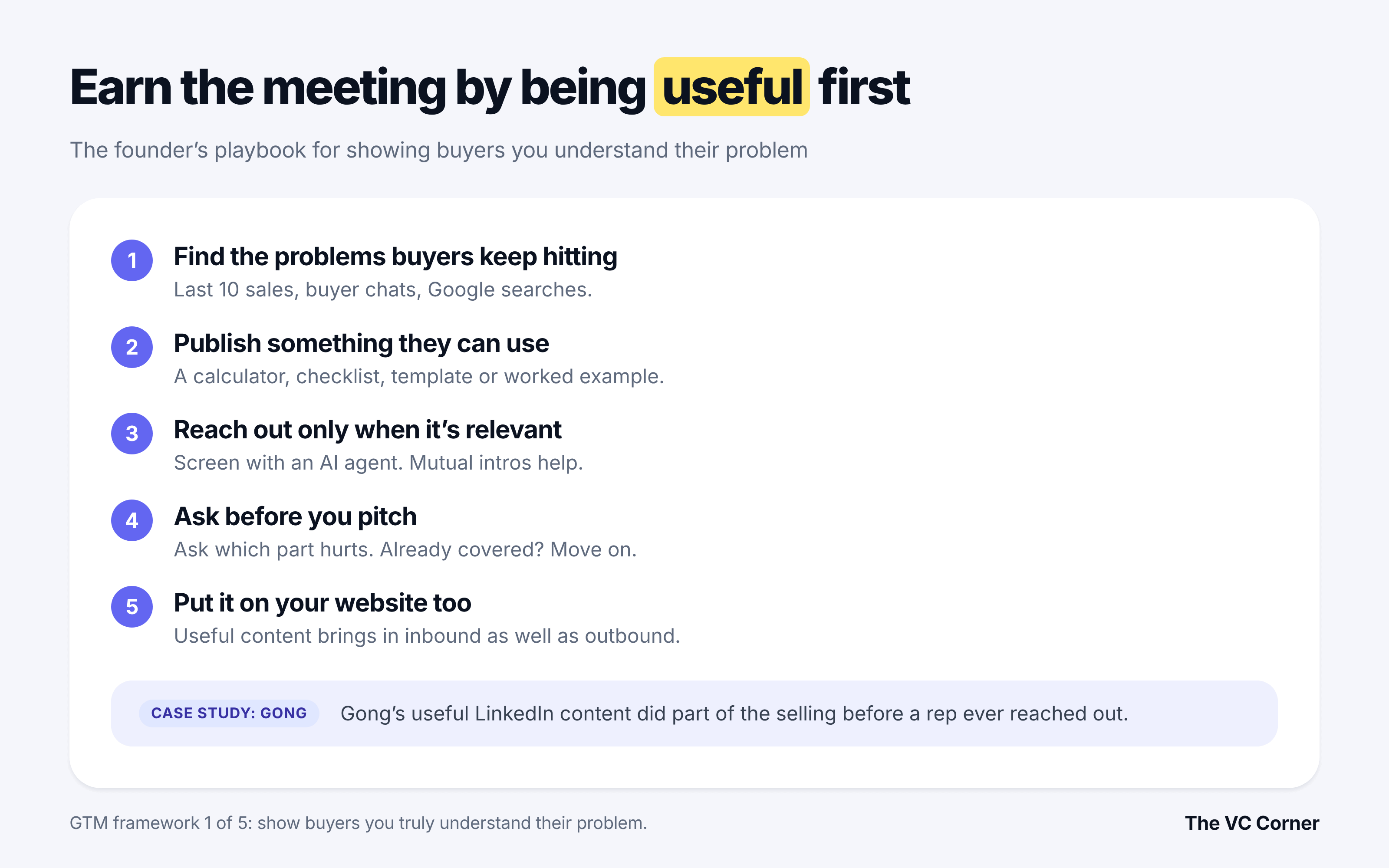
Find real problems that your buyers regularly struggle with and start publishing content around it. You can use your last 10 sales, or ask people, or go by google searches.
The key is publishing actually useful content or into stuff they can copy or use, like a calculator, a checklist, templates, or worked examples.
If you are selling invoice software, create an overdue-invoice checklist, then find 10 agencies whose finance job adverts mention chasing overdue invoices (use an AI agent to screen) and send them:
Your finance role mentions overdue invoices. I put together a checklist for finding out whether payment is stuck because of missing paperwork or a client’s payment process. Would it be useful?
Contact them only when the content is relevant to them. And using mutual introductions where available can speed things up.
If they reply, ask which part is causing trouble before pitching. If they already have it covered, move on.
And don’t forget to publish those resources on your website as well. The magic of useful content is that it creates as much as inbound as the outbound success you’ll get out of it.
2. Make The Product Easier to Buy than to Postpone
During a sales cycle, the most important part of the process is to get the buyer to do as little homework as possible.
Following the demo, there’s a lot of internal talk that needs to get done. Meetings, convincing, deck analysis and so on. And they are doing that while still working on whatever it is they are doing on a daily basis.
So buying from you has to compete with all that, including the work required to get the purchase approved and closed.
Case study: Deel
Deel’s Chris Lee calls this a “sales experience problem.” Chris Lee has scaled Deel to a $1.5B+ revenue company. According to him, selling includes outreach, a demo, a prospect after the demo, giving your phone number to thousands of people and tracking their feedback.
His secret is that you need to “delight the customer.” He gives a prospect to someone to contact and gives the company a way to notice when its own process is frustrating.
This is especially relevant when you are asking someone to choose a young company over an established solution. That’s because the buyer is evaluating your ability to respond when something goes wrong, along with the features on the screen.
The founder’s playbook
Imagine selling payroll software to a 30-person business. Your contact is fascinated by the demo, but they still need to know who moves the employee data, whether the current provider must remain in place during the transition and how much time their team will have to spend to set it up.
A cheerful follow-up like “Great to connect today” doesn’t give them anything.
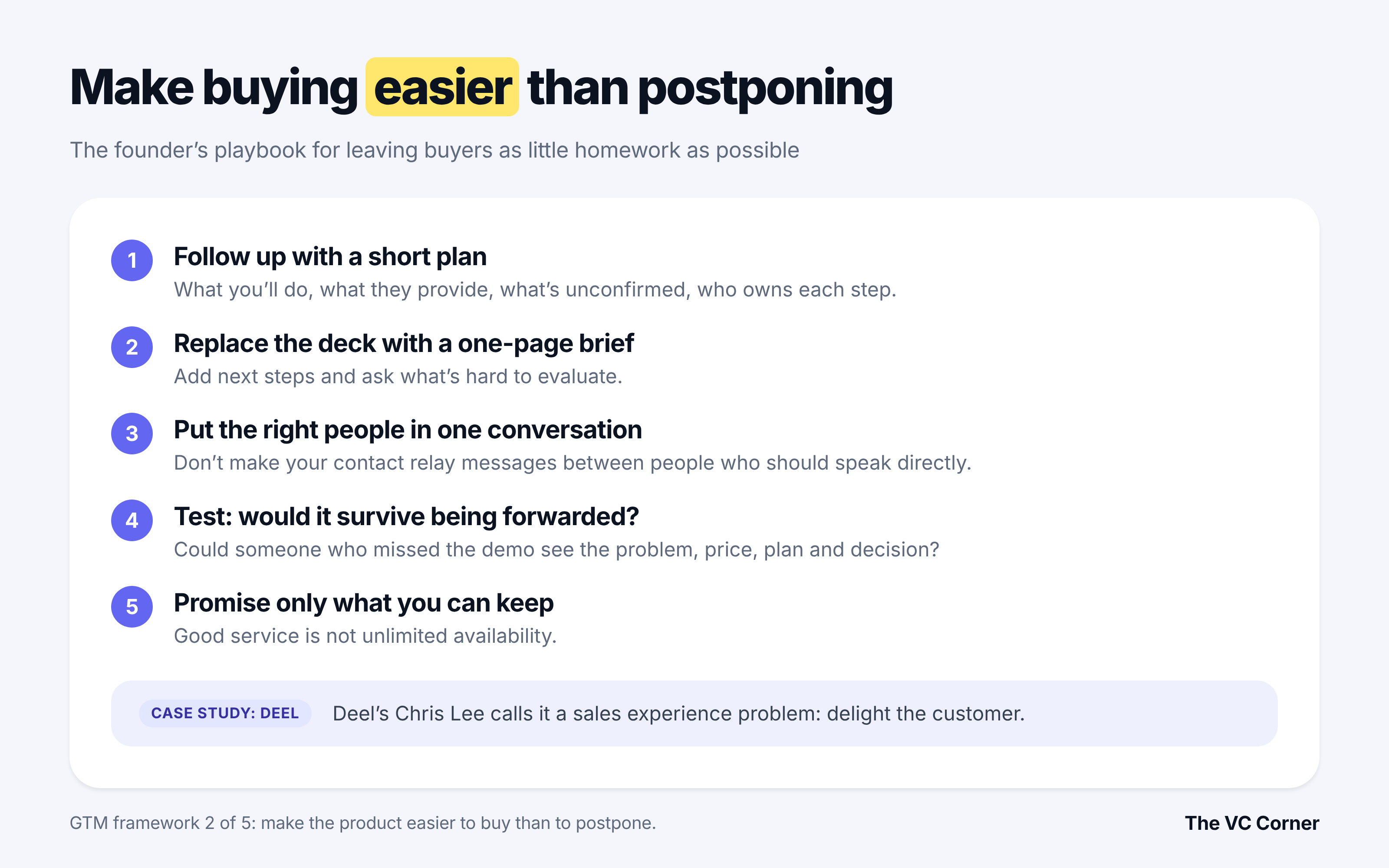
So the follow-up should always be a short plan based on the conversation, showing what you will do, what they must provide, what might remain unconfirmed and which person owns each step.
Make the work visible before the customer commits to it. Make them imagine it and feel realistic. Ease their mind. Make them feel confident about working with you.
And if a technical question is blocking the deal, arrange the right technical conversation rather than asking your contact to relay messages between two people who should speak directly.
A test to see if this works: Would your follow-up survive being forwarded?
Can someone who missed the demo understand the problem, the price, the proposed implementation and the decision being requested?
If no, it leaves homework to them, and it will be assigned to someone else, friction will be created, and eventually it will be lost.
If yes, you did it right.
Try it out. Following a demo, replace the deck with a one-page decision brief, next steps and ask what’s difficult to evaluate.
For a hypothetical payroll buyer:
Problem: Finance spends two days checking payroll. Buyer to confirm.
Test: Run an agreed sample and have finance check the output.
Work: Buyer provides sample records. We handle import and explain exceptions.
Decision: Finance reviews accuracy and setup effort on Tuesday.
And if you convert, don’t mix up service with unlimited availability. Lee’s personal access is an example of his approach, but a founder should choose commitments the business can keep.
3. Keep the Person Who Signs Informed
At the end of the day, the person that’s evaluating your product will probably need someone else’s approval to buy it. And if that approver first hears your argument at the final meeting, then more meetings will probably follow.
So you need to keep them informed while the evaluation develops, without requiring them to be present at every conversation.
Case study: Accord
Accord’s Ross Rich says that CROs will always delegate, so wanting a meeting with them is mostly pointless.
He says the usual work is done by working with revenue operations and other evaluation leaders while a relevant senior person sends the CRO brief updates after every meeting. This way, the executive has context without being asked for a decision.
The founder’s playbook
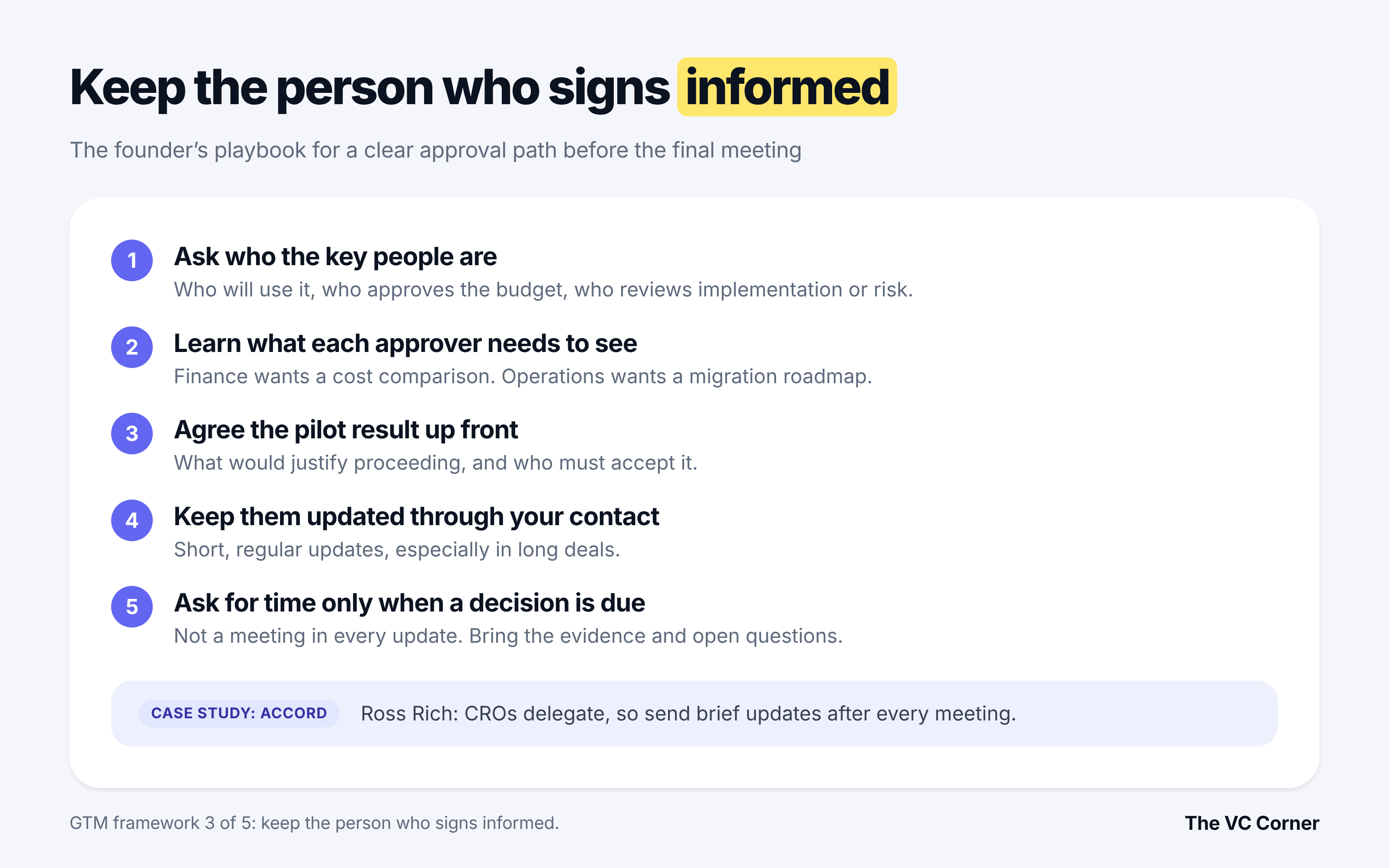
Ask your contact who the key people are. Who’s going to use it, who will approve the budget and who will review implementation or risk. Several of these roles may belong to a single person.
For each approver, you need to establish what they need to see. For example finance might need a cost comparison with other tools, operations may need to gain some confidence about migration, so show them a roadmap.
Before a pilot, agree on the result that would justify proceeding and who must accept it. With your contacts involvement, keep those updated at any given time, especially through long deals. For example:
We have agreed to test the reporting workflow against last month’s process. Dana is leading it, and I will share the result and remaining questions.
The useful output is a clear approval path, with fewer unknowns left for the final meeting.
Oh and finally, avoid requesting a meeting in every update. Ask for time when there is a specific decision to make, with the evidence and unanswered questions ready.
4. If You Want to Sell, Pay Up
At the end of the day, being a salesperson requires skills, so how you pay your own salespeople affects how they sell.
If they earn a bonus whenever a customer signs, they have a reason to focus on getting that signature. They themselves may offer extra support, or agree on future features that the product doesn’t even have yet.
That’s all part of the game.
However, your product has to follow-up on those promises, so be careful with how much freedom you’re giving out.
Your bonus plan should encourage salespeople to bring in customers your company can serve well and make money from.

Case study: HubSpot
Mark Roberge from HubSpot admitted that they would take commissions back when customers left within four months, then seeing cancellations rise the month after.
On the other hand, HubSpot rewarded their sales reps whose customers had a certain retention, after which he reports resulted to a 70% churn reduction over 6 months.
The founder’s playbook
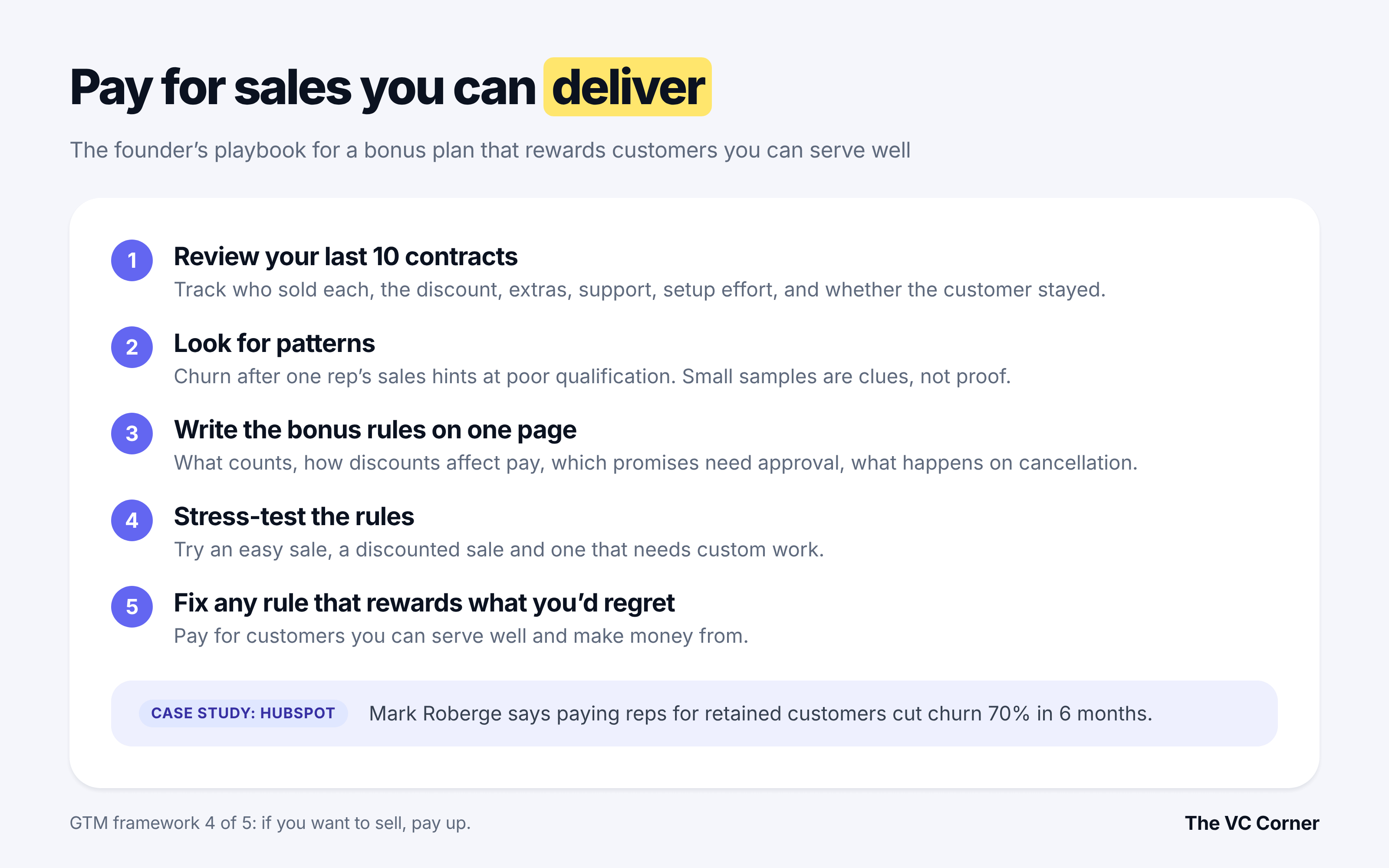
Go ahead and review your past 10 contracts and track who made each deal and the terms like discount, extra features, support, setup effort and check if the customer is still there.
Then you can identify patterns. If a customer left after one rep’s sale it probably suggests poor qualification or expectations. Problems concentrated around a particular setup process suggest a different issue. Small samples are clues to investigate.
Then write the rules for the next plan on one page:
Which sales count toward the bonus?
How do discounts and shared deals affect payment?
Which promises require approval?
What happens if a customer cancels?
Test those rules against an easy sale, a discounted sale and one requiring custom work. Fix any rule that rewards behaviour you would regret repeating
Say your salesperson signs 2 customers, each paying $12,000 a year. The first uses your standard product and only needs a few hours of support per month. The second only signs because the salesperson promises extra features and hourly support calls.
The salesperson gets the same bonus, but your developers and support team have much more work to do for the second customer.
So a bonus system based only on the amount sold can encourage sales that are expensive for the company to deliver.
5. Know When to Revisit Old Leads and How
Now before you start paying more, to get new leads and to your existing sales reps, go back and check what happened to the ones who showed interest before.
Those who have attended your webinar, downloaded a resource, inquired about the product, or a meeting was held at some point.
Sometimes it’s just a timing issue. Or they reached out when you weren’t able to put the right effort into converting them.
Case study: Salesforce
Salesforce had a scoring mechanism where they would continuously score leads from 1 to 5. Their sales team would focus on the 3s, 4s and 5s, while the 1s and 2s, which were roughly 75% of the volume, were left untouched.
According to Kris Billmair, Salesforce decided to hand that neglected group to an AI engagement agent, and the agent reported more than $100 million in pipeline over about 8 months. That basically means potential sales that still needed to close, but the volume was there.
The agent’s task was to start conversations with people the sales team was not contacting, then bring a human when there was a genuine opportunity to convert.
The founder’s playbook
Here’s what you need to do today, if you have a long list of leads that were left untouched for a while.
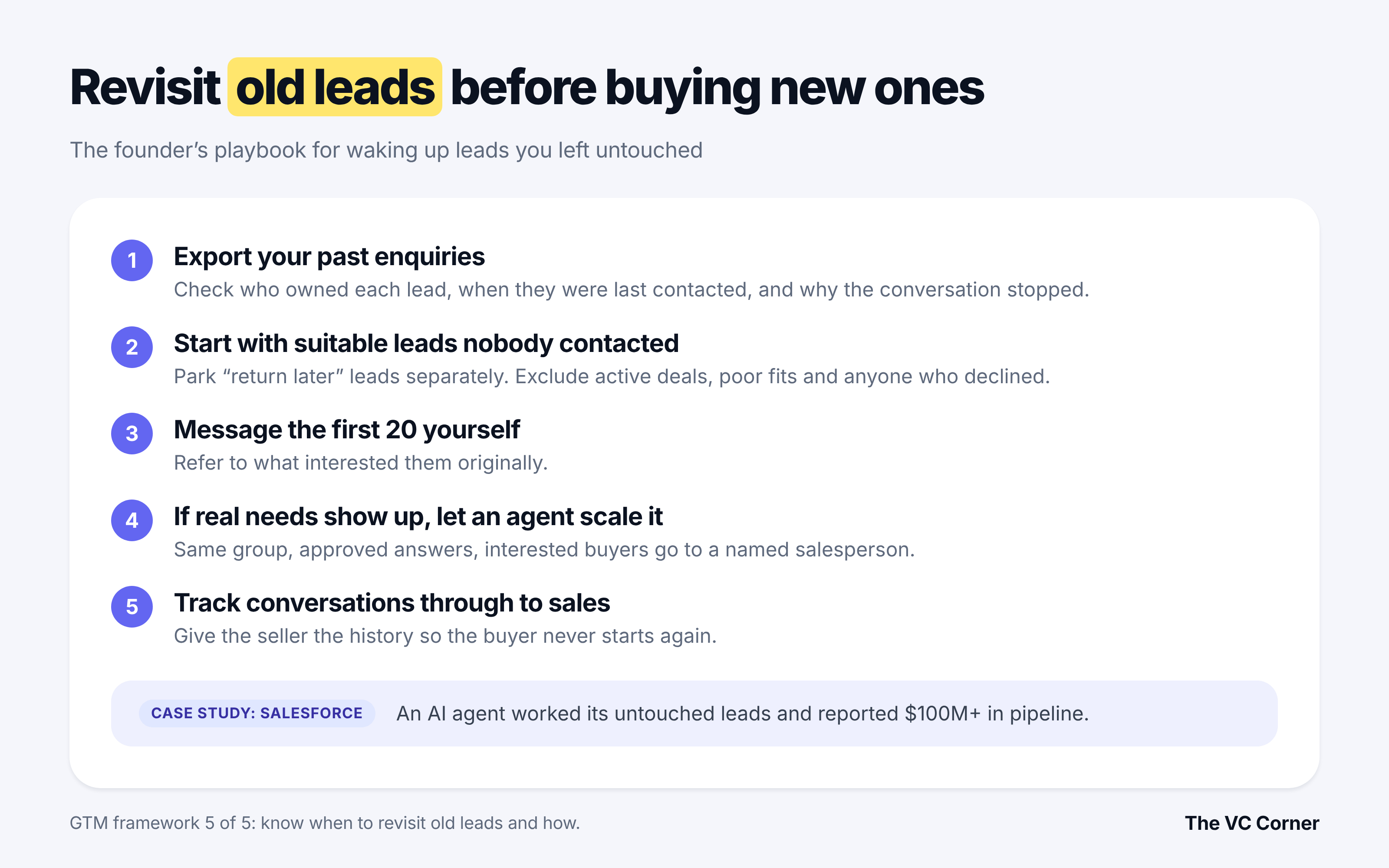
Export past enquiries and check who was assigned to each person, when someone last contacted them and why the conversation stopped.
Start with suitable people that nobody contacted and keep those who asked you to return later in a separate list. Exclude active deals, poor fits and anyone who declined further contact.
Try 20 yourself, referring to what interested them originally. For example, lead with:
You downloaded our guide to expense approvals. Are you looking at changing that process, or were you researching for later?
If those conversations reveal real needs, let an agent handle the same defined group, using approved answers and handing interested buyers to a named salesperson.
Give that seller the conversation history so the buyer does not have to start again. Track how many conversations become worthwhile sales opportunities, then follow them through to actual sales.
6. The Ultimate 2026 GTM Playbook
Congrats on making it to the end, now here’s how to use all of this information immediately.
Choose one type of customer and work through these steps, while keeping a record of what you you are sending out and the input you get back.

1. Create one useful reason to contact someone.
Find a question that keeps appearing in sales conversations and answer it with a checklist, template or worked example. Identify 10 companies where a recent event makes that resource relevant, then offer it before asking for a meeting.
2. Recover conversations you already paid to start.
Review twenty old enquiries. Separate people nobody contacted from those who asked you to return later. Reconnect using their original interest and any relevant change. Remove poor fits and people who declined further contact.
3. Give interested buyers a plan they can forward.
After the demo, send one page explaining the problem, price, setup work, responsibilities and unanswered questions. Ask your contact to correct it, then book the next step with the person needed to resolve the biggest obstacle.
4. Identify the person who can stop the purchase.
Ask who must approve it and what evidence they need. With your contact’s involvement, send that person a short update about the agreed evaluation. Follow up when you have results or a decision to discuss.
5. Check whether winning the deal would actually help your business.
Review discounts, extra promises and support requirements before approving exceptions. Write down how these affect sales bonuses so your team knows which deals you want repeated.
Just a note, all the links to the 5 GTM Frameworks point to the Agentic Strategy Summit