

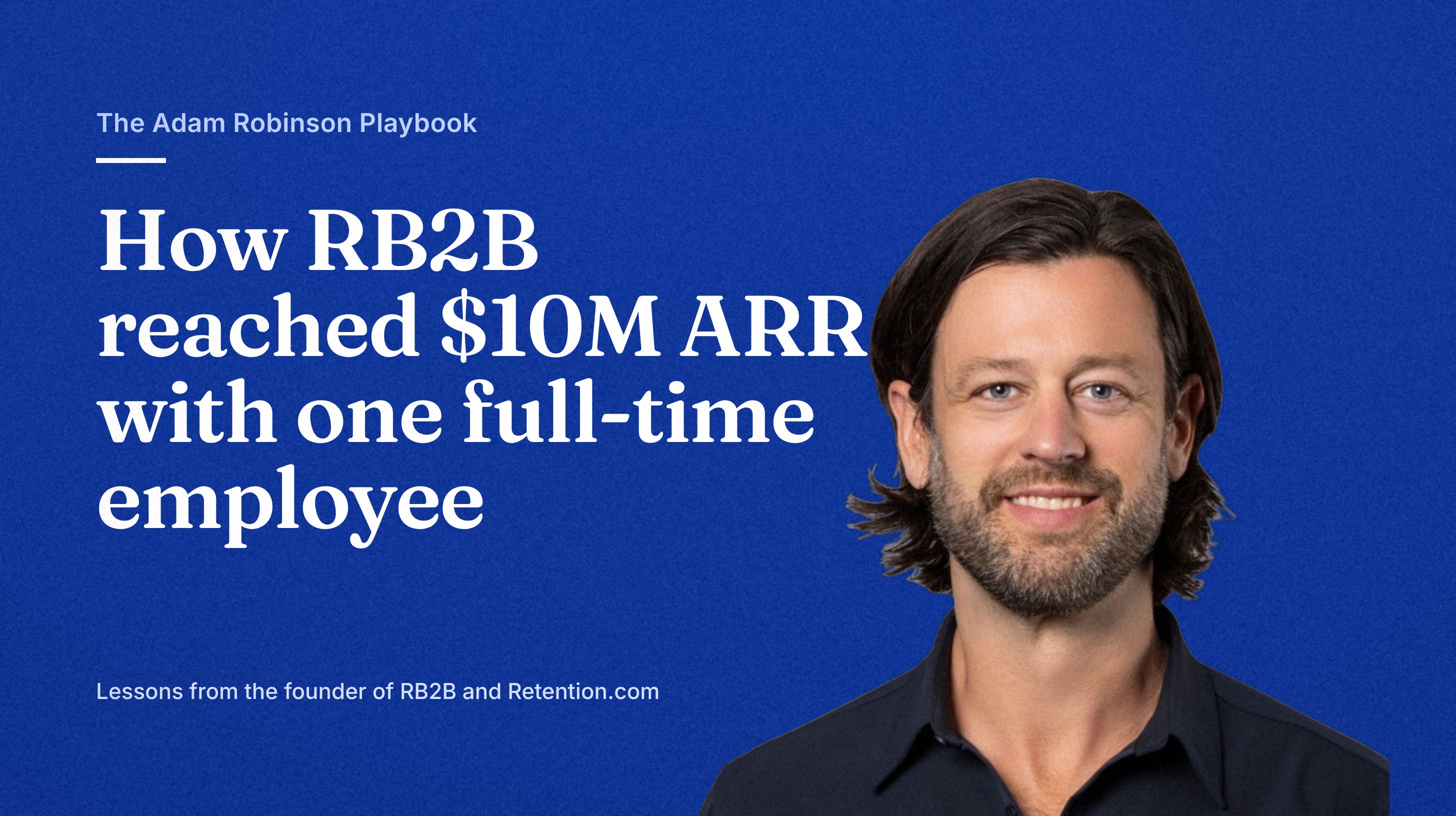
Adam Robinson, the founder and CEO of RB2B and Retention.com, died on November 1 in a plane crash in Florida with his wife Helen Sharp and their two young children, according to Business Insider. Our thoughts are with every family who lost someone that day.
Adam spent his last years teaching in public. Every week his newsletter shared real ARR and the decisions that went wrong, written for founders who wanted another path to a great business. That body of work is the most detailed bootstrapping manual in B2B software, and it deserves to be studied.
Our thesis is simple. Adam built distribution first and kept the product simple enough for AI to run, and that combination made profit the default outcome. On November 1 he wrote that “RB2B is $10m ARR with 1 FTE,” according to Fox News.
The Short Answer
Who he was: a former Lehman Brothers credit trader who bootstrapped four software companies and ran three of them with 32 people at $35M in annual revenue, according to Business Insider.
His record: each company reached $1M ARR faster than the last, from 17 months at Robly to 16 weeks at RB2B, according to his own newsletter.
His engine: a LinkedIn audience that drove about 75% of RB2B’s traffic, plus AI agents that answered 98.9% of support tickets by May 2026, both per his newsletter.
His message: “$10M ARR is the FU money of SaaS,” because a lean company at that size pays its founders millions every year.
Table of Contents
Who Was Adam Robinson?
How Did Adam Robinson’s Companies Grow?
What Did Adam Robinson Champion?
How Did He Build RB2B Step by Step?
Which Mistakes Did He Share in Public?
What Did Investors and Founders Say About Him?
The Takeaways for Your Startup
FAQ
1. Who Was Adam Robinson?
Adam played guard on the Rice University basketball team and spent about a decade trading credit at Lehman Brothers and Barclays, according to Business Insider. His first New York roommates had started Vimeo in their apartment, and watching them work made him want a job he loved.
In 2017 he heard a podcast with Maropost founder Ross Andrew Paquette and backed into the math of a $30M ARR company that dropped $20M to the bottom line with the founder owning all the equity. “That seemed like a better life for the founder than any other SaaS I had heard of,” Adam wrote in an August 2026 post. He spent the next decade building toward that model.
His companies, in order:
Robly (2014): an email marketing platform, sold to a private equity buyer in 2021 at $3M ARR and $1.5M EBITDA, he told Sramana Mitra.
Retention.com (2019): launched as GetEmails, a website visitor identification product for ecommerce brands that started as a feature inside Robly.
RB2B (2024): the B2B version, which matches anonymous website visitors to LinkedIn profiles and pushes them into Slack.
MoltSets (2026): an API-only contact data product for AI agents at $27 a month, launched in October 2026.
His co-founders and core team stayed with him across companies, including CTO Tate and CRO Diana Ross, whom he called the best salesperson he ever met.
2. How Did Adam Robinson’s Companies Grow?
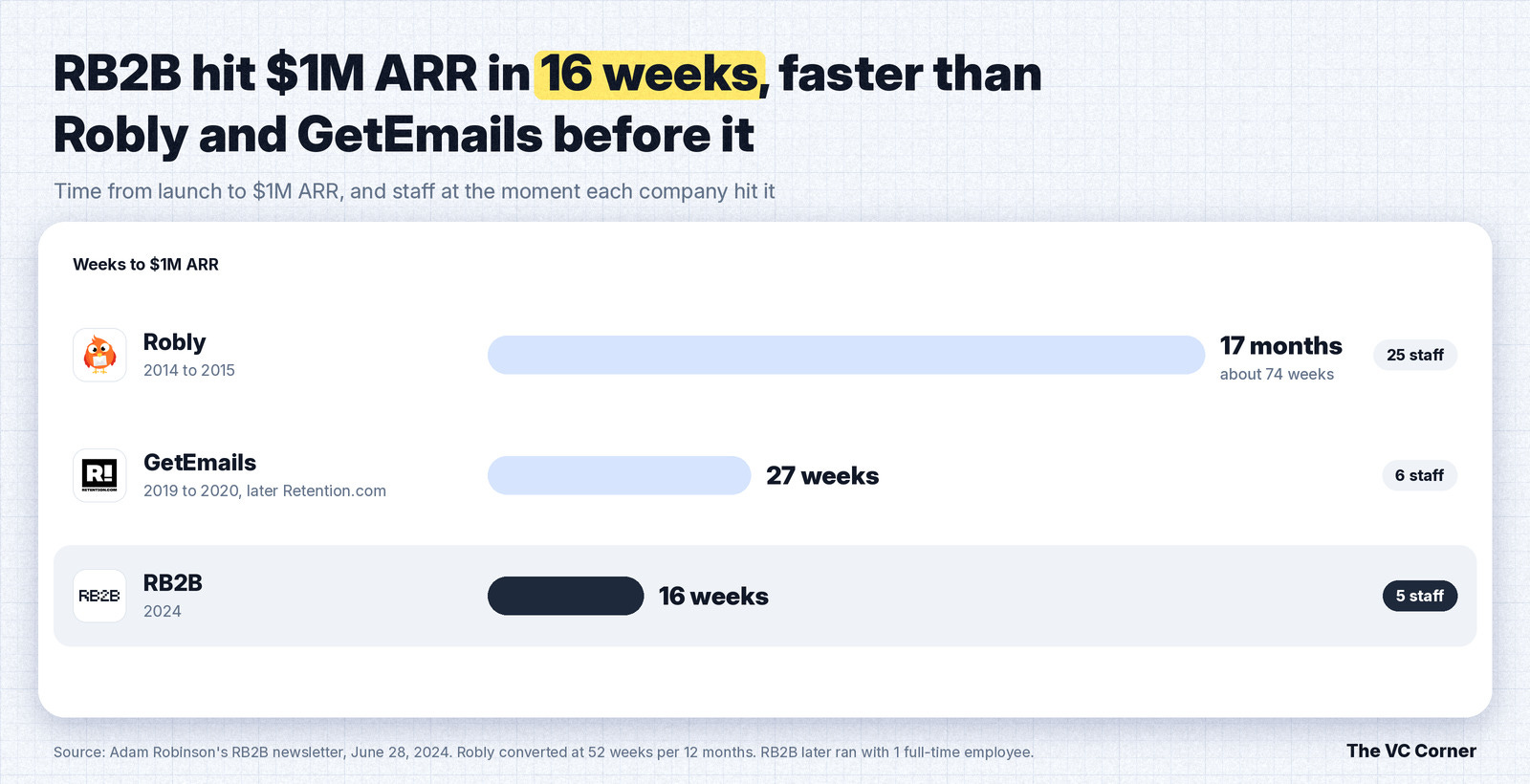
Adam tracked his own speed. In June 2024 he wrote that Robly took 17 months to reach $1M ARR with a staff of 25, GetEmails took 27 weeks with 6 people and RB2B took 16 weeks with 5, according to his RB2B newsletter.
Robly: a call center and one great list
Robly’s first customers came from a crawler. The team scraped about 250,000 small business websites that ran Constant Contact signup forms, enriched them by hand and cold called them from a call center in Adam’s apartment, he told SaaS Club. About 5,000 switched.
The list eventually ran dry, and growth stalled near $3M ARR. Adam later wrote that the first company “felt like it was cheating,” because the scraped list stayed its only acquisition channel.
Retention.com: the feature customers loved
The breakthrough was a Robly feature called Robly ID that found the email addresses of anonymous visitors. Customers downloaded the file, uploaded it to a competitor’s email tool and still gave Robly an NPS of 10. “At 25 cents per lead, this is the greatest product I’ve ever seen in my life,” one told him, he said to Sramana Mitra.
He spun the feature out in November 2019. Here is how it scaled, based on his interviews:
April 2020: $1M ARR in 27 weeks, driven by talking-head Facebook ads and 15-minute demos run by Diana, per his newsletter.
Peak efficiency: $12M ARR with six people, or $2M of revenue per employee, he told Nathan Latka.
2024: $23.8M in revenue and $11M in cash flow at an 87% gross margin, per the same interview.
August 2026: $23M ARR with 27 full-time employees, he wrote on X.
On the way to $10M ARR the company distributed $5M of cash to its co-founders, according to his newsletter.
RB2B: from launch to $10M ARR
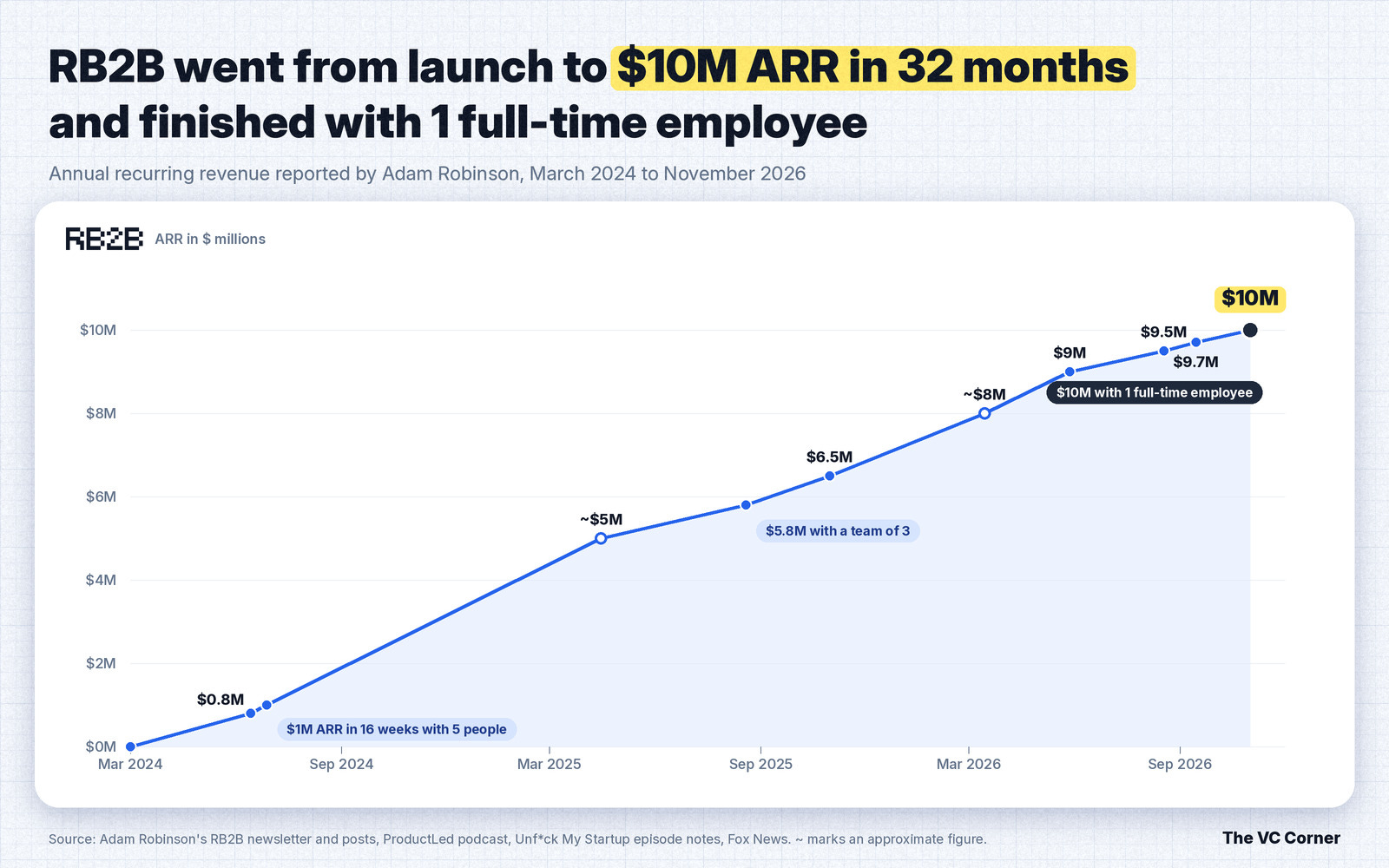
RB2B launched on March 1, 2024, and almost every step of its growth is on the public record. These milestones come from Adam’s newsletter unless noted:
June 14, 2024: $800K ARR at week 14, per his newsletter.
June 28, 2024: $1M ARR at week 16 with 5 people, per his newsletter.
April 2025: $5M ARR at 13 months, with 5 people.
August 2025: $5.8M ARR with a team of 3, according to his debate with Warmly’s founder.
October 2025: $6.3M ARR with 2 customer-facing employees.
May 2026: $9M ARR.
November 1, 2026: $10M ARR with one full-time employee, per Fox News.
By August 2026 the three companies together ran at $32M ARR and $15M in run-rate profit, according to his newsletter.
3. What Did Adam Robinson Champion?
$10M ARR as the real finish line
Adam’s best-known argument was a piece of math. At $10M ARR with a small team, he wrote in a November 2024 post, two co-founders “can easily clear $1M each” in salary and dividends. He added that “there are hundreds, maybe thousands, of EBITDA buyers at $30-$40m” for a company that size.
He compared that with a founder diluted to 5% on a 15-year run to $1B. Our breakdown of founder ownership in VC-backed companies shows how that dilution compounds round by round.
Freedom over status
He measured success in time. As CEO of a $29M ARR company he held internal meetings only on Mondays, and “by Friday most weeks my calendar is completely empty,” according to his January 2026 newsletter. He called it “optimizing for the energy to keep at this for DECADES.”
His shortest summary came in February 2026, per his newsletter: “It comes from $10m ARR. That’s the FU money of bootstrapping.”
Honesty about the hard parts
Adam wrote openly about layoffs and his own state of mind. Per his newsletter, he said shitposting campaigns hurt his mental health, and he described his first seven years as “terrible.” That candor built trust with buyers, and it gave younger founders a realistic picture of the work.
Founders who own their outcome
He rejected the label “lifestyle business” for profitable mid-size companies. After a call with Klaviyo co-founder Ed Hallen in April 2026, he wrote to a VC-backed founder: “Because I want you to win. And I want you to be free,” according to his April 2026 newsletter. For more on why profit gives founders options, see revenue per employee in SaaS and VC.
4. How Did He Build RB2B Step by Step?
Step 1: Find the pain through content
In 2023 Retention.com tried to scale like a unicorn and failed. The VP of sales quit, and Adam cut the sales team from 20 people to 4, he told SaaS Club. He wrote a post about it, and it exploded with B2B sales leaders.
His LinkedIn consultant told him B2B content would “absolutely crush,” according to SaaS Club. Adam wrote three B2B posts, and they drew two million impressions combined. “Now I know the game,” he said on the same podcast.
Step 2: Run discovery before code
From October 2023 to March 2024, Adam and his then COO Santosh Sharan talked to about 10 people a day for six months, close to 300 discovery calls, he told Nathan Latka. Sales leaders kept saying the same thing: they wanted to know the person behind the website visit. Our guide on how to find and validate profitable startup ideas uses the same order of operations.
Step 3: Ship something different, even if rough
The first version emailed a spreadsheet of visitors, and the $495 monthly price drew zero buyers, according to Wes Bush’s ProductLed podcast. The version that worked dropped each visitor into Slack with a headshot and a LinkedIn URL. “RB2B is riddled with horrible problems to this day,” Adam wrote a year later, “but 1 year ago we were the only vendor who resolved site visitors to the person-level.”
Step 4: Launch to a warm waitlist
Six months of B2B content built a waitlist of about 3,000 people before launch, according to his newsletter.
RB2B opened with a free Slack product, and the goal was to “take pricing off the table,” according to SaaS Club. The free tier of up to 200 leads covered 85% of signups, per the same interview.
Step 5: Fix pricing fast, with your audience
Forty-five days in, free-to-paid conversion sat at 0.2%. Users could route the free Slack alerts anywhere with Zapier, and about 90% of signups needed a price far below $495. Adam asked his LinkedIn followers what to do and launched tiered plans starting at $99 a month, according to his June 2024 newsletter.
Conversion jumped to 9% within three weeks. “Even though I’m SOOO much more experienced than 10 years ago, my intuition, most of the time, is still really bad,” he wrote. Our pricing guide for early-stage founders and our breakdown of how startup pricing evolves cover how to design those tiers.
Step 6: Make the founder the channel
By October 2025, LinkedIn posts drove 75% of RB2B’s traffic, Adam wrote. He published four posts a week, ran a weekly live show with about 250 attendees and sent a newsletter to 50,000 subscribers. That system produced 30,000 monthly sessions, 2,000 free signups and 250 paid conversions a month at an average of $225.
He spent about 75% of his work week on content and speaking in mid-2024, per his newsletter, and he chose to optimize for “human-to-human connection,” which he said “can’t be measured.” He also waited 60 days before pitching new connections. For your own content system, read our guide to writing with Claude and ChatGPT in your own voice.
Step 7: Pair content with targeted outbound
He called the method “inbound-led outbound.” When RB2B identified a visitor on its own site, an automated sequence wrote a personalized email within seconds, and that campaign converted at 10.4%, about 26 times an average cold email campaign, according to his newsletter. By October 2025, cold email produced 32% of RB2B’s ARR. Our 5-agent sales team build shows how to wire a similar flow.
Step 8: Cut spend that adds little
RB2B cut all paid marketing, about $100K a month, and growth sped up, according to his November 2025 newsletter. In his October 2025 funnel breakdown, per his newsletter, LinkedIn brought 75% of traffic and other channels brought the remaining 25%.
Step 9: Let AI run the customer side
RB2B’s support lead Robb Clarke wrote the documentation that Intercom’s Fin agent used. Resolution started at 25% and reached 98.9% of all tickets by May 2026, Adam wrote. A Delphi “Adam clone” handled about 1,000 pre-signup chats a month on pricing and security questions.
His rules were specific. Build a knowledge base one post per day, write FAQs in the customer’s own words, keep changelogs current and review every AI answer every morning. “Your AI is only as good as the content you feed it,” he wrote. Our guide to your GTM, run by agents expands on this setup.
In May 2026 he added that RB2B “kept the product dead simple so that AI could handle customer interaction” since day one. That simplicity let the core team move to MoltSets while RB2B kept growing.
5. Which Mistakes Did He Share in Public?
Adam’s mistakes are as useful as his wins, because he gave the numbers.
Scaling on a list: at Robly the team grew a sales floor to 38 people around a second Constant Contact list where few people answered, and he cut back to 6, he told SaaS Club.
Chasing a unicorn with profits: sharing an office with a fast-growing AI startup pushed him to try the same thing in 2023. He grew the team from 13 to 60 in 60 days and burned through the market in nine months. He later let go of everyone hired in that push, he wrote in his August 2026 newsletter. “Thank God I didn’t raise money,” he told Nathan Latka.
Misreading the market: Retention.com’s viable market shrank from the top 50,000 Shopify stores to about 1,400. In August 2024 the company let go of 40% of its ecommerce unit, 15 people, to refocus on efficiency, according to his newsletter.
Living with churn: RB2B stayed SMB freemium at 9% or more monthly churn, a trade-off he accepted to keep the product simple, he wrote in May 2026. Read the real cost of churn before you make the same call.
Paying for a slow channel: he spent over $350,000 on YouTube with 3,000 subscribers to show for it, and he kept going anyway, he wrote in October 2025.
Skipping backups: in March 2021, two weeks before Robly’s $10M sale closed, an engineer deleted the database, and the team recovered 97% of the code base only after a day of panic, according to his newsletter.
His response to a stalled business was always the same. “Get as small as possible. Focus on what IS working. Find a new Product-Market Fit,” he wrote, according to his August 2024 newsletter.
6. What Did Investors and Founders Say About Him?
The VC firms he turned down
Investors wanted in. “Over the past 12 months, I spoke to more than 50 top-tier VC firms about investing in my $22M ARR SaaS company,” Adam wrote in a November 2025 post, and he “walked away from every single one.”
Adam Robinson walks through the seven reasons he turned down more than 50 VC firms, via his November 2025 post on X.
His advice to a founder at $2.5M ARR who wanted to raise $5M to $7M was to keep bootstrapping and hire one leader per function first. He passed on a rule from iContact founder Ryan Allis: cap any raise at one times your ARR, according to his RB2B newsletter.
Investors and operators who share the view
Klaviyo co-founder Ed Hallen built a venture-backed public company and still makes a similar case. In Harvard Business Review, Ed and Benjamin Hallen describe a “mighty middle” of startups aiming for valuations in the high single-digit to high tens of millions. “Most VC-backed founders end up failing. That just sucks for Founders,” Hallen told Adam, as Adam recounted in April 2026.
SaaStr founder and VC Jason Lemkin frames venture capital as “a niche product” that requires triple-triple-double-double growth, according to SaaStr. Adam built a career on the companies that fall outside that niche.
In an August 2025 debate, Warmly founder Max Greenwald brought the VC-backed view. Warmly had $4.4M ARR with 55 employees, against RB2B’s $5.8M ARR with a team of 3, per the episode notes. He argued the same case on his live show against other operators, including a VC versus bootstrapping debate with sales leader Mark Kosoglow.
Tributes from founders who learned from him
Brett Hurt, the Bazaarvoice co-founder and a friend and mentor in Austin, called Adam an “amazing conscious capitalist” and said he “did so much for everyone around him,” according to Business Insider.
Customers.ai CEO Larry Kim, a direct competitor, wrote on X that Adam “pushed our whole category forward, and he made me sharper. Competing with him was a privilege.”
Kit founder Nathan Barry, whose public revenue dashboard Adam had followed for almost a decade, wrote that “there aren’t many people who bootstrap a company to $10M+ like he did, let alone to do it in public.”
HeyReach co-founder Nick Velkovski wrote on X that Adam talked him out of selling in a November 2025 call. Adam told him to keep growing profitably and use the cash to fund new companies, and Velkovski dropped the sale process in May 2026.
7. The Takeaways for Your Startup
Here are 8 moves from Adam’s record that any early-stage founder can run this quarter:
Build the audience before the product. Post to your future buyers for six months before launch, the way Adam warmed up RB2B’s 3,000-person waitlist, per his newsletter.
Run discovery at volume. Aim for 10 conversations a day until the same pain repeats, which took Adam about 300 calls, according to Nathan Latka’s interview.
Ship the different version first. A rough product that does something new beats a polished copy, and RB2B won as the only person-level option.
Give away the core value. A free tier that covers most signups turns users into word of mouth, as RB2B’s 85% free share did, per SaaS Club.
Reprice in public within weeks. Ask your audience what they would pay and move fast, as RB2B did going from 0.2% to 9% conversion, per his newsletter.
Design for AI support from day one. Keep the product simple and write documentation an agent can use, then review its answers daily.
Hire when it hurts. Retention.com reached $13M ARR with the same 6 people it launched with, according to Adam.
Use profit to fund the next bet. Adam incubated GetEmails inside Robly and MoltSets inside RB2B, using cash flow to start each one. The lean revenue model and our SaaS metrics dashboard help you track whether that cash is real.
For the full system behind a tiny team, read the one-person startup operating system and our guide on how to get to product-market fit.
In June 2026, according to his newsletter, Adam wrote that he hoped to keep building “elegant, cash generating companies with a calm schedule and energized, long-term team for decades to come.” Thousands of founders now have his notes to do exactly that.
FAQ
Who was Adam Robinson?
Adam Robinson was the founder and CEO of RB2B and Retention.com and a former credit trader at Lehman Brothers and Barclays. He bootstrapped every company he built and shared his numbers publicly through LinkedIn and the RB2B newsletter.
How did RB2B grow to $10M ARR?
Adam built a B2B audience on LinkedIn and ran about 300 discovery calls before launch. RB2B launched in March 2024 with a free Slack tier, fixed its pricing within weeks and reached $10M ARR with one full-time employee in November 2026, according to Fox News.
Did Adam Robinson ever raise venture capital?
He said he spoke to more than 50 VC firms about investing in Retention.com and turned all of them down, according to his RB2B newsletter. His companies were funded by their own cash flow.
How did RB2B use AI to run with a tiny team?
RB2B trained Intercom’s Fin agent on detailed documentation, and it resolved 98.9% of support tickets by May 2026, per Adam’s newsletter. A Delphi clone of Adam handled about 1,000 pre-signup chats a month.
What does RB2B do?
RB2B identifies anonymous visitors on B2B websites at the person level and pushes their LinkedIn profiles into Slack, so sales teams can follow up with people already showing interest.
Keep reading:
If Adam’s story helped you, share it with a founder who is building the bootstrapped way.
Rest in peace…