

Ask a founder six weeks into a raise why replies are at 2%, and they’ll show you the deck. They’ll rarely show you the list, and the list is usually the problem.
Investor lists rot faster than any other asset in fundraising. People change funds and their LinkedIn keeps the old title for years. Funds run out of deployable capital and leave the website up. A “Partner” in a bio can mean a coach who angel-invested once in 2019. Run any bought list or $29 template through real verification and something like half of it evaporates: wrong stage, no recent checks, no way in, or not actually an investor.
Which means most founders are A/B testing subject lines against ghosts. The deck was never the bottleneck.
The three numbers every row needs
A name becomes a target when it carries three scores:
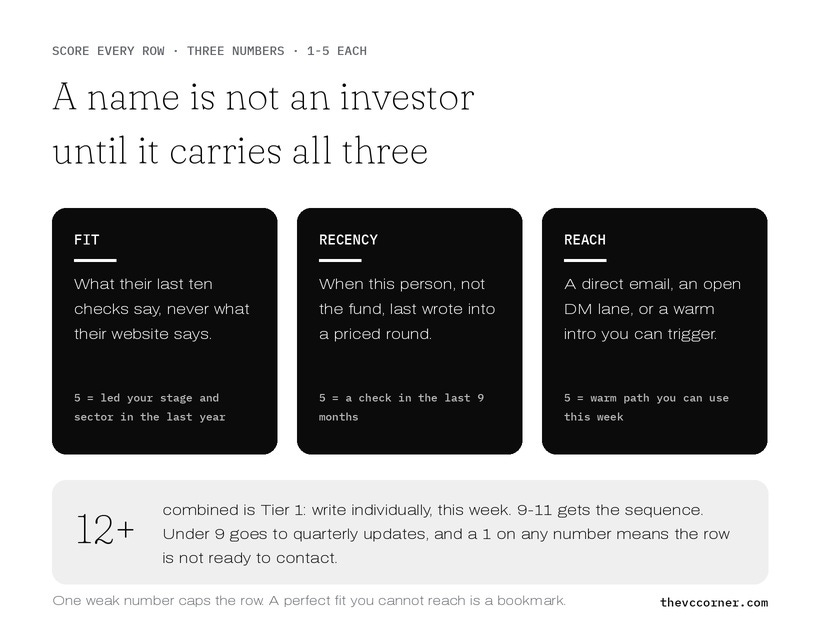
Fit is what their last ten checks say, never what their site says. The gap between “we invest in AI” on a landing page and what a fund actually wires is the gap between 2% replies and real conversations.
Recency belongs to the person, not the firm. A GP who hasn’t written into a priced round in a year and a half is hibernating regardless of how active the fund’s Twitter is.
Reach is whether a path exists at all: a direct email, an open DM lane, or a warm intro you can trigger this week. A perfect-fit investor you cannot reach is a bookmark.
Score each 1 to 5. Twelve or more combined is your Tier 1, written to individually. Nine to eleven gets the sequence. Below nine goes on the quarterly update list, and a 1 on any single dimension means the row isn’t ready to contact yet. One weak number caps the row, which is exactly what a single pass/fail filter or one blended score hides.
You can apply that scoring by hand to any list today, including the 903 European seed funds, the 300+ cold-pitch VCs or the family office database, and you’d already be ahead of most raises.
What sits behind the paywall is the machine that does it for you: a Claude Code project that takes your thesis and hands back a scored, deduplicated, verified list, plus the outreach system to run against it and the honest math on what reply rates to expect, because some of the numbers floating around this topic are fantasy.
The engine
1. Describe the list before you touch a tool
Every run starts from a spec, and the spec does more work than any scraper. Write it in a file called thesis.md:
COMPANY: one paragraph, what you do and for whom
STAGE: raising [pre-seed/seed/A], target check [range]
REGION: [one or two, no more]
INVESTOR TYPE: [VCs / angels / family offices — one per run]
ROLES THAT COUNT: Partner, GP, Principal, solo angel
FIELDS I NEED: person LinkedIn, work email, fund site,
  last 3 deals, last investment date
DISQUALIFIERS: no checks in 18 months, wrong stage,
  "investor" as vanity title
Narrow beats broad everywhere downstream: a spec for “seed AI infra in Europe, partners only” produces a cheaper, cleaner run than “tech investors” ever can, and every layer below filters against it.
2. Layer zero: start from lists that already exist
Here is where this system disagrees with the scrape-everything school: the cheapest high-quality rows are ones someone already curated. Load the investor lists library first and let the pipeline’s first job be scoring what’s already verified, not rediscovering it at scraper prices. Depending on your raise, that seed layer is the 903 European seed funds with contact routes on every row, the 300+ VCs that take cold pitches, the 180 emerging funds actively deploying, the funds under $200M still writing first checks, the 200+ US AI angels who are all builders, the SaaS angel database, the US women angel investors database, or the US VC database most founders never build. If you’re not sure where to start, the ultimate list of investor lists is the map, and startups raising right now shows you who your Tier 1 targets funded this quarter.
Scraping earns its cost at the edges: the niche the curated lists don’t cover, the region nobody mapped, the angels who exist only as LinkedIn profiles. That’s layer one.
3. The four layers
[0 Seed]     curated lists you already hold
[1 Source]   scrapers fill the gaps        → cheap, wide
[2 Enrich]   contacts + deal history       → paid APIs, fewer rows
[3 Verify]   recency, role, dedup          → Claude, fewer still
[4 Score]    fit/recency/reach vs thesis   → Claude, final rows
The economics only work in this order. Every layer runs on fewer rows than the one before, so the expensive steps (enrichment credits, Claude tokens) never touch rows that a cheaper filter would have killed. Sourcing wide is nearly free; enriching wide is how a $60 run becomes a $600 one.
For sourcing and enrichment, chain three kinds of tools, whichever providers you prefer:
▫️ A LinkedIn-profile scraper (Apify hosts several) filtered hard by region and investor-only titles. Cap the first run at a few hundred rows and check the schema before scaling. One honesty note the growth-hacking posts skip: scraping LinkedIn sits against its terms of service, accounts running it get restricted, and you should decide your own risk tolerance with a throwaway rather than your main profile.
▫️ SEC EDGAR Form D filings for anything US-facing: free, public, searchable through EDGAR’s full-text search, and the best dry-powder signal there is, because a fund that closed capital recently is a fund that has to deploy. Almost nobody uses it, which is part of why it works.
▫️ A deal-history enricher (Crunchbase-style APIs) pulling each fund’s last deals and roster. This is what catches the person who left the fund three years ago with the LinkedIn title intact, which is the single biggest source of list rot.
4. The Claude Code project
One folder, one agent per job, so when row 2,847 comes out wrong you know exactly which stage broke: