

There’s a reason most founders flinch at the thought of a board of directors meeting. These meetings remind them of quarterly rituals that they dread; pitch deck scrutiny, deadlines, nervous looks.

The best founders and investors do not live that way. They live like they own the building. When things break, they pick up the tools and find a way through themselves.
This is what high agency looks like in practice. Not a personality type. Not a skill you are born with. A quiet, deliberate refusal to be a passenger in your own life. While everyone else is waiting for a manual or a permission slip, the high-agency person is already 3 steps ahead, testing the locks and looking for a way through.
In an era where everything is changing fast, high agency is the only way to ensure you are the one driving the outcome rather than just watching it happen.
Before we get into the framework:
As you scale and bring institutional investors onto your board, the deals they help you close will increasingly require proof of security and compliance. Get ahead of it now.
See Vanta in action. No sales call required.

Vanta helps you automate compliance, manage risk, and prove trust continuously, all from a single platform.
▫️ Close deals faster by responding to security questionnaires in minutes, not days
▫️ Stay audit-ready year-round with continuous monitoring across 400+ integrations
▫️ Automate compliance for SOC 2, ISO 27001, GDPR, HIPAA, CMMC, and more
Over 16,000 companies around the globe trust Vanta. Watch the demo on your own time.
Table of Contents
1. Board Composition 101
2. The Asynchronous Advantage
3. The 70/20/10 Rule of Engagement
4. The Founder’s Letter
5. Managing Friction
6. Checklists for Building and Managing a Board
7. The Audit
1. Board Composition 101
Too many founders treat their board of directors like a cap table artifact, where whoever wrote the biggest check gets the biggest voice.
That default approach works at the seed stage, when there’s little to govern and everything runs on founder instinct. But once the company finds momentum, especially past Series A or $10M in ARR, the board’s composition starts to affect the company’s thinking in ways that aren’t always obvious.
Who sits in those seats determines which questions get asked, which assumptions get tested, and which blind spots go unaddressed.
Board Size by Stage
Early private companies typically have 3–5 directors
Public companies often have 7–9 directors
Composition usually shifts significantly in the years leading up to an IPO
Committees (audit, compensation) emerge as governance complexity increases
The Board Maker: Independent Director
The most underutilized role on the board is the independent director. They are often a real operator who has lived through the phase you’re about to enter.
If you’re building toward $100M in revenues, you want someone who has already climbed that hill and can tell you where the footing gets tricky. A good independent brings pattern recognition, and knows when to lean in with a question that cuts straight through the fog.
The best ones are what some founders call “high-challenge” allies. They won’t flatter you. They might insult you. But they are on your side at all times. They’ll help you think better.
Hiring the Room
Founders should approach board seats the way they approach executive hiring. Start with a role description, identify the missing pieces in your expertise, and be clear on what this person adds that isn’t already present.
A YC-style “dating period” works well. For example, it could look like six to nine months of informal collaboration before offering a seat. You’re not just filling a chair at the end of the day; you are recruiting a long-term thought partner.
The board is the mirror of a strong startup culture. The sharper, more experienced, and more intentional the members, the more useful that mirror becomes. Who you invite into the room determines how far, and how clearly, you can see.
Meeting Cadence:
Series A stage: informal touchpoints and 1:1s, bi-weekly to bi-monthly
Series B and beyond: quarterly board meetings, scheduled a year in advance
Format:
Strong bias toward in-person meetings
Ideal length: ~3 hours
CEO owns the agenda, always

2. The Asynchronous Advantage
If the first thing you do in a board meeting is open a slide deck and start talking, you have already lost the room.
The “No Surprises” Rule
Most board meetings are expensive reading sessions. Founders spend 30 hours building a deck, only to spend 3 hours narrating it to people who have already read it. This is a massive waste of high-priced brainpower.
So, adopt the “no surprises” rule, by assuming that your board of directors came prepared. If a major update is happening, the board should know about it before the meeting starts. There should be no moment where a missed quarter or a key resignation is revealed for the first time in the room. When you remove the element of surprise, you remove the need for “performance.” The meeting stops being a report card and starts being a strategy session.
The Workflow for a High-Resolution Board
Failing to prepare is preparing to fail. Here’s what you need to be doing:
7 Days Before: Send the board deck and the “Founder’s Letter” (more on that later). This gives directors time to actually think about the data rather than just glancing at it in the taxi on the way over.
4 Days Before: Board members drop their questions into a shared document or a Google Doc.
2 Days Before: The CEO and the leadership team answer those questions directly in the document.
By the time everyone sits down, the “What” and the “How Much” are already settled. You don’t need to spend 90 minutes looking at a burn chart because everyone has already read it and asked their questions. This frees up the entire meeting for the “Why” and the “What Next.”
Async preparation isn’t just about saving time. It creates a written record of your decision-making and reveals who on your board is actually doing the work and who is just showing up for the lunch.
Founders who master this not only run better meetings, they also earn the respect of their directors by valuing their time.
Your investor deck should follow your agenda precisely; start with highlights and lowlights, move through core KPIs, then dive deep on one or two strategic issues. For those strategic sections, show your thinking and lay out the options you considered, explain why you didn't take certain paths, and separate the risks you know about from the unknowns. Including a decision framework is crucial so investors understand how you're making calls, and push detailed metrics to appendices so they don't clutter everything else.

3. The 70/20/10 Rule of Engagement
In most meetings, once the data is out of the way and the agenda is complete, things can get a bit awkward, but don’t worry. This is where most founders usually try to fill the silence with more talking, which ends up in a meeting that goes off the deep end.
So you need a strict framework for how you spend your time, otherwise the conversation will expand to fill the hours available, often focusing on the easiest topics rather than the most important ones.
To avoid this, you need a rule for how you invest the attention of the room, think of it like a budget for your collective intelligence.
The 70% Strategic Deep Dive
This is where the “Extra Brain” strategy actually happens. Since you have already handled the status updates via the pre-read, you now have plenty of time to focus on one or two existential topics.
These are not tactical questions about hiring a single sales rep. They should be strategic and meaningful. For example, you might look at a 3-year plan or a major change in how your customers are behaving.
You should pick the topics where you genuinely do not have the answer yet. By presenting your thinking, the known risks, and the paths you decided not to take, you invite the board to test your logic.
The 20% Reality Check
Transparency is your best friend when things are going poorly. Use this portion of the meeting to look at the “bad and the ugly.” If a metric is in the red, do not ignore it. Use a simple color system to highlight where the friction is.
The goal here is not for the board to tell you how to fix a small pipeline issue. The goal is to get their perspective on whether the issue is a temporary stumble or a sign of a deeper structural problem. When you are honest about your struggles, you turn your board into a defense team instead of a firing squad.
The 10% Administrative Housekeeping
Every board has a duty to the company that involves legal formalities. You have to approve option grants, sign off on minutes, and handle formal resolutions. These are the legal “must-haves.”
By leaving these for the final few minutes, you ensure they do not eat into the creative energy of the meeting. These items are important for compliance, but they rarely help you win the market. Keep them brief and keep them at the end.
The CEO as the Conductor
As the leader of the company, you are the conductor of this time. If a board member starts digging into a specific hiring metric that was covered in the pre-read, you must pull them back.
Remind the room that the data has been settled. Your job is to protect the 70% of the meeting that actually determines the trajectory of the business.

4. The Founder’s Letter
There is a specific energy that defines the best board meetings. And no, it is not the tension of a performance review, it is about everyone being on the same page.
Everyone in the room knows what the CEO is focused on because the CEO took the time to say it in their own words before anyone arrived.
The most effective way to create that energy is with a written memo. Some founders call it a “CEO letter” or a “pre-read narrative.” The name is not important. The act of writing it is.
Before each meeting, you should send a short document that lays out where the company stands. This includes what is keeping you up at night, where the team is winning, and where you feel things are slipping.
The tone is direct and unguarded. The message is simple: here is how I really see it.
Checklist of what to include:
What is working
What is not
What is keeping you up at night
Where judgment matters
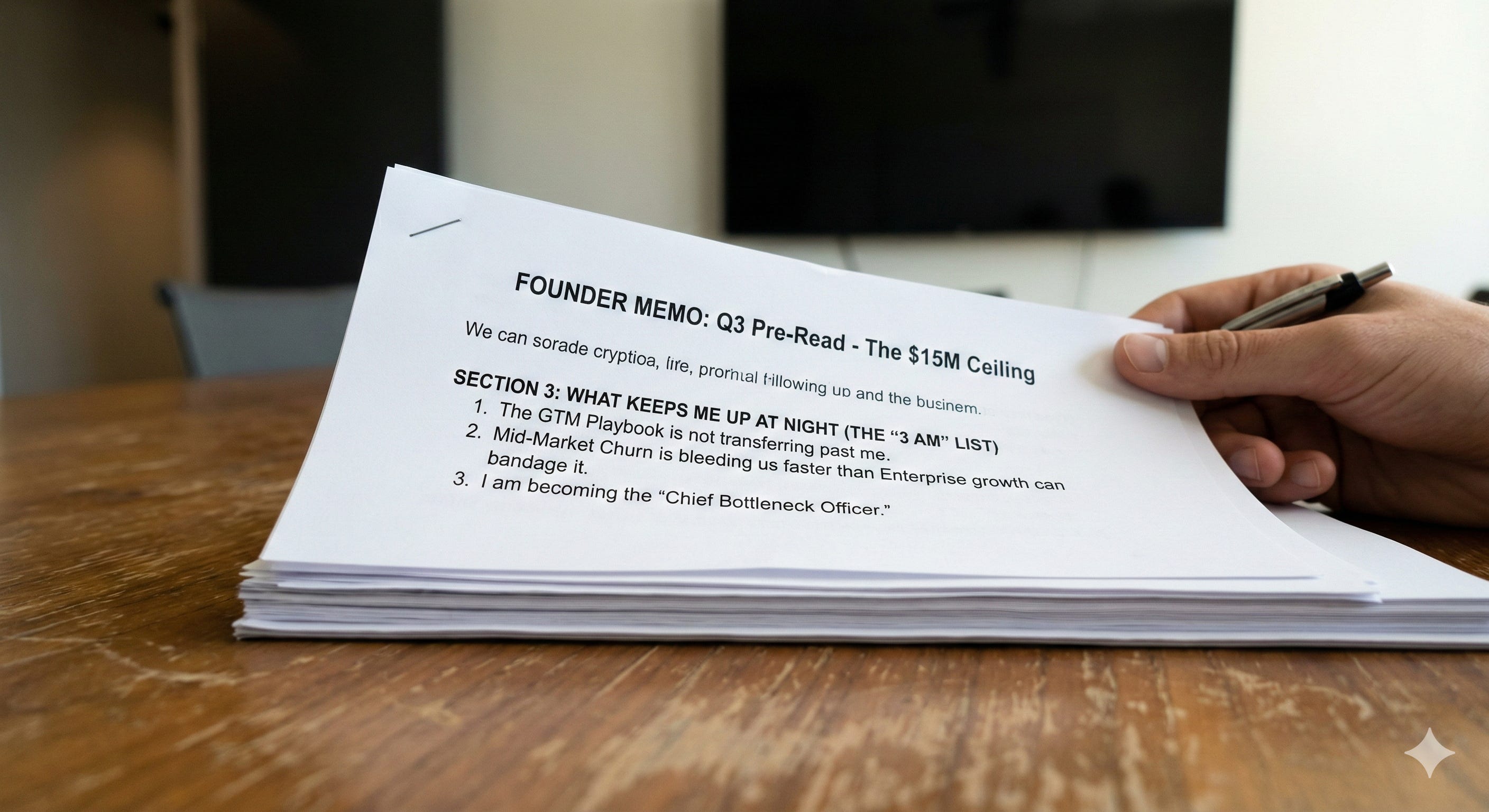
A written memo does something a 50-slide deck never can, it changes the attitude of the room.
Instead of inviting reactions to data, it invites partnership around your judgment. Instead of letting investors act like critics, it encourages them to act like co-builders, and it rallies the board to the founder’s side.
A clear and honest memo turns the meeting from a report card into a collaboration.
Great board management starts with owning the story. Founders who take the time to write their own perspective in prose set the terms of the conversation. They show confidence without the need for a performance. This creates space for the board to do what it was meant to do: think with you, not about you.

5. Managing Friction
Even in a well-built board, conflict exists. But the difference is whether you see it as a mistake or a tool.
The real risk is pretending it is not there or letting it turn into silence. Good boards bring tension to the surface early, they work through it and use it to find the truth rather than seeing it as a threat.
Consensus is Not the Goal
Although it’s a natural instinct, founders should not aim for everyone to agree, because it tends to lead to weak decisions. A better approach is to treat the board like a panel of experts. Your job is to get their best ideas, understand what they mean, and then make the final call yourself.
One practical tool is to filter every different opinion through this filter:
Long-term Value vs. Resource Risk
If a director pushes for a bold move, does it increase the value of the company over time or just test your ability to handle stress today?
If a director warns you to be careful, is it a real signal of danger or just a mismatch in how much risk they can take?
This keeps you from drifting when everyone starts shouting at once.
Handling Toxic People
Not all friction is helpful, sometimes it comes from a director who is not aligned with the company. This might be someone who tries to take over the room or questions the team in front of others.
In those cases, you have two clear moves. First, talk directly to the senior partner at the VC firm and explain that the board member is no longer helping.
Second, bring in more independent directors to balance the voices and bring the focus back to the business.

6. Checklists for Building and Managing a Board
And now to wrap it all up, here are your checklists that you can refer to.
Checklist on How to Build a High-Leverage Board:
Start With Intent
⬜ Am I treating board seats as strategic roles, not investor perks?
⬜ Do I know what kind of thinking I want more of in the room?
⬜ Have I identified my biggest blind spots as a CEO?
Set the Right Board Size for Your Stage
⬜ Early stage private company: 3–5 directors
⬜ Growth or pre-IPO: plan for expansion toward 7–9
⬜ Aware that composition must change as the company scales
⬜ Prepared for future committees (audit, compensation) as governance increases
Hire at Least One Independent Director
⬜ Has lived through the stage I am entering next
⬜ Is not financially or politically dependent on the outcome
⬜ Brings pattern recognition, not theory
⬜ Will challenge me directly, even uncomfortably
⬜ Is aligned with long-term company value, not short-term optics
“Hire the Room” Like an Exec Team
⬜ Wrote a role description for each board seat
⬜ Know what this person adds that no one else does
⬜ Clear on strengths and weaknesses
⬜ Would trust this person for a 10-year relationship
Use a Dating Period Before Offering a Seat
⬜ 6–9 months of informal collaboration
⬜ Seen how they behave under ambiguity
⬜ Asked founders they’ve worked with for references
⬜ Comfortable disagreeing with them already
Lock in the Operating Rhythm Early
⬜ Series A: informal 1:1s, bi-weekly to bi-monthly
⬜ Series B+: quarterly meetings, scheduled a year in advance
⬜ Strong bias toward in-person meetings
⬜ CEO explicitly owns the agenda
Checklist on How to Manage a Board So It Actually Helps You Win:
Enforce the No-Surprises Rule
⬜ No major updates revealed for the first time in the meeting
⬜ Missed targets communicated in advance
⬜ Key hires or exits pre-shared
⬜ Board meetings are for thinking, not confession
Run an Async-First Board Process
⬜ Deck + Founder’s Letter sent 7 days before
⬜ Board questions collected 4 days before
⬜ Written answers shared 2 days before
⬜ Meeting time reserved for “Why” and “What next”
Design the Board Deck for Decisions
⬜ Highlights and lowlights upfront
⬜ Core KPIs clearly presented
⬜ 1–2 strategic deep dives only
⬜ Options considered and rejected included
⬜ Known vs unknown risks separated
⬜ Decision framework made explicit
⬜ Detailed metrics pushed to appendix
Protect the 70/20/10 Rule During the Meeting
⬜ 70% on strategic, unresolved questions
⬜ 20% on real problems and friction
⬜ 10% on formal approvals and housekeeping
⬜ Willing to cut off tactical rabbit holes
⬜ Actively redirect discussion back to strategy
Control the Room as the CEO
⬜ I remind the board when data is already settled
⬜ I pull conversations back when they drift
⬜ I invite challenge but retain decision authority
⬜ I do not perform, I think out loud
Send a Founder’s Letter Before Every Meeting
⬜ Clearly states what is working
⬜ Clearly states what is not
⬜ Names what keeps me up at night
⬜ Highlights where judgment matters most
⬜ Written in direct, unguarded language
Use Monthly Updates to Train the Board
⬜ Sent every month, even between meetings
⬜ Includes performance snapshot
⬜ Includes hiring updates
⬜ Includes burning issues
⬜ Includes specific asks for help
⬜ Publicly recognizes helpful directors
Dealing with Friction
⬜ I welcome conflicting opinions
⬜ I don’t force consensus
⬜ I filter advice through long-term value & resource and cash risk
⬜ I decide, even when disagreeing
Address Toxic Behavior Early
⬜ I give direct 1:1 feedback with examples
⬜ I escalate to senior partners if needed
⬜ I add independents to rebalance the room
⬜ I protect the team from public undermining
Run an Annual Board Audit
⬜ I ask the 1% question for every director
⬜ I evaluate present value, not reputation
⬜ I rotate members as the company evolves
⬜ I treat board seats as scarce resources
Final Gut Check
⬜ Does this board help me think better?
⬜ Does it reduce blind spots?
⬜ Does it make decisions sharper under pressure?
7. The Audit (Evaluating the Board’s ROI)
Everything in a startup is measured. Teams are reviewed, software is tested, financials get tweaked.
Yet the board of directors often stays the same for years. This is a waste of a seat. Founders should run a review of the board every year with the same rigor they use for hiring.
The 1% Question
Ask yourself a simple question: Would I give this person 1% of my company today for the help they are giving me?
Do not think about what they did last year or their reputation in the industry. Think about their value right now. If the answer is no, you are keeping a seat filled that could be used for someone better.
Rotating for Growth
Strong boards change as the company grows. This means moving out members who no longer fit the path ahead. It means looking for new voices who have the instincts or the experience you need for the next stage.
This is all about discipline. Personal biases and emotions should not affect such decisions. The board should get better every year, if it is not helping you move faster, it is getting in your way.
A board can look impressive on paper and still be no help when the founder’s stuck.
I’d rather have one person who’ll ask the awkward question early than five big names who turn up for lunch.