

Why Having a SaaS Metrics Dashboard Is a Cheat Code
Founders tend to talk a lot about growth, and that makes them neglect a harder conversation that has to do with uncertainty.
You can be shipping fast, pushing campaigns, reviewing funnels every week, and still feel unsure about everything that’s going on behind the scenes.
One tool says activation looks fine, another hints at churn risk, and your spreadsheet tells a different story altogether. That scattered view is what pushes teams into reactive decisions.
I keep seeing the same pattern across early-stage companies. The data exists, but it never resolves into clarity. You track SaaS metrics inside your product analytics, billing system, CRM, and finance sheet, but none of them talk to each other. When revenue growth stalls or acquisition costs drift upward, you’re left interpreting fragments. It becomes hard to tell whether the problem sits in acquisition, activation, or the back end of the SaaS funnel.
This dashboard was built to bring the whole picture onto one page.
Table of Contents
1. Why a SaaS Metrics Dashboard Is Non-Negotiable
2. What This Model Actually Does (And Why It Works)
3. Acquisition: Building the Top of the Funnel
4. Funnel Mechanics: Where the Revenue Engine Lives
5. KPIs: Turning Model Outputs Into Insight
6. Who This Model Is For
7. Download the SaaS Metrics Dashboard Excel Template
8. How to Use It (Step-By-Step)
9. Frequently Asked Questions (FAQ)
1. Why a SaaS Metrics Dashboard Is Non-Negotiable
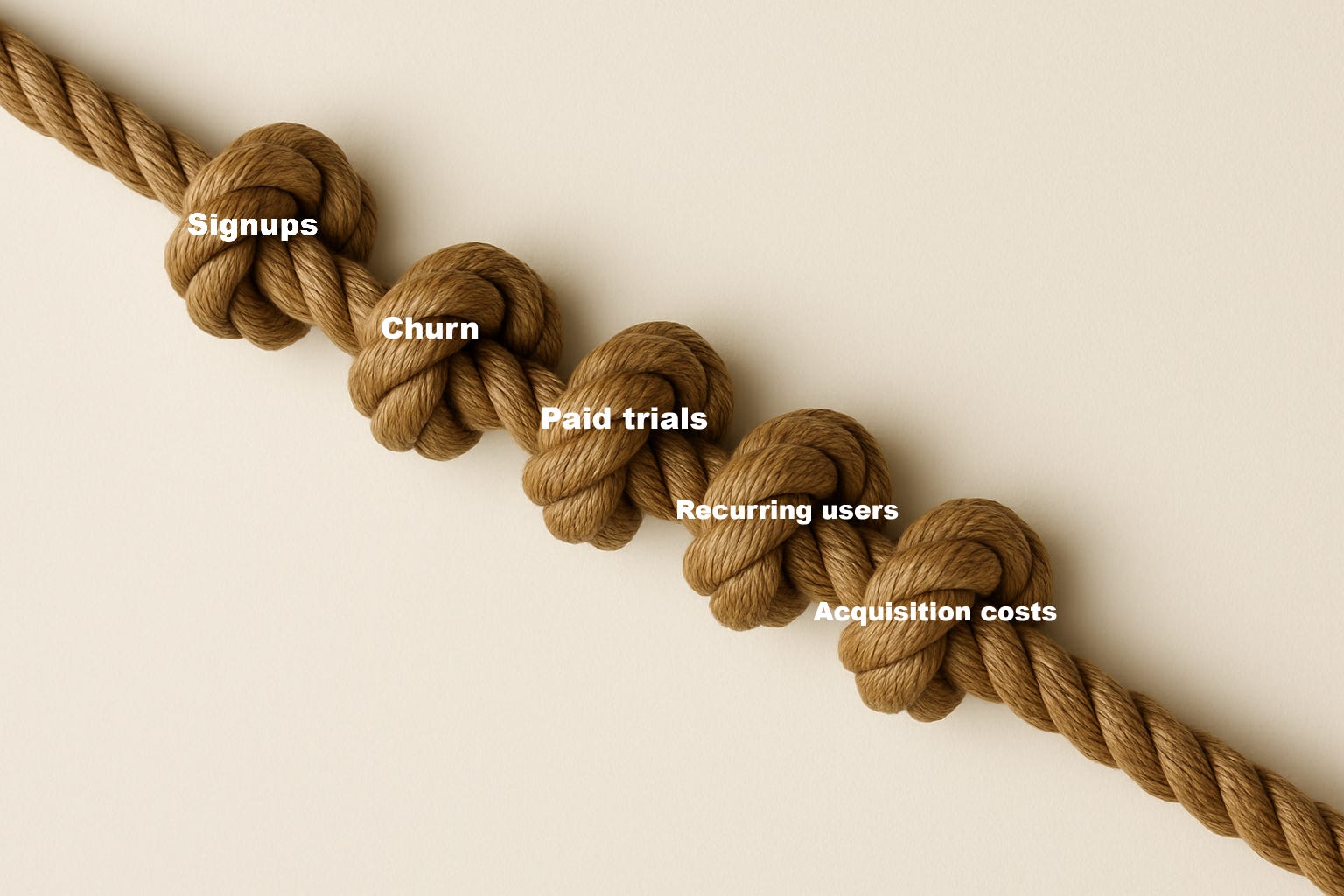
Early-stage teams move fast, but the engine underneath often stays blurry. You see pieces of the story. Signups here, churn there, a spike in paid trials; but nothing ties these signals together in a way that helps you act with confidence.
A unified SaaS dashboard gives founders a clean, dependable view of how the business actually works.
Clarity Over Chaos
Most early teams gather more data than they can interpret. Numbers live in separate tools, dashboards, and exports, which makes it hard to see how acquisition, activation, churn, expansion, and revenue connect.
A strong dashboard resolves that fragmentation. It creates one coherent storyline where every movement in the SaaS funnel is part of the same picture. Once the narrative is unified, patterns and problems surface naturally.
Diagnose Growth Quality, Not Just Growth
Founders often anchor on topline annual recurring revenue, but ARR alone doesn’t tell you what kind of growth you’re getting.
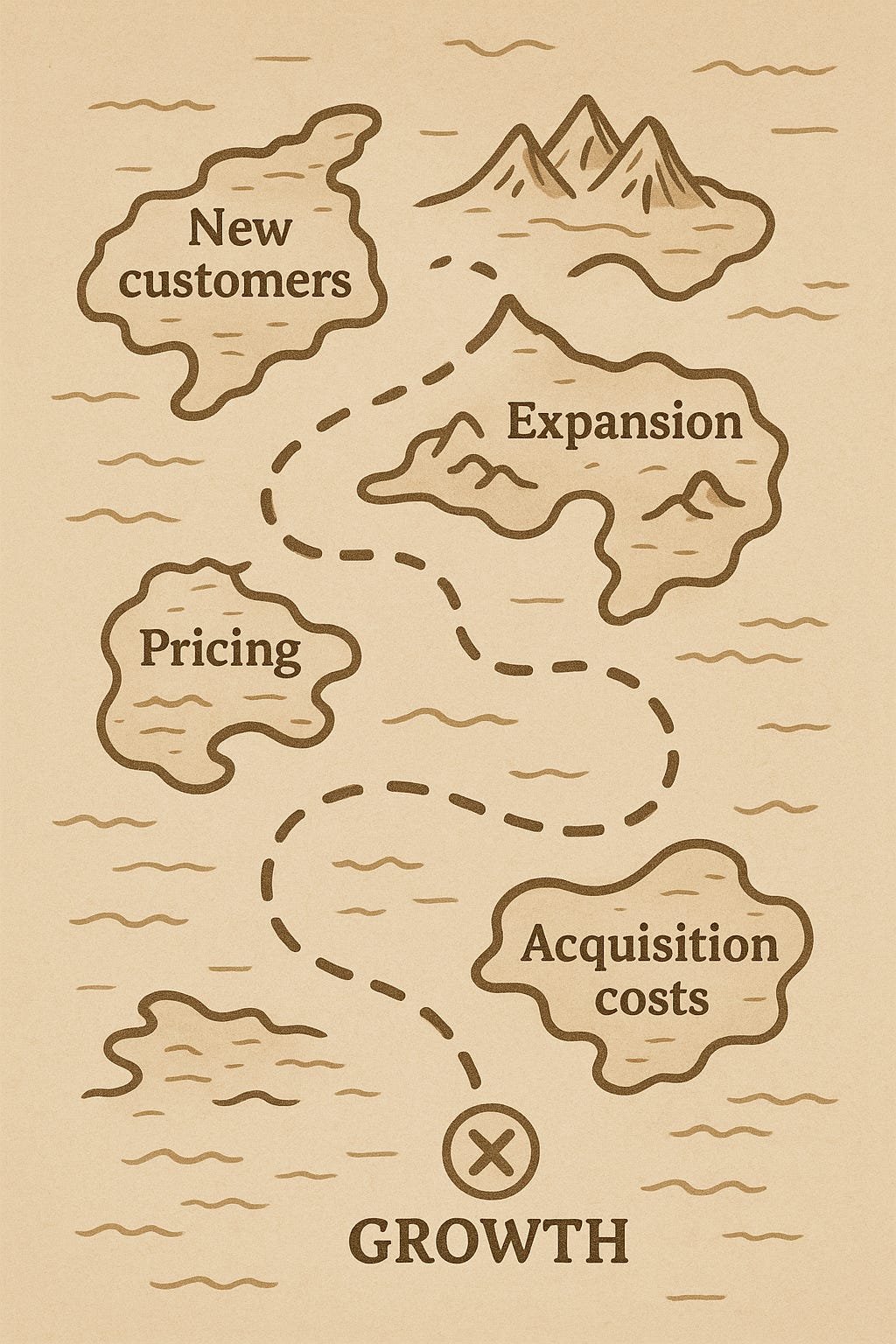
This model breaks down MRR growth into precise components so you can see what’s driving the movement. You understand how much comes from new customers, how much from expansion, and how much is influenced by pricing. You also see where revenue quietly slips away through churn. This view transforms net new MRR from a single result into a map you can act on.
Faster Decisions With Fewer Mistakes
Without a coordinated system, teams end up solving the wrong problems. Rising CAC might be a channel issue, or it might be a weak activation pattern. A conversion drop could come from the site, or it could come from onboarding friction.
Simply put, a useful metrics dashboard eliminates such guesswork. It surfaces CAC spikes, activation dips, contraction creep, and bad channel economics right when they start. Speed is essential for early-stage teams because small fixes compound quickly.
Investor-Quality Visibility (Without a Finance Team)
Investors care about predictability and efficiency, and your ability to show both depends on clean reporting. This model brings investor-grade clarity into your day-to-day ops.
You get a consistent read on SaaS KPIs like CAC payback, LTV, LTV:CAC ratios, GRR, NRR, active customers, and revenue mix. You don’t need a heavy SaaS financial model or a dedicated analyst to maintain it.
The clarity and ease-of-use helps you communicate traction to investors with convictions, avoiding the scramble that usually happens before a raise.
2. What This Model Actually Does (And Why It Works)
Once you understand why a unified view matters, the next step is seeing how the pieces fit together. This model was built to reflect the real behavior of a SaaS engine without turning everything into a heavy spreadsheet.
It gives founders a practical system instead of a wall of formulas, keeping the focus on movement, compounding, and decision-making.
A System, Not a Spreadsheet
The model works because everything flows in a straight line. Your assumptions define how users behave. That behaviour creates traffic patterns and trial volumes. Trials turn into activations, activations turn into paid customers, and customers generate MRR.
Once the math runs through the system, you get a clean set of SaaS KPIs that reflect the business as it stands today. The structure avoids noise and keeps only the metrics that matter for early-stage SaaS metrics and decision-making.

A Clean, Structured, High-Signal Growth Engine
Many dashboards try to track everything, which creates more confusion instead of clarity. This model does the opposite, by focusing on the signals that affect MRR growth and the economics behind it. Each tab builds on the one before it so the flow stays predictable:
Assumptions → Traffic → Trials → Activations → Paid Customers → MRR → KPIs
Because the relationships are simple and the math is transparent, founders can adjust a single assumption and instantly see how the SaaS funnel responds. Pricing tweaks, activation experiments, trial changes, or channel adjustments all cascade cleanly through the system.

3. Acquisition: Building the Top of the Funnel
Every growth engine starts with a simple question: where do your trials come from?
That’s what the “Acquisition” tab answers by showing how paid spend, channel mechanics, and organic momentum combine to create the trial volume that drives the entire SaaS funnel. Once you see these paths side by side, the early-stage fog around acquisition economics starts to clear.

How Paid Channels Shape Trial Volume
Paid channels are the most controllable lever, which is why the model makes them so explicit. Budgets determine how much volume you can push at the top of the funnel. Base CAC sets your initial cost efficiency, but the CAC slope tells the real story.
As you scale spend, efficiency declines because audiences saturate and targeting gets broader. The model shows this erosion in real time, which helps founders understand why “just spend more” rarely works for MRR growth without parallel improvements in activation.
The trials generated from paid channels give you a read on how responsive each channel is. One platform may deliver lower CAC but weaker activation. Another might have a higher CAC but consistently produces the customers who stick.
Seeing these differences side by side is often the moment founders realize where the real leverage sits.
How Organic and Direct Add Stability
Organic and direct sources behave differently. They aren’t driven by budget, and they tend to grow slowly but reliably. The baseline contribution stabilizes the top of the funnel, while month-over-month growth adds predictable compounding.
Even small increases matter because these users often convert at higher rates. The model highlights this dynamic, making it clear that organic is the backbone of long-term efficiency for SaaS metrics and SaaS KPIs.
How Blended Trials Reveal the True Engine
When you combine paid and organic, the total trial volume becomes much easier to understand. The output is a blended picture of how your acquisition machine actually behaves.
Paid drives bursts of volume. Organic carries the momentum. Together, they give founders a realistic sense of what the top of the funnel can sustain over the next quarter.
This blended view makes it easier to compare channels, understand where budgets have real impact, and see how organic saves you from relying solely on paid efficiency.
Founders often discover that the most effective strategy isn’t always the one with the lowest CAC. Sometimes the best CAC profile still underperforms once activation and retention enter the picture.
The acquisition tab gives you that perspective early, before you scale the wrong channel or overspend on a tactic that can’t support your long-term goals.
4. Funnel Mechanics: Where the Revenue Engine Lives
Acquisition gets users in the door, but the real story begins here. This is the bridge between interest and income, where product performance meets marketing intent.
Every movement in this tab determines how the engine behaves over time. If the acquisition layer shows how many people arrive, the funnel mechanics show how many stay, pay, return, expand, and ultimately compound.
This is ultimately the moment when the business stops being theoretical and starts revealing its actual physics.

Where Trials Become Activated Users
The first transformation happens when trials turn into activated users. This is where onboarding, product clarity, and early experience come together.
When activation lifts even slightly, the downstream effect is immediate. More users move into the zone where trial-to-paid conversion becomes possible. The funnel tab captures this transition with simplicity, showing exactly how activation influences the early movements of the SaaS funnel and sets the tone for everything that follows.
Where Activated Users Become Paying Customers
Once users activate, the next step is the conversion to paid. This part of the model exposes whether your product earns commitment or only curiosity. Marketing may drive the trials, but product determines whether they turn into customers.
When conversion improves, the model shows a visible rise in paid customer volume, which directly fuels MRR growth. When conversion weakens, the shortfall is unmistakable. You can see the drop before it hits the revenue layer, which makes this section a powerful early-warning system.

Where Customers Accumulate Into the Active Base
Paid customers don’t just add revenue for the month, they also accumulate into your active base. This accumulation is the real backbone of any SaaS business.
Customers enter through new conversions, stay if they find value, and grow if your product creates reasons to expand. The model tracks this month over month so you can see how the active base evolves, how cohort health develops, and how each layer contributes to the system’s resilience.
Where Churn, Expansion, and Contraction Shape the Outcome
The active base is never static. Churn reduces it and expansion grows it. Contraction sits in the background eroding what you gained.
Breaking these movements apart is the key to understanding the quality of your revenue. The model separates new MRR, expansion MRR, contraction, and churned MRR so founders can see exactly where the lift or drag occurs.
These distinctions show whether your business is carried by new logos or powered by the customers who stay.
Where Net New MRR Reveals the Truth
All of these pieces roll up into one signal, that is net new MRR. It is the cleanest measure of momentum inside any early-stage business.
A strong net new number means the entire engine is working together. A weak or unstable number reveals friction somewhere in the system. Because this tab connects acquisition, activation, retention, expansion, and contraction, it becomes the place where problems surface earliest and most clearly. For every SaaS company, this is the layer that decides whether the story continues to climb or begins to stall.
Every founder eventually realizes that this is the tab that tells the truth. It exposes bottlenecks, clarifies where effort is paying off, and shows where the product experience still needs refinement.

5. KPIs: Turning Model Outputs Into Insight
Once the assumptions, acquisition, and funnel mechanics flow through the system, the dashboard produces the signals that matter most.
This is where the noise settles and the business reveals its true behavior. A good SaaS dashboard does two things together: it reports the numbers, and it shows what they mean.
The KPIs here turn raw activity into patterns, and those patterns help you understand whether the engine is accelerating, stalling, or leaking value.

Customer and Funnel KPIs: The Health of the Journey
The first group of metrics tells you how users move through the experience. Trials show the top-of-funnel energy. Activated users show whether the product earns attention. New paying customers show where real commitment begins. The active customer count at the end of each month shows how much value you’ve retained and how well the SaaS funnel carries people from curiosity to revenue.
These numbers expose the shape of engagement:
If trials are stable but activation drops, onboarding needs attention.
If activation looks good but paid conversion flattens, your value moment may be unclear.
When the active base grows faster than acquisition, retention is doing work for you.

Revenue KPIs: The Quality of the Dollar
Revenue movement comes from a few consistent forces, and the model makes each one visible.
New MRR shows the lift from new customers.
Expansion MRR shows the strength of your product for users who stay.
Churned and contraction MRR reveal how much is being lost each month.
Net new MRR pulls all of it together into a single indicator of MRR growth.
Ending MRR shows where the month finally settles, and net revenue layers in discounts, fees, and COGS to create a realistic picture of what you actually keep.
The value of separating these is simple. A company growing through expansion behaves very differently from one depending entirely on new logos.
A company losing more through churn than it gains through acquisition has a predictable future unless something changes.
A company with flat new MRR but high expansion can still become a compounding machine. The revenue KPIs are where these truths emerge.

Unit Economics: The Engine’s Efficiency
The third layer exposes how efficiently your system turns spend into value:
Paid CAC spend shows how much force you’re applying.
Blended CAC shows the cost of acquiring the average customer.
ARPU reflects the value of that customer.
CAC payback connects these directly, telling you how long the business takes to recover what it spent.
LTV and LTV:CAC show long-term viability.
GRR and NRR reveal how much existing customers contribute to future stability.
These are the economics of survival. A healthy LTV to CAC ratio means you can afford to scale. Strong GRR and NRR mean the base carries momentum, easing the pressure on acquisition. A short payback period allows faster reinvestment.
These relationships help founders understand whether their growth is sustainable or expensive.
How to Read the Charts Without Getting Lost
The visuals in the dashboard are meant to guide interpretation.
The Ending MRR curve shows the arc of revenue momentum. A steady rise reflects a consistent engine. A flattened line signals friction.
CAC versus ARPU shows the tension between what you spend and what you earn. If the lines drift apart, efficiency is weakening.
The LTV:CAC ratio shows whether unit economics support long-term scale.
The net revenue waterfall makes the cost structure visible, showing exactly how discounts, fees, and COGS change what you keep.
When you read the charts together, the story becomes immediate. You see whether growth is broad or narrow, efficient or expensive, stable or fragile.
6. Who This Model Is For
The point is not to show more data, but to show the right data at the right level of resolution. Additionally, a good model earns its place by being useful to more than one team. And this one keeps the whole team happy.
For Founders Who Need a Clearer Picture
If you’re trying to understand how acquisition, activation, retention, and revenue actually connect, this dashboard gives you a dependable lens. You see the whole engine rather than scattered signals. It brings coherence to the SaaS metrics you already track, making patterns easier to interpret and decisions easier to justify.
For Marketing Teams Looking for Real Lift
Marketing teams get a clean view of how their work influences trials, activation, and paid conversions. When a campaign works, you see it in the funnel. When it doesn’t, the model shows why. It helps teams understand whether the movement comes from volume, quality, or a mismatch between acquisition and onboarding.
For Product Teams Trying to Reduce Drop-Off
Product gets as much value as marketing. The funnel mechanics reveal exactly where users hesitate, fall off, or move forward. Activation isn’t an abstract percentage anymore; it becomes a behavior you can trace. When changes are reflected on the product, the model picks up the impact almost immediately.
For Finance Teams Wanting Structure Without the Weight
Finance teams get the clarity of a light SaaS financial model without the overhead of maintaining one. Revenue components, efficiency ratios, SaaS KPIs, and CAC payback all flow cleanly from the core assumptions. It’s structured enough to support forecasting but simple enough not to derail monthly workflows.

For Investors Evaluating Traction
Investors look for predictability and efficiency, and this model makes both visible. They can scan growth quality, retention strength, unit economics, and revenue composition without digging through dense files. It gives them confidence in the story and helps them understand how the business behaves under different conditions.