

What could the average person achieve with $8 million? A very good investor would earn roughly 10% a year and walk away with approximately $33 million today. Most people would be happy with that.
But when we are talking about exceptional results, there is a story that goes far beyond any normal expectation.
In 2010, an $8.4 million seed fund was raised with no institutional backing, no legacy franchise, and no committee architecture. A single general partner ran it.
Before we get into how:
The best AI deals of the next decade are being funded right now.
The founders building the next Sacca-level returns are already taking checks. Most people will never see the deals…
This week, The VC Corner is giving readers early access to the same high-potential startup opportunities that elite venture firms are already co-investing in alongside Andreessen Horowitz, Bessemer, and Y Combinator.

Groq, Sleeper, and Replit are in the portfolio.
▫️ Curated deal flow alongside name-brand VC firms like a16z, Sequoia, and Bessemer

▫️ No obligation to invest
▫️ No cost to see the deals
The window is open this week. Next week it may not be:
Lowercase Capital is widely believed to have returned roughly 200x to 250x to its investors. A limited partner who committed $100,000 could have seen approximately $25 million returned over time. In an asset class where a 3x net outcome over a decade qualifies as strong and 5x places a firm near the top tier, this sits far outside conventional VC returns.
This is the story of how Chris Sacca built what might be the most successful investment fund ever. Not a stroke of luck, but the result of a few simple, smart choices that most people thought were too risky or too small to care about.

By the time he was done, those few million dollars had grown into billions. The fund is widely believed to have returned roughly 200x to 250x to its investors.
A limited partner who committed $100,000 could have seen approximately $25 million returned over time. In an asset class where a 3x net outcome over a decade qualifies as strong and 5x places a firm near the top tier, this sits far outside conventional VC returns.
To see how he pulled it off, we have to look past the fame and at the underlying logic that allowed a tiny fund to win bigger than the largest banks in the world.
Table of Contents
1. Before Venture Capital There Was Leverage and Loss
2. Google Was The Training Ground
3. Why a Small Fund Could Do What Large Funds Could Not
4. Keeping Your Slice of the Pie
5. Three Companies, One Fund, and the Reality of Concentration
6. Standing Out By Being Different
7. Why This Was a Rare Moment in Time
1. Before Venture Capital There Was Leverage and Loss
Long before Chris Sacca became associated with extreme outcomes in venture capital, he encountered capital in its least forgiving form.
In the late 1990s, while still in law school, he traded technology stocks using brokerage loopholes that allowed heavy leverage. Small sums expanded rapidly as the dot-com market inflated, reinforcing the sense that pattern recognition was skill rather than circumstance.
In rising markets, leverage feels like intelligence multiplied.
Leverage Without Friction
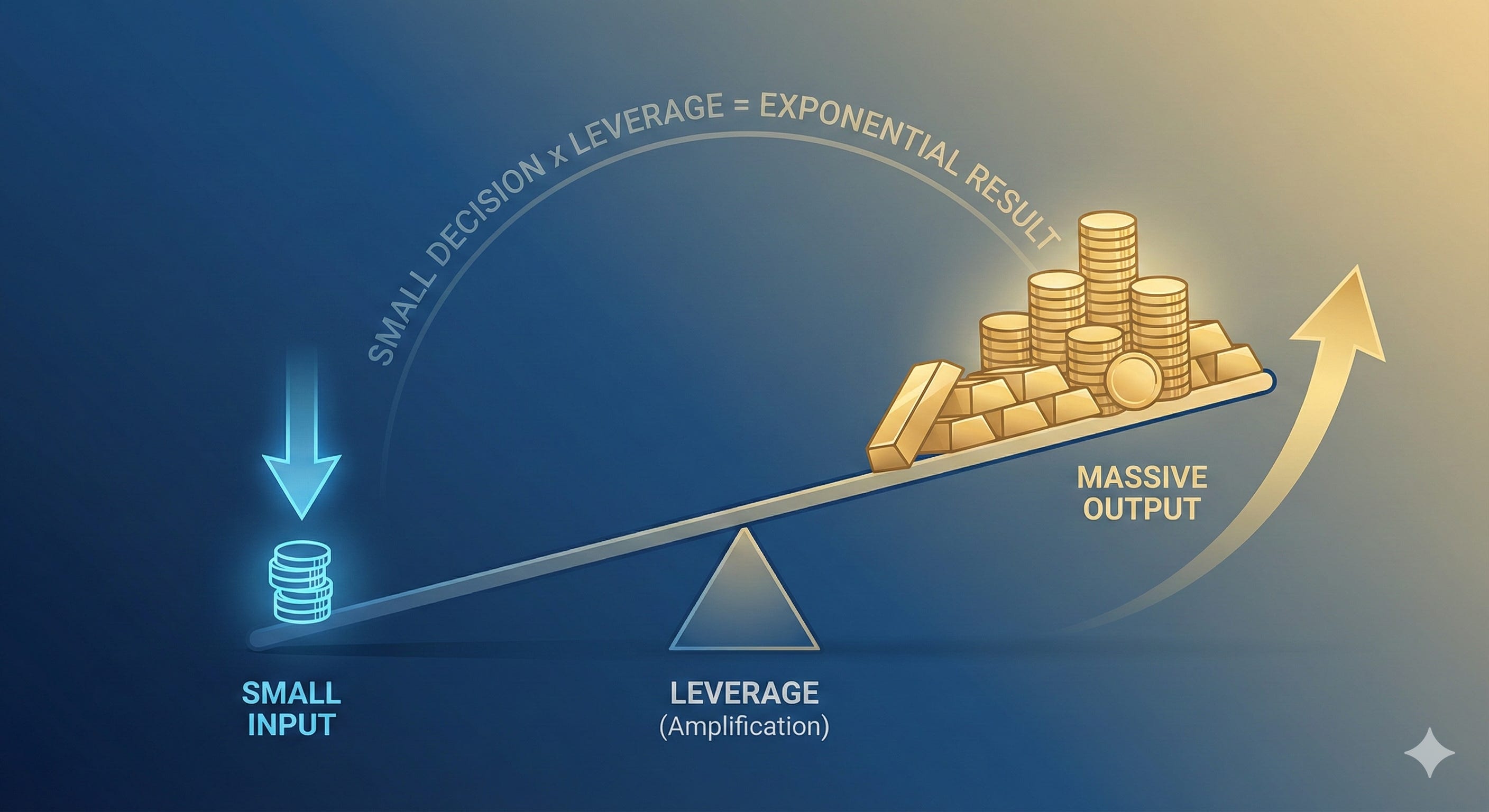
The lesson of that period wasn’t about brilliance but about amplification. Leverage compresses time between decision and consequence while magnifying both conviction and exposure.
When prices move upward without interruption, risk feels manageable because it remains unrealized. Gains compound quickly while judgment adjusts slowly.
The Reversal That Recalibrates
So when the market inevitably collapsed, that amplification worked in reverse. Positions inverted and Sacca was left several million dollars in debt, a burden that required negotiated restructuring and years of repayment.
The lasting effect was calibration. Loss at that scale teaches you how fragile everything is. How thin the line is between ownership and obligation, and how quickly paper wealth dissolves.
By the time he moved into early-stage investing, he had already internalized how leverage distorts perception and how downside materializes without warning. That early confrontation with reversal was the base for his approach to risk from day 0.
2. Google Was The Training Ground
In 2003, Google was still evolving from search engine into the invisible backbone of the internet. While most people viewed a job there as a highlight for their CV, Sacca saw it as a chance to learn how giant systems actually run.
He did not just sit in meetings about software. He worked on the hard stuff such as initiatives that intersected with telecom policy, building data centers, and dealing with international laws.
It was evident that for Sacca, growth was not just a number on a screen. It was a physical reality that required moving massive amounts of money and equipment.

Learning the True Weight of Risk
When you work for a company that’s spending billions on hardware, you learn to see danger differently. You stop focusing only on how many users sign up. Instead, you look for the bottlenecks that can break a business. You start to see the difference between a product that gets attention and a system that becomes a permanent part of life.
This experience taught him to look for “indispensable” systems. In a world of apps that come and go, he learned to spot the ones that could turn into a utility.
How This Turned Into Better Investing
This background gave Sacca a massive advantage when he started investing in startups. When he saw early versions of Twitter or Uber, he did not just wonder if they were popular. He looked at the underlying structure. He asked if these companies could build a strong foundation through network effects and government rules.
Most investors wait for a company to become a success before they believe in it. Because Sacca had seen how global platforms are built from the inside, he could spot that potential early.
He was not guessing about the future. He was looking for the same patterns he had already seen at Google.
3. Why a Small Fund Could Do What Large Funds Could Not
In the world of investing, people usually think that having more money is always better. If a big bank has a billion dollars and you only have eight million, you might assume they will win every time.
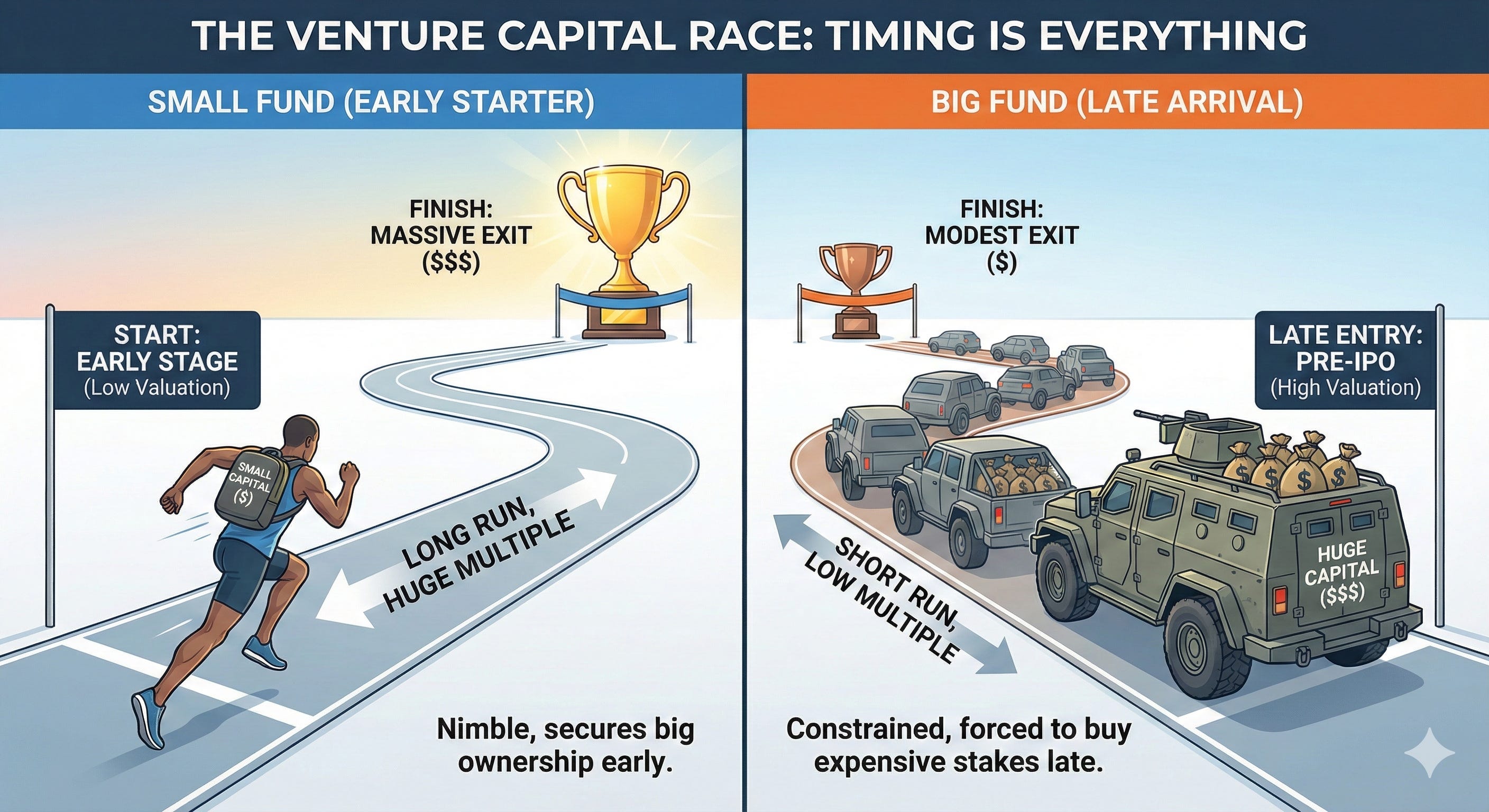
But the math of venture capital often works the other way around. Because Sacca’s fund was small, it could do things that the giants were physically unable to do.

The Simple Math of Winning Big
Think about it like this: if you have a tiny fund and you put $100,000 into a brand-new company, you might own 2% of it. If that company eventually becomes worth $10 billion, your small slice is now worth $200 million.
For an $8 million fund, that is a legendary result. But for a billion-dollar fund, $200 million is just okay. To a giant firm, that small check feels like a waste of time.
Big funds are trapped by their own size. They have so much cash that they are forced to write huge checks into companies that are already well-known. By the time they arrive, the price is high and the potential for a massive payout has shrunk.
Sacca’s advantage was that he could play in the “early days” where the big players wouldn’t or couldn’t go.
Ownership Over Everything
Many investors just want to say they were involved with a cool startup. They want the logo on their website for the fame.
But Sacca did not care about fame at all. He cared about how much of the company he actually owned.
When you run a huge firm, you have to answer to committees and partners. If you want to put 10% of your money into one tiny, risky idea, your boss will probably say no.
But because Sacca was working alone with a small amount of cash, he could be as bold as he wanted. He could focus his money exactly where he had the most confidence and conviction.
Speed and Freedom
Big firms move slowly. They have meetings, votes, and long lists of rules to manage risk. This protects them from losing money, but it also stops them from moving fast. Sacca had no one to argue with. If he liked a founder, he could write a check and get back to work immediately.
The success of Lowercase Capital Fund was not just about picking the right companies, but about having a setup that allowed him to own enough of those companies to move the needle.
Most big funds are built to be safe and steady. Sacca’s fund was built to capture the full power of a win.
4. Keeping Your Slice of the Pie
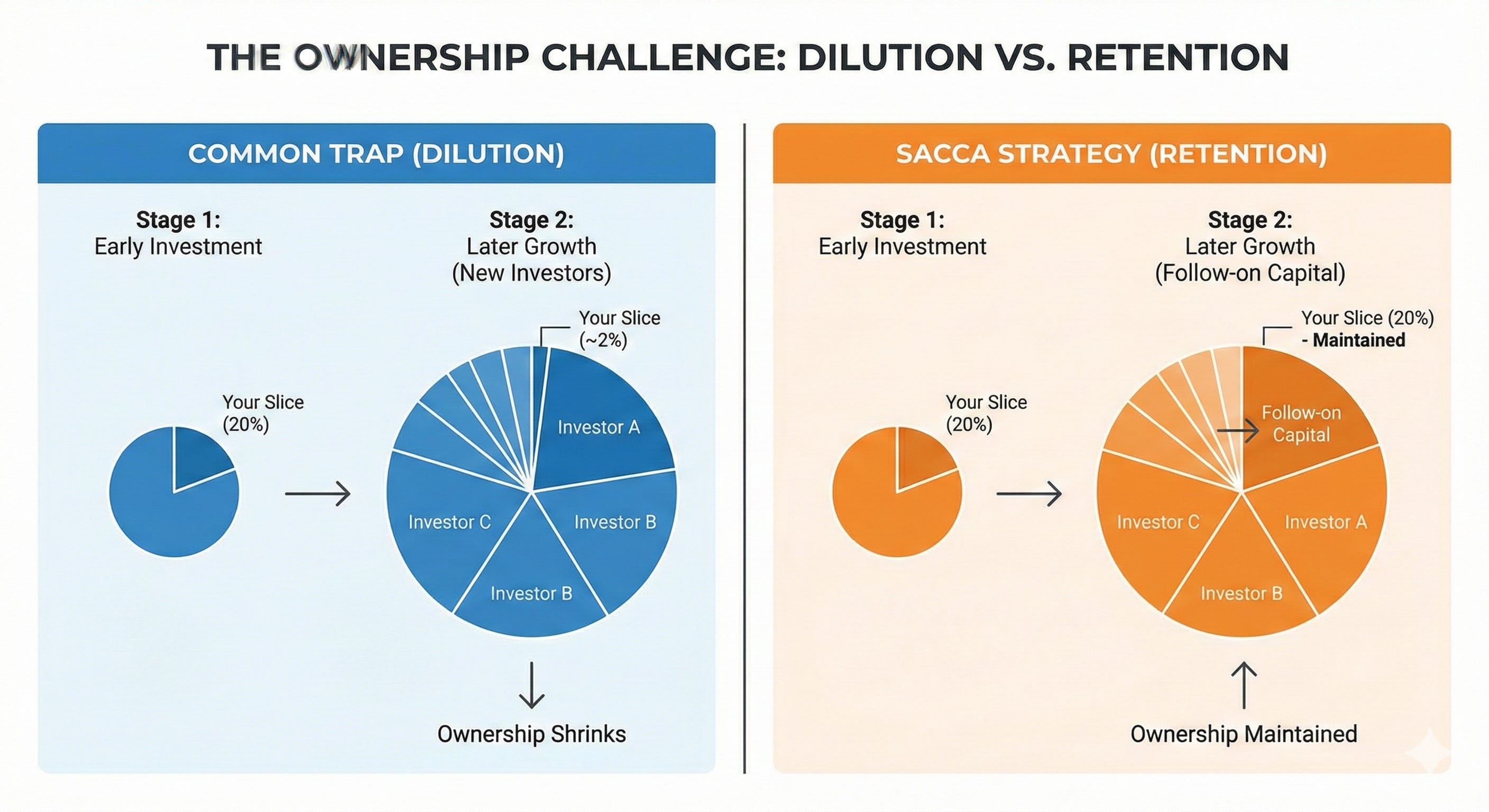
Getting into a great company early is only half the battle. As a startup grows, it needs more and more money to keep going. Usually, every time a new investor puts money in, the original investors see their percentage of the company get smaller through what is known as “dilution”.
This is a common trap. Many people own a piece of a “unicorn” company but end up with very little cash because their share was watered down over time.
Sacca understood that he didn’t just need to be “in” companies like Twitter and Uber. He needed to make sure his slice of the pie stayed large enough to be life-changing.
Buying When Others Wanted Out
When Twitter started to show it could be a massive success, it wasn’t yet a sure thing to the rest of the world. Some early employees and investors wanted to sell their shares to get cash right away.
At the time, most big investment firms weren’t set up to handle these small, private sales. They preferred to wait for the official, multi-million dollar funding rounds.
And that’s when sacca saw an opening. He created special accounts specifically to buy these shares from people who wanted out.
It was a brilliant move. He was buying more of the company at a price that looks like a bargain today. And he did the same with Uber.
He didn’t just wait for the company to ask for more money. He went out and found shares to buy whenever he could.

Using Money as a Simple Tool
In the later stages of a startup’s journey, writing a huge check is often about status or “signaling” to the market that a company is a winner.
For Sacca, capital was just a tool to solve problems and lock in his position. He used his funds to help founders bridge a short-term need for cash or to clean up a messy list of early investors.
By helping the company solve these small issues, he was able to buy more ownership when there was very little competition.
He was also disciplined about where he put his extra cash. He didn’t spread it thin across every company he owned. Instead, he doubled down on the ones where he had the most confidence.
In the end, his success came from treating ownership as something to be defended and grown, not just something you get lucky enough to start with.
5. Three Companies, One Fund, and the Reality of Concentration
People often look at a famous investor’s website and see a long list of logos. They assume the secret to success is being right fifty times. But for Lowercase Capital Fund, the story is all about concentration.
Twitter, Uber, and Instagram generated an overwhelming share of value. Yes, other investments did produce returns in absolute terms, but they did not define the fund. The real magic happened because Sacca went very deep on just a few massive winners.
To put this in perspective, the fund turned its initial $8.4 million into a payout of several billion dollars for its investors. At its peak, the Twitter position alone was worth approximately $1 billion, while the Uber stake grew to be worth billions more.
Betting Everything on Conviction
If you have eight million dollars and spread it thin across fifty different startups, you are actually making it harder to win big.
Even if one of those companies becomes a huge success, you won’t own enough of it to change your life. To reach a return like 200x, you have to do the opposite of “playing it safe.”
You have to find the companies that can become essential parts of daily life and own as much of them as you can.

The Math of the Home Run
In the startup world, there is a common rule: one big winner usually pays for all the companies that fail. Others might refer to it as the “Power Law.”
In this case, that rule was taken to the extreme. Twitter alone would have made Sacca one of the best investors ever. Uber was an even bigger win. When you add Instagram to the mix, the rest of the portfolio almost disappears.
Most people think that spreading your money around is the best way to manage risk. But in venture capital, spreading your money too thin can actually be a mistake. It dilutes your upside.
By focusing his cash and his time on just a few “indispensable” systems, Sacca turned a strong performance into a result that the rest of the industry still can’t quite believe.
6. Standing Out By Being Different
In an industry where consensus is starting to become the norm, being different is a huge advantage. Most investors in Silicon Valley wear the same clothes, talk the same way, and live in the same neighborhoods.
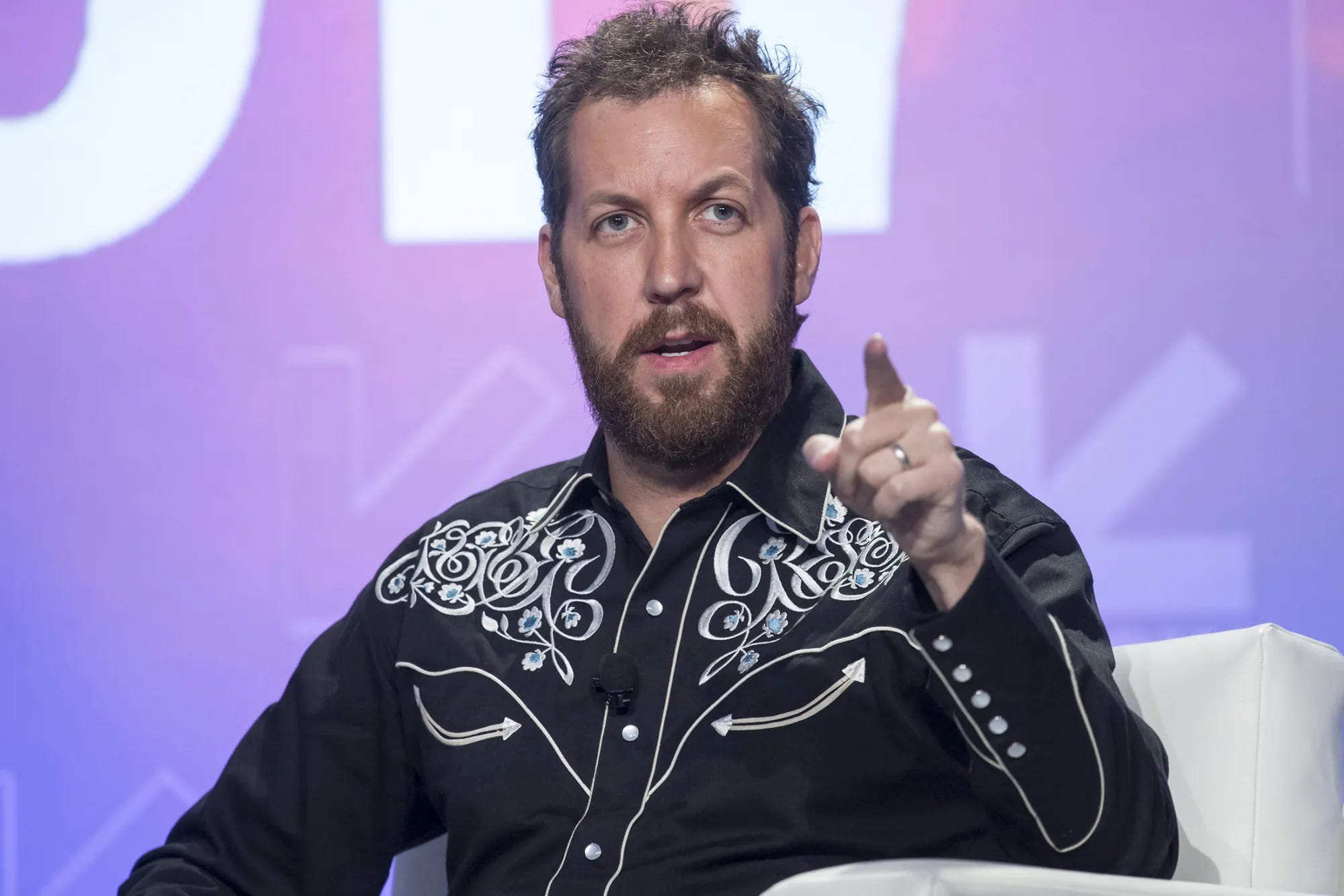
But Sacca did the opposite. He became famous for wearing embroidered cowboy shirts and living in the mountains of Truckee instead of staying near the big, traditional firms.
The Power of Being Memorable
When a founder meets 50 investors in a week, those people all start to blend together. But they always remember the guy in the cowboy shirt.
And this was not just a fashion choice for Chris. It was a strategy to be remembered. By standing apart from the crowd, he made it easier for the best founders to find him and remember him when it was time to sign a deal.
Using the Internet as a Bridge
Chris was actually one of the first investors to be very active on Twitter. By sharing his thoughts publicly, he made founders feel like they already knew him before they ever met in person.
This created a level of comfort that most other investors didn’t have. In a business built on relationships, being the person everyone feels they already know is like having a head start.
Access in venture is often attributed to network density and also shaped by signal clarity. By standing outside the prevailing aesthetic and geographic norms, Sacca increased the likelihood that founders would remember, contact, and engage him. In a business where first conversations often precede formal process, memorability has structural consequences.
7. Why This Was a Rare Moment in Time
It is tempting to look at these results and think there is a simple “how-to” guide you can follow to do it again.
But the truth is that Sacca’s success was a mix of great choices and a very specific moment in history. The late 2000s were a unique time when the world was changing in ways we will likely never see again.
A Perfect Storm of Technology
When the first fund started, smartphones were just becoming popular. Social networks were turning from hobbies into necessities, and it was becoming cheaper than ever to start a software company.
Companies like Uber and Twitter were building on top of brand-new technology that had not yet reached its full potential.
Less Competition
Back then, there were far fewer people trying to invest in tiny startups. Big firms were still focused on older, more established companies.
This meant Sacca could get into world-changing businesses at very low prices. Today, the market is crowded, valuations are inflated, and every big VC fund or investment bank has a team looking for the “next big thing.”
The Final Word
Lowercase Capital Fund I was a “lightning in a bottle” event. It was the result of a small fund having the freedom to move fast, a single person with a clear vision, and a world that was ready for a digital revolution.
While you might not be able to copy the exact results today, the lesson remains the same: focus, ownership, and the courage to be different are still the best tools an investor can have.
If you want to learn more about Chris Sacca, his podcast episode with Tim Ferriss from 10 years ago is definitely worth listening to: