

The Beginning of a Venture Capital Doom Loop?
The venture capital industry rarely reflects reality. It still feels like a new golden age.
Pitch decks look cooler than ever. Demo days are packed. And every other LinkedIn post is a “humbled and honored” announcement of a new $500M fund.
Everyone is talking about AGI and the next trillion-dollar frontier like the money is just going to keep flowing forever.

The reality is much more sobering when you look at the actual cash moving through the system.
We are stuck in a massive plumbing backup.
The traditional exit doors, where companies go public or get bought, have been welded shut for years. This has created a doom loop where firms are forced to keep raising new money just to stay in the game, even though the cash they owe their investors is trapped in startups that might not see a payday for another decade.
This is the biggest open secret in the valley.
The paper wealth has never been higher. The actual bank accounts are bone dry.
1 thing worth doing while the fundraising environment is still tight:
Enterprise deals are one of the few reliable growth paths in a market where VC money is moving slower. The one thing that consistently unlocks them is SOC 2 certification.
Vanta’s free checklist maps every step:
▫️ Scoping your compliance program from day one
▫️ Filling gaps before your audit
▫️ Continuously maintaining compliance after certification

Whether you are starting from scratch or preparing for your first enterprise customer conversation, you will know exactly what is required and when.
In a market where liquidity is scarce, SOC 2 is the credential that opens the doors VC cannot.
Table of Contents
1. The Machine Was Built for a World That No Longer Exists
2. What the DPI Numbers Are Actually Telling Us
3. 1,500 Unicorns, $6 Trillion, and Nowhere to Go
4. The Secondary Market Is Booming (And Why That’s a Problem)
5. When Investment Theses Start Sounding Like Theology
6. What Comes Next — And Who It’s Coming For
1. The Machine Was Built for a World That No Longer Exists
The traditional venture capital structure was designed for an environment where exits occurred often enough to recycle capital on a predictable rhythm.
Limited partners (LPs) usually commit money to funds expected to last roughly ten years. The first three to five years are spent deploying capital into startups. The remaining years are meant to convert those investments into realizations (cash) through acquisitions or public offerings.
The Breakdown of the Exit Rhythm
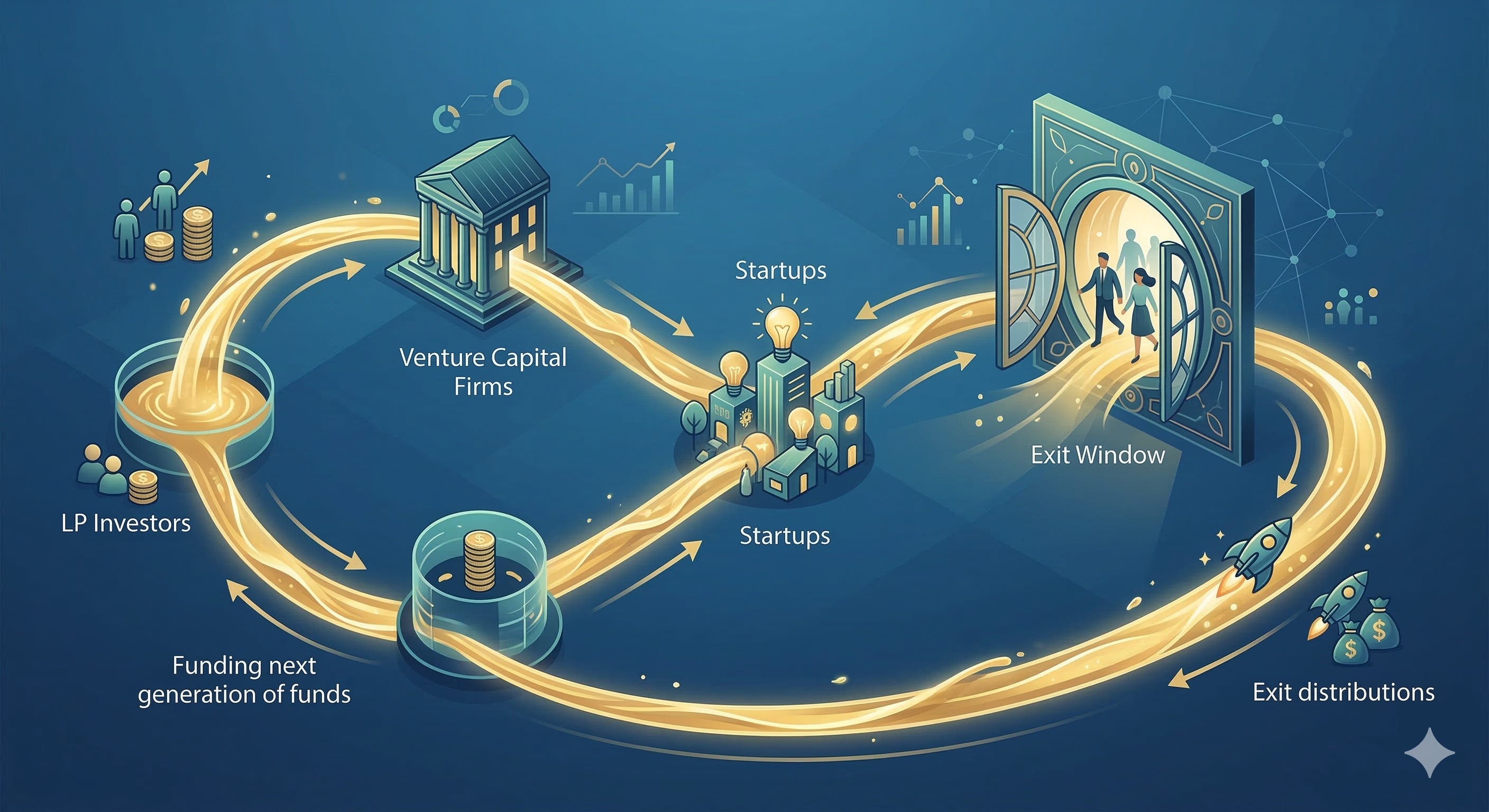
When exit windows functioned normally, the model worked with surprising elegance. Capital moved from LPs to venture firms, from venture firms to startups, and then back to LPs through distributions that funded the next generation of funds.
That rhythm depended on relatively stable exit markets. IPO windows opened regularly, strategic buyers paid strong premiums for technology assets, and venture-backed companies reached liquidity events within a timeframe that matched the structure of the fund.
Under those conditions, incentives across the system aligned neatly with investor interests. Cash returned to LPs funded new commitments and the cycle repeated.
The Incentive to Stay Big
The economics of the model explain why venture firms grew larger even as exits slowed.
Management fees, typically around 2%, scale with fund size. A firm managing $5 billion collects $100 million annually just to keep the lights on. This creates a powerful incentive to continue raising and deploying capital, even if the exit market is increasingly constrained.
What happens when the exit environment weakens for an extended period is now becoming visible. Funds still operate under the same ten-year structures and deployment windows defined in their LPAs.
Capital must still be invested. Firms must still demonstrate activity to justify their existence to current and prospective investors. The result is a system that continues deploying capital even as the exit becomes increasingly constrained.
This is the mechanical foundation of the doom loop. Firms are responding rationally to a structure built for an era of predictable liquidity that no longer exists.
2. What the DPI Numbers Are Actually Telling Us
The easiest way to misunderstand the current crisis is to focus on the wrong metrics. Venture firms often highlight “paper gains” to describe performance, but these numbers don’t answer the only question LPs actually care about:
How much cash has actually come back?
The Vintage-Year Story
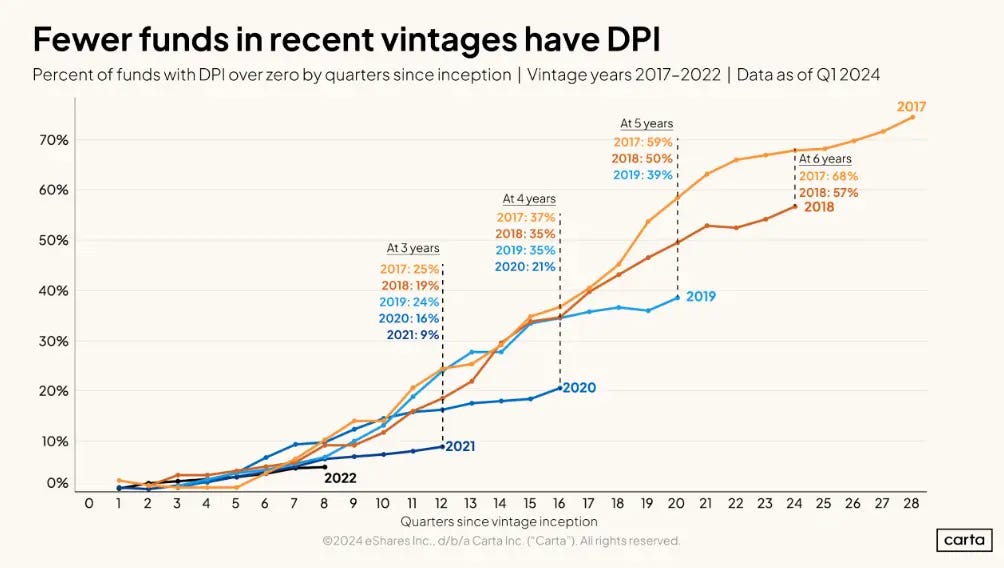
The most revealing metric is DPI (Distributed to Paid-In capital), which measures the distributed capital relative to the money investors originally committed. DPI is difficult to embellish because it measures realized outcomes rather than projected value.
Data from Carta illustrates that realized returns are getting harder to come by.. Five years after launch, 2017 vintage funds had returned roughly 59% of paid-in capital to investors, while 2019 funds returned only 39% at the same mark.
Historically, reaching the milestone of returning all original capital arrived much earlier. Today, it is becoming a rare event.
And although the gap may appear modest, across hundreds of funds it represents a significant drop in realized liquidity.
Paper Value Versus Cash
The gap between paper wealth (TVPI) and actual cash (DPI) has widened significantly. TVPI stands for Total Value to Paid-In Capital. TVPI includes both realized gains and unrealized portfolio value. So if a portfolio company raises a new round at a higher valuation, TVPI rises immediately. DPI does not move until that company produces an actual exit.
During periods of strong exit activity, the two measures tend to move together. When exit markets slow, they diverge. Venture portfolios can continue to show attractive TVPI while returning very little cash.
And that divergence has widened in recent years. According to McKinsey, LP distributions fell to roughly 6% of assets under management in the first half of 2025, while the ten-year average is closer to 14%. The gap translates to tens of billions of dollars in delayed liquidity.
Institutional investors like pension funds and endowments do not see this as a rounding error because they rely on those distributions to meet real-world payment schedules and scholarships. When the cash stops flowing, the pressure travels through the entire capital stack.
Quarterly letters may highlight improving portfolio valuations but DPI tells a simpler story. Cash is returning more slowly, and each successive vintage cohort is starting from a weaker position than the one before it.
3. 1,500 Unicorns, $6 Trillion, and Nowhere to Go
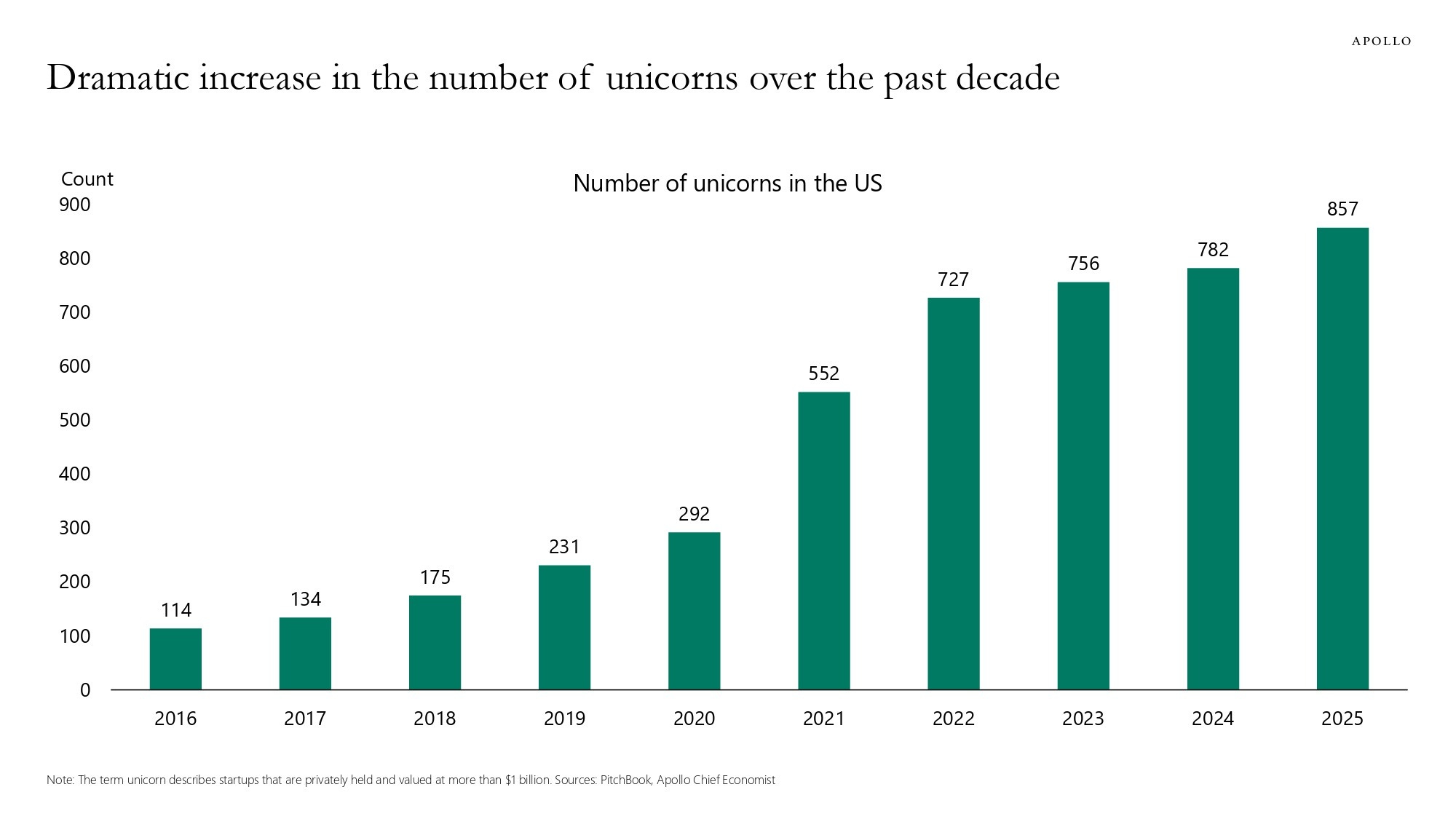
Over the past decade, venture investors created an unprecedented number of billion-dollar startups. The global roster now includes more than 1,500 such companies with a combined private valuation approaching $6 trillion.
That scale would be manageable if the exit pipeline were functioning normally. It becomes far more complicated when many of those companies remain private far longer than the venture model anticipated.
The 49-Year Backlog
Crunchbase data highlights how stagnant the situation has become. More than 60% of these companies have not raised capital at a new disclosed valuation for over three years. Their last marks often date back to the financing peak of 2021.
Crunchbase ran a simple thought experiment to illustrate the scale of the problem. If unicorns exited at roughly the same pace seen in recent years, clearing the backlog would take 49 years(!).
It sounds like an exaggeration, but the math is correct. The pipeline is not clearing; it is clogged with companies that are too large to be easily acquired and too “expensive” for the current public markets.
The IPO Window That Never Reopened
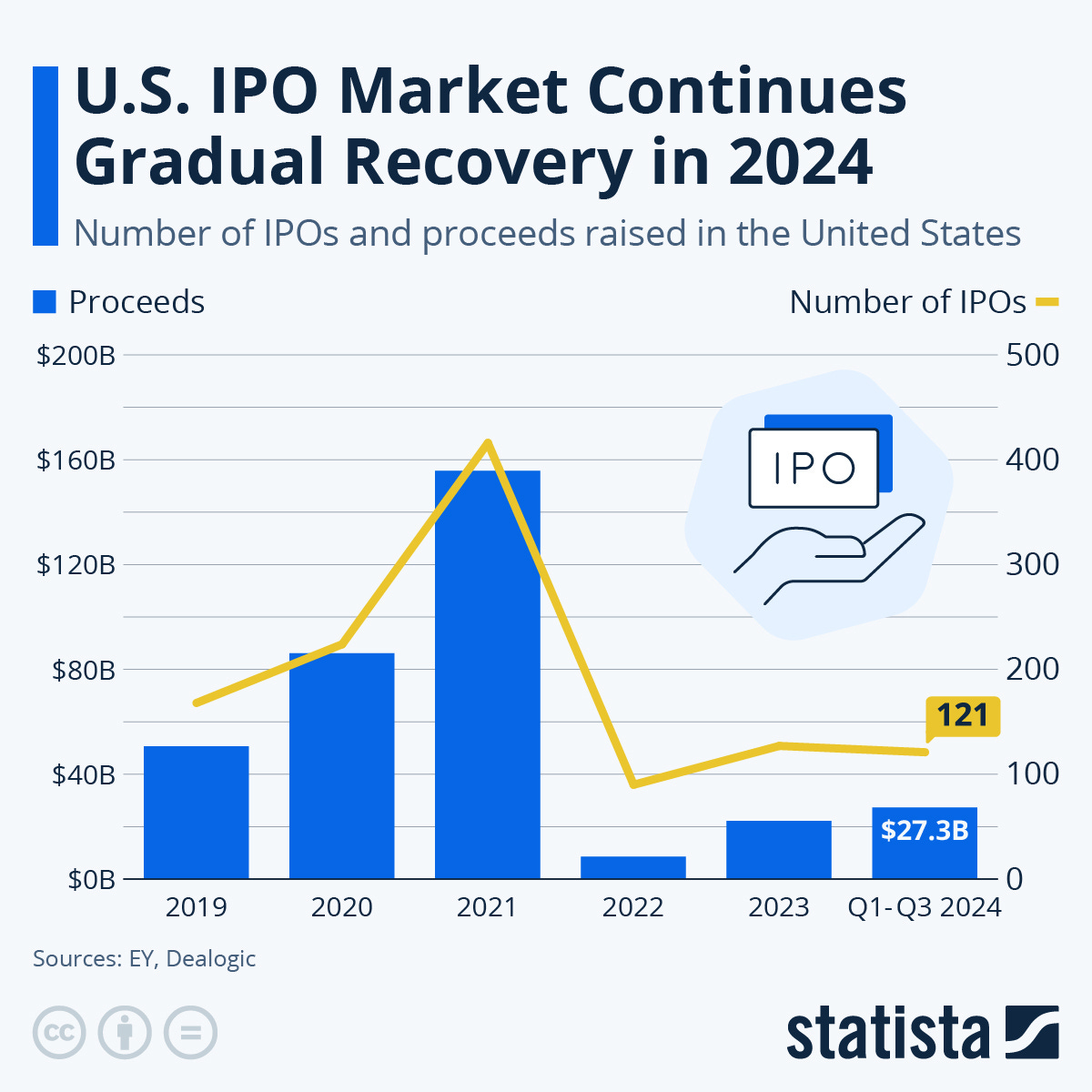
Public listings historically absorbed a large share of venture-backed liquidity. In 2021 the market saw almost 400 IPOs in the United States. The following year the number collapsed to just 38.
Activity improved slightly afterward, yet the recovery has been limited. Around 72 venture-backed companies went public in 2024. That represents stabilization, not a return to the pace venture portfolios were built around.
The slowdown has produced what many investors now describe as a venture capital IPO drought. A modest reopening of the window does little to resolve the imbalance between supply and demand for public listings.
The M&A Safety Valve That Slowed
Mergers & acquisitions usually provide the second path to liquidity. Large technology platforms frequently purchased emerging companies to expand product lines or defend market positions.
However, that environment has changed as antitrust scrutiny intensified in the United States and Europe. Deals involving major platforms now face longer regulatory reviews and greater political risk.
Private equity firms historically served as a secondary buyer for mature venture-backed companies, yet they are dealing with their own liquidity constraints. The result is an exit market that clears far fewer companies each year than the venture industry has created.
Late-stage companies that raised at 20x revenue in 2021 are looking at a public market that currently prices them closer to 5x. Rather than taking the “haircut” of a down-round or a disappointing IPO, they delay, keeping the valuations on the books while the backlog grows.
The Great SaaS Reset: From 30× Euphoria to AI-Driven Repricing

In the early days of a B2B SaaS startup, crossing $1M in Annual Recurring Revenue is the first true validation that you’ve built something people actually want.
4. The Secondary Market Is Booming (And Why That’s a Problem)
At first glance, the rise of the secondary market looks like one of the more encouraging developments in private markets. Transactions are increasing, liquidity options are expanding, and investors who once had to wait a decade for exits now have another path to reduce exposure.
By most conventional measures the market is thriving. Secondary transactions reached roughly $162 billion in 2024, about 45% higher than the previous year. Over the 12 months ending in June 2025, the volume of venture secondaries even exceeded the value of venture-backed IPOs.
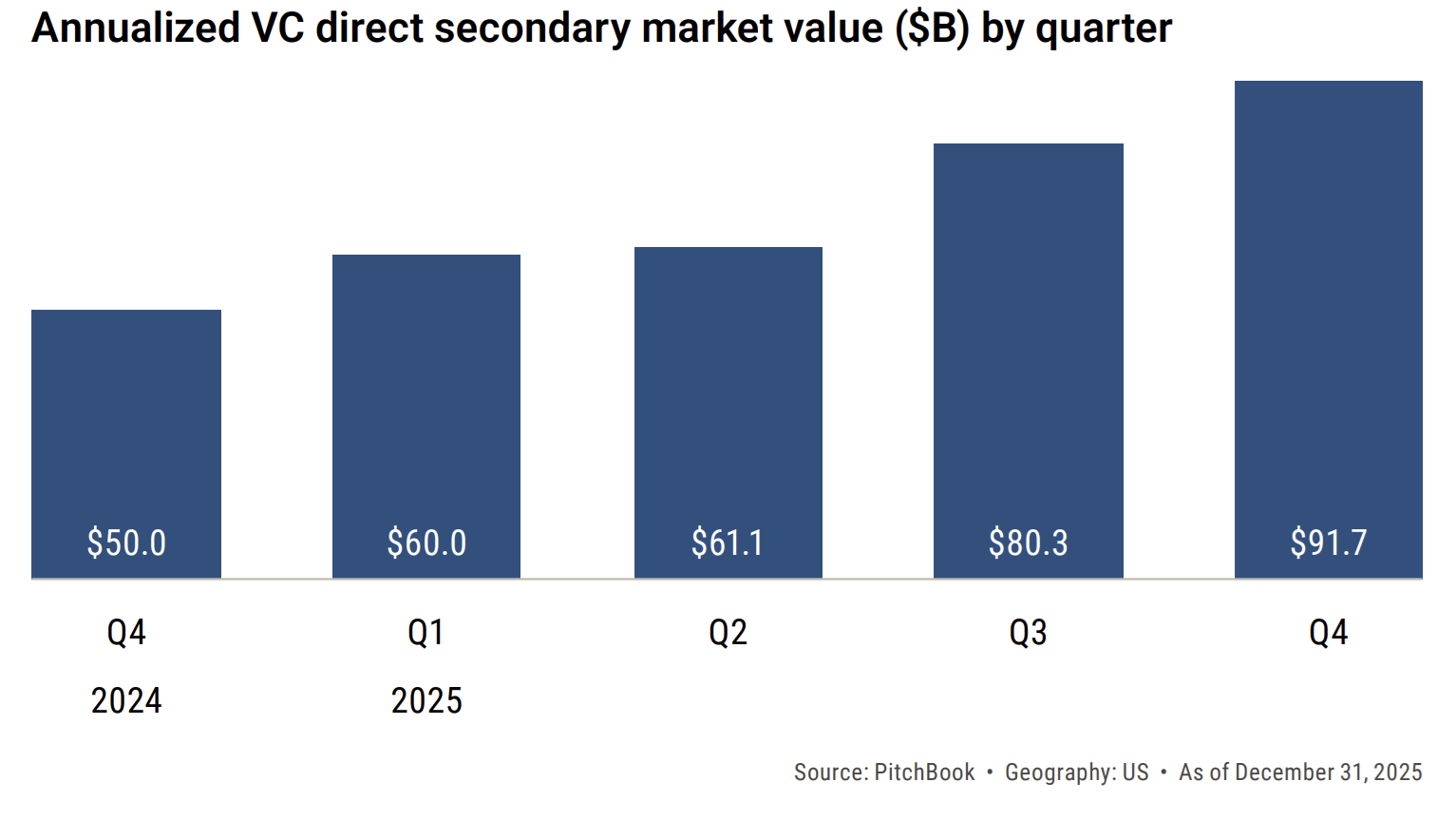
Recent data from PitchBook shows that US venture direct secondary transaction value totaled approximately $293 billion across the four quarters of 2025. If that trajectory holds, 2026 is shaping up to be the year the secondary market stops being a workaround and becomes the default.
The Reality of the Secondary Discount
Those numbers can easily be interpreted as evidence that the market has found a healthier equilibrium. In some ways it has.
Secondaries provide genuine price discovery and allow early investors, employees, and sometimes founders to obtain liquidity without waiting for a public listing that may never arrive. The market is performing a function that traditional exit channels have struggled to provide.
At the same time, the surge in secondaries is also the clearest signal of the strain. These trades reveal the prices sophisticated buyers are actually willing to pay.
Throughout late 2024 and 2025, stakes in VC funds often changed hands at discounts of 40% to 60% below their reported value.
These transactions are an indication of a market correction happening in private because formal write-downs weren’t appearing in quarterly reports.
The Rise of the Continuation Vehicle
This environment has also accelerated the rise of “continuation vehicles,” where a GP moves companies from an old fund into a new one. That way, early LPs gain the option to exit while the GP extends the holding period of assets that have not yet reached a natural liquidity event.
While useful for extending the clock on assets that aren’t ready to exit, their prevalence highlights a core issue. When exits fail to arrive on schedule, the system builds mechanisms to delay the inevitable.
Secondaries provide liquidity, but they also expose the depth of the valuation gap.
5. When Investment Theses Start Sounding Like Theology
Every investment cycle eventually produces stories that help participants make sense of uncomfortable numbers. When distributions slow and exits stall, those stories begin to promise certainty about a distant future, asking investors to have “conviction” rather than looking at present data.
At that point the language of venture capital begins to resemble belief more than analysis.
The Trap of Conviction-Based Narratives
One example discussed in recent years is the American Dynamism thesis. The argument is that geopolitical rivalry with China will force the United States to invest heavily in domestic defense technology, making venture-backed defense companies strategically indispensable.

While defense innovation is strategically vital, the liquidity timeline is often ignored. Defense procurement is slow and political.
Yet some narratives move quickly from that observation to a broader claim, where once artificial general intelligence arrives, traditional valuation frameworks no longer matter because the potential economic value becomes effectively unlimited.
Under that reasoning, the absence of present-day distributions is interpreted as evidence of how early the opportunity still is.

Disciplined Analysis vs. Belief
A disciplined investment thesis defines the conditions under which it proves incorrect. Many of the narratives circulating today do not. They offer conviction without a cash-out date.
This distinction matters when the capital involved belongs to pension funds and endowments that cannot pay their obligations with “conviction.”
6. What Comes Next — And Who It’s Coming For
Financial systems rarely collapse outright. What they do is adapt.
Venture capital is now entering a phase where the tools being built suggest this liquidity crisis is not a temporary glitch, but a permanent condition the market is learning to live with.
Adopting the Private Equity Toolkit
The first uncomfortable truth is that the venture capital industry is beginning to look more like private equity.
We are seeing the rise of evergreen structures, NAV lending, and retail access to private markets. These tools extend the life of assets that cannot clear the exit market.
In many cases, the result looks more like a refinancing process than a final realization. The system is learning how to hold assets for fifteen years instead of ten.
The New Reality for Founders and LPs
The implications differ depending on where you sit.
For LPs, quarterly marks are increasingly “estimates” rather than prices they could actually get.
For venture firms, survival depends on whether they can hold companies through longer cycles without losing their capital base.
For founders, the consequences are tough to swallow but not immediate. A slower exit environment eventually changes how new capital is priced and how much risk investors are willing to take.
Ultimately, the old rhythm of 2010-2022 is gone. The only question left is whether the industry adjusts gradually or through a correction it can no longer postpone.
This is well done. I think the big VC players are already acting like PE, just a question of whether they know it or not.
One of the best things that could happen is the public market becomes more receptive to smaller IPOs of tech companies again. Not sure how to solve that problem tho!
Also, I think we need terms to differentiate between seed funds and massive crossover funds that do a little bit of everything. They are not the same thing!