

A “secondary” is the sale of shares that already exist. A founder or an early employee sells stock they already own to an outside investor, so no new shares get issued and nothing reaches the company’s bank account.
In early 2026, institutional holders tried to move roughly $600 million of OpenAI stock on the secondary market and could not find buyers.
In the same stretch, Anthropic closed a $5.5 billion tender at a $380 billion valuation with demand running hot.
We’re talking about two of the most valuable private companies on earth, during the same quarter, with opposite results.
That is the market founders are now told they can count on for liquidity years before an exit. It exists, it is deep, and it is far more selective than any headline number suggests.
See Vanta in action. No sales call required.
No matter your size, Vanta helps you automate compliance, manage risk, and prove trust continuously—all from a single, agentic platform

Close deals faster by responding to security questionnaires in minutes, not days
Stay audit-ready year-round with continuous monitoring across 400+ integrations
Automate compliance for SOC 2, ISO 27001, GDPR, HIPAA, CMMC, and more
Over 16,000 companies around the globe trust Vanta. Watch the demo on your own time. Start anytime.
Table of Contents
1. Why Founders End Up Rich on Paper and Broke in Practice
2. The Number Everyone Quotes, and Why It Misleads
3. Eighty Percent of the Money Goes to Twenty Companies
4. Your Discount Was Set the Day You Last Raised
5. What Your Shares Are Actually Worth
6. Four Ways a Founder Secondary Dies Before It Closes
7. The Tax Rule That Costs More Than Any Discount
8. What to Do Before the Window Opens
1. Why Founders End Up Rich on Paper and Broke in Practice
Startup equity has always carried a catch, which is that you cannot spend it.
A founder’s stake only turns into cash at an exit, meaning the company is either acquired or goes public through an IPO. Until one of those happens, the shares are a number on a screen.
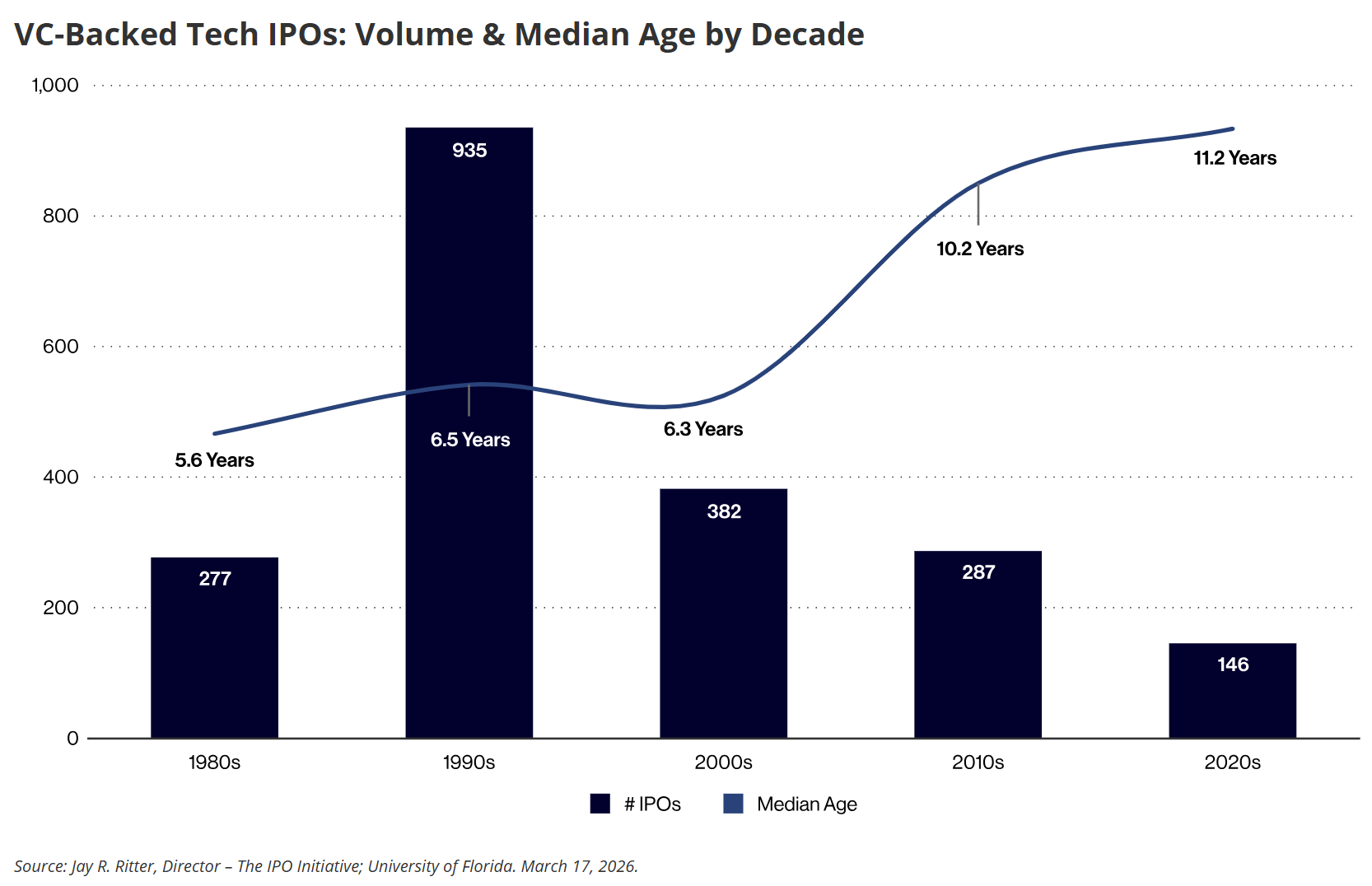
That has been a tolerable trade for startup founders in the past, because the wait from founding to exit ran about 5 to 7 years.
But recently, that timeline has roughly doubled. Companies now raise enormous sums privately and stay private for ten to fifteen years.
So a founder can hold $40 million of stock and still be doing sums about rent. Early employees have it worse, because they accepted below-market salaries for equity they cannot touch.
And that’s how the secondary market started growing.
Rather than waiting for the exit, shareholders sell a slice of what they hold to an investor who is willing to wait longer than they are.

2. The Number Everyone Quotes Is Measuring the Wrong Thing
According to a recent source, Carta has measured $61.1 billion of secondary share sales in the 12 months to June 2025, against $58.8 billion raised by every VC-backed IPO over the same period.
The conclusion drawn is that private share sales have overtaken the IPO market as a way for startup shareholders to get paid, which would mean the traditional exit no longer matters much.
But a distinction must be noted here.
Secondary sales put money in shareholders’ pockets. IPO proceeds put money in the company’s bank account. Those are different pots of money going to different people.
Founders and employees usually cannot sell anything at an IPO anyway. A lockup agreement typically bars insiders from selling for around 180 days after listing, so on the day a company goes public its founders receive nothing.
The fair comparison would be secondary sales against cash paid to shareholders in acquisitions, plus insider selling once lockups expire. On that basis, acquisitions alone are still far larger.
Then there is the question of whether anyone can measure this market at all, and the wider liquidity crunch has made it harder.
PitchBook’s Q1 2026 research put direct secondary transactions for the 12 months through March 2026 somewhere between $40 billion and $155.2 billion, midpoint $97.6 billion.
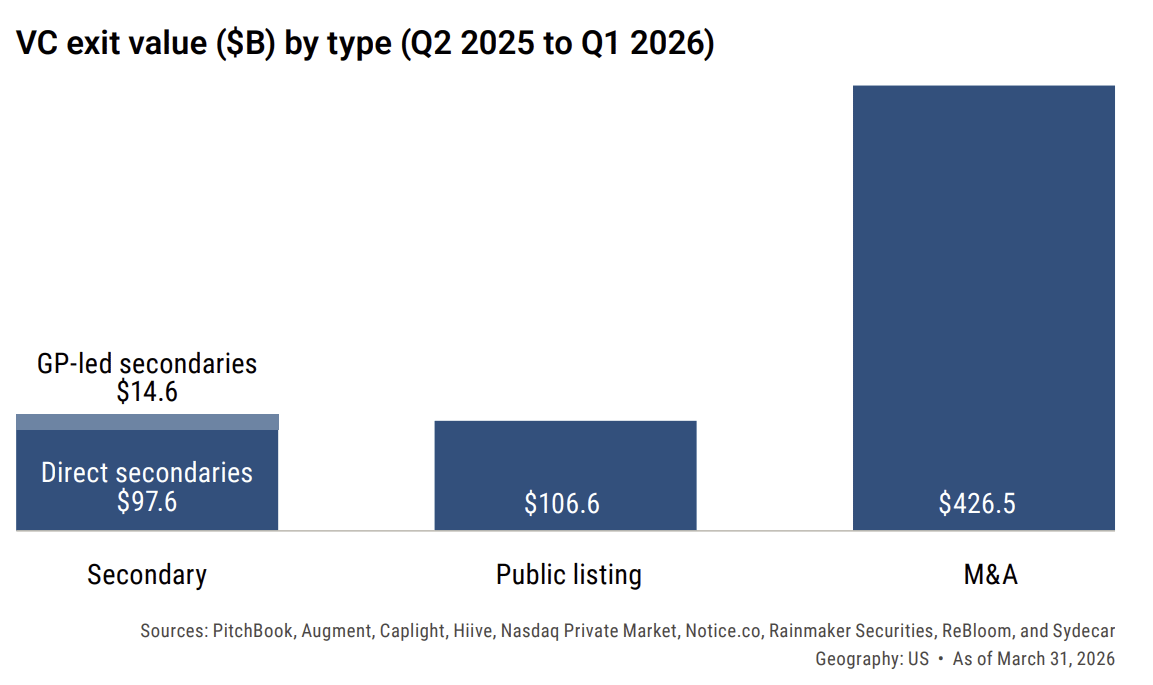
A spread that wide on a single defined quantity is arguably the most honest data point in the market.
Part of the reason is that much of what gets counted is not really a share sale. When a company refuses to approve a transfer, buyers find another way in.
They set up a shell company or setup a “Special Purpose Vehicle” (SPV), which either holds the shares or just holds a contract that tracks their price. Then they sell stakes in the shell instead. Sometimes shells sit inside other shells, two or three layers deep.
Every one of those layers can be counted as trading volume while the underlying shares never move.
Even at the largest estimate, almost none of that money is reachable for most companies.
3. Eighty Percent of the Money Goes to Twenty Companies
Secondary volume does not spread across the venture ecosystem. It clusters hard around a handful of perceived winners.
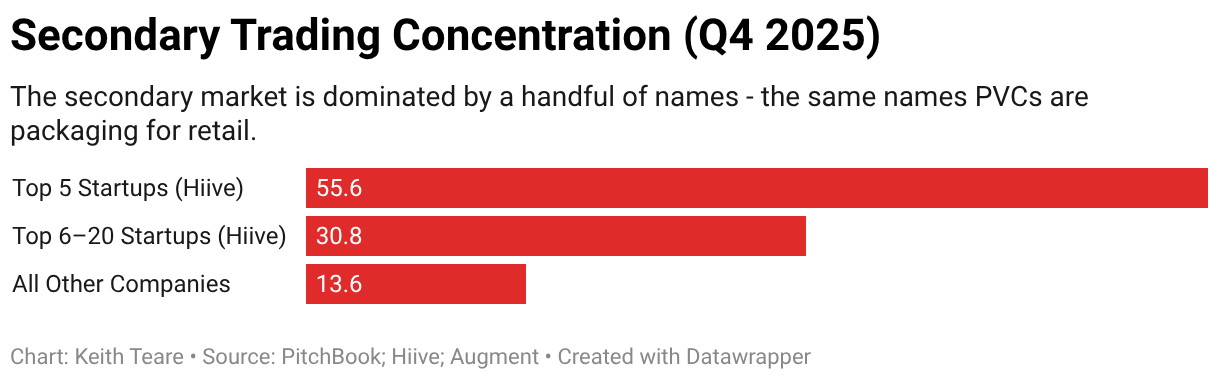
On Hiive, one of the main platforms where private shares change hands, the top 20 companies accounted for 86.4% of secondary trading value in Q4 2025, with the top five alone at 55.6%.
Caplight found that 75% of special purpose vehicles (SPVs) carrying carried interest were tied to 5 names: SpaceX, Anthropic, OpenAI, xAI, and Anduril.
And the anchor transactions say the same thing. SpaceX ran a $2.6 billion tender in December 2025 at a $1.25 trillion valuation, and OpenAI raised $6.6 billion in October at $852 billion.
That single OpenAI tender represented 6.2% of the entire year’s US secondary volume.
However, there is now real movement at the edges. By Q1 2026 the Hiive top 5 had fallen to 44.6% and the top 20 to 81.1%, which is genuine broadening inside one quarter.
Caplight counted 70 companies seeing their first-ever secondary trade during 2025, totalling $492 million between them. That averages around $7 million per company. Not too shabby.
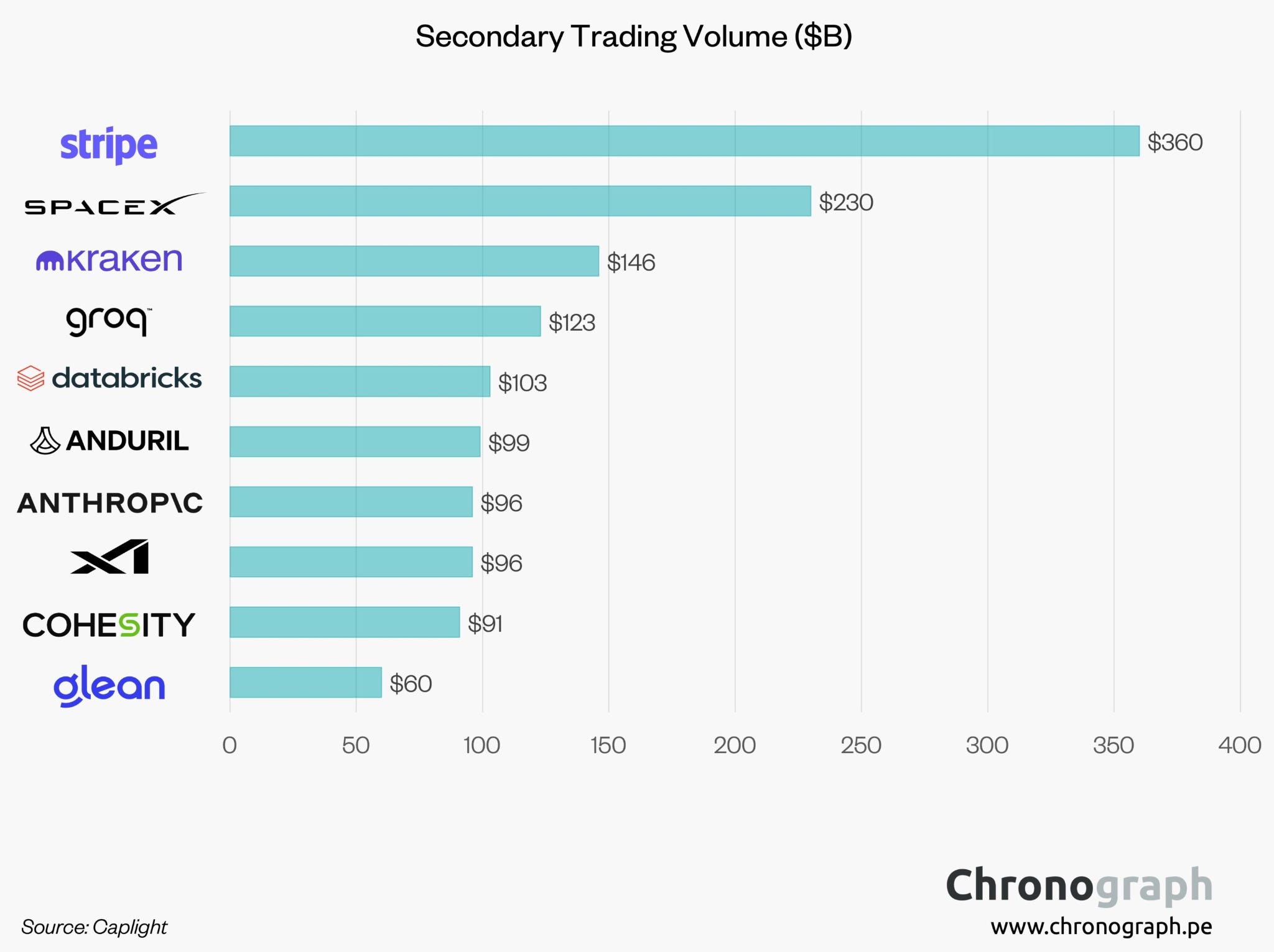
The on-ramp is widening and it is still narrow. If you run a median seed-stage company, nobody is bidding for your stock next quarter.
For companies that do trade, the price was largely settled long before the founder started thinking about selling.
4. Your Discount Was Set the Day You Last Raised
Private shares usually sell for less than the price of the company’s most recent funding round, and that gap is called the discount.
The most repeated pricing claim in secondary coverage is that discounts have nearly vanished, with the market-wide median falling to low single digits.
That median is close to meaningless, because it averages companies that share nothing except being private.
Caplight’s data, broken out by when each company last raised, tells a different story.
Businesses last priced in 2021 trade at roughly 60% below that round. The 2024 group sits at a 17% discount, 2025 at 1%, and companies priced in 2026 sell at full value.
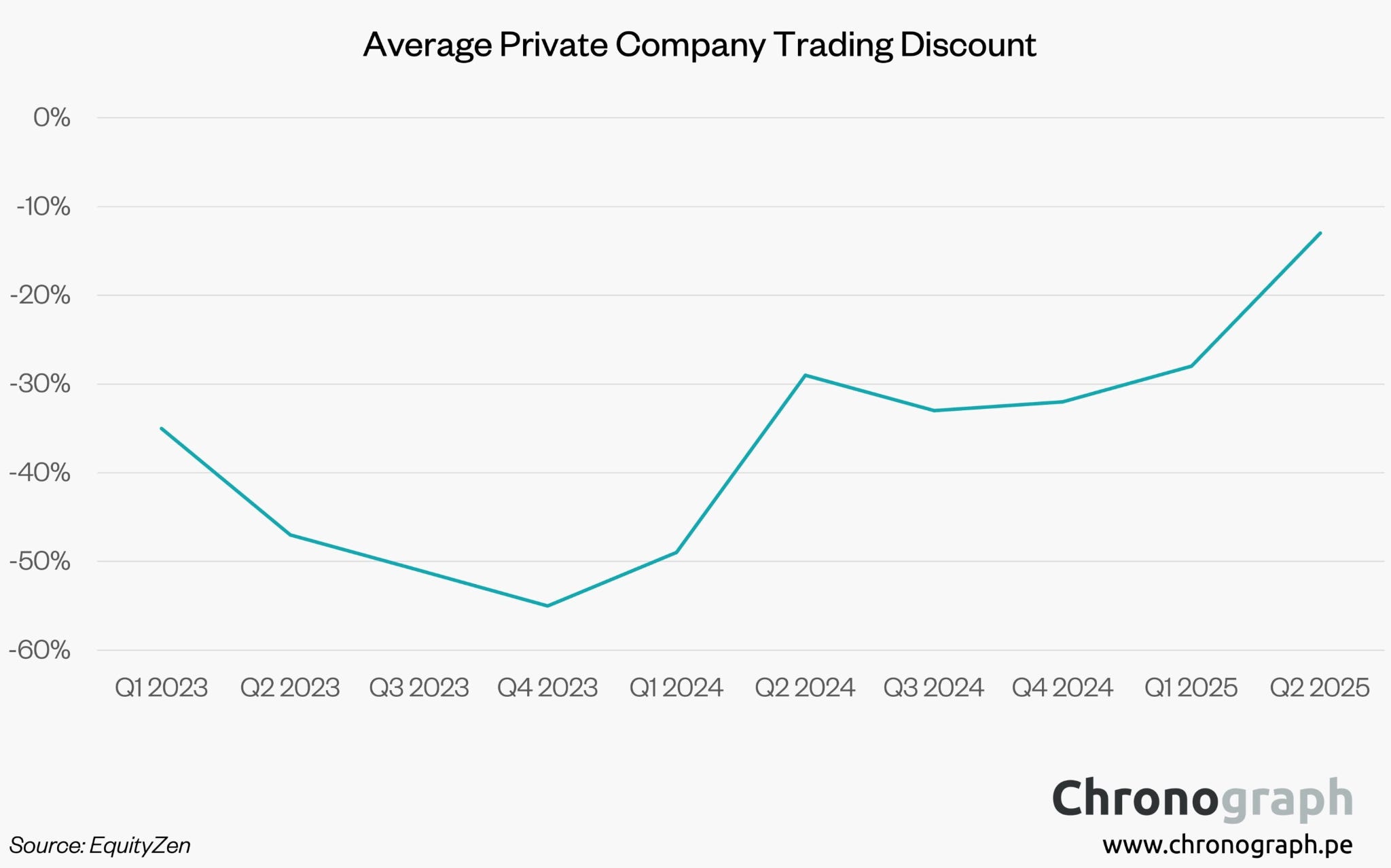
Your discount tracks when you last raised, not how the market happens to feel.
The reason is that 2021 was the peak of a funding bubble, when interest rates sat near zero and capital was close to free.
Buyers today refuse to pay prices built on conditions that no longer exist, and the 2021 overhang worked its way out of the trading population.
Much of the improvement in the headline median is not prices recovering. It is the 2021 group gradually dropping out of the pool of companies that trade at all.
Even at a fair clearing price, most founders start the conversation anchored to a number that was never really theirs.
5. What Your Shares Are Actually Worth
This is where founders lose the most money, and it comes down to owning a different class of stock from the investors.
Founders and employees hold common stock. Investors hold preferred stock, which comes with a protection called a liquidation preference.
A liquidation preference means investors get their money back first, before common shareholders see anything at all. The headline valuation reported in the press is calculated from the preferred share price, not the common one.
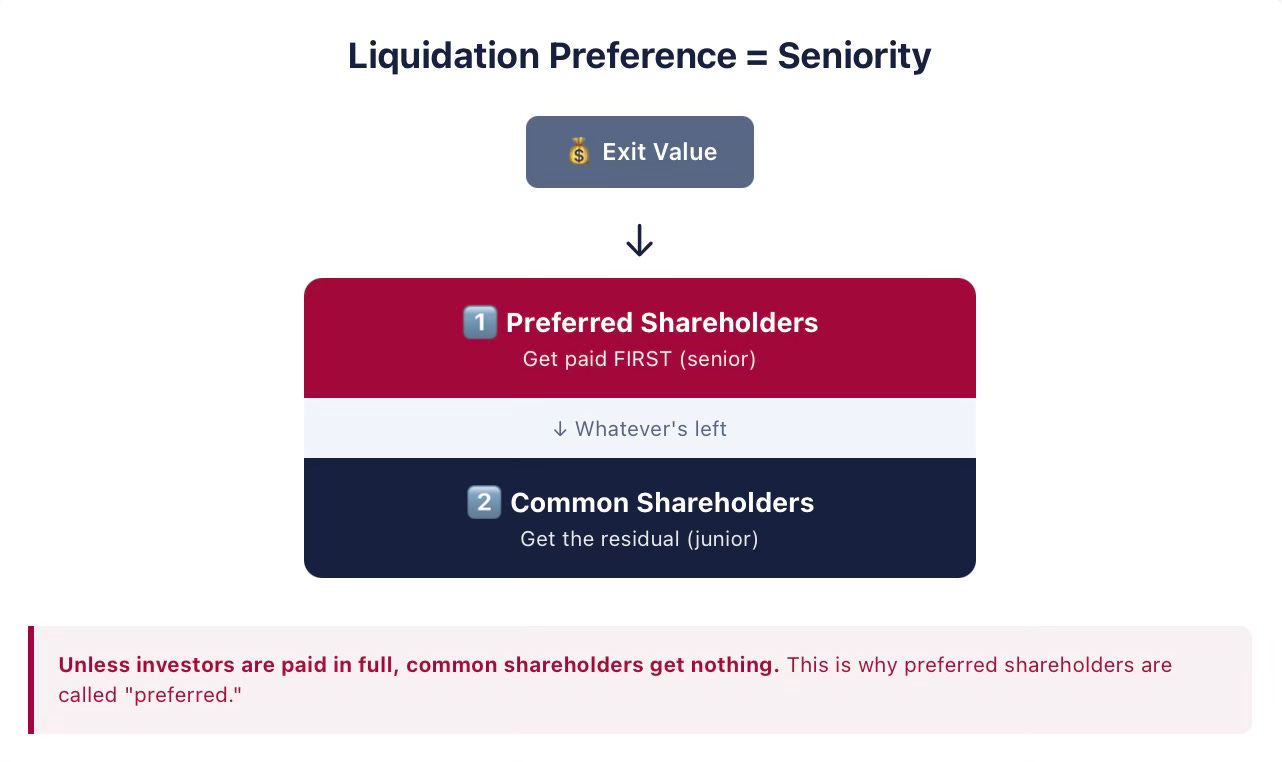
Take a company valued at $500 million after Series C, with 100 million shares and $150 million raised from investors. That is $5.00 a share, so a founder holding 10 million shares looks worth $50 million.
Sell for $200 million and investors take their $150 million back first, leaving $50 million across common. That is $0.83 a share, and the founder’s stake is worth $8.3 million.
At $150 million, common gets nothing.
The $50 million exists at exactly one valuation, which is today’s.
A discount to the preferred price is therefore rational, not a sign of weak demand.
It is also why the formal valuation of common stock, called a 409A, lands far below the last round price, and why how investors price it rarely matches what founders expect.
So, model the waterfall before discussing price. Pricing is the part founders can reason through, and the mechanics are where deals collapse.
6. Four Ways a Founder Secondary Dies Before It Closes
Founders very rarely miss out on liquidity because no buyer existed.
The Clause Nobody Read
Your financing documents almost certainly contain a right of first refusal, or ROFR. It lets the company and its existing investors match any outside offer before your shares can move.
Company-run sales, called tender offers, route around this: one price for all sellers, in a window US rules keep open at least 20 business days.

The 409A Advice That Is Backwards
A 409A is the independent valuation that sets the strike price on employee options, meaning what staff pay to turn options into real shares.
You will read that a tender protects your 409A while a private sale damages it. The reverse is true: a large sale open to everyone is the strongest evidence a valuer will see of what common is worth.
A tender buys control over timing, not protection from the price signal. Schedule option grants for after the number lands, or every hire that week gets a worse deal.
The Employees Who Cannot Take Part
Options must be converted into real shares before they can be sold. The strike price comes out of pocket, and US tax rules can treat the paper gain at conversion as taxable income.
So the longest-serving staff with the biggest stakes face the biggest cash bill, in a year when no cash has arrived. Letting them sell enough inside the same transaction to cover both costs fixes it, and most programmes omit it.
The Signal You Cannot Take Back
A founder selling reads, to the wrong audience, as a founder that is leaving.
So a better way of handling this is selling a small slice attached to a funding round, and applying the same rules as everyone else.
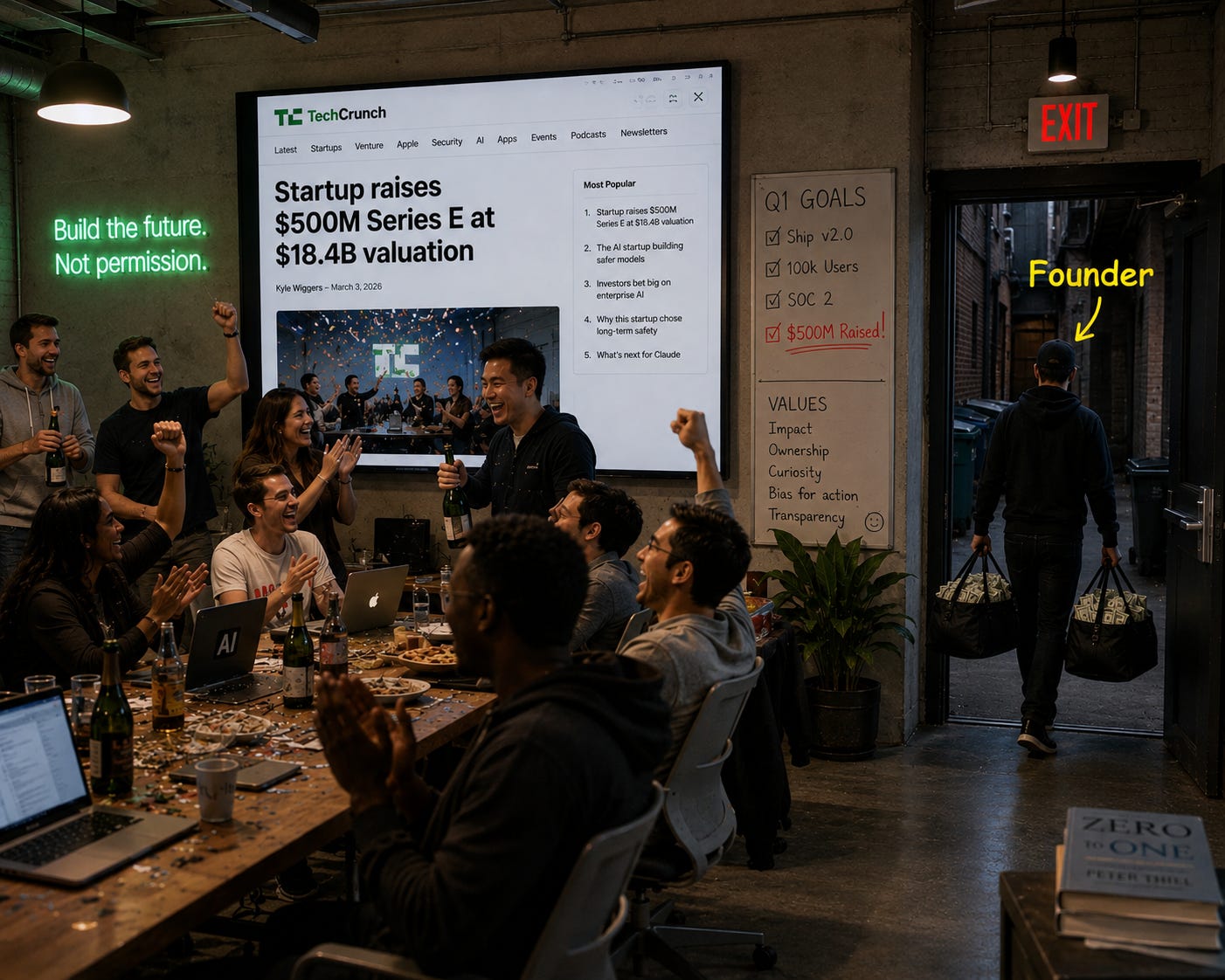
Selling 10% during a round everyone is celebrating signals confidence. Moving 60% behind the alley within a quarter signals what people fear.
7. The Tax Rule That Costs More Than Any Discount
For US founders especially, or those looking to relocate, the date on the share certificate is probably more important than the price negotiated.
There is a tax break called QSBS, short for Qualified Small Business Stock, that can wipe out federal capital gains tax on a sale of startup shares. It is usually the largest single number in the deal.
A law signed on 4 July 2025 rewrote this and shares issued after that date get a sliding scale. The current rule is: 3 years for half the gain tax-free, 4 years for 3 quarters, 5 years for all of it.
Shares issued on or before that date keep the old rules. 5 years or nothing, a $10 million cap, and no way to move existing holdings across.
Most founders selling today still sit under the old rules, where selling at year 4 is worth precisely nothing.

However, the new tiers are thinner than they look. Whatever is not exempt gets taxed at 28% rather than 20%, plus a 3.8% surcharge, so the real rate lands near 15.9% at three years and 7.95% at four.
On a $10 million gain, selling at year four costs roughly $795,000. Waiting twelve more months costs nothing.
If the company buys back its own shares as part of the deal, anti-abuse rules can void the break for shares issued around the same time.
Running the other way, a rollover provision lets you reinvest proceeds into another qualifying startup within 60 days and keep the clock running.
It is also federal only. California among other states ignores it, so a nationally tax-free sale can still produce a state bill.
None of which helps if you learn it during a live window.
8. What to Do Before the Window Opens
At the end of the day, the founders who manage to get liquidity are the ones who did the dull work months earlier. So here’s some advice.
Read your own documents. Pull the charter, financing agreements and stock plan, then write down what your ROFR, co-sale rights and transfer restrictions actually allow.
Get your tax position in writing. Note the issue date of every tranche, which rules apply, and when each holding period matures.
Agree an approach to liquidity with your board in a calm quarter, framed around keeping staff rather than personal need. A year early is the right timing.
Then attach the sale to your next funding round, where a fresh valuation and interested buyers are already in place, and a clean cap table makes it faster.
Sales usually cap participation between 10% and 20% of what you hold, so know your dilution across every round before picking a number.
There is a fair question about how long this lasts. Four fifths of trading value sits in companies that could go public soon, and PitchBook expects volume to drop when they list.
The infrastructure survives. Retail investors got access through OpenAI’s latest round, and the London Stock Exchange has launched the first regulated market for private shares.
Liquidity as a scheduled, repeatable process, running years before an exit, is a permanent change in how private companies work. This quarter’s volumes are not.
A founder who knows which tax rules her shares fall under, what her common is worth behind the preference stack, and what her ROFR permits is ready the day a window opens.