

A founder signs three SAFEs over eighteen months, each one a two-page document and a wire that arrives in days. Then the priced round comes, everything converts at once, and the ownership number on the pro forma cap table is fifteen points below what they carried in their head.
That conversation happens every week, and it happens because SAFEs delay the dilution math instead of removing it. The instrument is genuinely good, it transformed early-stage fundraising for a reason, but every SAFE is a promise of future shares at terms you agreed to under time pressure, and the bill arrives all at once.
This is the updated version of one of the most-read pieces in the archive, with the conversion mechanics worked through on real numbers, the data on what founders actually keep, and the cap table template rebuilt for modelling every scenario before you sign anything.
Dilution itself is the price of the game
Every round, every option pool, every advisor grant shrinks your percentage. The question was never how to avoid it, since 10% of a $100M company beats 100% of a $1M one by a distance. The question is whether each round makes the remaining slice worth more, and whether you gave up the equity knowingly.
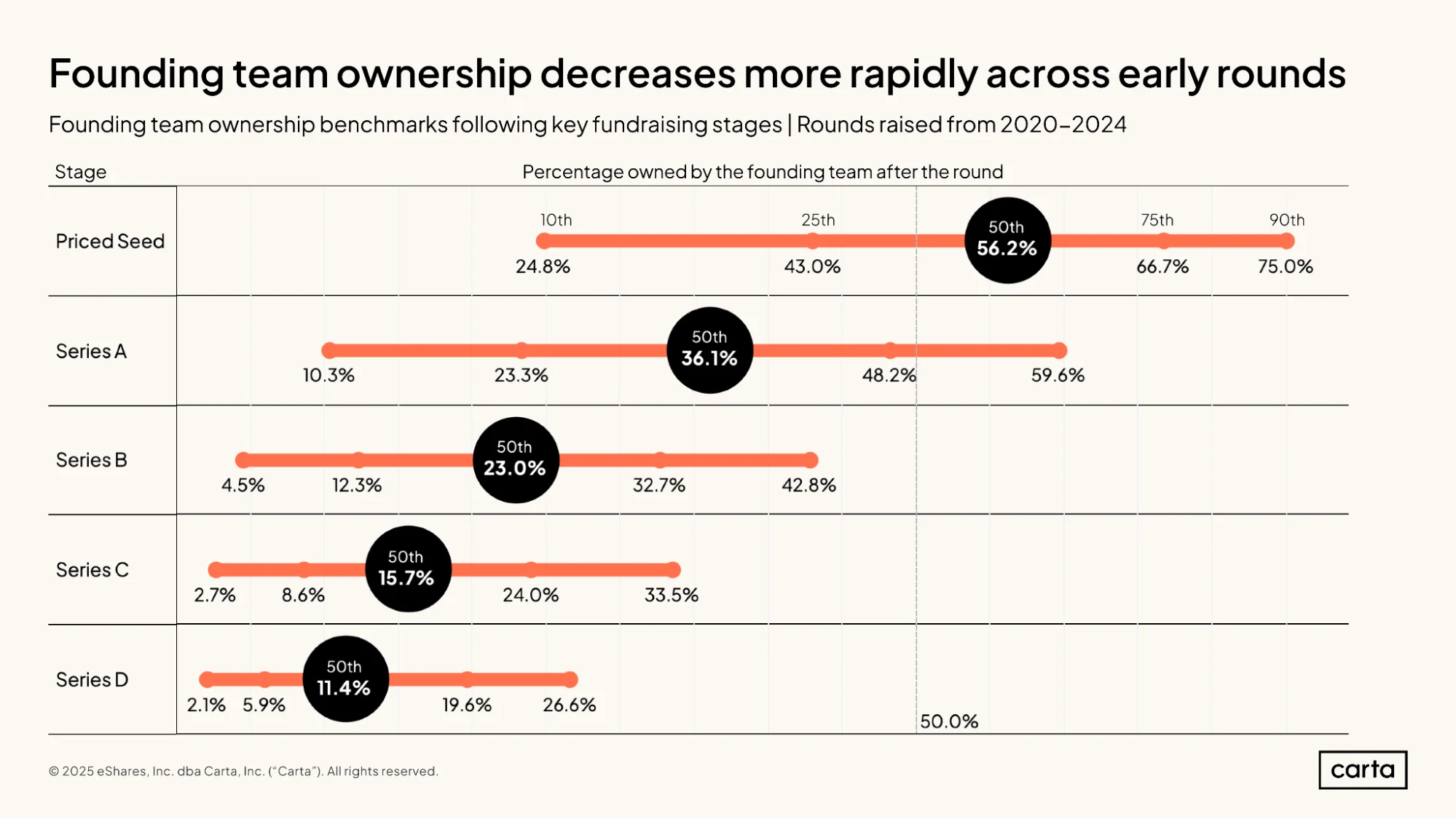
Carta’s data across thousands of startups shows the median founding team’s stake stepping down round after round, and the founders below the median usually got there in the same two places: option pool timing, and SAFE terms they never modelled. This piece is about the second one.
The two levers inside every SAFE
A SAFE investor takes risk before a valuation exists, and the instrument pays them for it through one or both of these.
The discount
A discount converts the SAFE at a reduced price against the next round.
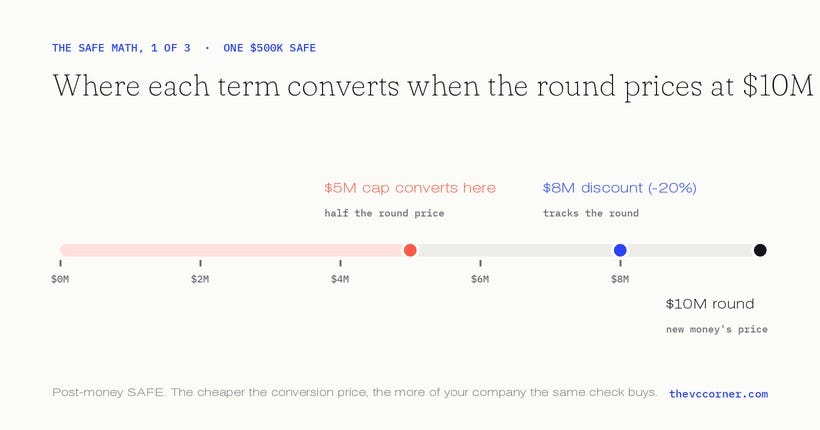
Say your SAFE carries a 20% discount and the next round prices at $10M. The SAFE converts as if the company were worth $8M, so the early investor gets more shares per dollar than the new money. Clean, simple, and its cost scales with the round: the higher you price, the more the discount is worth in absolute terms, and it never gets extreme.
The valuation cap
A cap fixes a ceiling on the conversion price no matter what the round prices at.
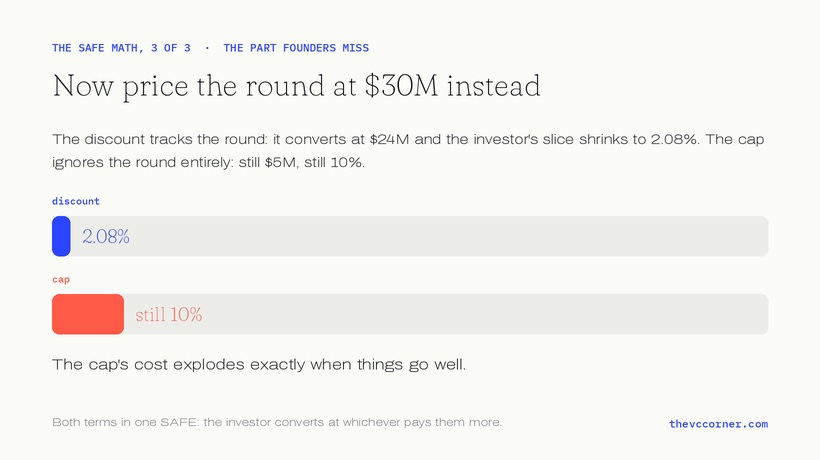
A $5M cap against a $10M round means the SAFE converts at half the price new investors pay. If the round had priced at $30M, the SAFE still converts at $5M, and your early investors would own six times more per dollar than the round investors. Caps are where the surprises live, because their cost explodes exactly when things go well.
Here is the same $500K on both terms:
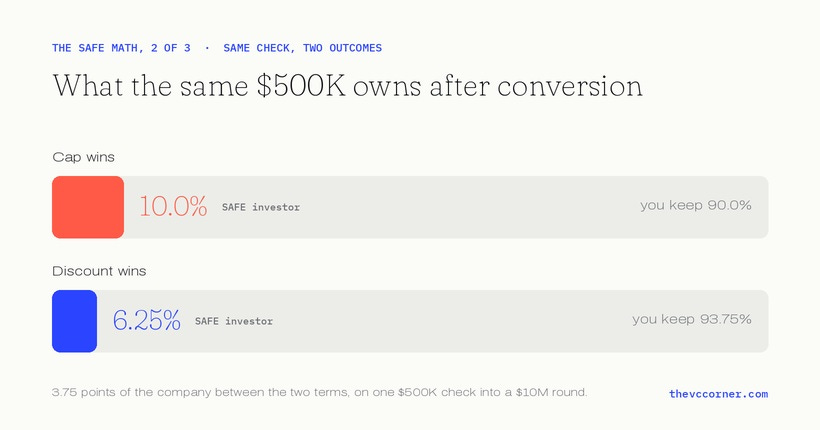
When both sit in the same SAFE, the investor converts at whichever price serves them better. Below the cap, they use the discount; above it, the cap. That structure is standard, and it means your dilution stays unknowable until the round prices, which is exactly why you model scenarios instead of guessing.
And the scenario founders most often skip is the good one:
The market data worth knowing when you negotiate: post-money caps have been the standard since Y Combinator’s 2018 update, 20% is by far the most common discount, and cap levels track round size. Where your terms sit against those medians is your negotiating position, and the term sheet guide covers how to argue it.
Pre-money versus post-money caps, in one paragraph each
A pre-money cap applies before the money raised is counted, which means every additional SAFE you stack dilutes the earlier SAFE holders alongside you. Investors dislike the uncertainty, and founders rarely benefit enough to fight for it.
A post-money cap counts all the SAFEs inside the valuation, so each investor knows their exact ownership the day they wire. The clarity cuts founder-ward too: under post-money SAFEs, every new SAFE you sign dilutes you and only you. Stack four of them and the founders absorb all four conversions while each investor’s percentage stays fixed. That single mechanic, more than any discount or cap, is what produces the fifteen-point surprise, and it’s why the modelling below exists.
What the investors on the other side are checking
VCs read your SAFE stack during diligence, and their checklist is short: do the founders still own enough to stay motivated for a decade, does the cap table convert cleanly, and did earlier money get terms that will anger the new money.
A messy stack costs real deals. Institutional investors have walked from companies where converted SAFEs left founders under 40% before the A, because the fund math needs founders with enough skin to survive three more rounds of dilution. Your SAFE terms today are your leverage two rounds from now.
The premium resource
Below the paywall:
▫️ The cap table template, rebuilt: model any combination of SAFEs (discount, cap, both, multiple rounds of each), see exact post-conversion ownership for every party, and simulate three next-round valuations side by side

▫️ The five questions to answer before signing any SAFE, with the ownership thresholds that matter at each stage
▫️ The full resource stack for the raise: the SAFE conversion calculator for quick checks, the cap table mastery guide for the long game, and the valuation methods breakdown for pricing the round that converts everything
A single membership also opens 10,000+ named investors, the 375 Prompt Book for Fundraising, 200+ pitch decks that raised, and the full financial models library.
Cancel anytime. First subscribers get 50% off forever.