

Proof or Math
There is more money chasing enterprise AI deals right now than at any point in the technology’s short history, and a surprising amount of it is being spent badly.
Maybe not on the wrong products, but definitely on the wrong customers.
What usually happens is that a company with a genuinely good AI product decides its first job is to win a marquee logo, a name recognizable enough to anchor a sales deck, on the theory that prestige clears the path for everyone after it. The revenue from that first deal barely matters, and is often discounted to nothing, because the logo is the whole point.

For a certain kind of AI company, that is exactly the correct instinct. For a larger number of them, it is a slow and expensive way to lose the market to whoever skipped the ceremony and started selling.
What decides which one you are on is not product quality or team strength. It comes down to one person, the individual who has to sign the contract, and two questions about them worth getting right before a funding round answers for you.
Together with Granola:
Both questions get answered in a conversation.
Whether your buyer needs proof or runs the math, that answer lives in the discovery call, the demo and the coffee at their office. And those details fade fast when you’re the one presenting.
Granola is an AI notepad built for exactly those moments.

It works in any meeting, on a call or across a table, and stays in the background so your attention stays on the buyer. You jot the few lines that matter to you, and right after the meeting Granola turns them into complete, structured notes. It’s easier to control than a bot, and far less distracting for the person across the table.
Walk out of your next first meeting with the signer’s answers in writing.
Table of Contents
1. The Signature Is What You Are Actually Selling
2. Two Questions That Draw the Whole Map
3. The Lighthouse: When Two Signatures Move a Market
4. The Landgrab: When Math Closes and Coverage Wins
5. The Mistake Most AI Founders Are Making Right Now
6. How Each Playbook Kills You
7. Sequencing: Earning the Right to Go Wide
1. The Signature Is What You Are Actually Selling
Enterprise software gets described as something companies buy, and companies do not buy anything.
Companies Don’t Sign. People Do.
A person signs, and that person has a boss, a budget line with their name on it, and a performance review in nine months.
What they want is not complicated. They want the thing they approved to work, and they want to still be employed when it does or does not.
Every other input, the demo, the roadmap, the benchmark chart, gets filtered through that one calculation. The buyer is pricing their personal exposure, not your product.

Founders Price the Mistake From the Wrong Side
A support agent that gives a clumsy answer annoys one customer and gets corrected. A collections tool that misstates an invoice produces an awkward phone call and a credit note.
Those are bad afternoons, but nobody’s career ends over them.
Put a drafting model inside a law firm and let it fabricate a citation in a filed brief, or let a research tool invent a figure that misprices a hedge fund position, and the same class of error becomes a different event entirely.
Founders consistently misjudge this because they price the mistake by what it costs them to fix, not by what it costs the buyer to have approved it.
Once you accept that the buyer is managing exposure rather than evaluating features, two questions sort nearly every enterprise AI market.

2. Two Questions That Draw the Whole Map
Neither question is about your product, your team, or the industry code on the account. Here’s what you need to ask.
A. How Exposed Is the Person Who Signs?
Exposure climbs with regulation, because a vendor’s mistake in a regulated industry becomes the buyer’s compliance problem.
It climbs again when you replace a system of record instead of sitting alongside one, and it climbs hardest when the output leaves the building as a filed document or a customer-facing answer rather than an internal draft someone reviews first.
In law and finance all of that runs hot. In AR automation almost none of it does.
When exposure is high, ROI math is beside the point. A general counsel can see a spreadsheet proving 60% savings and still not move, because no discount covers the day she explains a fabricated citation to a judge.
B. Does Proof Travel?
Law firms watch each other obsessively. So do asset managers and consultancies. Status is legible, and when two firms near the top adopt something, the firms behind them treat it as diligence already done.
It is the same reflex that turned venture itself into a consensus machine. Once the right names move, everyone else moves on their signal rather than on their own read.
The controller in Des Moines lives in a different information economy. She does not read the same trade press, does not sit on the same panels, and will never hear that a household-name brand runs your software.
Concentrated, status-driven markets carry proof for you. Fragmented markets make you earn every deal on the math.
A16z has put the question in 4 axes.
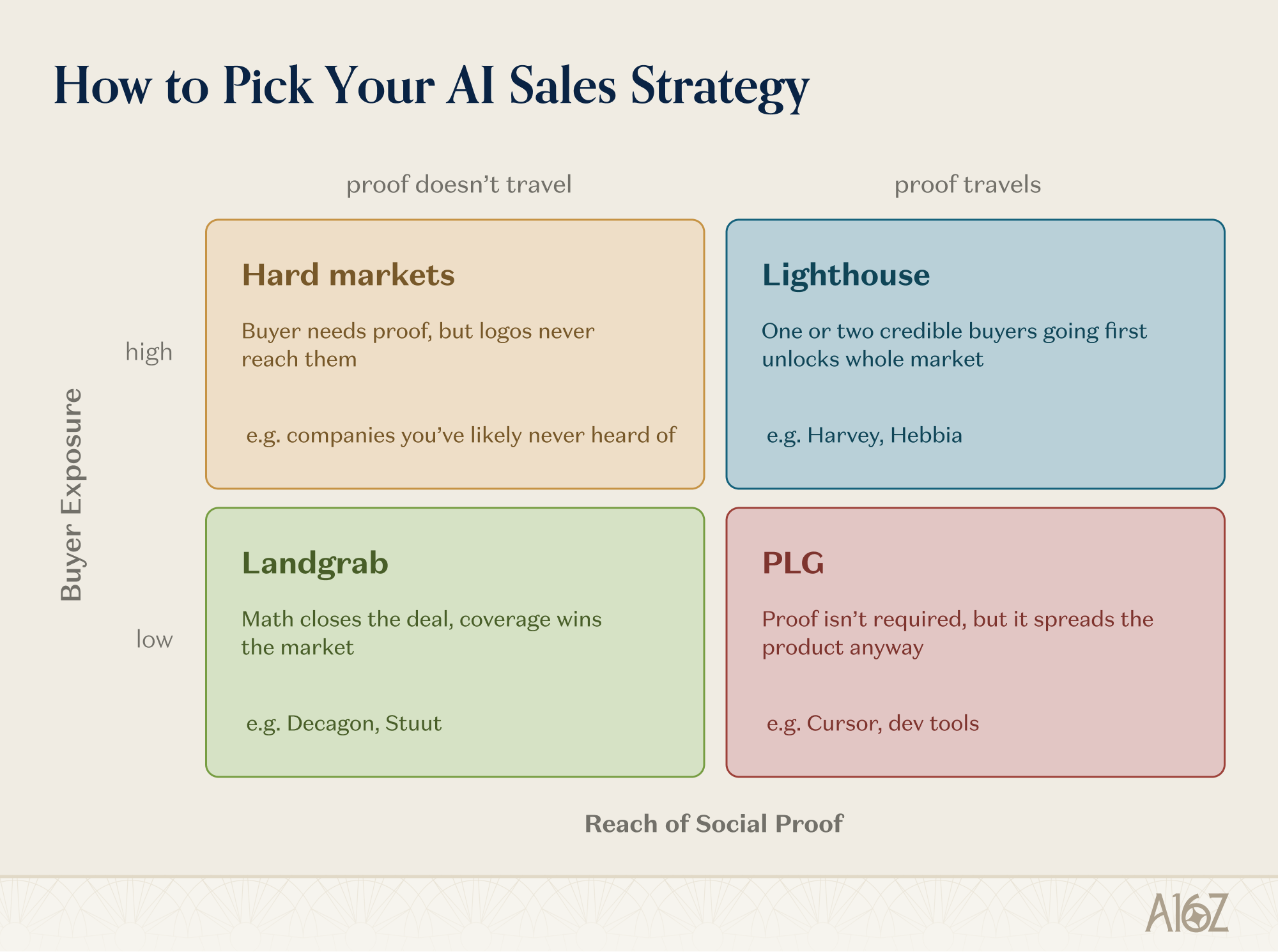
Two of those corners matter most to enterprise sellers, and Joe Schmidt and Julian Marx at a16z gave them names worth keeping: the Lighthouse and the Landgrab.
3. The Lighthouse: When Two Signatures Move a Market
The lighthouse play belongs to category creation, where AI does work that could not be done before and the buyer has no mental model for it.
What Harvey and Hebbia Sold
Law firms in 2022 bought research tools from Thomson Reuters and LexisNexis that surfaced information for an associate to interpret. Harvey proposed to do the drafting, research, and due diligence itself, across thousands of documents.
No firm wanted to go first. Once Allen & Overy did, the rest of the market read those signatures as permission.
Paul Weiss followed in early 2023, and Harvey is now targeting a $15.5 billion valuation.
Hebbia ran the same play in finance, breaking through with the largest private equity firms and hedge funds before expanding to more than 40% of the biggest asset managers by AUM.
In both cases the first customers were not really buying software. They were buying the right to be first in a market where everyone behind them was watching.
What the Motion Costs
Lighthouse selling is founder-led, high-touch, and slow by design. Deals start at six figures and often reach seven.
Cycles run three to six months or longer, because the buyer needs pilots, custom work, and a reason to believe going first is an opportunity rather than a liability.
The team closing the deal is usually the same team delivering the product. That is expensive and does not scale, and it does not need to, because a handful of these customers unlock everyone standing behind them.
The best lighthouse sellers understand what they are really doing. They make the leap feel like a chance to win big, not a chance to be wrong.
When the buyer already knows the problem and a mistake costs a quarter rather than a career, the entire game inverts.
4. The Landgrab: When Math Closes and Coverage Wins
The landgrab belongs to markets where the buyer already believes your category is possible and just needs the arithmetic to work.
Distribution Before the Incumbent Gets Innovation
The pitch here is one sentence:
“We replace what you have at lower cost or with a better outcome.”
You get the meeting by showing a VP of Support their current spend and cutting it in half on one slide.

Speed is the entire game here, because you are racing incumbents as much as startups. Founders entering a market need to get distribution before the incumbent gets innovation.
What the Motion Requires
Landgrab selling is demo-driven and needs a larger team than founders expect. The product has to be standardized enough that a customer onboards in days and sees value the same week, which is most of what durable distribution means at this stage.
Implementation runs through forward-deployed teams built for delivery rather than discovery.
The unit economics have to work at volume, because volume is the whole strategy.
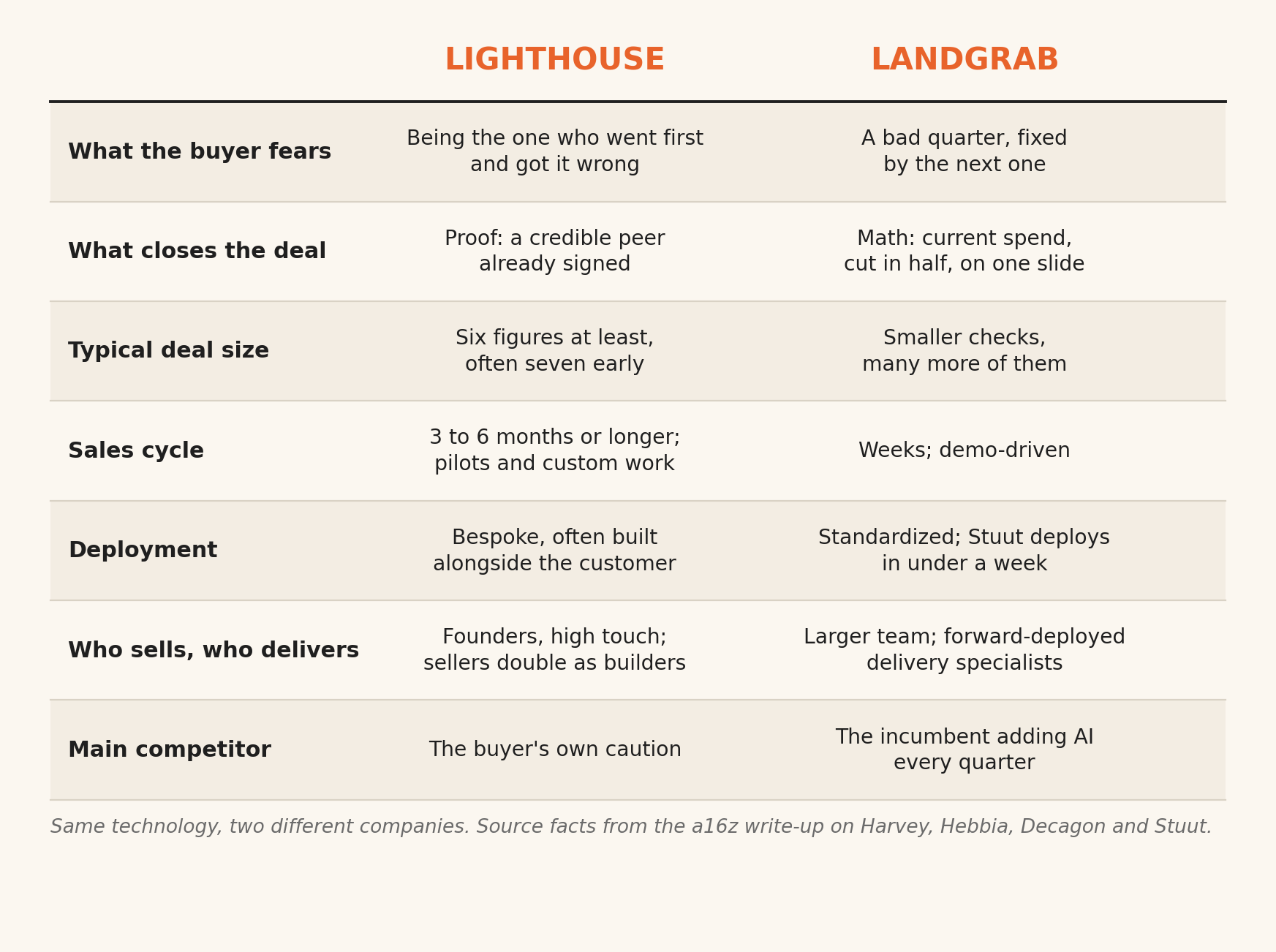
Laid side by side, the two motions look like different companies, which is exactly why running the wrong one is so expensive.
5. The Mistake Most AI Founders Are Making Right Now
If founders split evenly between the two plays this would be an essay about diagnosis, and they do not split evenly.
Because the technology is new, founders assume the market needs educating.
However, education means proof, proof means logos, and so they run a lighthouse motion in markets where the buyer already has a budget line and was never afraid of being wrong.
Show up to that buyer with a marquee logo and a category-creation story and you have answered a question nobody asked.

But there is a gut check here. And that happens by Looking at your last ten sales conversations.
If cycles run past 60 days, if you are doing custom work to prove the concept, if the buyer asks “is this safe?” before “what does it cost?”, your buyers need proof.
If they ask about price first and point to an existing budget, they need math, and a tight demo with a number on the last slide beats any logo on the first.
One rule overrides the rest. When budget and exposure point in opposite directions, exposure wins every time. A buyer can have the money, see the ROI, and still refuse to move until someone credible goes first.
This map also leaves out industry codes. SMB skewing landgrab, regulated sectors skewing lighthouse, additive tools moving faster than replacements, all of these are real patterns, and every one traces back to exposure or proof.
The controller at the distributor is a landgrab buyer because her deal is small and her market is fragmented, not because of anything on her company’s tax filing.
Picking the right play is necessary and not sufficient, because each one carries its own way of killing a company.
6. How Each Playbook Kills You
The failure modes are as specific as the strategies.
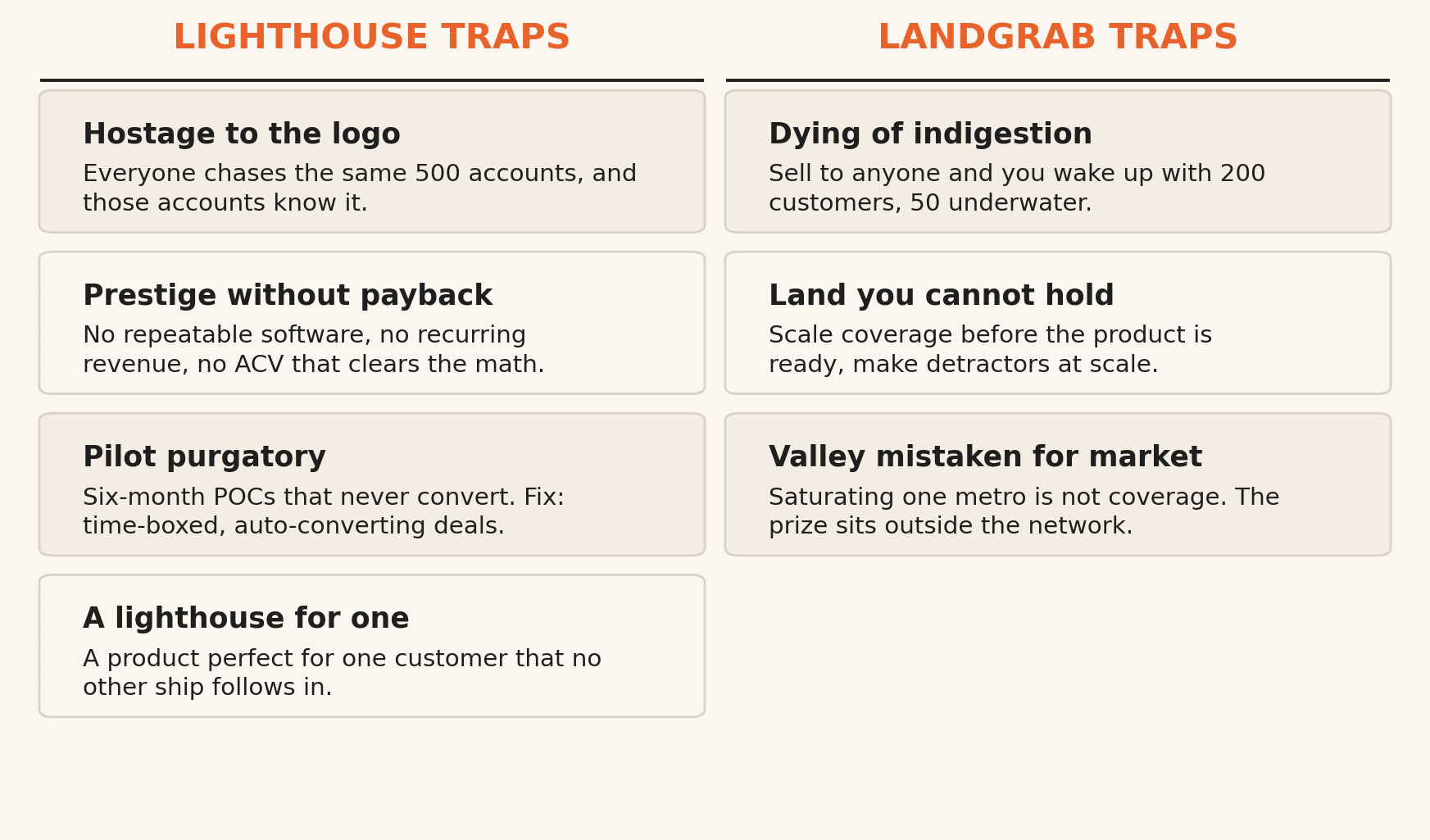
Lighthouse Traps
The first is becoming a hostage to the logo. Every AI startup is pitching the same 500 accounts, those accounts know it, and they extract concessions accordingly.
The second is prestige without payback, where a marquee customer that will not collaborate on repeatable software, will not pay recurring, or will not pay an ACV that makes the math work. You have traded a year for a vanity slide.

The third is “pilot purgatory.” Big logos love six-month proofs of concept that never convert, and the only fix is time-boxed pilots with milestones and contracts that auto-convert.
The fourth is a lighthouse for one. A product built perfectly for a single demanding customer, and no other ship follows the light in.
Landgrab Traps
Dying of indigestion comes first. When you can sell to anyone, discipline means saying no, and without a deal desk you wake up with 200 customers and 50 of them underwater.
Grabbing land you cannot hold comes next. Scale coverage before the product is ready and you manufacture detractors at scale. Fifty unhappy customers is churn. Five hundred is a reputation.
The last is mistaking the valley for the market. Canvassing every bus stop in one metro is not a landgrab; the real prize is working out how to show ROI to the 50,000 companies that sit outside anyone’s network.
7. Sequencing: Earning the Right to Go Wide
The best companies do not pick one mode and stay there.
They win a bellwether in one vertical, dominate that vertical, then find adjacent ones that rhyme.
Affirm’s breakthrough was Casper. One mattress company became every mattress company, then exercise equipment, then categories that resemble exercise equipment only in being big-ticket items people would rather pay for over time.
Mattresses and Pelotons share nothing except that, and Affirm saw the pattern before the market did.
The transition has to be earned. Going wide before the category exists, before anything resembling product-market fit has shown up in the pipeline, burns cash and credibility at the same time.
The signal is unambiguous: buyers start arriving with allocated budgets and asking for a demo instead of asking who went first. That is the lighthouse working, and the moment to run the landgrab.
Every AI founder believes they are inventing the future, and plenty of them are. The person signing the contract does not buy the future.
They buy proof, or they buy math. If they need proof, go win the logo that supplies it. If they need math, build the go-to-market system that gets you on a plane and in front of them before a competitor or the incumbent does.
The founders who get this wrong will not have built the wrong product. They will have never asked which game they were in, and in a market moving this fast, you may only get to ask once.
This is such a great rehash of what experienced sellers know but today, often forget in the AI gold rush. Proof, budget, exposure...figure these out and then determine who you're selling to. Then start building a market.