VC Horror Stories
In June 2026, a founder named Greg Isenberg posted a story on X about pitching a $15 million Series A to 12 people at a top-three venture firm and… one of the general partners fell asleep.
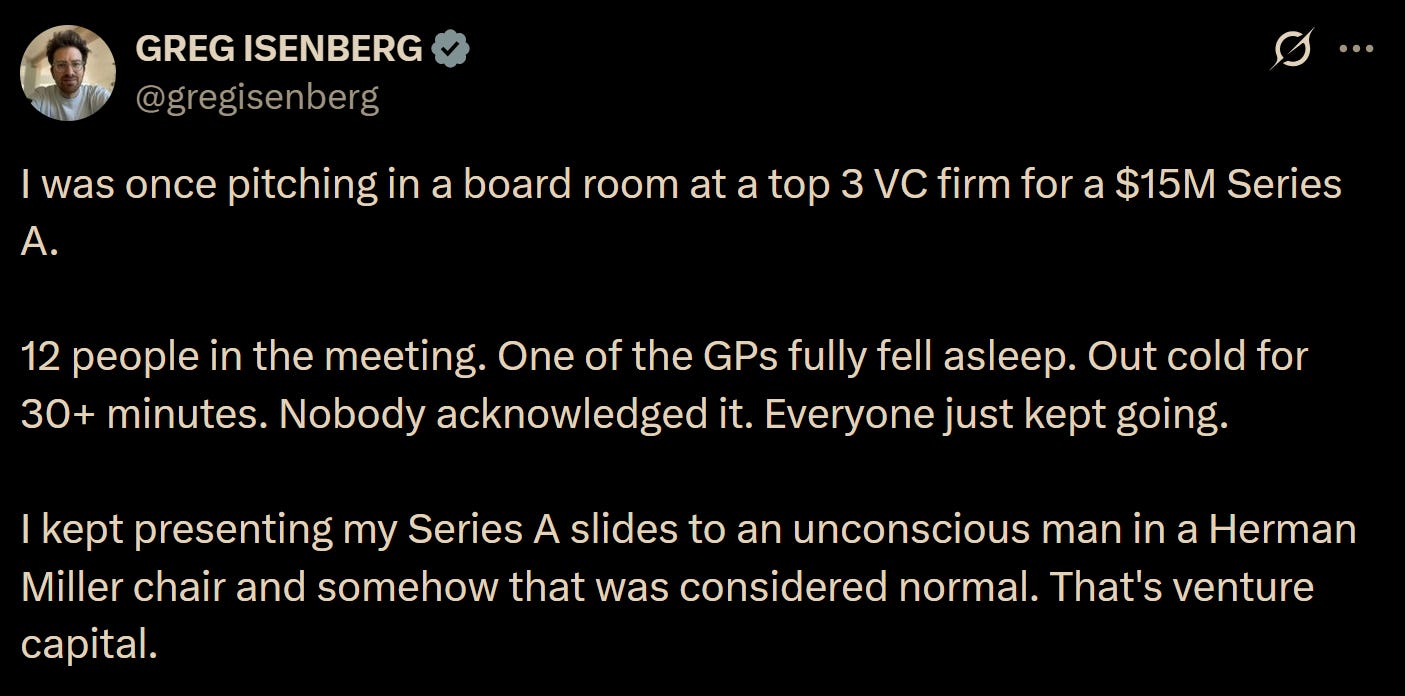
He did not simply nod off. He was out cold for more than half an hour, slumped in a Herman Miller chair, while the room carried on as if nothing was happening.
That single post cracked something open. Within days, X had turned into a confession booth for founders. Some were funny, some were infuriating, and a few named names that almost nobody names in public.
The stories ran the full range of bad behavior. Partners asleep, partners ghosting, partners pulling signed term sheets, partners saying things in meetings that would end a career in most other industries.
One thing founders almost never mention in these stories: the deals that died before the pitch even started
The SOC 2 conversation is the one that kills enterprise deals quietly, with no drama and no viral thread.
The customer is ready to sign. The contract is drafted. Then someone from procurement sends an email asking for the security report.
Marcus from Engineering has to deliver the news.

Vanta is used by 16,000+ companies including Ramp, Cursor, and Harvey to make sure that conversation never happens. The Vanta Agent runs in the background around the clock, pulling evidence, drafting fixes, and answering security questionnaires automatically.
Compliance handled. Back to the horror stories.
Here are the 10 stories that make the hall of fame:

Table of Contents
The Partner Who Slept Through a $15M Pitch
The Bias That Cost a Sequoia Partner an $87 Billion Company
The “Fire Your Co-Founders” Offer That Became VinodGate
Travis Kalanick Pitched From the Passenger Seat
5. The VCs Who Invited Him Sailing, Then Sailed Without Him
“Smaller Than the Market for USB Cables”
The Partner Who Juggled Peanuts Through the Whole Pitch
The Rolls Royce, the Butler, and the Five Meals
The Famous VC Who Picked His Nose and Ate It
The Signed Term Sheets That Vanished
What the Week Actually Proved
1. The Partner Who Slept Through a $15M Pitch
Greg Isenberg was deep into his Series A deck when one of the general partners across the table went under. 12 people sat in that room, and a man worth more than most of them combined was unconscious in his chair for the better part of thirty minutes.
Nobody flinched, and nobody woke him. Isenberg kept clicking through slides to a sleeping audience because stopping felt more awkward than continuing.
The detail that made the story travel was not the nap. It was that everyone treated it as completely ordinary.
Sleeping VCs turned out to be the most common confession of the entire week. It was common enough that former a16z partner Arianna Simpson asked publicly whether narcolepsy was running through the industry.

Founders had simply never said any of it out loud, because saying it might cost them the next check. The lesson sits inside that silence.
The fundraising process rewards founders for tolerating things they would never accept anywhere else. Admitting the dynamic is real, rather than assuming you imagined it, is the first step to protecting yourself.
A partner who cannot stay awake for your raise is telling you something useful. He is showing you exactly how much attention you will get once the wire clears.

2. The Bias That Cost a Sequoia Partner an $87 Billion Company
Matthew Prince, co-founder and CEO of Cloudflare, shared the story that produced the loudest silence.
A Sequoia partner passed on the company early because he did not believe a woman could lead a security infrastructure business.
The woman was Michelle Zatlyn, Cloudflare’s co-founder and COO. The judgment has not aged well.
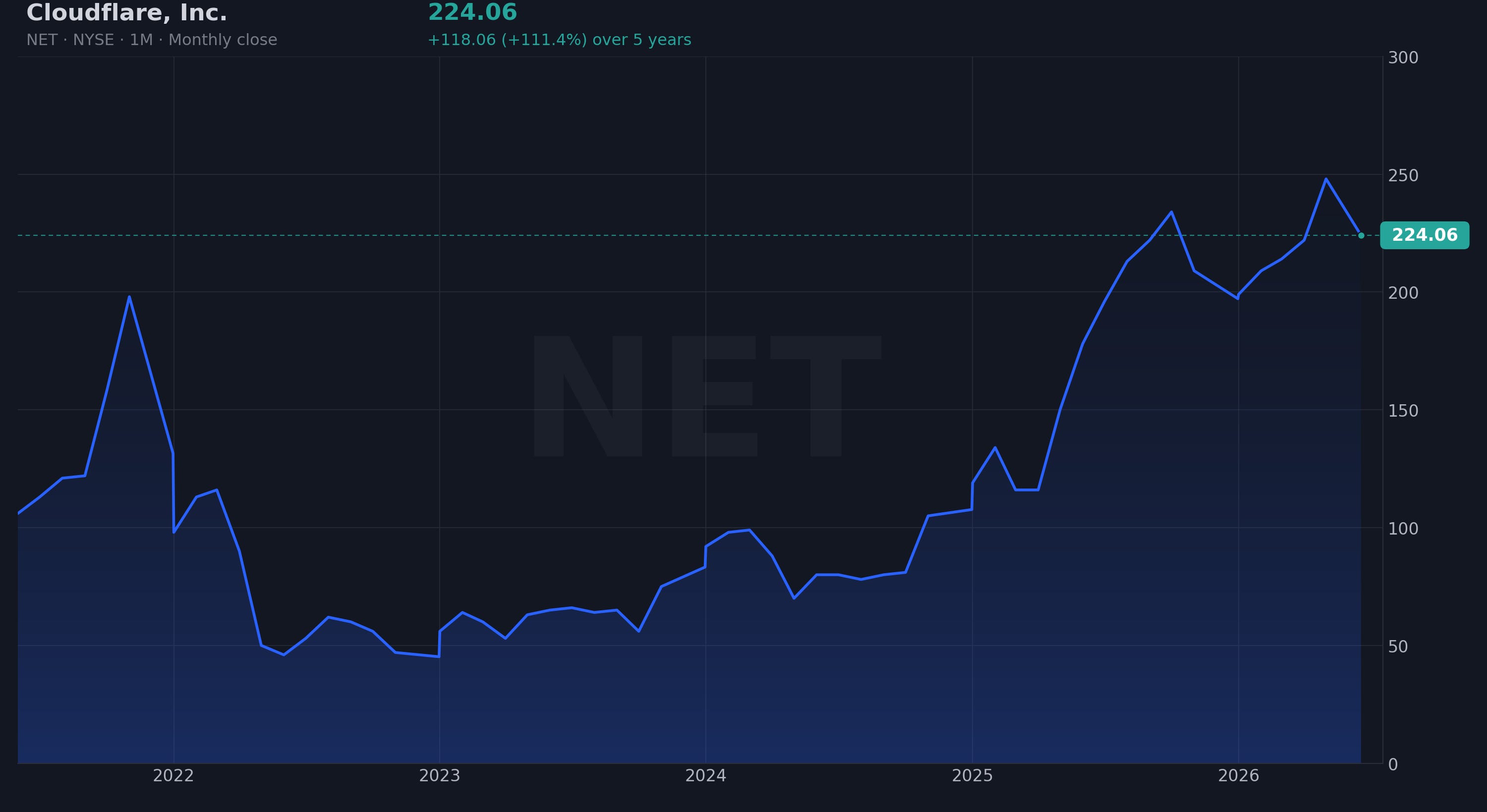
Cloudflare now carries a market cap around $80 billion and expects roughly $2.8 billion in revenue in 2026. That makes this one of the most expensive judgment calls anyone confessed to all week.
When Sequoia’s Shaun Maguire asked Prince to name the partner, Prince declined in public. He said the guess was probably easy enough already.
Pattern matching is the engine of most venture decisions, and when the pattern is wrong, it stays wrong for years. Founders who do not fit the template a partner carries in his head are not getting a fair read, and no deck fixes that.
The only real defense is finding the investors whose pattern already includes you. Everyone else is a waste of your calendar.
3. The “Fire Your Co-Founders” Offer That Became VinodGate
In the same thread, Prince described a meeting with Vinod Khosla, founder of Khosla Ventures, a firm with more than $15 billion under management. Khosla, by Prince’s account, offered to invest and then suggested Prince fire his co-founders and take their stock.
Prince was offended enough to block the number and never speak to him again. Khosla pushed back days later, claiming his firm never offered to invest at all.
Prince answered with a screenshot of the actual term sheet. The exchange lit up X for the better part of a week.
What kept the story from being a simple morality tale was the defense it produced. Khosla-backed founder Clara Gold wrote that his willingness to move a founder is openly known inside his portfolio.
She framed him as company-first rather than founder-first, and argued the same ruthlessness cuts both ways. Derek Andersen then shared how Khosla answered a 1:39am email from a near-stranger six weeks from bankruptcy and helped him raise $1 million in six weeks.
The takeaway is that reputation and fit are different questions. A partner can be brilliant, ruthless, and exactly wrong for you all at once.
Diligence the person, not only the track record. Decide before you sign how much control you are willing to hand to someone who will use it.

4. Travis Kalanick Pitched From the Passenger Seat
Some founders absorb the power dynamic, and Travis Kalanick, the co-founder of Uber, refused to. He arrived for a meeting and realized the GP was trying to leave the building before it started.
It was an attempt to ghost in real time and in person. Rather than accept the brush-off, Kalanick followed the investor out to his car.
He climbed into the passenger seat and delivered the pitch from there. The GP presumably wondered how his exit plan had failed so completely.
The story is funny because it is so on-brand, but the instinct underneath it is worth copying. A founder who treats a no-show as a closed door loses; a founder who treats it as a logistics problem sometimes wins.
Persistence has limits, and there is a real line between determined and unhinged. Still, the founders who raise in hard markets are almost never the ones who took the first silence as a verdict.

5. The VCs Who Invited Him Sailing, Then Sailed Without Him
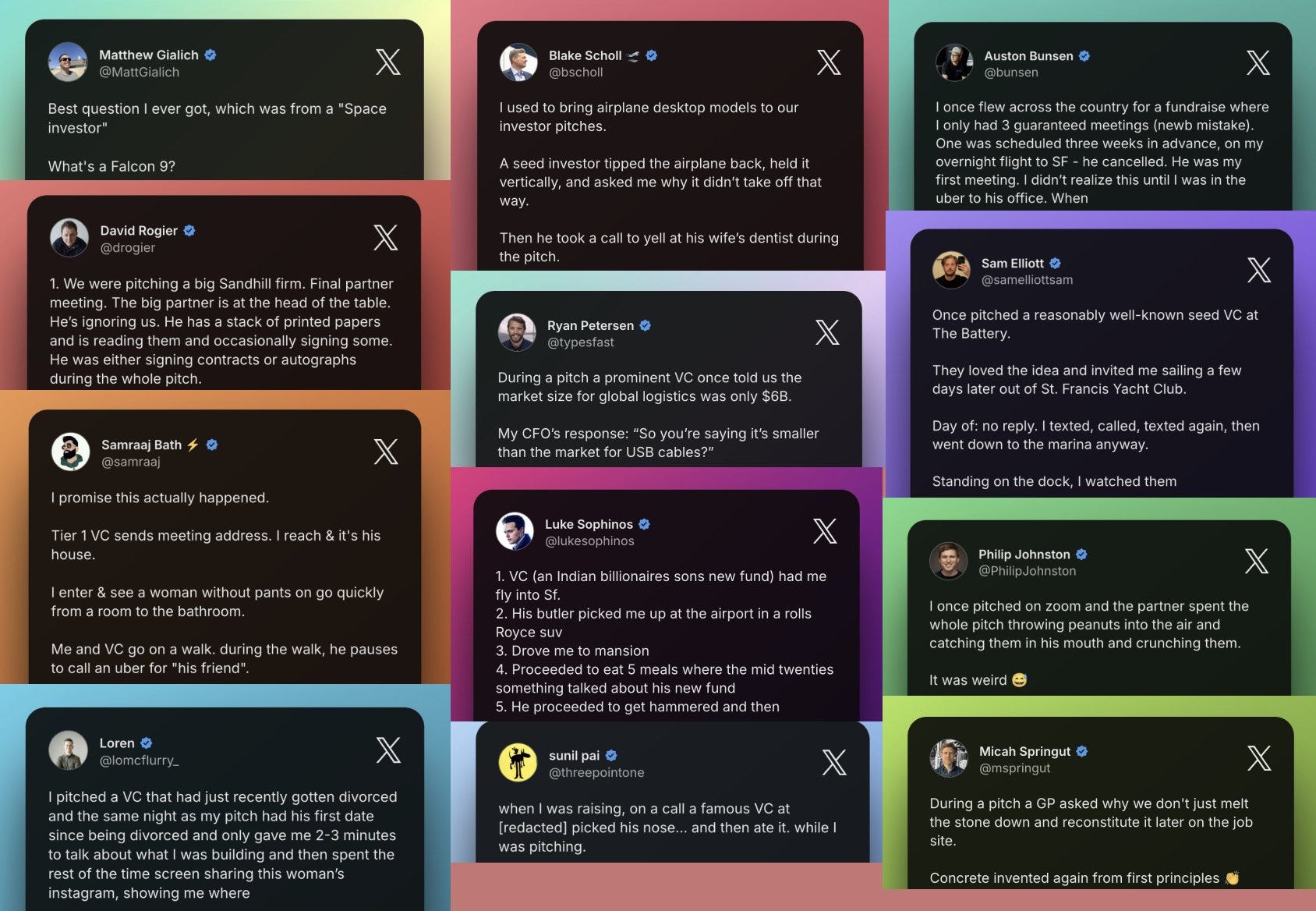
Sam Elliott pitched a reasonably well-known seed VC at The Battery, the private club where a lot of San Francisco deals get their first look. They loved the idea and invited him sailing a few days later out of the St. Francis Yacht Club.
The invitation read as a strong signal, the kind of warmth founders learn to chase. Then the day arrived and the replies stopped.
Elliott texted, called, and texted again, with nothing coming back. He drove down to the marina anyway, because the invitation had felt that real.
Standing on the dock, he watched the boat leave without him. The enthusiasm at The Battery had not survived the week.
The lesson is one founders relearn constantly. A single enthusiastic investor is not a round, and chasing one warm lead is how good processes go cold.
Treat every glowing first meeting as one input among many, not a reason to slow your outreach. The founders who never get left on the dock are the ones who kept twenty other conversations warm at the same time.

6. “Smaller Than the Market for USB Cables”
Ryan Petersen, founder of Flexport, was mid-pitch when a prominent VC confidently informed him that the total market for global logistics was only $6 billion. Global logistics is now a multi-trillion-dollar industry.
That made the number less an estimate and more a confession of how little homework had been done. Petersen’s CFO did not let it pass.
His reply landed instantly: so you are saying it is smaller than the market for USB cables?
The lesson cuts against the instinct to defer to the person holding the checkbook. Investors are wrong about markets constantly, and a confident wrong number is still a wrong number.
Founders who know their market cold, down to the real total addressable figure and the source behind it, can correct an investor without sounding defensive. That command is often more persuasive than the projections themselves.

7. The Partner Who Juggled Peanuts Through the Whole Pitch
Philip Johnston was pitching over Zoom when he noticed the partner on the other end had found something more interesting to do. For the entire call, the investor threw peanuts into the air and caught them in his mouth.
He crunched through Johnston’s presentation one nut at a time. Johnston’s summary of the experience was a single word: weird.
He was right, and the clip became one of the defining images of the week. It was a tidy symbol of how little some partners bother to hide their disinterest.
The lesson is about reading signals early and saving your energy. Disengagement in the first meeting is data, and performing for an obviously checked-out investor is spending runway on a lost cause.
The peanuts are funny in hindsight. In the moment, they were a clear sign to wrap up and spend the next hour on someone who was actually listening.

8. The Rolls Royce, the Butler, and the Five Meals
Luke Sophinos is the founder of the Vertical SaaS Group and his story is objectively pretty funny.
An Indian billionaire’s son with a brand-new fund flew him to San Francisco and had a butler collect him from the airport in a Rolls Royce SUV.
From there he was driven to a mansion, and the staging was flawless. Then the meeting happened, or rather, did not.
The young investor proceeded to eat five separate meals while talking mostly about his own fund. He finished the day by getting hammered.
Somewhere in the middle of all that, Sophinos was supposedly pitching his company. The lesson hides behind the comedy.
A process built around the investor’s image rather than your business is not a real process, no matter how expensive the car that picks you up. New funds run by people with more money than reps can be the most seductive and the least reliable.
Weigh the show against the substance. A Rolls Royce is not a buying signal.

9. The Famous VC Who Picked His Nose and Ate It
Some stories need no setup. Sunil Pai was on a call, mid-raise, pitching a famous investor, when the VC picked his nose and then ate it on camera.
Pai kept presenting, because what else are you going to do? It was the shortest confession of the week and one of the most shared.
A story like this requires no explanation. Everyone who has ever pitched understood the specific helplessness of watching it happen and choosing to carry on anyway.
The lesson is smaller than the others but real. The person across the table is not auditioning for you, and the asymmetry of the room means you will witness things you cannot react to.
That imbalance is the whole game in miniature. Naming it, the way this week finally did, is the first step toward treating fundraising as a negotiation between equals rather than a performance for a king.
10. The Signed Term Sheets That Vanished
Ultimately, the stories that left a mark were about broken commitments. Founders described VCs who signed term sheets and then ghosted, never wiring the money after a handshake everyone treated as final.
One investor committed $5 million at the start of a round. Then he asked to be downsized to $100,000 on the day they were meant to close, a story Ankur Nagpal shared and many recognized.
The most galling version came from VCs who pulled out and then behaved as if nothing had changed. Some asked the founder for company updates afterward, and some asked to serve as a reference.
One reportedly wanted a cut of the eventual acquisition proceeds, despite having invested nothing at all. The lesson here is the hard one.
A term sheet is not money, and a verbal commitment is worth exactly what it is written on, which is nothing. Until the wire lands, keep every other conversation alive and never tell your team a round is closed.
Treat enthusiasm as a starting point rather than a guarantee. The founders who get burned are usually the ones who stopped selling the moment they heard yes.
11. What the Week Actually Proved
The week was less about any single bad actor than about a power dynamic founders have always felt and rarely described. At the end of the day, VCs pass so many deals, and that leaves a large supply of bruised founders.
The value of the confession booth was never the gossip. It was that thousands of founders learned, in the same week, that their strangest pitch memory was not unique and not their fault.
The process is genuinely odd, and the asymmetry is genuinely real. A founder who walks into the next meeting already knowing that is much harder to rattle, and that clarity is worth more than any single term sheet.