

Most people think you need capital to start a venture fund.
Harry Stebbings proved distribution comes first.
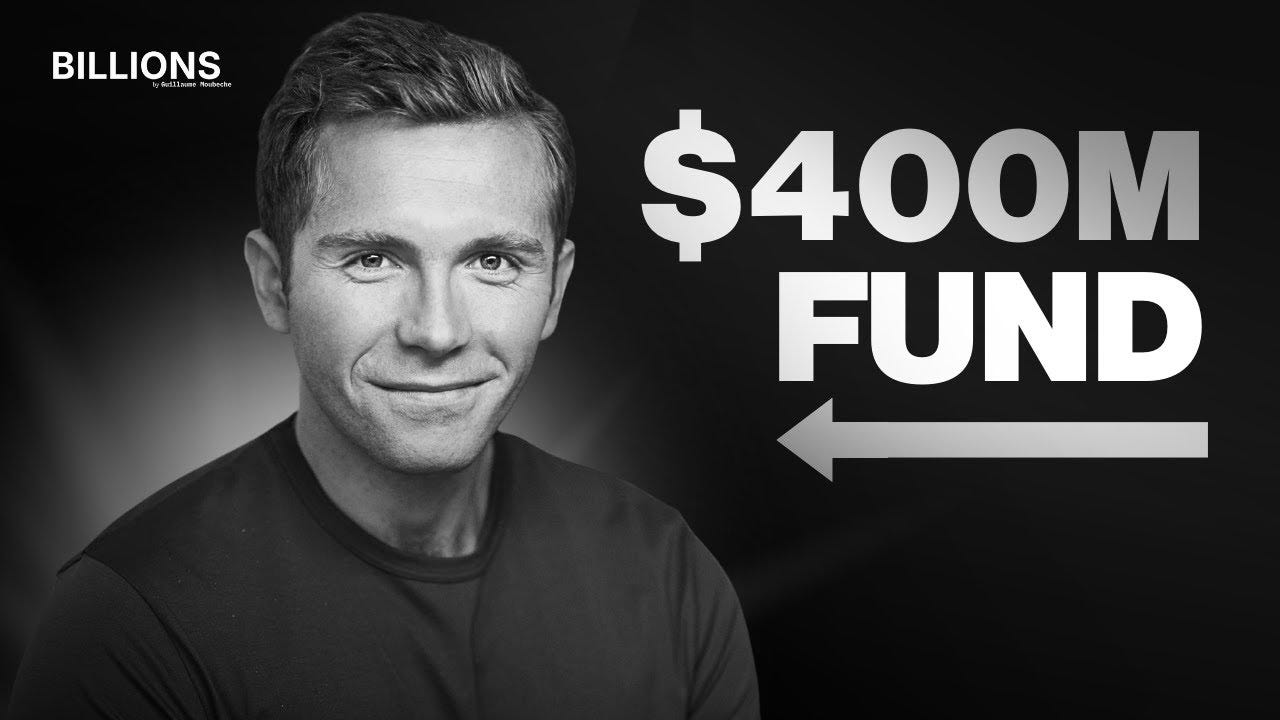
At 18, he started recording interviews in his bedroom in London. No connections. No track record. No money.
Eleven years later: $400 million fund, 1,000+ interviews, millions in ARR generated for portfolio companies with single posts.
This playbook focuses on distribution as the engine that transforms content into capital.
brought to you by Vanta
📋 ISO 27001, simplified for startups
ISO 27001 is powerful—but it’s not exactly startup-friendly…
Vanta’s checklist breaks it into clear, doable steps your small team can tackle without burning weeks 👇

No filler—just the essentials to help you move fast and build with confidence
Here are the 10 systems behind the podcast that became a venture machine 👇
1. The $400M Deal Harry Passed On (And the $115M in Carry He Lost Forever)
Harry Stebbings met Alex Bouaziz at Deel’s seed round and passed.
Deel became one of the fastest-growing payroll companies in the world.
That decision cost him $400 million in potential gains.
The math: $8 million fund, $250K investment at $12 million valuation, 30% carry.
He walked away from $115 million in personal carry.
Why? He looked at Paychecks, ADP, massive entrenched incumbents.
Who is this young guy competing with billion-dollar companies?
He knew Alex was unbelievable. He let the market override the founder.
Most investors would bury this story. Harry brings it up in every interview. That transparency is the tell.
Try this
Write down your three most recent misses. Those scars become your education.
2. Why Harry Passed on Two $5B+ Companies (And Changed His Entire Strategy)
At pre-seed and seed, only the founder matters.
If a VC passes for any reason other than “I don’t believe you can do this,” they’re either lying or they’re not good at early-stage investing.
Harry made the same mistake twice.
First Deel, then Vanta. Christina Cacioppo was world-class. The company is now worth $5 billion with Sequoia leading.
Harry could have invested at $12-15 million.
But compliance? SOC 2? Five years ago, that market looked tiny and boring.
Now Harry invests in any market if the founder is generational. Great founders find markets. If they don’t find one this time, they’ll find one next time.
For investors
Write two lists. Founder strengths. Market weaknesses.
If list one is strong and list two is your reason to pass, you’re making a mistake.
3. 3 Founder Signals That Beat Stanford, Y Combinator, and Every Other Credential
Signal 1: Age of first entrepreneurial activity
Great entrepreneurs start young. Rarely at 27.
They were building websites at 13. Selling sticker books at school at 7.
The pattern shows up 90% of the time.
Signal 2: Gaming background over credentials
Your clan in a gaming community is more indicative of success than your college.
Gamers disproportionately outperform because they understand systems, competition, and collaboration.
Signal 3: Broken relationship with a parent
Hard to say out loud, but it creates a chip on the shoulder.
A desire to prove oneself. An unwillingness to let a parent see them fail.
For boys, most often with a father.
All three in one founder? Lot of green lights.
For diligence
Add these three questions to founder interviews. Track the correlation with your best investments over two years.
4. How an 18-Year-Old Got Guy Kawasaki With One Email (Then Sent Marc Benioff 53 More)
Harry’s first guest was Guy Kawasaki.
Harry was 18. London bedroom. Zero connections.
He found Guy’s email in the source code of his website. Read three of his books. Sent a four-line email:
“Hi, Guy. Keeping short out of respect for your time. I’ve read all your books. In X book, page 284, you said X. I would love to discuss this with you on my podcast. I know you’ve got a book tour coming. Could we align it? Let me know, Harry.”
The ask was clear. The proof of work was obvious. Zero fluff.
Bonus move: Add a PS with something esoteric about the guest that few people know.
Harry emailed Marc Benioff 53 times before he said yes. Different PS every time. His holiday home. His favorite whiskey and the vintage year.
The structure
Four lines max
Proof of work
Clear ask
Esoteric PS
Track response rate
5. The Week Harry Raised $8M From 50 Founders Who’d Been on His Show
Harry spent years interviewing the best founders.
They started sending him deals.
“You’ve got followers. Put in $50K.”
Harry didn’t have money. Still a kid.
Then one multi-billionaire founder said:
“Take money from me and invest it. I would love to support you.”
Harry went to 50 other founders from the show. Raised $8 million in about a week. All throwing in $100K to $250K each.
Media created access.
Access created trust.
Trust created capital.
This is the playbook most VCs ignore because it takes years before you see returns.
For emerging managers
Track who reaches out unprompted. That signal is your deck before you have one.
6. Why Harry Only Interviewed Seed Investors for 2 Years (And Will Make You $1M if You Copy This)
Biggest mistake: trying to be too much to too many people.
For two years, Harry only interviewed seed investors in San Francisco.
He knew his guest. He knew his audience. Nothing else.
Interviewing “entrepreneurs” is the worst podcast idea because it’s way too broad.
Here’s a great podcast:
people who scaled a newsletter from zero to 1 million in 12 months.
Start it today. Two people a week.
Harry’s prediction: you’ll make a million dollars in year one.
Narrow focus means:
Clear guest profile
Obvious sponsorship model
A thousand true fans who actually care
Narrow positioning feels limiting. That discomfort is the point.
The test
Write your exact audience in one sentence. Can’t do it? Too broad. Narrow until it hurts.
7. The LinkedIn Post That Generated $3-4M in ARR in 72 Hours
Harry’s thesis: media is the single biggest lever an investor can bring today.
He invested in Fixer, an email autocomplete company. Did one LinkedIn post.
Within 72 hours: $3 to $4 million in ARR.
Hundreds of thousands of impressions
Thousands of conversions
Another portfolio company got thousands of job applications after one post.
This is why founders saying “no time for interviews” frustrates Harry.
Do you care about customers, fundraising, or talent? That person Googling you before applying will see you on a podcast or see nothing.
For founders
Track content by outcome. Hires. Revenue. Inbound. Can’t measure it? Can’t improve it.
8. How Harry Convinced LPs He Could Win With a Twitter DM (Then Raised $400M)
Harry went from $8 million to $140 million. Then $140 million to $400 million.
Hardest transition: $8 million to $140 million. Moving from non-institutional to institutional capital.
What you need: proof you have access to the best founders.
Four pillars of venture:
Sourcing
Selecting
Winning
Servicing
Harry’s edge is simple.
Most VCs sell knowledge or network. He sells a product founders actually want. Media and distribution. Millions of fans. Hundreds of thousands listening.
How did he meet Linktree?
The founder slid into his DMs on Twitter. Multi-million dollar gain from a DM.
When you can articulate with tangible product how you’re different, LP decisions become easier.
For fund managers
Map your edge to the four pillars. Can’t explain differentiated advantage in each? You don’t have one.
9. The Slide That Says “Don’t Invest in Me” (And Why Harry Put It in His $400M Deck)
Counterintuitive advice: put reasons investors should NOT invest on a slide.
Everyone has subconscious doubts.
Guide them to doubts you want them focused on. Then alleviate them.
When Harry raised $400 million, he led with the hardest question:
“Can we get 15%+ ownership in great companies?”
Then showed data.
Last seven deals averaged 12.5%. That number increased 50% year over year. Clear trend. Unwavering persistence.
Self-awareness in a partner matters more than confidence.
Acknowledge weaknesses. Show a plan to mitigate them.
For fundraising
Add one slide titled “Key Questions You Should Ask.” List 2-3 concerns. Address each with data.
10. Why Harry Can’t Name Five Good Series A Funds in Europe (And Why That’s His Advantage)
VCs don’t create content because you need personality.
That removes 80% of them.
For three years, Harry didn’t get 1,000 plays per episode. For four years, didn’t earn a dollar.
20VC now has a 21 media team. Video, short form, long form, LinkedIn.
The barriers have professionalized.
But here’s the opportunity: weak competition.
In Silicon Valley, you compete against Sequoia, Benchmark, a16z.
In Europe? Harry can’t name five good Series A funds.
Choose weak competition
For operators
Audit your competition’s content. Not creating consistently? You have a 3-5 year window to own distribution.
5 Principles to Steal
Harry raised $400 million because he built distribution that turned content into capital.
Start young, stay relentless (4 years, zero dollars)
Focus on 1,000 true fans (Seed investors, not “entrepreneurs”)
Bet on founder over market (Great founders find markets)
Build distribution before capital (Media created the fund)
Acknowledge weaknesses publicly (Put them in deck, solve them)
Harry made a $400 million mistake on Deel and carries that scar every day. Most VCs would bury that story, but Harry turned it into a lesson. That’s why he wins.
Full interview: Billions Podcast with Guillaume Moubeche
RESOURCES 🛠️
access all for the next year with a 25% limited discount
BREAKING: I’m Sharing the Pitch Decks That Built Unicorns

Before companies like Airbnb, Uber, or Revolut were widely recognised, they were just early-stage startups trying to explain themselves clearly enough to raise their first checks.
✅ FREE Startup Kit for founders (10k investor list + 59 templates)
✅ The 100 Most Important Pension Funds in the World
✅ 350+ verified platforms where you can post your startup
✅ 153 Startups Fundraising Right Now (And Their DECKS)

✅ RIP SEO: the GEO Playbook for 2025
✅ The Venture Capital Method: How Investors Really Value Startups
✅ IRR vs Return Multiple Explained + Template
The Cash Runway Model Every Founder Needs (2026 Edition)

Ask 10 founders whose startups failed to give you the number one reason. Almost half of them will admit it is because they simply ran out of money.
✅ The Headcount Planning Module
✅ Synthesia’s deck (got them $180M)
✅ CLTV vs CAC Ratio Excel Model
✅ 100+ Pitch Decks That Raised Over $2B
The 100+ Pitch Decks That Raised Over $2B 💰

Most pitch decks don’t get funded. These did, raising billions.
✅ VCs Due Diligence Excel Template
✅ SaaS Financial Model
✅ 10k Investors List
✅ Cap Table at Series A & B
✅ The Startup MIS Template: A Excel Dashboard to Track Your Key Metrics
✅ The Go-To Pricing Guide for Early-Stage Founders + Toolkit
✅ DCF Valuation Method Template: A Practical Guide for Founders
✅ How Much Are Your Startup Stock Options Really Worth?
✅ How VCs Value Startups: The VC Method + Excel Template
✅ 2,500+ Angel Investors Backing AI & SaaS Startups
2,500+ Angel Investors Backing AI & SaaS Startups💰

If you're building an AI tool or SaaS product and struggling to raise capital, here’s the hard truth:
✅ Cap Table Mastery: How to Manage Startup Equity from Seed to Series C
✅ 300+ VCs That Accept Cold Pitches — No Warm Intro Needed
✅ 50 Game-Changing AI Agent Startup Ideas for 2025
✅ 144 Family Offices That Cut Pre-Seed Checks
✅ 89 Best Startup Essays by Top VCs and Founders (Paul Graham, Naval, Altman…)
✅ The Ultimate Startup Data Room Template (VC-Ready & Founder-Proven)
✅ The Startup Founder’s Guide to Financial Modeling (7 templates included)
Financial Modeling Examples for Founders: A Startup Guide with Templates

As a founder, your primary responsibility is simple: ensure your company doesn’t run out of cash. Without sufficient funds, scaling or achieving product-market fit becomes impossible. If your business isn’t yet profitable, your runway shrinks with each passing day, and the risk of running out of cash increases.
✅ SAFE Note Dilution: How to Calculate & Protect Your Equity (+ Cap Table Template)
✅ 400+ Seed VCs Backing Startups in the US & Europe
✅ The Best 23 Accelerators Worldwide for Rapid Growth
✅ AI Co-Pilots Every Startup & VC Needs in Their Toolbox
The single most important external factor in Harry’s trajectory was Fred Wilson
Fred did three things that changed everything:
He legitimized Harry early. Fred publicly supported Harry when many dismissed him as “just a podcaster.” In venture, legitimacy compounds faster than capital.
He mentored without control. Fred didn’t turn Harry into a junior partner or mascot. He treated him as a peer in the making.
He signaled trust to the ecosystem. When Fred Wilson takes someone seriously, others follow. LPs. Founders. GPs. Everyone noticed.
Harry’s success is because of the support Fred gave him. Ive followed Harry from the beginnig and he is where he is because of those who supported him with introductions. Most people think Harry made it because of his podcasts.