


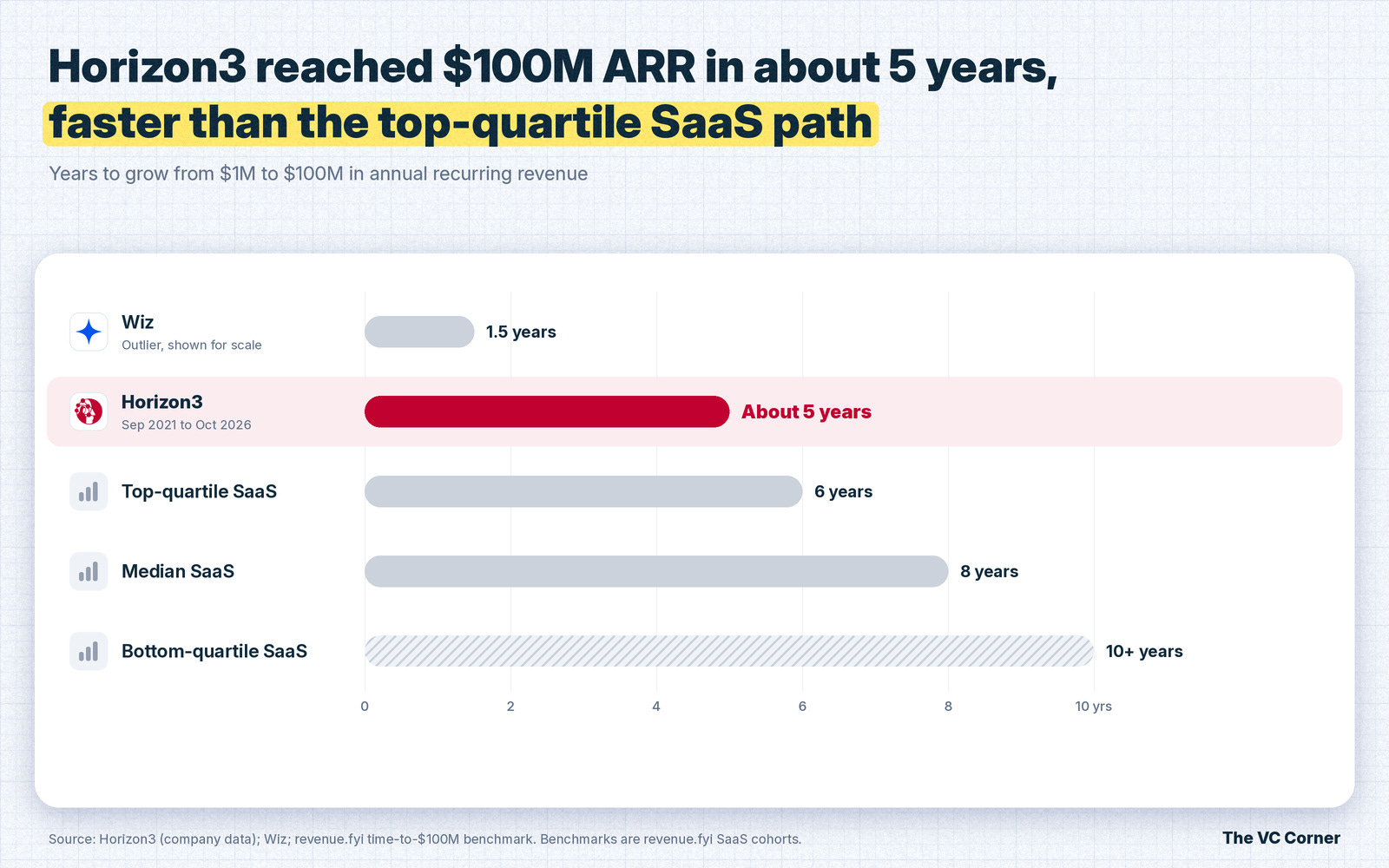
Horizon3 crossed $1 million in annual recurring revenue in September 2021. It passed $100 million in October 2026, with 95% gross dollar retention and 125% net dollar retention. The median software company takes about eight years to walk that path, and a top-quartile one takes six. Horizon3 did it in roughly five, while the funding market froze and a bank failure locked up every dollar it held.
Eleven weeks before that milestone, the company closed a $250 million Series E at a valuation above $2 billion. Part of that money now funds the Adversarial Intelligence Frontier Lab, a research group built on the data from hundreds of thousands of customer pentests.
The round is the headline. The part founders can copy is the engine that made the round possible, and what Horizon3 chose to build with the money.
Antani answered our questions in writing for this piece, and his answers run through the sections below in his own words.
The Short Answer
NodeZero is the product. It is an AI system that attacks a company’s own production network the way a real intruder would, then proves which fixes actually closed the hole.
The growth ran from $1M ARR in September 2021 to more than $100M in October 2026, with revenue still climbing above 120% a year.
The engine was a partner channel that handled 80% of the first 3,000 customers, paired with a subscription that turned a once-a-year test into a weekly habit.
The capital adds up to $428.5 million across six rounds, and the valuation moved from $650 million to more than $2 billion in about a year.
The reinvestment is a frontier AI lab run by Purdue’s Dr. Z. Berkay Celik, fed by an estimated 30 billion tokens of labeled attack data a day.
Table of Contents
Horizon3 by the Numbers
A 20-Year Apprenticeship Before Day One
The Channel Came First
One Test Became a Weekly Habit
Lean Through the Downturn
What Each Investor Bought
Where the Series E Money Goes
The Reinvestment Playbook
The Verdict
FAQ
1. Horizon3 by the Numbers
Snehal Antani and Anthony Pillitiere founded Horizon3 in 2019. The product, NodeZero, shipped in October 2020 as self-service software a customer could run without help from the company.
The funding history reads like a team that waited for proof before it raised:
Seed, January 2020: $3.5M led by SignalFire, closed after Antani collected two term sheets.
Series A, 2021: $5M led by SignalFire, folded into an $8.5M announcement that June.
Series B, November 2021: $30M, again led by SignalFire.
Series C, August 2023: $40M led by Craft Ventures, which brought the total to $78.5M.
Series D, June 2025: $100M led by NEA, for $178.5M raised in all.
Series E, August 2026: $250M co-led by NightDragon and NEA at more than $2B.
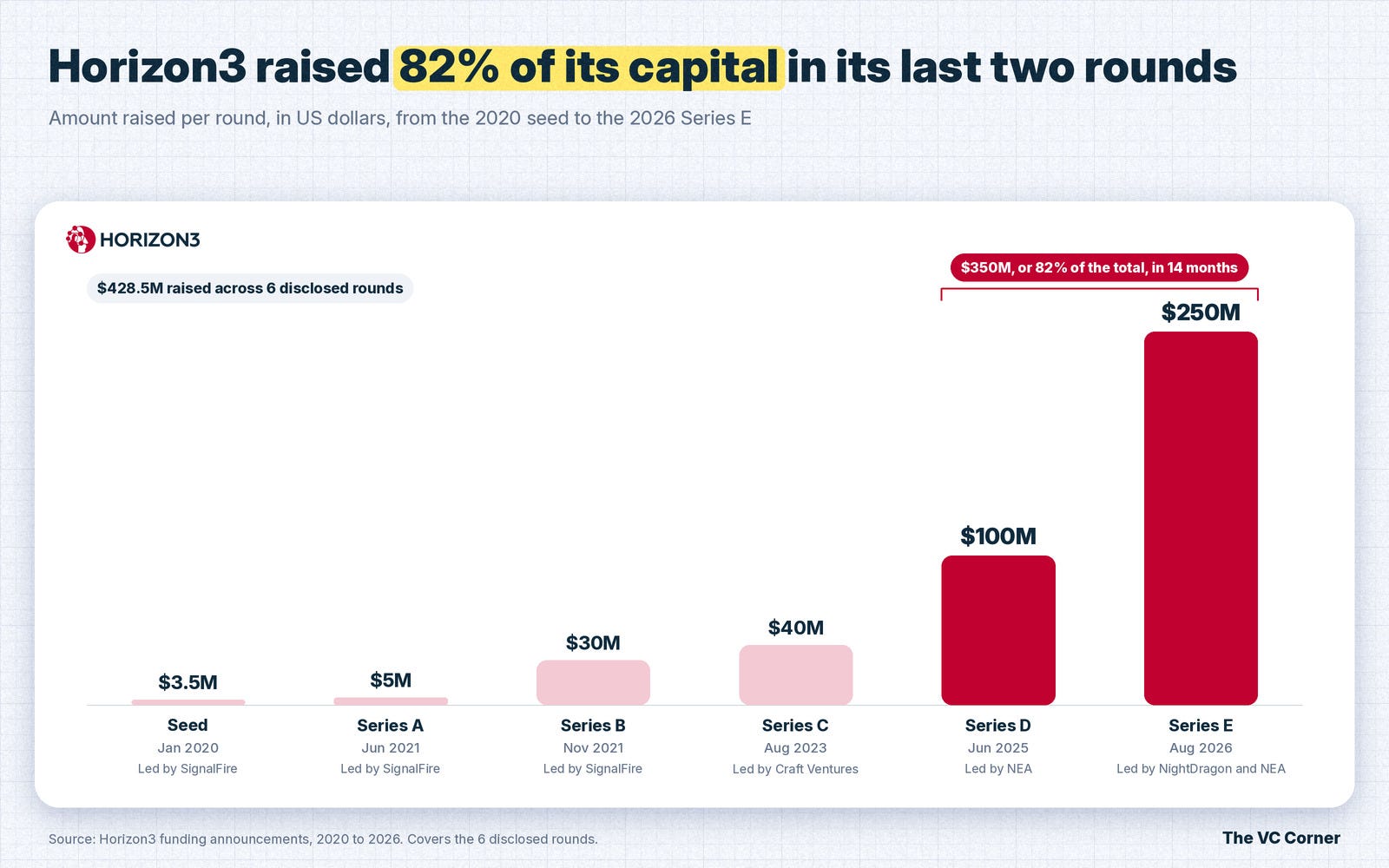
Add the rounds and you reach $428.5 million. The last two account for $350 million of that, so Horizon3 built most of the business on the first $78.5 million and raised the rest once the engine was proven.
The customer count moved as fast as the funding. Horizon3 served more than 3,000 organizations in early 2025, nearly 4,500 by that November and more than 7,000 by August 2026, four of them in the Fortune 10. Deloitte ranked it the third fastest-growing company in North America on its 2025 Technology Fast 500, with 19,939% revenue growth from 2021 to 2024.
2. A 20-Year Apprenticeship Before Day One
Antani was 46 when Business Insider profiled him, and he treats the two decades before Horizon3 as training he did on purpose. He learned how to launch products at IBM, how to manage an organization at GE Capital, how to survive hypergrowth at Splunk and how to lead under pressure inside the US Joint Special Operations Command.
The titles fill in the rest. He started as a software engineer at IBM, held CIO roles at GE Capital, then became CTO and SVP at Splunk. From 2018 to 2021 he was the first CTO of the Joint Special Operations Command. He holds 18 patents, with 30 more pending.
At JSOC he met Pillitiere, an Air Force veteran and former deputy CTO within US Special Operations Command, who became his co-founder. The two built the early team on a model Antani admired in Israel’s cyber industry, pairing operators from Special Operations, the NSA and the CIA with people who had scaled businesses before. “You don’t want to learn how to deal with HR issues for the first time as a founder,” he told Business Insider. “You want to have learned that stuff ahead of time.”
Fundraising was the one job he had never done. “The first time, you kind of suck,” he said. “You have to invest in being a good storyteller.” He rebuilt the deck and the model after every meeting until the seed came together.
The lesson for founders sits in the order he chose. He gathered the operating skills a CEO needs at scale before he started a company in a field where he had been both the buyer and the operator. If you are earlier in that arc, our guide to building a board that works is the fastest way to borrow judgment from people who already have it, and thinking like a VC before you raise covers the storytelling gap Antani had to close.
We asked Antani which of those four jobs shaped Horizon3 most. He picked JSOC:
“My role as JSOC’s first CTO shaped the company most. That is where I met my co-founder, Anthony Pillitiere, gained firsthand experience with offensive and defensive cyber operations, and received the operational mandate that became our product thesis: ‘Don’t tell me we’re secure. Show me.’”
He built that mandate into the company from the first year. “From year one, our culture and operating style deliberately reflected the special-operations emphasis on mission focus, calm execution under pressure, and ‘pace-setters’ over process theater.”
He traced a specific lesson to each of the other three jobs. “IBM taught me product discipline, GE Capital taught me organizational and CIO-level prioritization, and Splunk taught me how to scale through hypergrowth. JSOC supplied the through-line of purpose, leadership, and letting results do the talking.”
That JSOC mandate is the product in one line. NodeZero runs the attack on the customer’s own network and hands back the proof.
3. The Channel Came First
Antani credits three decisions for the whole climb. The first was investing in the channel early. The second was turning a single product into a platform. The third was holding financial discipline through the cycle.
Start with the channel, because it is the one most founders get backwards. The usual move is to build a direct enterprise sales team and bolt on partners later. Horizon3 did it the other way. By early 2025, managed security service providers fully serviced 80% of its 3,000 customers, and partner-sourced pipeline had grown 106% year over year.
The product made that possible. NodeZero was agentless from the start, with the attack logic built in, so a provider running IT for a small defense supplier could launch a full internal pentest for that client and read the results the same day. Antani was already pitching that buyer in 2021. Every partner became a distribution node, which is why the NSA could lean on NodeZero to run its Continuous Autonomous Penetration Testing program for defense contractors. That program reached 200 companies in year one and surfaced 50,000 vulnerabilities, according to Infosecurity Magazine’s account of Antani’s Black Hat talk.
Customers stayed happy enough to keep the channel humming. Horizon3 reported a Net Promoter Score of 88, and its sales cycles in late 2024 ran 34% shorter than before.
If your buyer already hands the work to a service provider, build the product so the provider can run it, price it so the provider earns a margin and treat that partner as your first sales team. Our breakdown of why distribution is the final moat goes deeper on choosing that channel early, and the new SaaS playbook for the agent era shows how product and distribution now fold into one motion.
We asked Antani what the first partner deals looked like. He described a setup light enough for almost any provider to run: “Early partner deployments, around our 2022 international expansion, were lightweight: partners could spin up a small Docker host and run tests without owning hardware or having deep pentesting expertise.”
He pointed to packaging as the change that made the channel scale.
“The shift that scaled MSSP adoption was packaging that turned NodeZero into a high-margin services engine: unlimited or elastic testing, multi-tenant controls, Fix Actions, 1-Click Verify, and clear evidence that lets partners sell remediation, continuous validation, and advisory services on top.”
The channel still carries most of the business today. “Roughly 70% of customers are now served through MSSPs,” Antani wrote. “Partners use NodeZero both to deliver testing and to expand into higher-value work. The Vanguard program later formalized tiers, deal registration, and enablement around this model.”
If you sell through partners, that is the margin lesson. Give the partner a product that creates billable work on top of the test, and the partner will keep selling it for you.
4. One Test Became a Weekly Habit
The second decision was the slow build from a single product into a platform. Horizon3 started with the hardest version of the job, internal pentesting of live production networks, and that choice handed it something rivals could not buy: data from behind the firewall.
From there the platform grew along two tracks. It covered more ground first, adding external networks, cloud, Kubernetes and web applications, all tested safely in production. Then it moved into the budgets next door, with deception that drops decoys along proven attack paths, exposure-management workflows and remediation handled by blue-team agents.
Pricing turned the platform into a routine. Horizon3 sells a predictable subscription with a self-service feel, and about 80% of customers moved from an annual test to a monthly one, while 40% went weekly. That single shift is the whole business model. A yearly pentest is a compliance line item. A weekly one is an operating tool, which is why expansion revenue grew 111% in 2024 and net dollar retention reached 125% by 2026.
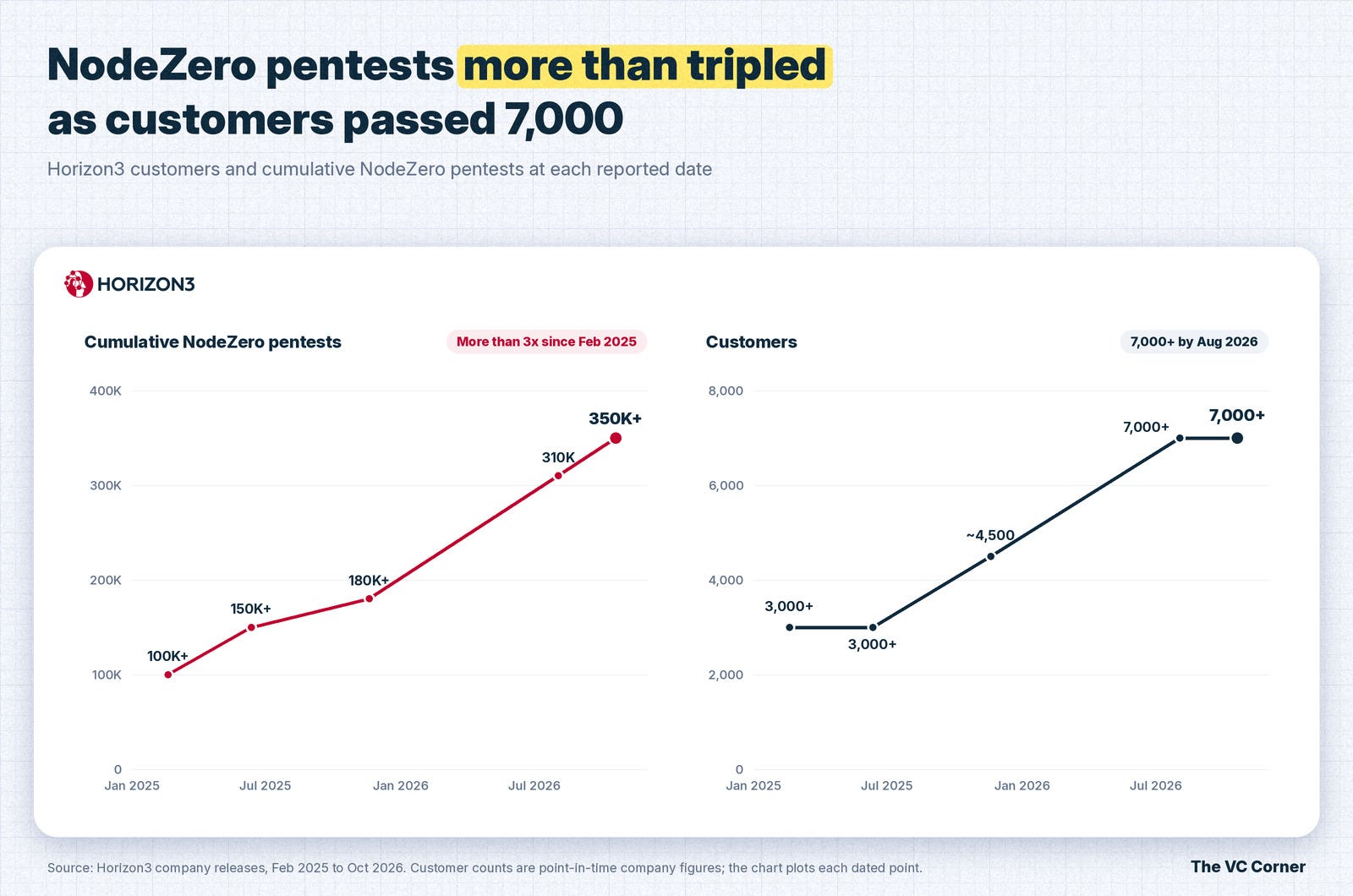
Test volume tracks the habit. NodeZero ran 100,000 pentests by February 2025 and 350,000 by October 2026. Every one of those tests feeds the dataset that section 7 is built on.
The retention numbers explain why investors leaned in. At 95% gross retention, a $100M base sheds about $5M a year to churn and downgrades. At 125% net retention, that same base grows to roughly $125M before a single new logo signs. Our churn and retention playbook shows how to wire that loop into your own product, and the SaaS metrics dashboard tracks gross and net retention the way the best companies report them.
5. Lean Through the Downturn
The third decision was financial nerve. About three years in, the funding market tightened and Horizon3 had to make its cash last. Antani leaned on a lesson from a former boss, who taught him to sell his way through a downturn. The company found roughly $3 million it could redirect, from benefits to hiring plans to other overhead, and pushed it into sales and marketing, according to Business Insider. Revenue grew nearly fivefold that year, a number Craft Ventures echoed in its investment memo when it put 2022 ARR growth near 5x.
Then March 2023 arrived. When Silicon Valley Bank collapsed, every dollar Horizon3 held sat inside it. A missed payroll could have triggered about $750,000 a day in California penalties, enough to end the company inside a week, Antani told Business Insider. He drew $1 million from a personal line of credit, the leadership team walked employees through the plan in the open, and the company paid him back once regulators restored access.
“It’s all about being steady, calm, controlled,” Antani told Business Insider. “You can’t be panicked.”
Five months after the freeze, Horizon3 closed its Series C. By the Series D in June 2025, the company was Rule of 40 positive while still growing ARR above 100%.
Two moves translate directly to your own company. Bank in at least two places and keep a payroll buffer outside your primary bank, because SVB taught that lesson to a generation of founders at once. Our 13-week cash flow forecast shows how many weeks of payroll you hold at any moment. Then reallocate before you cut: Horizon3 funneled its $3 million into the revenue engine when the reflex everywhere was to shrink, and the headcount planning module helps you find which lines to move.
We asked Antani to walk us through that reallocation. He described it plainly:
“We identified roughly $3 million in costs we could cut or redirect through benefits changes, hiring plans, and other operating expenses. We reinvested that money in sales and marketing, explicitly choosing to sell through the downturn. Revenue grew nearly fivefold year over year.”
6. What Each Investor Bought
Every round brought a different kind of backer, and each one paid for a different piece of evidence.
SignalFire led the first three rounds, when the only proof was the founders’ record and a product that worked. Craft Ventures led the $40M Series C in 2023, a brutal year for security funding. Before writing the check, Craft asked operating partner Bil Hamer, a five-time CISO, to run NodeZero on his own network. He had a pentest going within minutes. Craft came away calling Horizon3 “a data company,” because every pentest teaches the system how attackers chain harvested credentials, misconfigurations, product defaults and live vulnerabilities.
NEA led the $100M Series D in June 2025 and took a board seat through Lila Tretikov, its head of AI strategy and a former deputy CTO of Microsoft. The proof by then was efficient scale: more than 3,000 organizations, ARR growth above 100% and a positive Rule of 40. For the Series E, NightDragon co-led alongside NEA, and founder Dave DeWalt, the former chief executive of FireEye and McAfee, joined the board. “Horizon3 coined the concept of cyber warfare being AI vs. AI, and that future has arrived,” DeWalt said in the funding release.
The round was oversubscribed, with seven new investors and five returning backers, among them Sapphire Ventures, PSG and Acrew Capital, plus strategic money from SAIC and Singapore’s EDBI that lines up with a planned push into Singapore and Australia.
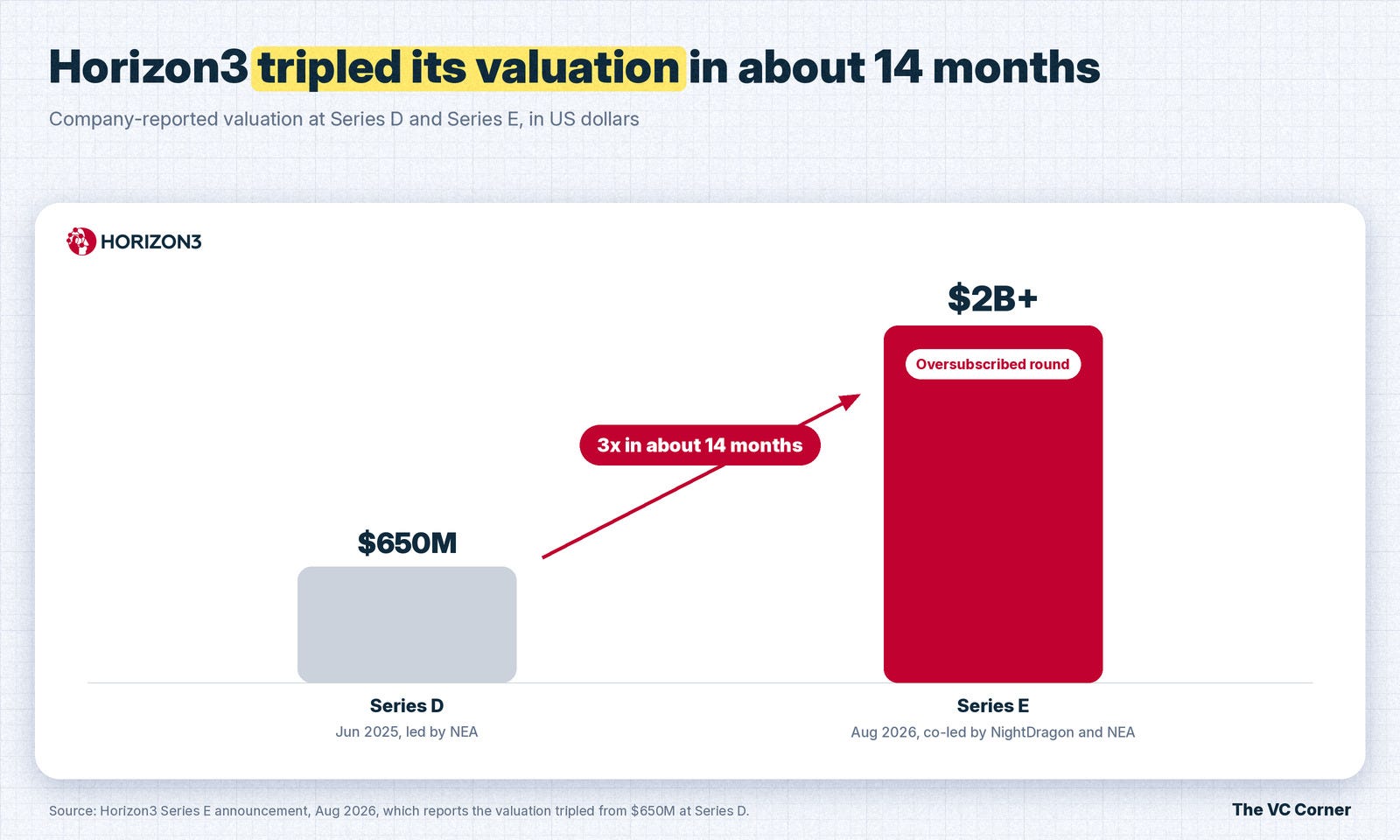
The multiple is worth sitting with. A valuation above $2 billion against ARR that crossed $100 million eleven weeks later lands the round near 20 times revenue. Our SaaS valuation formula walks through how growth and retention set that number, and the Great SaaS Reset explains why the market still pays up for companies holding above 100% growth. One more figure makes the efficiency concrete: with about 550 employees, Horizon3 runs near $182,000 of ARR per head. Morgan Kyauk of NightDragon called the go-to-market motion “incredibly efficient, highly scalable” in the Series E announcement.
We asked Antani what NEA and NightDragon pushed hardest on in diligence. He walked us through it in order, starting with growth:
“Top-line ARR growth got us in the door. We were growing more than 100% year over year, from $30 million to $60 million, with a 12-month plan to sustain that growth and a path to more than $122 million in ARR.”
Then the questions turned to efficiency. “The focus then shifted to operational excellence: sales efficiency, burn multiple, net dollar retention, gross dollar retention, pipeline coverage, channel contribution, and sales rep attainment. We were in the top 10% or top 25% for each metric.”
The last test was the platform story. “Finally, we needed to demonstrate our ability to evolve into a multi-product platform built on a data moat that compounded in value over time,” he wrote. “Our module attach rates, such as the percentage of customers using our deception module, together with the growth in training data, made clear that we had the potential to become a public company serving a large total addressable market.”
Growth got Horizon3 the meeting. The efficiency metrics and the data asset carried the round, and that is the order to prepare in if you are heading into a growth raise.
7. Where the Series E Money Goes
Horizon3 set three priorities for the $250 million. It will scale go-to-market across every segment, federal buyers included. It will expand into Singapore and Australia and deepen its footprint across EMEA. And it will accelerate a product idea that ties the whole company together: a continuous learning loop between AI attackers and AI defenders, including autonomous blue-team agents that remediate what NodeZero finds.
Antani tied the money directly to that third priority when we asked him about the lab: “Our Series E explicitly funds autonomous blue-team agents that remediate findings from NodeZero pentests, closing a continuous attacker-defender learning loop.”
That third priority is where the lab lives. Horizon3 is launching the Adversarial Intelligence Frontier Lab under Dr. Z. Berkay Celik, an associate professor of computer science at Purdue and co-director of the Purdue Security Laboratory.
The lab is possible because of the business in sections 3 and 4. More than 7,000 customers, from large banks and federal agencies to local hospitals, run hundreds of thousands of production-safe tests, and Horizon3 estimates it now collects 30 billion tokens of cleanly labeled attack-and-defense data a day. The data captures each attacker command, whether it worked, how the defensive tools reacted and how the services behind the firewall were configured.
“We’ve spent years collecting the attack-and-defense data required to research these systems,” Antani said in the lab announcement. “The next step is to use that verified attack-path evidence to improve how offensive and defensive agents work together in environments that actually matter.”
The lab opens with four research lines. One uses frontier models to speed up vulnerability discovery and studies how AI attackers, coordinated agent swarms included, operate and respond to deception. One tests how offensive and defensive agents can work together to speed up the hack, fix, verify cycle. One builds and measures safe, controllable autonomy for security agents, with scope limits, interruption and rollback. The fourth studies how AI changes the protection of critical infrastructure and the training of the cyber workforce. The group will also oversee Horizon3’s Cyber Resilience Centers of Excellence for critical infrastructure.
Strip it back and the reinvestment loop is simple. The channel brings customers. Frequent testing creates data. The lab turns that data into better agents, and better agents make the weekly test worth more, which pulls in the next customer. Our AI Corner companion piece on how NodeZero works covers the technical half of that loop:

We asked Antani how he will judge whether the lab pays off. He answered with product and customer measures:
“We measure return by how quickly research becomes a capability in NodeZero, by customer outcomes such as time to remediate, verified attack-path closure, and reduced residual risk, and by its contribution to ARR and expansion. Academic output is part of the work, but those product and customer outcomes are how we measure its practical value.”
He also set a timeline for the first results: “Customers should expect the first concrete research-derived capabilities, including enhanced governed remediation agents and Honeyquest-informed deception placement, on a timeline measured in quarters, not years. That is consistent with our existing pattern of shipping capabilities such as Tripwires, AD Tripwires, WebApp testing, and the Vulnerability Management Hub.”
8. The Reinvestment Playbook
Seven moves from this story that an early-stage founder can run this quarter.
Pick a wedge that makes proprietary data. Horizon3 chose the hardest product, internal production pentesting, because it opened a data source nobody could buy. Ask what your hardest feature records that a competitor cannot.
Build for the partner who already owns the customer. A pentest a provider can run without a red team is a pentest a provider will resell, and that model brought in 80% of the first 3,000 customers.
Price for frequency. Subscriptions moved most customers to monthly testing, and frequency compounds retention and data together.
Grow into the budgets your product already touches. Deception and automated remediation sat right next to pentesting, and Horizon3 reached both from the same attack data.
Reallocate before you cut. The $3 million that moved into sales during the downturn is the clearest example in this story. Run the same audit each quarter with our lean revenue model.
Raise when the proof matches the round. Each Horizon3 round sold a specific piece of evidence to a specific kind of investor. Map your own the same way with the VC method for startup valuation.
Turn growth into research customers can feel. The lab runs on growth money, an outside academic leader and customer data. Yours can be smaller, as long as a research budget ties to a data asset and a clear path back into the product. The board meeting operating system helps you win approval for it.
9. The Verdict
The field is filling in. Pentera passed $100M ARR in January 2026, and XBOW raised $120M at a valuation above $1B two months later. Gartner expects global security spending to reach $240 billion in 2026, so several of these companies can win at once.
Horizon3’s edge is the asset sitting under the revenue. Every weekly test adds to a record of real attacks on real networks, and the Series E is paying to turn that record into research that flows back into the product. Antani called $100M ARR “just the first mile marker in our marathon.” The lab is his bet on running the next stretch faster than the last.
FAQ
How fast did Horizon3 reach $100M ARR?
Horizon3 reached $100M ARR in October 2026, about five years after crossing $1M ARR in September 2021. A median software company takes roughly eight years to cover the same ground.
How much has Horizon3 raised?
Horizon3 has raised $428.5M across six rounds. The most recent was a $250M Series E in August 2026 at a valuation above $2 billion, co-led by NightDragon and NEA.
Who is Snehal Antani?
Snehal Antani is the co-founder and chief executive of Horizon3. He was the first CTO of the Joint Special Operations Command from 2018 to 2021, and before that served as CTO of Splunk and in CIO roles at GE Capital.
What is the Horizon3 AI lab?
The Adversarial Intelligence Frontier Lab is Horizon3’s research group, led by Purdue’s Dr. Z. Berkay Celik. It works on zero-day discovery with frontier models, AI attacker behavior, closed-loop attack-and-defense agents and customer-specific cyber world models, drawing on data from more than 7,000 customers.
What does NodeZero do?
NodeZero is Horizon3’s AI system for autonomous penetration testing. It safely attacks a customer’s own production environment, shows which weaknesses an attacker could chain together, points to the fix and then checks that the fix held.
Keep reading:
If this helped you think about your own growth engine, send it to a founder who is planning their next raise.